- Connect with our licensed Canadian insurance advisors
- Schedule a Call

Basics
Common Inquiries
BASICS
- Is Infinite Banking A Smart Financial Strategy?
- Understanding the Infinite Banking Concept
- Why Infinite Banking Appeals to Canadians Seeking Financial Freedom
- How Infinite Banking Strategy Helps Build Financial Independence
- Challenges and Misconceptions About Infinite Banking
- Who Should Consider Infinite Banking for Financial Freedom?
- How to Start Your Infinite Banking Journey
- Key Advantages of the Infinite Banking Strategy
- A Day-to-Day Struggle: Why More Canadians Are Exploring Infinite Banking
- Potential Drawbacks You Should Know
- The Future of Infinite Banking in Canada
- Is Infinite Banking a Smart Financial Strategy?
COMMON INQUIRIES
- Can I Have Both Short-Term and Long-Term Disability Insurance?
- Should Both Husband and Wife Get Term Life Insurance?
- Can I Change Beneficiaries on My Canadian Term Life Policy?
- What Does Term Life Insurance Cover and Not Cover?
- Does Term Insurance Cover Death?
- What are the advantages of Short-Term Life Insurance?
- Which Is Better, Whole Life Or Term Life Insurance?
- Do Term Life Insurance Rates Go Up?
- Is Term Insurance Better Than a Money Back Policy?
- What’s the Longest Term Life Insurance You Can Get?
- Which is better, Short-Term or Long-Term Insurance? Making the Right Choice
IN THIS ARTICLE
- What is the minimum income for Term Insurance?
- How Does Income Affect Your Term Life Insurance Policy?
- Can You Buy Term Life Insurance Online with a Low Income?
- How Can You Lower Your Term Life Insurance Cost?
- How Much Term Life Insurance Do You Need?
- Can Your Term Life Insurance Policy Be Adjusted Over Time?
- Why Term Life Insurance Is Ideal for Lower-Income Canadians
- Final Thoughts
- More on Term Life Insurance
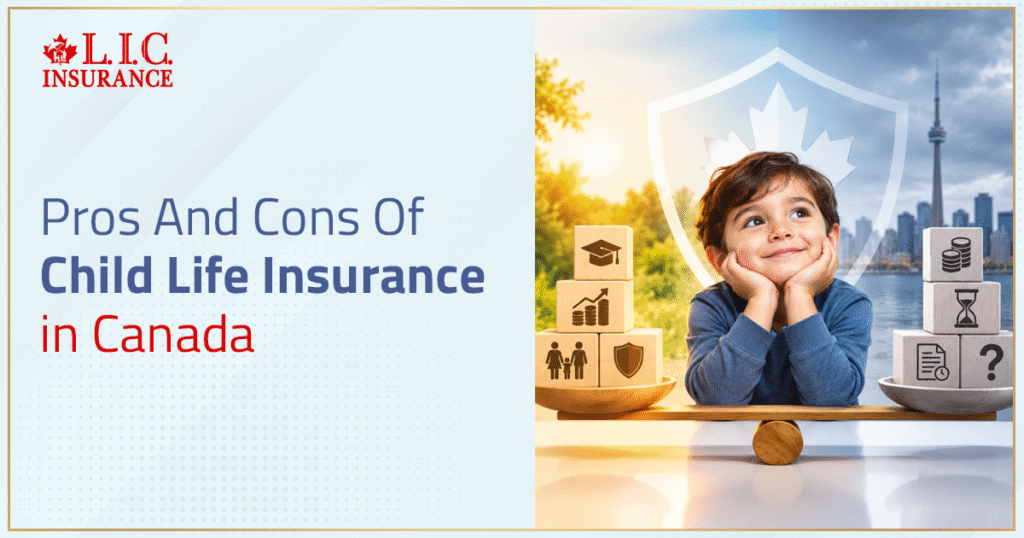
Pros And Cons Of Child Life Insurance In Canada

By Harpreet Puri
CEO & Founder
- 11 min read
- Oct 01, 2026
SUMMARY
Pros and cons of Life Insurance for children in Canada, including Child Life Insurance cost, cash value growth, future insurability, and Family Life Insurance Plans. Covers Whole Life Insurance, Term Life Insurance Policy options, guaranteed coverage, Child Term Rider benefits, long-term financial planning, RESP comparisons, Critical Illness Riders, and how Permanent Life Insurance may support a child’s financial future and financial security
Introduction
Parents throughout Canada are viewing the task of financial planning quite differently from what they used to do just a few years back. The rise in the cost of living, increasing worries over the future health care costs, and concerns regarding their overall financial security have made parents rethink their options, moving away from conventional savings plans and RESPs. More often, parents are considering the possibility of their child’s Life Insurance being useful in both ways.
This shift is not happening in isolation.
Based on the Canadian Life and Health Insurance Association, millions of Canadians use various types of Life Insurance Plans within the context of comprehensive financial management plans aimed at saving wealth. Simultaneously, there are constantly growing housing prices, tuition rates, and inflation. Nowadays, people have numerous questions that they did not even think of ten years ago. Should Life Insurance for children provide just-in-case coverage only? Will the plan generate a profit in the long run? What does child coverage bring in terms of securing a solid financial future?
Very often, we talk with people whose aim is to manage finances wisely while avoiding any additional financial strain on their household budget. In many cases, families want to ensure the guaranteed future insurability of the child due to hereditary diseases. There are people who want Life Insurance that can develop cash value, and people who need a kind of buffer in case of an emergency.
It goes without saying that Child Life Insurance has its merits and downsides, and for some families, such coverage is a valuable investment, while other people find that it is not currently their priority.
That is why understanding both sides matters before purchasing any policy.
What Is Child Life Insurance In Canada?
Child Life Insurance can be defined as a kind of Life Insurance Policy taken out on a minor child. Child Life Insurance in Canada is often set up as a permanent form of insurance or as temporary insurance linked to an adult policy.
In most cases, when parents are thinking about buying Life Insurance for babies in Canada, they first learn about permanent insurance since this type of insurance provides coverage until death. Such policies as Whole Life Insurance and universal life provide not only a death benefit but also the building up of some financial savings within the contract.
One of the main reasons for choosing permanent insurance for a child is connected with financial planning and building up money over a long period of time.
The important thing about Permanent Life Insurance is the inclusion of accumulated cash value, which accumulates over the years. One part of the insurance cost goes towards the insurance itself, and another portion helps accumulate money within the policy.
What many parents do not realize is that these types of insurance can later turn into a valuable asset that their children will own. Once the child grows up and becomes an adult, it often means that the asset will be directly transferred to him or her.
The other type of insurance that people usually hear about from us is a Child Term Rider. Child Term Riders are relatively inexpensive and serve as temporary insurance that covers children before they grow up into adults. However, this type of insurance does not have a cash value, which makes its long-term use somewhat difficult.
When we explain this choice to parents, we usually tell them that it has nothing to do with costs. It has everything to do with their long-term purpose.
Why Parents Are Buying Life Insurance For Kids Earlier Than Before
The present-day generation of parents is taking the issue of future insurability much more seriously than their predecessors did.
Health issues, which used to be diagnosed mostly later in life, are nowadays diagnosed more often and at a younger age. Mental illnesses, diabetes, autoimmune diseases, and various chronic illnesses can greatly influence a person’s ability to get insured when they reach adulthood.
This issue is among those that have contributed immensely to the fact that families nowadays buy insurance for children to protect themselves from any future problems with insurability.
A lot of insurance plans include guaranteed future insurability that helps children buy additional protection at a later date without undergoing a medical examination. This option may prove to be really useful in case the family history involves some genetic health risks.
It is getting more common to see people buying insurance when there is no immediate necessity.
Affordability also plays a major role.
It’s also common for policies taken out during infancy or early childhood to provide lifetime low premiums. Given that children are low-risk applicants, it becomes relatively easy for them to get very competitive rates for permanent insurance when purchasing such plans while still very young.
Many parents find that buying permanent insurance for their children while they are young gives them the benefit of guaranteed insurance when they become adults, something that may no longer be possible due to poor health or other factors that would make them high-risk applicants.
There are many parents out there who see purchasing insurance for their children as just another way of securing a sound financial future through financial instruments like TFSAs and RESPs.
While it doesn’t necessarily mean all children need insurance, it helps explain the trend towards buying child insurance policies in Canada.
Cash Value: Does Child Life Insurance Build Cash Value?
The main factor why parents consider getting permanent Child Life Insurance is the chance to build up cash value in the future.
The ability to create cash value is inherent in permanent insurance products like Whole Life Insurance and some types of universal Life Insurance. As opposed to a Term Life Insurance Policy, permanent products can create cash value during their term.
The created value may serve as a financial asset in the future.
Often, parents wonder whether the built-up cash value in the future can be used for important financial needs like buying a house, paying for higher education, starting a business venture, etc. In most cases, the answer is affirmative.
However, having knowledge of how the growth occurs is essential.
The main purpose of permanent insurance is to act as a vehicle for long-term investment and planning, and not as an easy way to become rich quickly. Growth, in most cases, happens very slowly over the years. Early surrenders do not allow for receiving expected results from the product.
Growth depends on such components as guaranteed values, dividends paid, or paid-up additions. In case of participating policies, growth may occur due to high dividends paid by the insurer; however, dividends are not guaranteed to occur each year.
Frequently, parents compare the insurance of children with a Registered Education Savings Plan; however, these products are created for different purposes.
While an RESP is targeted at education savings and grants, Permanent Life Insurance is designed to provide benefits to customers in terms of lifelong insurance coverage, stability, estate planning, and growth opportunities.
Under the rules set by the Canada Revenue Agency, certain Canadian insurance policies can receive favourable treatment according to the country’s tax rules. Nonetheless, any withdrawal or loan might have significant consequences when paying taxes.
That is why permanent insurance should always be considered in a wider scope of personal financial planning.
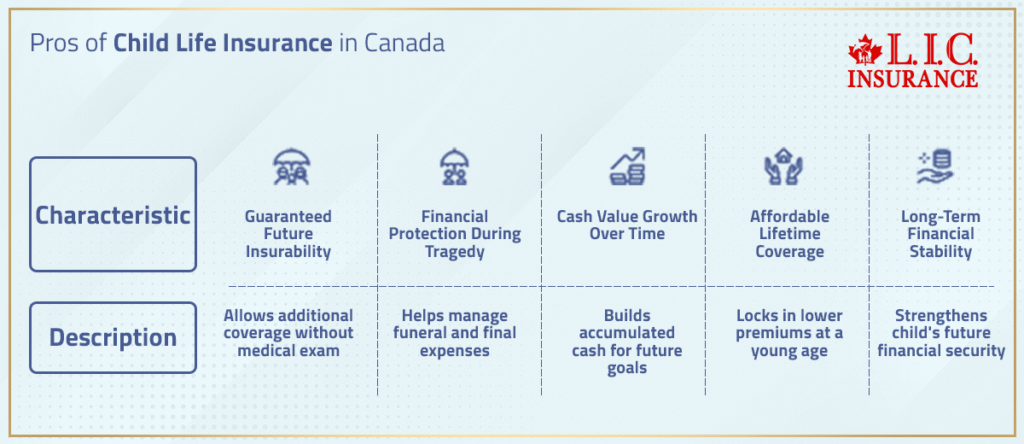
Pros Of Child Life Insurance In Canada
Child Life Insurance can provide long-term financial protection and future flexibility when it aligns properly with a family’s overall financial plan.
- Guaranteed Future Insurability – Many Permanent Life Insurance Policies for children allow the insured child to purchase additional coverage later without another medical exam, even if health conditions develop in adulthood.
- Financial Protection During Unexpected Tragedy – A Child’s Life Insurance Policy can help families manage funeral costs, final expenses, and temporary financial stress during an emotionally difficult period.
- Cash Value Growth Over Time – Certain Whole Life Insurance Plans gradually build accumulated cash value, which may support future financial goals such as education, emergency needs, or long-term financial planning.
- Affordable Lifetime Coverage – Purchasing Life Insurance for kids at a young age usually locks in lower premiums compared to obtaining permanent coverage later in adulthood.
- Long-Term Financial Stability – Some families use permanent coverage as part of broader estate planning and wealth preservation strategies designed to strengthen a child’s future financial security.
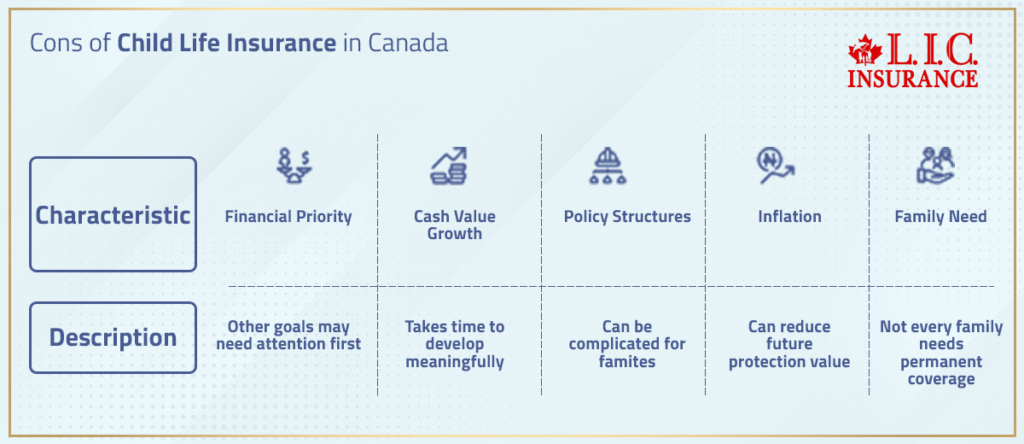
Cons Of Child Life Insurance In Canada
Despite its advantages, permanent child coverage may not be the right financial priority for every Canadian family.
- Other Financial Goals May Need Attention First – Families struggling with debt, limited savings, or insufficient adult Life Insurance Coverage may benefit more from strengthening those areas before purchasing child coverage.
- Cash Value Growth Takes Time – Permanent Life Insurance Policies are designed as long-term financial tools, and meaningful accumulated cash value usually develops gradually over many years.
- Policy Structures Can Be Complicated – Features such as paid-up additions, policy loans, participating dividends, and tax implications may confuse families unfamiliar with permanent insurance planning.
- Inflation Can Reduce Future Value – A smaller policy purchased today may provide less meaningful financial protection decades later unless future coverage options are used properly.
- Not Every Family Needs Permanent Coverage – In some situations, RESP contributions, emergency savings, or stronger adult insurance protection may offer more immediate financial value than buying Life Insurance for children early.
Child Life Insurance Vs RESP: Which One Helps A Child’s Future More?
| Feature | Child Life Insurance | RESP |
|---|---|---|
| Primary Purpose | Lifetime protection and cash value growth | Education savings |
| Government Grants | No | Yes |
| Tax Treatment | Tax-advantaged growth potential | Tax-deferred growth |
| Flexibility | Can support multiple future goals | Education-focused |
| Death Benefit | Yes | No |
| Future Insurability | Possible | No |
| Risk Level | Depends on policy structure | Depends on investments |
| Access To Funds | Policy rules apply | Education withdrawal rules apply |
As per the Canada Revenue Agency, RESPs are eligible for government grants under the Canada Education Savings Grant Program, making them very desirable for individuals who are only interested in financing their education.
The major drawback is that RESPs do not offer any lifetime insurance benefits or insurability benefits in the future.
For most families, the key is to choose neither. The key is to know what can be accomplished by using either option.
Child Term Rider Vs Standalone Policy
Child Term Rider insurance is one of the first child plans that people usually come across because they are cheap to attach to adult plans.
For those who are seeking affordable protection, it is possible for the family to benefit from a rider plan.
Riders have some limitations as well.
The biggest limitation of riders is that they usually run out when the children reach adulthood, and the plans rarely accumulate much cash value.
Standalone policies offer many more advantages than riders.
There are several stand-alone permanent plans that offer lifelong coverage, ownership transfer capabilities, accumulated value, and future insurability guarantees.
If all you care about is affordability, then a rider makes more sense.
But if you are planning for the future, it would be wise to opt for a permanent stand-alone policy.
Child Term Rider Vs Standalone Policy
| Feature | Child Term Rider | Standalone Policy |
|---|---|---|
| Coverage | Temporary | Lifetime |
| Cost | Lower premiums | Higher premiums |
| Cash Value | Usually none | May build cash value |
| Future Insurability | Limited | Often included |
| Ownership | Linked to parent policy | Can transfer to the child |
| Best For | Affordable protection | Long-term financial planning |
How Much Child Life Insurance Coverage Is Enough?
No formula exists for calculating how much Life Insurance should be purchased for a child.
Some people buy small policies that will merely take care of any expenses related to the funeral and burial.
Others buy bigger policies that will cater to their long-range financial needs and plans.
Our advice to parents is not to think about the maximum limit possible but rather to consider whether the policy really fits within their financial plans and objectives.
It should be a natural extension of their financial plans and not an added burden to them.
Critical Illness Riders And Additional Benefits For Children
Another option that some families might consider including would be critical illness coverage for their kids.
Being ill is always a stressful thing, especially for children, and can take its toll not only on the parents emotionally but financially as well. Although healthcare costs are covered to a certain extent provincially, the loss of income, as well as travel and accommodation costs, will be incurred.
A Critical Illness Rider could pay out a lump sum that would lessen the financial burden.
However, all insurance policies differ.
The family needs to consider all aspects when including other riders.
When Is Life Insurance For Children Worth It In Canada?
According to our observations, permanent insurance for children makes the most logical choice in cases where families emphasize the importance of long-term planning.
These might be parents interested in guaranteed future insurability, those with hereditary health issues, or those who have established considerable amounts of emergency funds for adults.
It may be important for one family due to the availability of affordable lifetime protection. Others would prioritize financial security and flexibility.
The bottom line is that it all comes down to what the family considers more important.
Situations Where Child Life Insurance May Not Make Sense
There are also many instances when providing for children is not the best financial choice.
People who are having trouble with debts, poor cash flows, and inadequate emergency savings would find it more useful to improve these areas first.
Also, parents who do not have enough insurance for themselves should take care of their own needs before taking out policies for their children.
A child’s policy should help secure the financial status of a family, not burden it.
Questions Parents Should Ask Before Purchasing Life Insurance For Children
Before purchasing Life Insurance for children, parents should clearly understand how the policy works long-term and whether it truly supports their family’s financial goals.
Important questions to ask include:
- Will the policy build guaranteed cash value over time?
- How does the policy growth structure work?
- Are there surrender charges or restrictions if the policy is cancelled early?
- What are the possible tax implications of withdrawing the accumulated cash value later?
- Can ownership of the policy transfer to the child in adulthood?
- Does the plan include guaranteed future insurability options?
- Is the policy participating or non-participating?
- Will premiums remain fixed throughout the payment period?
- How does this policy compare with other long-term financial planning tools?
The quality of both the advisor and the insurance provider matters significantly because a Child’s Life Insurance Policy can affect decades of future financial planning and financial security.
How We Help Families Build Long-Term Financial Security
We assist families in evaluating several insurance companies and designing their plans around long-term financial considerations rather than just standard advice.
Families may be concerned about affordable coverage. Some families may be more interested in Permanent Life Insurance Coverage and estate planning.
Our job is to educate the parents about the benefits and drawbacks of child coverage.
Since these policies may impact the child’s financial future for years to come, careful planning becomes extremely important.
Conclusion
The debate about children’s Life Insurance has come a long way from merely offering coverage as an emergency measure.
In today’s Canada, more families view a permanent coverage option for their children as part of a bigger scheme that includes considerations such as insurability in the future, protection, stability, and asset-building.
Nevertheless, this does not imply that all families require child insurance.
In certain cases, bolstering emergency funds, increasing RESP payments, or even improving coverage in the case of the parents could be the most prudent move at the time. In other cases, a well-designed permanent plan may prove to be a valuable asset down the road in the child’s life.
Ultimately, the utility of a child insurance policy comes down to the needs and circumstances of a family.
Used properly, Life Insurance can do much more than just offer coverage; it can serve as part of a bigger financial framework.
Author: Harpreet Puri, Licensed Insurance Adviser | MDRT Qualifier
Experience: 14 Years In Life Insurance & Financial Planning
LinkedIn Profile:https://www.linkedin.com/in/harpreetpuricanadianlic/
Disclaimer:
The information provided is for general educational purposes only and should not be considered legal, tax, or financial advice. Child Life Insurance Policies, cash value growth, and tax implications vary by insurer and individual circumstances. Readers should consult a licensed insurance advisor or qualified financial professional before purchasing Life Insurance for children or making long-term financial planning decisions.
FAQs
Yes, most insurers do provide Permanent Life Insurance for children regardless of whether their parents have been in Canada for a long time. This is subject to their residency status, province documents, and the underwriting process. Some immigrants prefer to start saving through Family Life Insurance Plans right after moving to Canada.
All insurance companies will require the applicant to provide basic identification information, such as the child’s birth certificate, proof of the parent’s identification, and medical history information, in case it is required. In certain Whole Life Insurance Policies, residency information and beneficiary information may be needed.
Some Permanent Life Insurance Plans provide flexibility when there is sufficient cash value within the plan. Based on how the plan is designed, the value within the plan can assist with paying premiums for a while. This aspect differs widely among insurance companies and must be considered before depending on it.
In most cases, children’s Life Insurance Policies continue to be valid even when the insured moves, works, or studies abroad. In addition, there may be some complications related to the future management of the policy, as well as financial and taxation issues.
It is possible that some people may eventually invest in their entrepreneurial ventures or business ventures using the savings built up within their whole-Life Insurance Policy. Though policies may not be designed as loans for business ventures, they may provide added financial flexibility later in life.
Most Whole Life Insurance Plans provide a fixed premium, which is guaranteed to stay the same throughout the period during which payments will be made. However, when it comes to universal Life Insurance, a flexible approach to premium paying can be possible based on the specifics of the particular plan.
In some cases, there might be a shared responsibility by two parents who have undergone divorce or separation to maintain their child’s Life Insurance Plan. The structure of ownership is different for various companies providing such services, hence the need for legal consultation when purchasing the plan.
The Permanent Life Insurance Policy does not inherently disqualify an individual from receiving benefits from most student financial assistance schemes. Nevertheless, if a significant amount of built-up cash value is subsequently realized, it might be prudent for one to consult a professional financial counsellor.
Some insurers permit the beneficiary child to enhance or convert parts of the present Life Insurance Policy into bigger adult life policies without having to begin the whole process anew. This feature can be very useful for adults when their liabilities have grown post-marriage and children, or post-home purchase.
It is common for many families to opt for Life Insurance on behalf of newborn children in Canada, owing to the fact that premium costs at this stage can be much lower. Nonetheless, it should be noted that the optimal time to do so is dependent on many factors other than simply age.
A number of prominent Canadian insurance companies provide excellent Life Insurance Policies for children, which include participating Whole Life Insurance Plans that offer benefits such as guaranteed insurance, paid-up additions, and future insurability options. While choosing the best policy may not be solely based on the company’s reputation, the effectiveness of the insurance plan in relation to the family’s future is an important consideration.
Permanent Child Life Insurance may help in future savings plans because some types will develop accumulated cash value over time. Nevertheless, it is important to understand that permanent Child Life Insurance does not take the place of regular investments or even an emergency fund. It is better to consider it as one aspect of family finances in general.
The Registered Education Savings Plan focuses on financing education after high school, whereas Permanent Life Insurance can cover the child throughout his/her life, with potential benefits in the future. The first strategy concerns education, while the second is about providing insurance for the future. Parents in Canada tend to use both of them simultaneously.
The coverage amount for Life Insurance for children generally ranges between $10,000 and $250,000, depending on the insurance company, type of policy, and the goals of the family. The premiums depend on the type of Life Insurance purchased, whether it be a permanent or temporary Life Insurance, but purchasing insurance at an early age is always cheaper.
Whole Life Insurance Policies vary from one insurance company to another in their features, particularly the performance of dividends, future insurability, accumulation of cash value, and payment arrangements. While some companies concentrate on participative whole life products, other firms tend to put more emphasis on simplified issue or flexible universal life products.
There exist Permanent Life Insurance Plans that enable families to opt for either the limited payment periods option, lifetime premium payments, or accelerated funding plans. There are certain types of Permanent Life Insurance Plans that are set up to pay off entirely within a predetermined period, thereby cutting down payment costs without jeopardizing the coverage for life.
There are many different benefits that some policies provide that have nothing to do with the death benefit at all. Some of the possible benefits will depend on the type of policy purchased, but they could potentially consist of cash build-up, insurance opportunities, or growth possibilities, among others.
Early purchasing of Life Insurance for one’s kids can end up restricting financial resources that might have been used for other purposes, such as paying off debts, building an emergency fund, and saving for college. Besides, Permanent Life Insurance Policies take some time before the growth of their cash values becomes significant.
Sources and Further Reading
- Financial Consumer Agency Of Canada – Permanent Life Insurance And Cash Value Explained
- Canada Revenue Agency – Registered Education Savings Plans (RESPs)
- Canada Life – Permanent Life Insurance And Lifetime Coverage
- Canada Life – Participating Whole Life Insurance And Cash Value Growth
- Canada Life – Term Vs Permanent Life Insurance Comparison
- Sun Life Canada – Whole Life Insurance And Cash Value Benefits
- Sun Life Canada – Participating Life Insurance And Dividend Growth
- Sun Life Canada – Permanent Life Insurance Overview
- Sun Life Canada – Term Vs Permanent Life Insurance Explained
- Sun Life Canada – Whole Life Insurance Rates And Coverage Features
- Canada Life – Converting Term Life Insurance To Permanent Coverage
Key Takeaways
- Life Insurance for children in Canada is often used for more than just a death benefit, especially when families focus on long-term financial planning and future financial security.
- Permanent Whole Life Insurance may build accumulated cash value over time, which can support future goals such as education funding, emergency needs, or financial flexibility later in adulthood.
- One of the biggest advantages of Child Life Insurance is guaranteed future insurability, which may allow the insured child to access additional coverage later without another medical exam.
- A Child Term Rider usually provides lower-cost temporary coverage, while standalone permanent policies offer longer-term benefits such as cash value growth and lifetime coverage.
- Lower premiums at a young age make Life Insurance for kids more affordable compared to purchasing permanent coverage later during adulthood.
- A Registered Education Savings Plan and permanent Child Life Insurance serve different purposes, and many Canadian families use both strategies together rather than choosing only one.
- Permanent coverage may not be the right financial priority for every household, especially if parents still need emergency savings, debt reduction, or stronger adult insurance protection.
- Policy structure matters significantly because insurers differ in how they handle dividends, payment flexibility, guaranteed coverage, and long-term cash value growth.
- Families considering buying Life Insurance for children should review policy ownership rules, tax implications, future flexibility, and long-term affordability carefully before purchasing coverage.
- The value of Life Insurance for children depends entirely on the family’s financial goals, risk tolerance, and long-term planning priorities rather than emotional marketing alone.
Your Feedback Is Very Important To Us
IN THIS ARTICLE
- Pros And Cons Of Child Life Insurance In Canada
- What Is Child Life Insurance In Canada?
- Why Parents Are Buying Life Insurance For Kids Earlier Than Before
- Cash Value: Does Child Life Insurance Build Cash Value?
- Pros Of Child Life Insurance In Canada
- Cons Of Child Life Insurance In Canada
- Child Life Insurance Vs RESP: Which One Helps A Child’s Future More?
- Child Term Rider Vs Standalone Policy
- How Much Child Life Insurance Coverage Is Enough?
- Critical Illness Riders And Additional Benefits For Children
- When Is Life Insurance For Children Worth It In Canada?
- Situations Where Child Life Insurance May Not Make Sense
- Questions Parents Should Ask Before Purchasing Life Insurance For Children
- How We Help Families Build Long-Term Financial Security
- Conclusion
Sign-in to CanadianLIC
Verify OTP