- Connect with our licensed Canadian insurance advisors
- Schedule a Call

BASICS
- Is Infinite Banking A Smart Financial Strategy?
- Understanding the Infinite Banking Concept
- Why Infinite Banking Appeals to Canadians Seeking Financial Freedom
- How Infinite Banking Strategy Helps Build Financial Independence
- Challenges and Misconceptions About Infinite Banking
- Who Should Consider Infinite Banking for Financial Freedom?
- How to Start Your Infinite Banking Journey
- Key Advantages of the Infinite Banking Strategy
- A Day-to-Day Struggle: Why More Canadians Are Exploring Infinite Banking
- Potential Drawbacks You Should Know
- The Future of Infinite Banking in Canada
- Is Infinite Banking a Smart Financial Strategy?
COMMON INQUIRIES
- Can I Have Both Short-Term and Long-Term Disability Insurance?
- Should Both Husband and Wife Get Term Life Insurance?
- Can I Change Beneficiaries on My Canadian Term Life Policy?
- What Does Term Life Insurance Cover and Not Cover?
- Does Term Insurance Cover Death?
- What are the advantages of Short-Term Life Insurance?
- Which Is Better, Whole Life Or Term Life Insurance?
- Do Term Life Insurance Rates Go Up?
- Is Term Insurance Better Than a Money Back Policy?
- What’s the Longest Term Life Insurance You Can Get?
- Which is better, Short-Term or Long-Term Insurance? Making the Right Choice
IN THIS ARTICLE
- What is the minimum income for Term Insurance?
- How Does Income Affect Your Term Life Insurance Policy?
- Can You Buy Term Life Insurance Online with a Low Income?
- How Can You Lower Your Term Life Insurance Cost?
- How Much Term Life Insurance Do You Need?
- Can Your Term Life Insurance Policy Be Adjusted Over Time?
- Why Term Life Insurance Is Ideal for Lower-Income Canadians
- Final Thoughts
- More on Term Life Insurance
Whole Life vs Universal Life: Which Saves You More?

By Pushpinder Puri
CEO & Founder
- 08 min read
- Aug 17th, 2026
SUMMARY
Whole Life vs Universal Life Insurance compared using permanent Life Insurance Canada and cash value Life Insurance Canada strategies. Covers Whole Life Insurance Policy Canada and Universal Life Insurance Canada, including cash value growth, death benefit differences, premium structures, and real insurer comparisons to help decide which Life Insurance is right for long-term financial planning.
Introduction
Life Insurance In Canada Is Changing Fast
There is an ongoing change within Canadian homes. People now recognize Life Insurance as an investment that will require their attention for many years. More often than not, it becomes an integral part of a larger financial plan. Based on a survey conducted by the Canadian Life and Health Insurance Association, more than 22 million Canadians currently hold Life Insurance Policies, with the largest percentage among these belonging to Permanent Life Insurance, Canada insurance coverage that provides lifelong protection coupled with financial gain.
This growing trend is well-reflected by the work done at Canadian LIC every day. Customers are no longer inquiring about the required amount of protection. Instead, they want to know if purchasing a Whole Life Insurance Canada or a Universal Life Insurance Canada will provide them with any financial benefits in the years to come.
The main question that most people can’t seem to get past is easy enough to ask, yet very complex to answer. Which is better, Whole Life vs Universal Life Insurance—what will save me more money?
Understanding The Basics Of A Life Insurance Policy In Canada
A modern Life Insurance Plan in Canada can be broadly categorized into three classes: Term Life Insurance, Whole Life Insurance, and Universal Life Insurance. Each of the above has distinct functions.
The Term Life Insurance Plan is meant to cover short-term requirements. While it may offer reduced premiums and simple coverage options, it does not accumulate any cash value, thus making it inefficient when it comes to long-term financial planning purposes.
Contrary to Term Insurance, Whole Life and Universal Plans include some sort of savings aspect, which allows you to withdraw money while living. That is why they become popular when dealing with financial and retirement planning.
The growth of the cash value of qualifying plans under the Canadian tax system is considered tax-deferred, as per the rules of the Canadian Income Tax Act Section 148. This fact explains why many business people and affluent individuals consider Cash Value Life Insurance in Canada.
The main difference between the Term Life vs Whole Life vs Universal Life Insurance Canada does not concern their duration, but their financial performance.
What Whole Life Insurance Offers: Stability, Guaranteed Death Benefit, And Predictable Cash Value Growth
The Whole Life Policy is characterized by certainty. The insurer is committed to providing three types of certainty from the very moment when the contract becomes operational: certainty in premium payments, death benefits, and cash value growth.
Each payment made towards the premium serves two purposes: the cost of insurance and Whole Life Insurance cash value accumulation.
Real-World Perspective From Canadian LIC
Recently at Canadian LIC, a businessman aged 38 opted for the Sun Life Financial Participating Whole Life Insurance Policy in Canada. He did not seek fast growth, but rather wanted consistency and estate planning for the future.
At the 20-year mark, the cash value had built up enough for the businessman to withdraw money to fund the development of his business without affecting his insurance coverage. The policy still offered lifetime insurance cover while the build-up value worked behind the scenes.
The advantage of Whole Life Insurance is that it does not depend on timing or any form of management. It caters to those people who value stability and require an investment that will perform consistently and predictably.
Whole Life Insurance Benefits And Drawbacks You Must Know
A closer look at Whole Life Insurance, why it is considered one of the most stable long-term financial tools in Canada.
Benefits:
- Guaranteed Death Benefit: Your beneficiaries receive a fixed payout, regardless of when you pass away, creating a reliable long-term safety net.
- Fixed Premiums: Premium payments remain unchanged throughout your lifetime, offering certainty in budgeting and protecting against rising insurance costs.
- Guaranteed Cash Value: The policy builds a steady cash value component that grows over time and can be accessed when needed.
- Predictable Cash Value Growth: Unlike market-linked products, growth is stable and consistent, making it easier to plan for retirement or estate needs.
Drawbacks:
- Higher Premiums: Compared to Term Life or even some Universal Life structures, Whole Life requires a higher financial commitment, especially in early years.
- Lower Growth Potential: While stable, returns are more conservative than investment-based strategies tied to a market index.
- Limited Flexibility: Premiums and structure are fixed, which means less ability to adjust as your financial situation changes.
Why Many Still Choose It:
- Long-Term Stability: The combination of guaranteed cash and lifelong coverage creates a dependable financial foundation.
- Wealth Preservation: Ideal for estate planning, final expenses, and transferring wealth efficiently across generations.
What Universal Life Insurance Offers: Flexibility, Growth Potential, And Control
While Whole Life Insurance is all about predictability, the Universal Life Insurance Plan in Canada provides you with options to change. In Universal Life Insurance, there is no limit on how much money can be put in and how the investment can be made within the account.
In this kind of insurance plan, the insurance part is separated from the investment part. When the costs of insurance are met, the remaining amount goes into the investment accounts that can be connected with either interest rates or market indexes.
For people with variable incomes, the Universal Life Insurance Plan can work best.
Universal Life Insurance Pros And Cons: Growth Potential Vs Risk
The primary characteristic that distinguishes Universal Life Insurance from other types of insurance policies is the growth capacity. While the returns in the Whole Life plan are constant, Universal Life Insurance enables you to increase your gains depending on market fluctuations.
In yet another Canadian Life Insurance Company case, the client decided to go for a Universal Life Insurance product by Manulife Financial. The allocation was quite balanced, and within 25 years, it surpassed all predictions of traditional Whole Life plans because of the market environment.
Nevertheless, the situation does not end here. The client had to readjust the premium payments during turbulent market conditions in order to ensure that the Universal Life Insurance Plan performed optimally. Therein lies one of the major facts about Universal Life Insurance cost – it changes over time based on the results of the investments made under the policy.
Indexed Universal Life: Growth Linked To Market Index And Upside Potential
Indexed Universal Life Insurance combines stability and growth. Rather than being exposed directly to the markets, the return on investment is based on an index that tracks market movements, providing growth coupled with a built-in safeguard.
Even though there are some restrictions associated with this strategy, the idea behind it is not to limit gains but to protect the investor from loss when the market is down.
Most plans in Canada adopt this kind of system by using segregated funds or interest-based plans. It would work well for people looking for moderate growth but without being fully exposed to the markets.
Key Differences Between Whole Life And Universal Life Insurance
| Feature | Whole Life | Universal Life |
|---|---|---|
| Death Benefit | Guaranteed | Flexible |
| Cash Value | Guaranteed | Market-dependent |
| Premium Payments | Fixed premiums | Flexible premiums |
| Insurance Costs | Higher but stable | Lower initially |
| Growth Potential | Predictable | Variable |
These key differences highlight the fundamental trade-off: stability versus flexibility.
Cash Value Growth: Which Policy Helps You Build Cash Faster?
It should be noted that the speed of cash accumulation is influenced by two factors: structure and conditions.
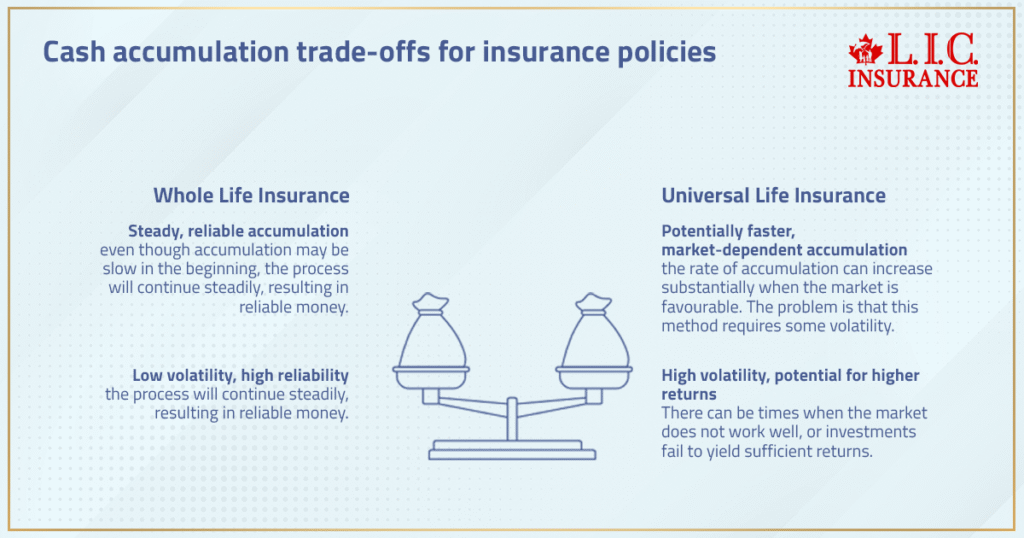
Whole Life Insurance has structured cash values; even though accumulation may be slow in the beginning, the process will continue steadily, resulting in reliable money.
In the case of Universal Life Insurance, the rate of accumulation can increase substantially when the market is favourable. The problem is that this method requires some volatility. There can be times when the market does not work well, or investments fail to yield sufficient returns.
In conclusion, one has to choose between two options depending on personal preferences.
Real Premium Comparison In Canada (2025–2026)
To ground this comparison in reality, consider actual quoting patterns from insurers such as Sun Life Financial, Manulife Financial, and Canada Life.
Sample Profile
- Age: 35
- Non-smoker
- Coverage: $250,000
| Insurer | Whole Life Monthly | Universal Life Monthly |
|---|---|---|
| Sun Life | $167 | $123 |
| Manulife | $160 | $118 |
| Canada Life | $172 | $130 |
These figures are based on real advisory case data and insurer illustrations, not generic estimates.
They illustrate a common pattern: Universal Life Insurance may start with lower monthly premiums, but long-term costs depend on how the policy is managed.
Which Life Insurance Is Right For Me?
The choice between Whole Life and Universal Life Insurance does not imply selecting the more advantageous product. The key is to make the right choice based on your needs.
When stability, simplicity, and guarantees are important for you, Whole Life Insurance seems like the best choice. On the other hand, if you are open to investment management and prefer flexibility, then Universal Life Insurance can be a better option.
Many of our clients at Canadian LIC successfully use the combination of Term Life and permanent insurance.
Insurance Vs Investment: Where Whole Life And Universal Life Fit In Your Financial Plan
Discussion about insurance versus investment tends to ignore the larger context. The two concepts have distinct functions.
Whole Life Insurance gives you an asset that is relatively secure and grows at a known rate. On the other hand, Universal Life Insurance offers you flexibility and profit-making.
A combination of the two will give you a good balance of your financial plan.
How Canadian LIC Helps You Choose Between Whole Life And Universal Life
Our emphasis is more on strategy than on any product. All our recommendations come from a thorough analysis of your current situation, risk appetite, and future goals.
Our financial planners will compare all kinds of insurance policies offered by several companies, making sure that the selected insurance policy structure suits your requirements and remains effective over time.
Final Thoughts: Whole Life Vs Universal Life
Choosing between Whole Life and Universal Life Insurance is not about determining what works for everyone. It’s about knowing which one will work best for your finances.
Whole Life Insurance provides peace of mind. Universal Life Insurance provides adaptability. Both options offer coverage throughout your lifetime.
It all comes down to what you plan to do with your money.
Author: Pushpinder Puri, Licensed Insurance Adviser | MDRT Qualifier
Experience: 14 Years In Life Insurance & Financial Planning
LinkedIn Profile:https://www.linkedin.com/in/harpreetpuricanadianlic/
Disclaimer:
This content is for informational purposes only and does not constitute financial, legal, or tax advice. Life Insurance products, including Whole Life Insurance Policies in Canada and Universal Life Insurance in Canada, vary based on individual circumstances and insurer terms. Any premium or cash value examples are illustrative and not guaranteed. Consult a licensed advisor before making financial decisions.
FAQs
Conversion to permanent insurance is possible in many Term Life Insurance contracts. The feature enables you to switch from Term Life Insurance to permanent without having to undergo a physical examination. Conversion is useful in case of improvement in one’s financial status or when the insured person decides to change his/her long-term financial plan objectives.
Cash value accumulation for both types of insurance plans will be tax-deferred according to the CRA’s existing rules. That is, there will be no taxes levied against your cash value gains each year. But there can be tax consequences if withdrawals exceed adjusted cost basis or poor structuring occurs.
In the event that the payment of premiums is missed, the plan will be able to make use of any available cash value to keep the insurance going for a certain period. If the available cash value is insufficient to support the coverage, then the policy lapses.
While a medical test may be necessary in order to obtain more coverage amounts, there are several forms of simplified issue or no-medical Life Insurance that one may choose from in Canada. This would either cost more in terms of insurance premiums or have reduced insurance coverage.
Absolutely, many Canadians utilize the strategy of Cash Value Life Insurance Canada to create cash reserves, which will be useful for their retirement. With the help of loans against policies or withdrawal strategies, it can even serve as an additional source of income.
Universal Life Insurance includes the inclusion of charges for policies, which vary with the investments selected. The charges will differ with the insurance company and strategy employed. For instance, Whole Life Insurance charges incorporate all the expenses in one lump sum of money.
Inflation may also affect the real value of your insurance benefit in the future. There are insurance contracts that provide options for adjustment or add-on benefits in order to keep pace with inflation.
The advisors will determine your financial situation, risk level, and your objectives to determine what type of Life Insurance is best for you. This can mean choosing between guaranteed cash values and flexibility, depending on how your needs change over time.
The difference between a Whole Life Insurance Policy and a Universal Life Insurance Policy is that in the case of the former, the premiums are constant and known throughout the period of the policy. However, in the latter, there is room for changing the amount of premium paid, beyond the basic cost involved.
The participating Whole Life policies sold in Canada by insurance companies have the potential to earn an annual dividend that depends on the financial performance of the company. Such dividends may be invested to create cash, lower premiums, or provide for an additional amount of coverage in the form of paid-up additions.
The majority of insurers in Canada do not permit a switch from Whole Life Insurance to Universal Life Insurance after the issuance of the policy due to the unique structure of each policy. Thus, changing the coverage type can only be achieved by purchasing another policy, which may result in an increase in costs.
Many Universal Life Insurance Plans have different levels of costs that include administrative expenses, fees for investment management, and the cost of insurance deductions. It is important to understand how these costs work since they may influence the growth of cash value, particularly during the initial years of the plan.
Whole Life Insurance and Universal Life Insurance in Canada have a similar advantage of tax-deferred accumulation of cash value according to Canadian tax regulations. The difference lies in their treatment for contributions and withdrawals. Effective utilization will enable both plans to become useful financial planning vehicles.
Sources and Further Reading
- CLHIA – Industry Data
https://www.clhia.ca - Canada Revenue Agency (CRA) – Tax Rules
https://www.canada.ca/en/revenue-agency.html - CRA – Life Insurance & Taxation (Specific)
https://www.canada.ca/en/revenue-agency/services/forms-publications/publications/it87r2.html - OSFI – Insurance Regulation
https://www.osfi-bsif.gc.ca - Sun Life – Whole Life Insurance
https://www.sunlife.ca/en/insurance/life-insurance/whole-life-insurance/ - Manulife – Universal Life Insurance
https://www.manulife.ca/personal/insurance/life-insurance/universal-life-insurance.html - Canada Life – Permanent Insurance
https://www.canadalife.com/insurance/life-insurance/permanent-life-insurance.html - FSRA Ontario – Licensing & Consumer Protection
https://www.fsrao.ca - Government of Canada – Financial Literacy
https://www.canada.ca/en/services/finance.html
Key Takeaways
- Whole Life vs Universal Life Insurance in Canada comes down to stability versus flexibility within permanent Life Insurance Canada strategies.
- Whole Life Insurance Policy Canada offers fixed premiums, a guaranteed death benefit, and predictable cash value growth for long-term security.
- Universal Life Insurance Canada provides flexible premiums and higher growth potential, but requires active management and carries market-related risk.
- Cash value Life Insurance in Canada can support retirement planning, borrowing needs, and tax-efficient wealth accumulation over time.
- Premium costs for Whole Life are higher upfront, while Universal Life Insurance costs may start lower but vary based on investments and contributions.
- Choosing between Whole Life and Universal Life depends on financial goals, risk tolerance, and how you want your Life Insurance Policy to perform over time.
Your Feedback Is Very Important To Us
Understand challenges, decision barriers, and preferences around Whole Life Insurance Policy Canada vs Universal Life Insurance Canada, including cash value Life Insurance Canada strategies.
IN THIS ARTICLE
- Whole Life vs Universal Life: Which Saves You More?
- Understanding The Basics Of A Life Insurance Policy In Canada
- What Whole Life Insurance Offers: Stability, Guaranteed Death Benefit, And Predictable Cash Value Growth
- Whole Life Insurance Benefits And Drawbacks You Must Know
- What Universal Life Insurance Offers: Flexibility, Growth Potential, And Control
- Universal Life Insurance Pros And Cons: Growth Potential Vs Risk
- Indexed Universal Life: Growth Linked To Market Index And Upside Potential
- Key Differences Between Whole Life And Universal Life Insurance
- Cash Value Growth: Which Policy Helps You Build Cash Faster?
- Real Premium Comparison In Canada (2025–2026)
- Which Life Insurance Is Right For Me?
- Insurance Vs Investment: Where Whole Life And Universal Life Fit In Your Financial Plan
- How Canadian LIC Helps You Choose Between Whole Life And Universal Life
- Final Thoughts: Whole Life Vs Universal Life
Sign-in to CanadianLIC
Verify OTP