- Connect with our licensed Canadian insurance advisors
- Schedule a Call

BASICS
- Is Infinite Banking A Smart Financial Strategy?
- Understanding the Infinite Banking Concept
- Why Infinite Banking Appeals to Canadians Seeking Financial Freedom
- How Infinite Banking Strategy Helps Build Financial Independence
- Challenges and Misconceptions About Infinite Banking
- Who Should Consider Infinite Banking for Financial Freedom?
- How to Start Your Infinite Banking Journey
- Key Advantages of the Infinite Banking Strategy
- A Day-to-Day Struggle: Why More Canadians Are Exploring Infinite Banking
- Potential Drawbacks You Should Know
- The Future of Infinite Banking in Canada
- Is Infinite Banking a Smart Financial Strategy?
COMMON INQUIRIES
- Can I Have Both Short-Term and Long-Term Disability Insurance?
- Should Both Husband and Wife Get Term Life Insurance?
- Can I Change Beneficiaries on My Canadian Term Life Policy?
- What Does Term Life Insurance Cover and Not Cover?
- Does Term Insurance Cover Death?
- What are the advantages of Short-Term Life Insurance?
- Which Is Better, Whole Life Or Term Life Insurance?
- Do Term Life Insurance Rates Go Up?
- Is Term Insurance Better Than a Money Back Policy?
- What’s the Longest Term Life Insurance You Can Get?
- Which is better, Short-Term or Long-Term Insurance? Making the Right Choice
IN THIS ARTICLE
- What is the minimum income for Term Insurance?
- How Does Income Affect Your Term Life Insurance Policy?
- Can You Buy Term Life Insurance Online with a Low Income?
- How Can You Lower Your Term Life Insurance Cost?
- How Much Term Life Insurance Do You Need?
- Can Your Term Life Insurance Policy Be Adjusted Over Time?
- Why Term Life Insurance Is Ideal for Lower-Income Canadians
- Final Thoughts
- More on Term Life Insurance
Is Mortgage Insurance Mandatory For All Homebuyers In Canada?


By Pushpinder Puri
CEO & Founder
- 12 min read
- Aug 24th, 2026
SUMMARY
Mortgage Insurance Canada explained with clarity—what is Mortgage Insurance, when Mortgage Insurance is mandatory, and how Mortgage Insurance works for high ratio mortgages. Covers Mortgage Insurance rates, Mortgage Insurance Coverage, default insurance, and Mortgage Insurance vs Life Insurance. Also explains the Mortgage Insurance premium calculator, costs, lender protection, and impact on mortgage payments and approval.
Introduction
Why Mortgage Insurance Matters In Canada’s Housing Market
The housing market in Canada remains stretched in terms of affordability, particularly for first-time homebuyers who seek entry into the market using a low down payment. High-ratio mortgages account for a significant proportion of mortgages disbursed annually by the Canada Mortgage and Housing Corporation. These are cases where borrowers put less than 20% down payment. Herein lies the significance of Mortgage Insurance Canada.
Clients at Canadian LIC frequently ask questions about whether or not Mortgage Insurance is mandatory. Most feel it’s another expense one may take care of optionally, while others think it guarantees the security of their family’s wealth. However, neither is correct. Whether Mortgage Insurance is necessary for your home loan or not will depend on a number of aspects, like the down payment percentage and the mortgage lender’s policies.
In order to better understand the concept of Mortgage Insurance, its necessity in certain cases, and the difference between Mortgage Insurance and other types of insurance, read on. This article explains all you need to know about Mortgage Insurance in Canada.
What We Commonly Hear From Clients
At Canadian LIC, there are many clients who believe that Mortgage Insurance will help their families in the event of their death. The latest example was a client from Brampton who had come for a consultation, thinking that his bank insurance would take care of his spouse. After looking at his paperwork, he came to know that his Mortgage Insurance only covers him but does not provide any help to his family, and therefore structured a new Term Life Insurance Policy for them.
The second conversation is related to a client who is interested in reducing initial investment by keeping down payments low without considering the extra cost that will be incurred in terms of Mortgage Insurance premiums.
This clearly indicates that there is a lot of confusion about Mortgage Insurance among Canadians.
Understanding Mortgage Insurance In Canada
What Is Mortgage Insurance?
The term “Mortgage Insurance” refers to an insurance program meant to safeguard the interests of lenders. If the borrower fails to pay the mortgage and becomes a defaulter, the insurer repays the lender for the loss incurred. This arrangement is meant to minimize the risks associated with lending.
Three major institutions offer Mortgage Insurance in Canada. The three include Canada Mortgage and Housing Corporation, Canada Guaranty, and Sagen. These institutions evaluate the risk level of each mortgage loan and calculate the insurance premium.
Despite the fact that the borrower pays for this form of insurance, it should be noted that it differs from other forms of insurance, such as life and homeowner’s insurance.
Why Mortgage Insurance Exists
The Mortgage Default Insurance is important to the lenders and enables the financial organizations to lend money to people who may not have been eligible under normal circumstances because of the lower down payments that must be made.
In addition, it acts as a stabilizer in the entire mortgage market as it ensures that lending is continuous regardless of economic conditions. It achieves this by shifting some of the risk from the lender to the insurer.
When Is Mortgage Insurance Mandatory In Canada?
High Ratio Mortgages And Legal Requirements
The need for Mortgage Insurance arises if the purchaser puts in a down payment that is below 20%, causing a situation referred to as a high-ratio mortgage. Under such circumstances, the law in Canada demands that lenders arrange for Default Mortgage Insurance before providing mortgage financing.
The arrangement of insurance is compulsory. Mortgage Insurance is arranged by the lending institution, and its costs are charged to the borrower as an insurance premium.
Key Conditions That Trigger Mandatory Insurance
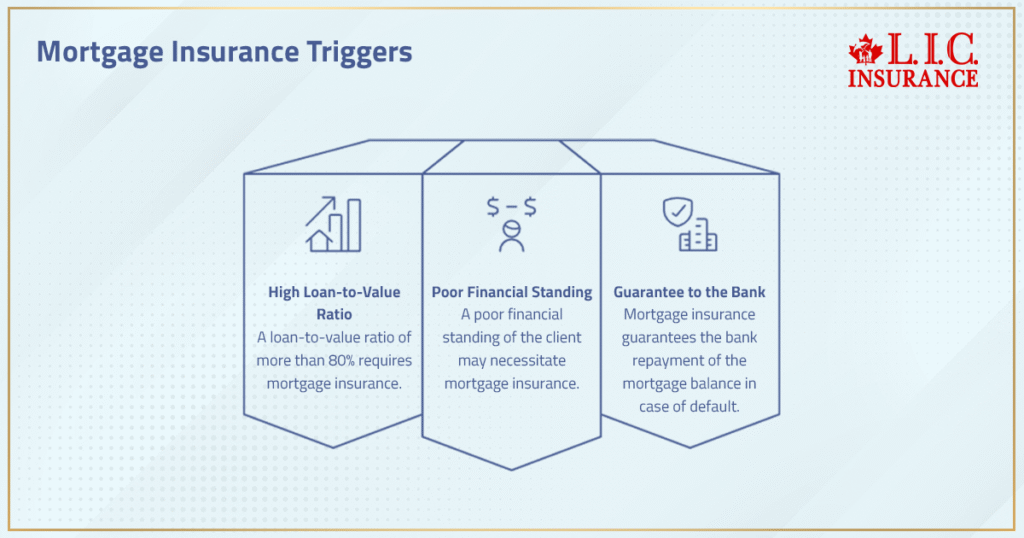
A loan-to-value ratio of more than 80% means that the mortgage will be categorized as an insured mortgage, and hence, Mortgage Insurance Coverage will be needed.
There are other aspects which may lead to an increase in Mortgage Insurance requirements. For instance, a poor financial standing of the client will mean that Mortgage Insurance is necessary. Although a good credit score may increase the likelihood of getting the mortgage approved, it still doesn’t negate the need for insurance in the case of high-ratio mortgages.
This is because Mortgage Insurance will guarantee the bank that the remaining balance on the mortgage will be repaid even if there is any default.
Additional Regulatory Rules You Must Know
There are also regulatory limitations that affect insured mortgages within Canada, according to Canada Mortgage and Housing Corporation and federal laws. Recently, the Mortgage Default Insurance was restricted to homes sold at less than $1.5 million in price.
Further, there are also limitations in terms of amortization schedules. Insured mortgages usually have an amortization period of up to 25 years. In some cases, first-time home buyers or new home owners who purchase their own house have the opportunity to receive a longer amortization period of up to 30 years. The regulation came into effect in 2024.
Additionally, all mortgage applicants need to pass the OSFI stress test and obtain approval based on the higher interest rate of 5.25% or contract rate +2%.
When Mortgage Insurance Is NOT Mandatory
When the buyer pays a deposit of 20 percent or higher, then the loan becomes a traditional loan, and hence no Mortgage Insurance will be needed. It is among the best methods of avoiding the cost of Mortgage Insurance.
There are, however, those individuals who opt for other methods, such as mortgage Life Insurance and Term Life Insurance, to protect their family from financial ruin. While default insurance protects the lender, mortgage Life Insurance and Term Life Insurance benefit the policyholder directly.
It is imperative that we understand the difference between Mortgage Insurance vs. Life Insurance when comparing them.
How Mortgage Insurance Works Step-By-Step
Understanding how Mortgage Insurance works helps you see its direct impact on mortgage cost and monthly payment.
- Mortgage Assessment: The mortgage lender reviews the loan amount, down payment, credit profile, and overall financial standing.
- High Ratio Check: If the mortgage is classified as a high ratio mortgage, the lender arranges Mortgage Insurance through an insurance provider.
- Risk Evaluation: The insurer assesses borrower risk and assigns a premium rate based on the loan-to-value ratio.
- Premium Structure: The insurance premium is either paid upfront or added to the mortgage loan amount.
- Cost Impact: When added to the mortgage, it increases the total loan, leading to higher monthly payment and more interest paid over time.
- Coverage Reality: Mortgage Insurance protects lenders, not the borrower, despite being paid by the borrower.
- Market Access Benefit: It allows buyers to enter the housing market earlier, especially when property values are rising.
Mortgage Insurance Rates And Premium Table (2026)
Mortgage Insurance rates in Canada are primarily determined by the loan-to-value ratio, which reflects the relationship between the loan amount and the property value.
Mortgage Insurance Premium Rates (2026)
| Loan To Value | Down Payment | Premium Rate |
|---|---|---|
| 65% – 75% | 25% – 35% | 0.60% |
| 75% – 80% | 20% – 25% | 1.70% |
| 80% – 85% | 15% – 20% | 2.40% |
| 85% – 90% | 10% – 15% | 3.10% |
| 90% – 95% | 5% – 10% | 4.00% |
Example Calculation
If we take into consideration a house purchased for $600,000 with a down payment equal to 10% or $60,000, then in this case, there will be an amount mortgaged equal to $540,000 with a loan-to-value of 90%.
Considering the present Mortgage Insurance premium rates, the 90% loan-to-value ratio belongs to the category ranging between 90% and 95% of the loan-to-value ratio, having a premium rate of about 4.00%.
This indicates that the Mortgage Insurance premium will be $21,600. In most cases, this type of insurance is incorporated in the amount mortgaged.
In the case of a greater down payment, there is a significant difference. If the down payment is increased by 15% or $90,000, the loan-to-value ratio becomes equal to 85%, and the premium rate decreases to 3.10%.
First-Time Homebuyer In Canada
A first-time buyer buying a house worth $500,000 with a 5% down payment will have a completely different structure from this scenario. The mortgage will stand at $475,000, and the premium rate that applies in such a case will be approximately 4%.
The insurance premium is therefore approximately $19,000, which will be included in the mortgage. Interest will be charged on this money, thereby making the cost of homeownership more expensive.
Nevertheless, without Mortgage Default Insurance, the borrower would not have been eligible for the loan at all.
Mortgage Insurance Vs Life Insurance Decision Framework
The confusion between Mortgage Insurance vs Life Insurance often leads to poor financial decisions. While both involve coverage related to a mortgage, their purpose and structure differ significantly.
| Feature | Mortgage Insurance | Life Insurance |
|---|---|---|
| Coverage | Declines with the mortgage balance | Fixed or adjustable |
| Beneficiary | Mortgage lender | Family or beneficiaries |
| Flexibility | Limited | Highly flexible |
| Ownership | Linked to the lender | Owned by the policyholder |
Benefits And Drawbacks Of Mortgage Insurance In Canada
| Pros Of Mortgage Insurance | Cons Of Mortgage Insurance |
|---|---|
| Enables access to high-ratio mortgages | Adds insurance premium to the loan |
| Helps buyers enter the housing market sooner | Protects lenders, not borrowers |
| Improves mortgage approval chances | Increases total mortgage cost |
| Supports financial system stability | Premium is non-refundable |
| Allows a smaller down payment | Interest paid on the premium over time |
Is Mortgage Insurance Worth It In Canada?
The importance of Mortgage Insurance is largely determined by your finances. For individuals who can afford to pay a smaller amount as a down payment, it offers the advantage of entering the real estate market sooner, which may prove beneficial when there is an increasing trend in property value.
For those who can make higher payments as down payments, not having to opt for Mortgage Insurance will prove economically efficient in the long run.
Key Factors Affecting Mortgage Insurance Cost
Several factors determine Mortgage Insurance cost and directly impact your total mortgage payments and upfront expenses.
- Purchase price influences the overall mortgage amount and insurance premium calculation.
- The loan-to-value ratio is the biggest driver of Mortgage Insurance premiums.
- The amortization period affects long-term cost and total interest paid.
- Interest rate environment impacts affordability and mortgage payments.
- Provincial sales tax (Ontario, Quebec, and Manitoba) applies upfront and increases the total initial cost.
Role Of Mortgage Broker And Insurance Company
The mortgage broker has an essential part to play when it comes to assisting in the mortgage process by ensuring that appropriate lending institutions and financing are obtained by the borrower. On the other hand, the insurer analyzes the risk involved and determines the relevant premium.
It is in this way that the two ensure proper alignment between the two parties within the Canadian Mortgage Insurance framework.
Final Strategic Advice From Canadian LIC
Mortgage Insurance does not need to be considered merely as yet another expense. Mortgage Insurance represents a built-in element of Canada’s home financing scheme. Nevertheless, using only Mortgage Insurance fails to fill a void in protecting personal finances.
A better solution lies in integrating mandatory Mortgage Insurance and a wisely chosen Life Insurance package. With such an arrangement, one can guarantee that both your lender’s and your family’s needs are being catered to.
Author: Harpreet Puri, Licensed Insurance Adviser | MDRT Qualifier
Experience: 14 Years In Life Insurance & Financial Planning
LinkedIn Profile:https://www.linkedin.com/in/harpreetpuricanadianlic/
Disclaimer:
This content is for informational purposes only and does not constitute financial, mortgage, or insurance advice. Mortgage Insurance in Canada varies based on lender policies, borrower profile, and market conditions. Readers should consult a licensed mortgage broker or insurance advisor before making decisions. Canadian LIC does not guarantee approval, rates, or coverage outcomes.
FAQs
The fact is that some lenders will offer reduced interest rates for an insured mortgage because of the reduced risks associated with it. Even though it might increase the total amount borrowed due to increased premiums, the lower rates may help in managing the repayments. It must be analyzed thoroughly.
The removal of Mortgage Insurance from a Canadian mortgage that has already been placed on a high-ratio mortgage cannot happen, even if the balance on the mortgage reduces. It stays part of the mortgage loan itself. Refinancing may present an opportunity to get away from default insurance.
Mortgage Insurance premiums are usually not refundable once made either in advance or when included in the total cost of the mortgage. Regardless of whether or not the buyer retains the property for a lengthy period, the insurer pays off the mortgage only upon default on payment by the buyer.
The Mortgage Insurance does not take into account any kind of individual financial problems, such as unemployment or physical disability. Mortgage Insurance works solely to protect the lender from defaulters, and is therefore not similar to life or income insurance coverage.
A smaller down payment leads to an increase in the loan-to-value ratio, and consequently, an increase in Mortgage Insurance premiums. With the increase in the cost of the house due to a smaller down payment, Mortgage Insurance premiums also increase. Therefore, a larger down payment will greatly reduce the cost of financing.
Mortgage Insurance is provided by the mortgage lender from a reputable insurance company, like the Canada Mortgage and Housing Corporation or a group of insurance companies that work together with the lender in the Canadian mortgage system. The borrower does not choose their insurance provider themselves.
Mortgage Insurance mainly refers to those homes which are being used as residences for their owners and whose values do not exceed specified levels set by regulatory authorities. Those whose values exceed these levels or which are not used as residences might not be eligible.
There will be no new Mortgage Insurance when a mortgage is renewed if it is not originally included in the mortgage agreement. In the case that the original mortgage has insurance, this will remain the same when the mortgage is renewed.
Mortgage Insurance helps home buyers who have saved less money to finance their homes early on. It helps reduce the risk on behalf of the lender, making it possible to obtain high-ratio mortgages. This is a very important method of getting into the market early on.
Mortgage Insurance is computed based on the initial loan-to-value ratio without changing, regardless of increases in future market values. This means that even if there is an increase in the purchasing value of the home, there will be no change to the terms of the insurance contract.
In Canada, Mortgage Insurance is provided by Canada Mortgage and Housing Corporation (CMHC), as well as other private insurance companies such as Canada Guaranty and Sagen. They provide their services directly to the lender who then insures their high ratio mortgages. First time home buyers will usually acquire their services from their bank.
Canadian borrowers don’t have to make an application for their Mortgage Insurance, since mortgage lenders make the arrangements when they process mortgages. When your ratio of loan to value passes the maximum insured amount, your file is sent by your lender to an insurer. Your approval becomes part of the approval for your whole mortgage.
The borrower will pay for the Mortgage Insurance premium even though it only insures the lenders. Instead of paying the insurance premium in full, the amount is included in the total mortgage figure making it higher. Eventually, the interest on the insurance will be charged against the total mortgage figure.
A Mortgage Insurance may increase one’s probability of getting approved for several reasons, such as the lowering of risk associated with lending. By having a default insurance policy, the lending institution will be more confident in approving an application of a mortgage with a high ratio, even if the applicant has little cash as down payment.
Certainly, in almost all instances, Mortgage Insurance is required in the case of high-ratio mortgages when the down payment is less than 20%. This is due to the fact that the insurance is required according to Canadian law, which exists to cover the risk associated with the lender.
In cases where there is an application for refinancing in the Canadian market, the existing Mortgage Insurance will not be transferred to the new financing plan. There is a possibility that the new mortgage loan will need new approval and even a new Mortgage Insurance based on its Loan-to-Value ratio.
Mortgage Insurance by itself does not influence your credit score since it is not a credit product on its own. Nevertheless, Mortgage Insurance can be considered one of the factors influencing your credit score because paying off your mortgage on time is important for maintaining a good credit record.
Sources and Further Reading
- Canada Mortgage and Housing Corporation
Mortgage Loan Insurance Overview
https://www.cmhc-schl.gc.ca/consumers/home-buying/mortgage-loan-insurance - Canada Mortgage and Housing Corporation
Mortgage Insurance Premium Rates
https://www.cmhc-schl.gc.ca/consumers/home-buying/mortgage-loan-insurance-premiums - Office of the Superintendent of Financial Institutions
B-20 Mortgage Stress Test Guideline
https://www.osfi-bsif.gc.ca/Eng/fi-if/rg-ro/gdn-ort/gl-ld/Pages/b20_dft.aspx - Canada Guaranty
Mortgage Insurance Products
https://www.canadaguaranty.ca/products/ - Sagen
Mortgage Default Insurance
https://www.sagen.ca/products/ - Financial Consumer Agency of Canada
Mortgage Basics And Costs
https://www.canada.ca/en/financial-consumer-agency/services/mortgages.html - Government of Canada
Housing Market And Mortgage Rules
https://www.canada.ca/en/services/finance/housing.html
Key Takeaways
- Mortgage Insurance Canada is mandatory for high-ratio mortgages where the down payment is less than 20%, as Mortgage Default Insurance protects lenders against borrower defaults.
- Understanding Mortgage Insurance is essential, as it does not protect the borrower; it reduces lender’s risk and enables access to the housing market with a smaller down payment.
- Mortgage Insurance rates are based on loan to value ratio, and the insurance premium is usually added to the mortgage amount, increasing total payment and long-term interest costs.
- Mortgage Insurance vs Life Insurance is a critical distinction—mortgage Life Insurance and term Life Insurance protect your family, while default insurance only protects the mortgage lender.
- Using a Mortgage Insurance premium calculator helps estimate Mortgage Insurance cost and plan for upfront expenses, including provincial sales tax in some regions.
- Buyers with higher credit score, larger down payment size, and lower loan amount can reduce Mortgage Insurance premiums or avoid it entirely with conventional loans.
- Mortgage Insurance in Canada improves mortgage approval chances by lowering lender risk, making it easier for first time homebuyers to qualify within standard financial guidelines.
- A balanced financial strategy combines required Mortgage Insurance Coverage with separate Life Insurance to protect both the mortgage loan and long-term family security.
Your Feedback Is Very Important To Us
IN THIS ARTICLE
- Is Mortgage Insurance Mandatory For All Homebuyers In Canada?
- What We Commonly Hear From Clients
- Understanding Mortgage Insurance In Canada
- When Is Mortgage Insurance Mandatory In Canada?
- When Mortgage Insurance Is NOT Mandatory
- How Mortgage Insurance Works Step-By-Step
- Mortgage Insurance Rates And Premium Table
- First-Time Homebuyer In Canada
- Mortgage Insurance Vs Life Insurance Decision Framework
- Benefits And Drawbacks Of Mortgage Insurance In Canada
- Is Mortgage Insurance Worth It In Canada?
- Key Factors Affecting Mortgage Insurance Cost
- Role Of Mortgage Broker And Insurance Company
- Final Strategic Advice From Canadian LIC
Sign-in to CanadianLIC
Verify OTP