- Connect with our licensed Canadian insurance advisors
- Schedule a Call

BASICS
- Is Infinite Banking A Smart Financial Strategy?
- Understanding the Infinite Banking Concept
- Why Infinite Banking Appeals to Canadians Seeking Financial Freedom
- How Infinite Banking Strategy Helps Build Financial Independence
- Challenges and Misconceptions About Infinite Banking
- Who Should Consider Infinite Banking for Financial Freedom?
- How to Start Your Infinite Banking Journey
- Key Advantages of the Infinite Banking Strategy
- A Day-to-Day Struggle: Why More Canadians Are Exploring Infinite Banking
- Potential Drawbacks You Should Know
- The Future of Infinite Banking in Canada
- Is Infinite Banking a Smart Financial Strategy?
COMMON INQUIRIES
- Can I Have Both Short-Term and Long-Term Disability Insurance?
- Should Both Husband and Wife Get Term Life Insurance?
- Can I Change Beneficiaries on My Canadian Term Life Policy?
- What Does Term Life Insurance Cover and Not Cover?
- Does Term Insurance Cover Death?
- What are the advantages of Short-Term Life Insurance?
- Which Is Better, Whole Life Or Term Life Insurance?
- Do Term Life Insurance Rates Go Up?
- Is Term Insurance Better Than a Money Back Policy?
- What’s the Longest Term Life Insurance You Can Get?
- Which is better, Short-Term or Long-Term Insurance? Making the Right Choice
IN THIS ARTICLE
- What is the minimum income for Term Insurance?
- How Does Income Affect Your Term Life Insurance Policy?
- Can You Buy Term Life Insurance Online with a Low Income?
- How Can You Lower Your Term Life Insurance Cost?
- How Much Term Life Insurance Do You Need?
- Can Your Term Life Insurance Policy Be Adjusted Over Time?
- Why Term Life Insurance Is Ideal for Lower-Income Canadians
- Final Thoughts
- More on Term Life Insurance
What Role Do EAPs Play In RESP Withdrawals

By Harpreet Puri
CEO & Founder
- 09 min read
- July 29, 2026
SUMMARY
RESP withdrawals include contributions and Educational Assistance Payments that fund post-secondary education. Understanding what EAP in RESP is helps structure withdrawals, minimize taxable income, and maximize government grants. Proper planning and withdrawals ensure funds are used efficiently across years, reducing tax exposure while supporting education savings goals.
Introduction
Why RESP Withdrawals And EAPs Matter More Than Most Parents Realize
The Registered Education Savings Plan can be considered an effective method of saving for one’s education on a regular basis. Contributions are made to the plan, the plan earns interest, and receives grant money from the government. The process looks quite simple until one actually needs to take out the funds from the plan.
Millions of Canadian dollars lie in various RESP accounts across Canada, but unfortunately, not all the money is taken out effectively. In order for money to be withdrawn from a Registered Education Savings Plan according to regulations, it is necessary to meet some conditions. If such RESP withdrawal requirements are not known, one might have problems taking out the money.
Most times, the attention is on contributions, with very little consideration being paid to the withdrawal approach. The true worth of the RESP in a financial sense is determined by its effective utilization in the years following high school. It is at this point that one needs to understand what EAP is in RESP.
The EAPs are the growth component in the RESP and consist of government grants and any investment gains. They constitute an important source for financing the educational expenses of the child. Effective management of EAPs helps minimize the tax payable.
What Is EAP In RESP And How It Works
To comprehend what an education assistance payment in a RESP means, it becomes crucial to analyze the components of a RESP. In a RESP, funds are not kept as a bulk. Rather, there are layers in a RESP account, which perform distinct functions.
The first layer is made up of the amount of contributions from the contributor. The funds are contributed from after-tax earnings. Hence, there is no further need to pay taxes on the withdrawal of these amounts. On the other hand, the second layer comprises government grants, such as the Canada Education Savings Grant, and interest earned on the investments.
Withdrawing an education assistance payment pertains to the second layer. The educational assistance payment consists of grants and interest and is known as the educational assistance payment EAP. It becomes payable once the beneficiary enrolls in an approved post-secondary educational program.
The distinctive feature of the EAP is that this type of savings plan is regarded as taxable income, but this tax liability is paid not by anyone else other than the beneficiary himself/herself. As the income of young people is usually negligible, there will hardly be any significant taxes charged.
In terms of the advantages provided by the Canada Education Savings Plan, the aforementioned point can definitely be highlighted.
Educational Assistance Payments EAPs: The Core Of RESP Withdrawals
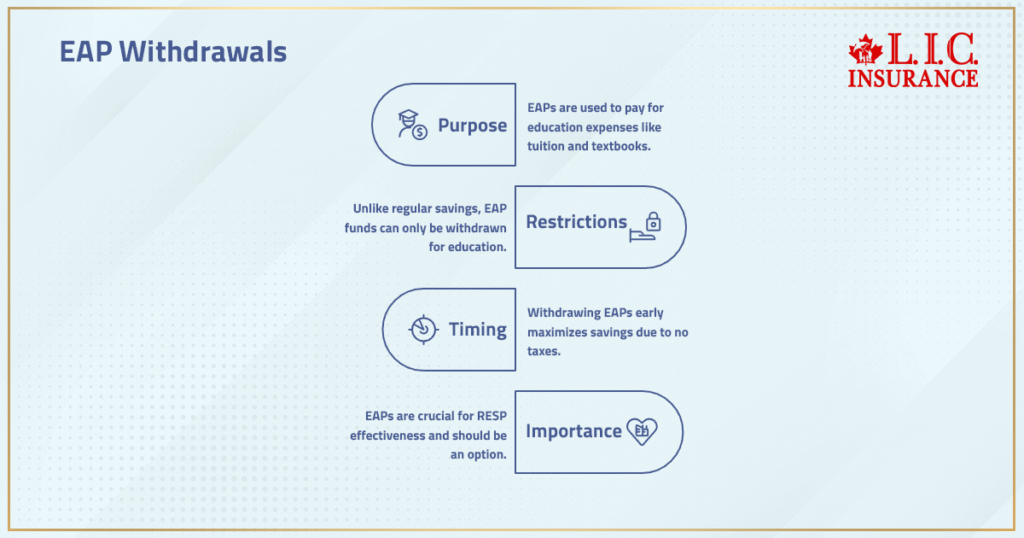
Among all RESP withdrawals, the most significant one is EAPs. They are made up of accumulated savings, which have been achieved through the help of grants provided by the government and growth generated from investments.
The purpose of these withdrawals is to pay for education expenses, such as tuition fees, accommodation fees, and textbook fees, among others. As opposed to money saved in a regular savings account, which can be used however people wish, money saved in a RESP can only be withdrawn in case of education expenses.
There is an important thing about time to consider. Families that withdraw from EAPs at the beginning achieve the most out of their savings. The reason behind this is that the recipient has little money during the first few years of education, thus no tax is paid when withdrawing EAPs.
It needs to be stressed here that EAPs must not be an option. They play a crucial role in a RESP Canada. Without EAPs, the contribution withdrawal becomes ineffective.
CRA Data Table: RESP Structure And Withdrawal Components
| Component | Source | Tax Treatment | Paid To | Purpose |
|---|---|---|---|---|
| Contributions | Subscriber deposits | Withdrawn tax-free | Subscriber | Flexible use |
| Educational Assistance Payments | Grants + earnings | Taxable income | Beneficiary | Education costs |
| Accumulated Income Payments | Earnings (unused) | Tax + penalty | Subscriber | Non-education |
This approach, in line with the guidelines by the Government of Canada, will help ensure that RESP money is spent responsibly, but will also have many financial benefits.
The various parts will play separate roles. The contributions will allow you some flexibility, the EAPs will be able to generate money in a tax-efficient manner, and the accumulated income will represent any unused growth.
RESP Withdrawals: Understanding The Two Categories Clearly
Every withdrawal from an RESP belongs to either of the two categories. The difference between them influences the whole plan for withdrawal.
EAP withdrawals constitute the first category of withdrawals. They include government grants and investments that generate interest. These withdrawals are counted as income of the beneficiary and, thus, taxable. Contributions belong to the second category. It implies that the contribution amount is paid back to the subscriber, and no tax payment is required.
Most people think that withdrawals can be conducted regardless of the above-mentioned categories. Nevertheless, such an approach will only result in inefficiency. Withdrawals of contributions in advance may seem simple, but such withdrawals prevent using EAP funds, whose withdrawal would result in paying fewer taxes.
More efficient withdrawals involve early withdrawals of EAP funds. It helps to utilize grants while the student’s income of the student is minimal.
RESP Withdrawal Rules Every Subscriber Must Know
RESP withdrawal rules are very strict and should be adhered to by the family carefully. If one needs to withdraw money from an EAP, then the beneficiary will have to enroll in a recognized post-secondary institution.
There are certain criteria that the RESP should fulfill according to the federal regulations. The subscriber will have to present proof of enrollment in order to withdraw money from the RESP.
Proof of enrollment may include admission letters, enrollment in courses in the institution, or any other kind of proof. The above-mentioned criteria will ensure that RESPs are utilized for their intended purpose, which is education.
Even though it looks like too much bureaucracy, it protects the system from misuse.
Full-Time Student Vs Part-Time Studies: Impact On EAP Withdrawals
The type of student has a great influence on how the withdrawals should be organized. The one who is studying in a full-time program as a full-time student has better withdrawal rates than the one who is engaged in part-time studies.
In the first 13 weeks of the EAP program, there are some withdrawal limits. They ensure that all payments will take place slowly and in connection with the active education process. Once the
13 weeks pass, limits are raised, allowing for greater flexibility.
Withdrawal limits are lower when it comes to part-time students. It means that the amount of funds available depends on the academic activity and the type of student.
CESG Breakdown Visual: Understanding Government Grants
The Canada Education Savings Grant maximum is a key driver of RESP value. It enhances the impact of contributions and accelerates the growth of education savings.
| Contribution Per Year | CESG Rate | Annual Grant | Lifetime Grant Limit |
|---|---|---|---|
| $2,500 | 20% | $500 | $7,200 |
| Catch-Up Contribution | 20% | Up to $1,000/year | Within limit |
In addition to federal grants, some provinces offer provincial grants, further increasing the value of the RESP. These incentives make RESP one of the most effective Education Savings Accounts available.
How RESP Withdrawals Are Taxed In Canada
Knowing the taxation process of withdrawal from a RESP is important for reducing any expenses. Withdrawal of money from an EAP account will be considered as taxable income; however, it is taxed according to the status of the student.
Since students normally earn very little, the amount of taxes payable by them is usually very small. It is possible to arrange withdrawals from an EAP in a manner that the taxes payable will either be nil or minimal.
Withdrawals made in respect of contributions will never be taxed.
Accumulated Income Payments And What Happens If RESP Funds Are Left Unused
If the child chooses not to attend post-secondary education, then the RESP enters another stage. The interest part will become accumulated income payments that can be withdrawn by the plan holder.
This money is taxed as income, and there might be an extra tax applied as well. It becomes much less effective than withdrawing EAPs from an RESP.
Money sitting idle will decrease the value of the RESP. Parents should seek other solutions, such as switching beneficiaries, rather than letting it come to this point.
Advanced Withdrawal Strategy Scenarios
Practical applications emphasize the significance of withdrawal strategies.
One such practical application entails withdrawing EAPs slowly for many years due to low-income status. This helps maintain tax-efficient income and ensure maximum benefit from government grants.
Another practical example entails balancing withdrawals of EAPs with contributions each year. It enables continuous funding with minimal constraints.
Finally, an ineffective practical application is characterized by delayed withdrawal and contributions only. It may lead to increased taxable income.
The aforementioned practical applications indicate the significance of the time and form of withdrawal.
Planning Withdrawals Strategically For Maximum Benefit
Withdrawal planning should involve ensuring that withdrawal timing matches the finances of the student. This can ensure that as many EAPs are taken advantage of as possible, while taxable income is kept to a minimum.
Strategies include spreading the withdrawal periods over several years, taking advantage of EAPs as soon as possible, and basing withdrawal amounts on enrollment status.
RESP Benefits Beyond Just Education Savings
RESPs are more than just Education Savings Accounts. They combine disciplined saving with structured government support and tax-efficient withdrawals.
The combination of government grants, investment income, and flexible withdrawal options makes the RESP one of the most effective tools for funding education in Canada.
When used correctly, the benefits extend beyond covering costs. They create financial stability during a critical stage of a child’s life.
Final Thoughts: Making RESP Withdrawals Work For Your Child’s Future
RESPs are more than just savings. They are implementing. Knowing what EAP in RESP and properly handling RESP withdrawals can turn a RESP into an effective money management device.
The EAPs are what make the RESP grow, gain grants, and hold the upper hand. When handled right, they lower taxes, increase freedom, and help the child get ready for college.
We believe that the success of a RESP is not determined by how much savings there are, but how well they are managed.
Written By: Harpreet Puri
Licensed Insurance Adviser | MDRT Qualifier
With over 14 years of experience in Life Insurance, wealth planning, and tax-efficient strategies for Canadians.
LinkedIn Profile: https://www.linkedin.com/in/harpreetpuricanadianlic/
Disclaimer: This content is for informational purposes only and does not constitute financial, tax, or legal advice. RESP rules, including RESP withdrawals and Educational Assistance Payments, may change based on updates from the Canada Revenue Agency. Individual outcomes vary depending on the beneficiary’s income, enrollment status, and specific plan details. Consult a qualified advisor or RESP provider before making decisions related to education savings or withdrawals.
FAQs
Certainly, Educational Assistance Payments, EAPs, can be viewed as being among those elements that could constitute part of one’s income for the purposes of financial aid. Some of these programs consider the total income taxes, which are relevant to their eligibility criteria.
EAP withdrawals do not have any maximum amount during a person’s lifetime; however, they are restricted by the income and grants that have been accumulated in the RESP account, and once these run out, only the contribution can be withdrawn.
Yes, withdrawals from an RESP can be deferred based on student requirements and timeframes. But withdrawing from EAPs over extended periods could increase the taxpayer’s income for future years. A better strategy would be to withdraw amounts over several years.
Where a student discontinues his or her post-secondary studies, the RESP contributions may also be temporarily suspended. This does not mean that the student will stop receiving funds; the account can become active once again when the individual enrolls in an eligible program.
Certainly, RESP money may be accessed as long as the organization fits into the definition according to CRA. Many foreign post-secondary schools qualify, as long as certain enrollment conditions are met by the beneficiary. Verification from the RESP is necessary.
In most cases, withdrawing from the RESP does not impact the income tax of the subscriber, as EAPs are taxable to the beneficiary. There may be scenarios, however, where income accumulation payments can result in tax liability for the subscriber.
After contributions have been withdrawn from a RESP, it is usually not possible to redeposit them without impacting the possibility of receiving grants or having access to additional contributions.
A withdrawal from an RESP will help fund approved trades or apprenticeships that qualify for post-secondary funding. In any case, where the child is taking an eligible course, Educational Assistance Payments can be withdrawn for these purposes.
Any Educational Assistance Payments made to the beneficiary will be taxable. Due to the low income levels of the students, the effect of taxation is not very significant. On the other hand, where high Educational Assistance Payments are withdrawn in one year, it is important for payments to be spread throughout several years to mitigate income taxes.
Financial institutions and advisers licensed to provide advice on RESPs also give directions on how one can withdraw money from RESPs. A trustworthy RESP firm will help ensure that all documentation is completed correctly, eligibility criteria are met, and withdrawals are planned accordingly.
Educational Assistance Payments (EAPs), when withdrawn appropriately, should never cause any problems with repaying governmental grants. Improperly withdrawing the funds, such as when the student is not attending school, may lead to repayments being demanded. Adhering to the guidelines regarding RESP withdrawals helps ensure that the maximum amount from the grant is received.
The program must be delivered by an educational institution and satisfy the requirements of the CRA for a qualifying educational program. The person must also be a registered student in the course that will assist them in their post-secondary education, whether at a university, college, or trades program.
Yes, withdrawal from EAP is for educational purposes, which includes accommodation, food, and even travel. If the individual is enrolled in an education program, then these funds will cover any costs that he may incur. It is in this way that RESP becomes a useful tool in education.
There is no set annual limit after the first restriction period, but at the beginning of an EAP, there are limits imposed within the first 13 weeks. Beyond this period, withdrawal depends on the funds in the RESP account, investment returns, and contributions from the government. Planning withdrawals guarantees that EAP amounts match the limits and the student’s requirements.
Sources and Further Reading
- Canada Revenue Agency – Registered Education Savings Plans (RESPs) and payments guide
https://www.canada.ca/en/revenue-agency/services/tax/individuals/topics/registered-education-savings-plans-resps/payments-resp.html - Government of Canada – Paying for education with RESP withdrawals
https://www.canada.ca/en/services/benefits/education/education-savings/paying-education.html - Canada Revenue Agency – RESP detailed guide (RC4092)
https://www.canada.ca/en/revenue-agency/services/forms-publications/publications/rc4092/registered-education-savings-plans-resps.html - Government of Canada – Legal framework for RESP rules and withdrawals
https://laws-lois.justice.gc.ca/eng/regulations/sor-2005-151/FullText.html - Canada Revenue Agency – Tax treatment of unused RESP earnings
https://www.canada.ca/en/revenue-agency/services/tax/businesses/topics/payroll/payroll-deductions-contributions/special-payments/resp-accumulated-income-payments.html - Employment and Social Development Canada – CESG and RESP program details
https://www.canada.ca/en/services/benefits/education/education-savings.html
Key Takeaways
- Educational Assistance Payments (EAPs) are the most valuable part of resp withdrawals, as they include government grants and investment income that support education funding.
- Understanding what EAP in RESP is helps families structure withdrawals in a way that reduces taxable income and improves overall efficiency.
- RESP withdrawals are divided into two categories—EAPs (taxable to the beneficiary) and contributions (withdrawn tax-free)—and using them strategically is essential.
- Following the RESP withdrawal rules, including enrollment in a qualifying educational program and providing proper proof, is required to access funds without issues.
- Proper planning of withdrawals across multiple years allows families to maximize education savings, minimize taxes, and fully benefit from government incentives.
Your Feedback Is Very Important To Us
Please take a moment to share your experience. Your responses help improve guidance around resp withdrawals, Educational Assistance Payments, and overall education savings planning.
IN THIS ARTICLE
- What Role Do EAPs Play In RESP Withdrawals
- What Is EAP In RESP And How It Works
- Educational Assistance Payments EAPs: The Core Of RESP Withdrawals
- CRA Data Table: RESP Structure And Withdrawal Components
- RESP Withdrawals: Understanding The Two Categories Clearly
- RESP Withdrawal Rules Every Subscriber Must Know
- Full-Time Student Vs Part-Time Studies: Impact On EAP Withdrawals
- CESG Breakdown Visual: Understanding Government Grants
- How RESP Withdrawals Are Taxed In Canada
- Accumulated Income Payments And What Happens If RESP Funds Are Left Unused
- Advanced Withdrawal Strategy Scenarios
- Planning Withdrawals Strategically For Maximum Benefit
- RESP Benefits Beyond Just Education Savings
- Final Thoughts: Making RESP Withdrawals Work For Your Child’s Future
Sign-in to CanadianLIC
Verify OTP