- Connect with our licensed Canadian insurance advisors
- Schedule a Call

BASICS
- Is Infinite Banking A Smart Financial Strategy?
- Understanding the Infinite Banking Concept
- Why Infinite Banking Appeals to Canadians Seeking Financial Freedom
- How Infinite Banking Strategy Helps Build Financial Independence
- Challenges and Misconceptions About Infinite Banking
- Who Should Consider Infinite Banking for Financial Freedom?
- How to Start Your Infinite Banking Journey
- Key Advantages of the Infinite Banking Strategy
- A Day-to-Day Struggle: Why More Canadians Are Exploring Infinite Banking
- Potential Drawbacks You Should Know
- The Future of Infinite Banking in Canada
- Is Infinite Banking a Smart Financial Strategy?
COMMON INQUIRIES
- Can I Have Both Short-Term and Long-Term Disability Insurance?
- Should Both Husband and Wife Get Term Life Insurance?
- Can I Change Beneficiaries on My Canadian Term Life Policy?
- What Does Term Life Insurance Cover and Not Cover?
- Does Term Insurance Cover Death?
- What are the advantages of Short-Term Life Insurance?
- Which Is Better, Whole Life Or Term Life Insurance?
- Do Term Life Insurance Rates Go Up?
- Is Term Insurance Better Than a Money Back Policy?
- What’s the Longest Term Life Insurance You Can Get?
- Which is better, Short-Term or Long-Term Insurance? Making the Right Choice
IN THIS ARTICLE
- What is the minimum income for Term Insurance?
- How Does Income Affect Your Term Life Insurance Policy?
- Can You Buy Term Life Insurance Online with a Low Income?
- How Can You Lower Your Term Life Insurance Cost?
- How Much Term Life Insurance Do You Need?
- Can Your Term Life Insurance Policy Be Adjusted Over Time?
- Why Term Life Insurance Is Ideal for Lower-Income Canadians
- Final Thoughts
- More on Term Life Insurance
Is Workplace Disability Insurance Enough In Canada?


By Harpreet Puri
CEO & Founder
- 13 min read
- Nov 24, 2026
SUMMARY
Workplace Disability Coverage can leave major financial gaps for many Canadians, especially higher-income earners and professionals with significant financial obligations. The discussion compares Employer Disability Insurance Policy structures, group Disability Insurance limitations, Long-Term Disability Insurance rules, taxable disability benefits in Canada, and private Disability Insurance options while explaining how additional Disability Insurance Coverage in Canada may strengthen long-term income protection.
Introduction
Canadians tend to believe that Disability Insurance becomes relevant only when issues arise.
This notion tends to shift quite rapidly once any health condition arises and prevents an individual from performing at their job.
We have had the opportunity to interview individuals who invested many years in developing a career path and saving for retirement without even briefly considering whether the Disability Insurance offered at their workplaces provided sufficient coverage if they become ill. The confidence usually comes from seeing Disability Insurance listed inside an employee benefits package. It feels reassuring. The coverage exists, premiums are deducted automatically, and most people naturally assume the protection must be comprehensive.
The reality often looks very different once a Disability Insurance claim begins.
The fact is that more and more Canadians are finding out that Disability Insurance might pay a portion of income, limit its payments, or leave too big an income gap to maintain stability. Some people find out that their benefits will be subject to taxes. Some realize that bonuses are not counted as income when it comes to replacement calculation. Higher-income earners are surprised to find out that they will receive much lower benefits on their disability claims compared to what they actually need.
Such questions are becoming more and more topical in the light of increasing disability claims, especially those related to mental issues.
As it was stated by the Canadian Life and Health Insurance Association, more than 17 billion dollars worth of claims were paid for Canadian residents during the last several years, illustrating how important it is to consider the issue on a national level. As it was reported by Sun Life Financial, in many Canadian workplaces, there are cases when almost 40% of disability claims are related to mental conditions, such as anxiety, depression, and burnout syndrome.
According to Statistics Canada, millions of Canadian citizens of working age are affected by disabilities that impact their ability to work and perform daily tasks. Still, many workers do not know anything about how their company’s disability policy would affect them financially, especially when it comes to income replacement levels, taxable benefits, and disability limits for groups. No longer are anxiety disorders, burnout, and other stress-induced diseases exclusive problems experienced by a select few workers. Rather, they have come to play a major role in the debate over income replacement.
Unfortunately, many employees still lack insight into the mechanics behind their company’s disability coverage policy.
That uncertainty creates an important question.
Is workplace Disability Insurance enough in Canada?
For some employees, workplace plans may provide reasonable protection. For many others, however, important gaps remain hidden until a serious illness or injury exposes them.
What Is Workplace Disability Insurance In Canada?
Workplace Disability Insurance tends to be provided by employers through their benefits packages for their employees. It is often offered on the basis of Group Disability Insurance, where the employer and insurance company reach an agreement. Insurers such as Canada Life, Manulife, Sun Life Financial, RBC Insurance, and Desjardins Insurance offer various kinds of Employer Group Disability Insurance in Canada.
Workplace benefits tend to include at least two types of Disability Insurance programs.
Firstly, there is Short-Term Disability Insurance, which provides a certain portion of income as a supplement to the individual’s salary following their absence due to illness or injury. Secondly, Long-Term Disability Insurance kicks in following a short-term or waiting period. Many employees tend to think that both programs guarantee absolute protection against financial loss.
In truth, however, workplace benefits vary widely among different employers. While some benefit packages tend to have extensive coverage for the employee’s own occupation, others may have a restrictive definition of disability as well as a low percentage of income replacement.
Another detail many Canadians overlook involves taxation.
The total payment made by the employer towards the premium for disability can cause the disability income received to be taxable in the future. When employees make premium payments using post-tax income, the disability income is usually exempt from taxes. This can have a very important impact on the net income one will receive during disability.
Many people seek reviews on their Disability Insurance for professionals because they thought that the Disability Insurance provided by their company would adequately replace their salary, only to find out that the opposite is true.
What Does Workplace Disability Insurance Cover?
Workplace Disability Insurance usually provides partial pay if an individual suffers from an illness or injury that renders him/her unable to go to work. This could be due to various reasons, including cancer therapy, post-surgical complications, chronic disease, back injuries, nervous system issues, and mental health issues such as anxiety and depression.
However, many people in Canada are unaware that their eligibility for Disability Insurance depends on how the policy defines the inability to work rather than the actual diagnosis.
This becomes particularly critical in the case of Long-Term Disability Insurance claims.
While most Employer-Sponsored Disability Insurance Policies start out using the own-occupation test for qualifying as disabled, after a while, Long-Term Disability Insurance Policies may evolve to use an any occupation test. This means that the insurance company will argue that although a worker may not be able to resume his old job, he can do another kind of job.
That transition becomes one of the most disputed areas in Disability Insurance claims across Canada.
The insured professional may be suffering from chronic pain, cognitive exhaustion, or significant mental disability, whereas the insurance company is insisting that he or she has retained the ability to work in some other capacity. For individuals who are already physically and mentally exhausted, the re-assessment procedure can turn out to be particularly difficult.
In British Columbia, the number of technology professionals and telecommuters facing disability issues in connection with mental exhaustion and stress is increasing. In Alberta, industries involving physically demanding conditions, such as construction, transportation, and oil and gas industries, continue to generate disability claims in connection with musculoskeletal disabilities. Professionals in Ontario working in challenging business environments are shocked when they find out that there are income replacement limits on their workplace plans.
It is not just the disability that poses an issue, but also the associated financial insecurity.
Why Many Canadians Overestimate Their Workplace Disability Coverage
A natural inclination exists to believe that Employer-Sponsored Insurance provides a total package since it comes as an automatic entitlement from working for a company. Workers rarely take the time to calculate the extent of financial protection offered by an employer’s insurance policy in cases of extended incapacity.
It is understandable that one should feel this way since Group Disability Insurance is introduced as part of secure employment. The amount deducted might be minimal from the paycheck. The HR department will present a favourable view when introducing the insurance program.
However, Group Insurance Policies are generally designed to achieve wide acceptance rather than personalized financial security.
Most Corporate Disability Plans cover about 60%-70% of pre-disability income. Initially, this may seem like a realistic number. However, in reality, there are a number of key points that start to impact the real income replacement percentage.
The plan might not cover any bonuses. It will exclude commissions entirely. The employee may lose all of their overtime income. Their disability benefits may become taxable based on who makes the payments. Even the monthly disability benefit maximums might limit what an individual makes.
We work with professionals who earn over $100,000 each year and thought that the plan provided by their employer was adequate coverage for their needs in case of disability. After analyzing the policy, however, it became obvious that the income replacement percentage is much lower than one might expect due to the taxation and benefit maximums.
This creates additional risks for employees living in major cities like Toronto or Vancouver.
Does Workplace Disability Insurance Cover Full Salary?
In most situations, no.
This is one of the largest misconceptions surrounding Workplace Disability Insurance Canada Plans.
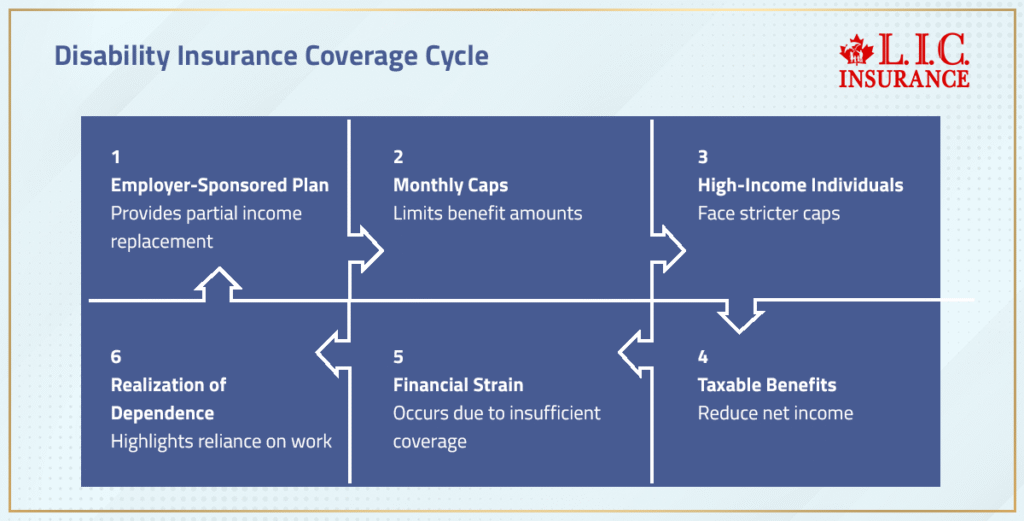
Most Employer-Sponsored Disability Insurance covers only partial replacement of earnings and not total salary continuance. This becomes more relevant when it comes to high-income individuals who are subject to strict monthly caps on benefits through their Employer-Sponsored Plans.
In our case study, we had analyzed the coverage provided by the company for a 43-year-old finance executive from Ontario with a yearly salary of about $165,000 without considering any bonuses. He was under the impression that the Disability Insurance offered by his employer could easily replace most of his employment earnings in case of any illness.
However, after analyzing the Disability Coverage provided, it became clear that there were some issues that should have been highlighted. His Disability Insurance provided only $6,500 per month, annual bonuses were not covered, and the disability benefits were taxable as well since it was paid by the employer.
Situations like this are not unusual.
Most people do not stop paying off mortgages, children’s expenses, cars, investments, and insurance premiums even when they are disabled. This is particularly true in cases where those who earn high incomes have developed a standard of living that is largely dependent on their careers.
Disability Insurance comes in handy at a time like this because one realizes just how much their financial stability was dependent on their ability to work.
The Hidden Weaknesses Inside Group Disability Insurance
One of the biggest weaknesses in Workplace Disability Coverage involves portability.
The majority of Group Disability Insurance Policies continue to be associated with employment. When the employee chooses to retire, change professions, lose employment, or become self-employed, then the coverage might be terminated entirely.
This particular problem becomes of critical importance when health issues start developing subsequently.
For example, a 38-year-old Albertan transportation contractor decided to switch from working at a big company to becoming self-employed after over ten years of experience within the industry. In much the same way as many other Canadians, he expected that Individual Disability Insurance could easily be obtained at a later date if required.
However, less than a year later, he started suffering from severe lower back pain that restricted his capacity to work full-time. The presence of medical symptoms made the process of getting Individual Disability Insurance more challenging.
Another weakness involves the evolving definition of disability itself.
Many Long-Term Disability Insurance Plans start out generous, only to slowly restrict themselves over time. A worker, after initially meeting the criteria for own occupation coverage, could suddenly be re-evaluated against more stringent any occupation criteria. In such cases, continued receipt of benefits might largely hinge on continually being able to provide supporting medical documentation, specialist input, and evaluations by the insurance company.
The field of mental health Disability Insurance has recently gotten more complicated.
Statistics from Sun Life Financial and other top insurance providers continue to reveal growing numbers of mental health-related disability claims in Canada. However, the process for these types of claims has been shown to entail numerous reassessments, paperwork, and proof of ongoing treatment. Individuals with anxiety, depression, post-traumatic stress disorder, or exhaustion have found the process to be very stressful.
For instance, a technology industry worker, aged 35, contacted Canadian LIC upon experiencing extreme exhaustion and anxiety stemming from workplace pressure in British Columbia. Despite having a plan at his workplace that provided for long term disability, the process of filing a claim had become emotionally draining due to the need for updated documentation.
That emotional side of Disability Insurance claims is rarely discussed openly when employees first enroll in workplace plans.
Employer Disability Insurance Vs. Private Insurance Canada
Group Disability Insurance and Private Disability Insurance are typically viewed as essentially the same insurance, when, in reality, the two policies serve completely different purposes.
Company-Sponsored Disability Insurance refers to general Group Insurance Coverage based on active employment. Personal Disability Insurance is tailored for the needs of the insured person and is independently purchased.
This difference impacts all aspects of financial protection.
Personal Disability Insurance remains even if you switch jobs or start a self-owned business. Personal Disability Insurance Policies can often be customized based on your occupation class, preferred benefit period duration, monthly benefits, and a more precise definition of own occupation.
Individual Disability Insurance becomes more important for independent contractors, professionals, entrepreneurs, medical doctors, and executives since they cannot rely entirely on Group Insurance.
There is no need to duplicate the existing policy.
What is needed is to increase the protection against a period of time without earnings due to health issues.
Do I Need Disability Insurance If Covered At Work In Canada?
This question largely depends on the effectiveness of the workplace plan and the financial situation of each individual employee.
Some Canadians will likely have good coverage from their workplace and manageable financial liabilities with a lot of savings. Other people might be at higher risk because, even though they do have Disability Coverage from their workplace, their risks might be too high.
We also like to tell clients not to consider percentages only.
If a household with large mortgage repayments, children’s education costs, debt obligations, and investment obligations finds out that partial income replacement is a burden, then this becomes particularly pertinent for professionals who earn commissions and/or bonuses and are therefore unprotected by the company plan.
High-income individuals might be the most vulnerable to financial ruin since a capping mechanism used in Disability Coverage lowers the percentage of income replaced drastically.
This is not an issue of whether or not Disability Insurance is present in their plan.
It is whether or not such insurance will cover their way of life.
Can Self-Employed Canadians Get Disability Insurance?
Absolutely.
Disability Insurance plays an even greater role in the lives of many self-employed Canadians since there are no safety nets in the form of benefits provided by employers to protect them.
Self-employed professionals like contractors, consultants, incorporated professionals, or owners of businesses need to rely solely on themselves to make money. In case of sickness or injury, not only does their financial security become threatened, but also that of their household members.
Many self-employed individuals feel at first glance that Disability Insurance would cost too much. In truth, however, the prices for Disability Insurance vary based on elements like age, job, health status, waiting period choices, and other factors.
It’s something we do regularly at our office with professionals who are self-employed in Canada.
Government Benefits Rarely Replace Real Financial Stability
Programs such as CPP disability and employment insurance sickness benefits certainly provide important support for many Canadians. However, these programs are rarely designed to replace the full financial structure of middle-income or higher-income households.
The conditions attached to such programs are rather rigorous, too.
Proof that the illness makes it impossible for a person to work must be provided by the patient through medical documentation. In cases where a person qualifies for the benefit, the monthly allowance may prove insufficient compared to the individual’s monthly income from employment.
With mortgage loans, childcare costs, retirement plans, and debt obligations for Canadians, government benefits alone prove insufficient.
When Canadians Contact A Long-Term Disability Lawyer
Not every Disability Insurance claim proceeds smoothly.
Some employees may choose to consult a Long-Term Disability attorney due to certain issues, such as claims denials, termination of benefits, concerns related to surveillance activities, or conflicts associated with medical evidence and the definition of disability.
A major part of these conflicts is related to whether an individual is still unable to work according to the insurer’s interpretation of the policy language.
In such cases, it is absolutely necessary to have strong documentation that will ensure the continued receipt of Long-Term Disability benefits in Canada.
It is strongly advised that you understand your Disability Insurance Policy in detail before filing a claim.
Common Claim Mistakes Canadians Make
Many Disability Insurance claims become more stressful because employees unknowingly make avoidable mistakes during the process.
- Waiting too long to report a Disability Insurance claim after an illness or injury begins.
- Assuming Workplace Disability Coverage automatically protects bonuses, commissions, or self-employed side income.
- Failing to maintain consistent medical treatment and updated medical reports during Long-Term Disability Insurance claims.
- Returning to work too early without understanding how partial disability benefits or Group Disability Coverage rules apply.
- Relying entirely on the Employer Disability Insurance Policy without reviewing monthly benefit caps or taxable disability benefits.
- Ignoring policy wording related to the definition of disability, waiting periods, and benefit period limitations.
- Believing that CPP disability or government benefits alone will provide enough financial protection for long-term financial obligations.
- Not reviewing Disability Insurance Coverage after major life changes such as promotions, mortgages, career changes, or becoming self-employed.
How Canadian LIC Helps Canadians Build Better Income Protection
Disability Insurance is an area that should receive much more consideration within financial planning discussions than it often does.
Many Canadians spend years focusing on investments, mortgages, and retirement savings while overlooking the single asset supporting all those goals: the ability to earn an income.
An Employer-Based Plan might offer some good protection. In certain instances, it might even offer fantastic coverage. Assumptions are dangerous.
We assist Canadians in assessing their existing Disability Coverage from their employers and exploring gaps in income replacement. We compare various Disability Insurance products available from companies like Canada Life, Sun Life Financial, Manulife, RBC Insurance, and Desjardins Insurance.
The objective is not always to replace workplace coverage completely.
Often, it is strengthening the weak points before an illness or injury exposes them unexpectedly.
Final Thoughts
Workplace Disability Insurance could certainly be able to provide protection for employees during difficult times in life. There will definitely be Canadians who already have some form of coverage at their workplace, and it may provide adequate protection for them.
For the majority of other Canadians, however, significant loopholes will continue to exist under the surface.
Taxable benefits, monthly caps, a narrow definition of disability, difficulties in filing mental health claims, and cancellation upon unemployment are just some of the factors that could expose employees to risks that they never realize until their claim process gets started.
The real question is not whether there is Workplace Disability Insurance.
The real issue is whether there really is adequate coverage protecting one’s financial well-being if one suddenly is unable to earn a living.
Written By: Harpreet Puri
Licensed Insurance Adviser | MDRT Qualifier
With over 14 years of experience in Life Insurance, wealth planning, and tax-efficient strategies for Canadians.
Disclaimer:
The information provided above is for general educational purposes only and should not be considered legal, tax, medical, or financial advice. Disability Insurance Coverage, benefit periods, definitions of disability, and eligibility rules vary by insurer, province, employment contract, and policy wording. Readers should consult a licensed insurance advisor or qualified professional before making decisions regarding Disability Insurance Plans or financial protection strategies in Canada.
FAQs
Yes, at times, workplace Disability Insurance can be modified through changes in the insurance companies utilized by the employer or through restructuring of the company’s benefits package. At times, employees may realize that they have been affected without realizing the full impact on their financial security.
It can. Certain Disability Insurance Policies measure eligibility and the amount of monthly disability benefit based on average employment earnings or minimum working hours prior to becoming disabled. Individuals who are shifting to part-time positions need to learn how their part-time position may impact their disability benefits eligibility in Canada.
Indeed. Most insurance firms provide an opportunity to make an appeal in their internal system. Here, one can present extra medical information, the opinion of specialists, or new medical reports before turning to legal actions. Good documentation always plays a significant role in such cases.
Certainly. Occupation class is a significant factor in determining Disability Insurance premiums in Canada. Workers who work in occupations requiring physical activity, like construction, transportation, and oil and gas, will have a separate rate from workers in white-collar occupations due to their higher chance of disability claims.
Some Disability Insurance Plans for employers exclude temporary, seasonal, or contractual employees from coverage, while some others require waiting periods prior to providing coverage through Disability Insurance. Canadians on employment contracts that are only valid for a short time should never take their Group Insurance for granted.
Absolutely, and the problem is more obvious with extended disability cases. There are Disability Insurance Policies that have built-in cost-of-living increases, but this feature is lacking in most employee programs. The end result is that the buying power of the monthly payments may dwindle away over time.
Some Disability Insurance Policies will continue paying benefits even if the patient receives medical care and treatment abroad; however, some requirements must be met according to the insurance provider and specific terms of the policy. Employees need to check for any such restrictions before travelling outside of Canada.
Many individuals opt for additional Disability Insurance to provide themselves with better income stability without being tied to their job. The desire to change careers, career progression, increasing responsibilities, and fear of becoming uninsurable often prompt individuals to buy private Disability Insurance while they are young and healthy.
Canadians often look into individual Disability Insurance after becoming aware that their Workplace Disability Coverage will not be adequate to cover their needs over time. Individual coverage allows for better protection from income loss, as well as higher monthly payments, and also offers more comprehensive coverage than most group plans for professionals.
Workplace plans generally cater to employees in general terms, whereas private Disability Insurance Plans are made specifically in relation to one’s job, income, and financial security needs. Individual Disability Insurance Plans continue to be valid even if a person changes his/her jobs, which cannot be said of workplace Disability Insurance Plans.
In many instances, high-income individuals find that Group Disability Coverage covers a far smaller portion of their income than they originally anticipated due to taxable payments and monthly limits. Individuals who have larger mortgages, investments, and/or salaries that fluctuate need supplemental disability coverage in order to ensure financial security in the event of disability.
Yes, many Canadians combine Workplace Disability Coverage with individual Disability Insurance to strengthen overall income replacement protection. This approach is common among business owners, incorporated professionals, and employees who want financial protection that remains independent of their employer or workplace plan.
Sources and Further Reading
- Canadian Life and Health Insurance Association (CLHIA) — Industry data, Disability Insurance trends, and Canadian life & health insurance statistics. (clhia.ca)
- Government of Canada – Disability Insurance Information — Official overview of Disability Insurance Coverage, income replacement percentages, and eligibility basics in Canada. (Canada)
- Sun Life – Disability Insurance Overview — Information about Disability Insurance, income protection, and Employer Disability Insurance Coverage. (Sun Life)
- Sun Life – Long-Term Disability Claim Trends Report — Canadian long term Disability Insurance trends, including rising anxiety and depression-related claims. (Sun Life)
- Sun Life – Chronic Conditions And LTD Claims Report — Research discussing the growing complexity of long-term disability benefits claims in Canada. (Sun Life)
- Canada Pension Plan (CPP) Disability Benefits — Official CPP disability eligibility rules, application details, and government benefits information.
- Sun Life – Mental Health And Long-Term Disability Trends — Coverage of Canadian mental health-related long-term disability claims and workplace disability trends. (Benefits and Pensions Monitor)
- CLHIA – A Guide To Disability Insurance — Consumer-focused information explaining individual Disability Insurance and Group Disability Coverage in Canada. (clhia.uberflip.com)
Key Takeaways
- Workplace Disability Coverage may provide valuable income protection, but many Employer Disability Insurance Policies replace only part of regular employment income during long-term disability.
- Group Disability Insurance Plans often contain monthly benefit caps, taxable disability benefits, and restrictive definitions of disability that employees may overlook until a Disability Insurance claim begins.
- Mental health conditions such as anxiety, burnout, and depression now represent a growing share of Long-Term Disability Insurance claims across Canada.
- Higher income earners, incorporated professionals, business owners, and self-employed Canadians frequently face larger financial gaps because workplace plans may not fully protect bonuses, commissions, or lifestyle-related financial obligations.
- Private Disability Insurance can help strengthen income protection by providing more flexible Disability Insurance Coverage that remains independent of an employer or workplace plan.
- CPP disability and other government benefits may provide partial support, but they rarely replace enough employment income to maintain long-term financial stability comfortably.
- Reviewing existing Group Disability Coverage before a medical issue arises can help Canadians identify weaknesses in benefit periods, income replacement levels, and overall financial protection strategies.
Your Feedback Is Very Important To Us
Tell Us About Your Disability Insurance Concerns
Canadian LIC is gathering insights to better understand the real financial and emotional challenges Canadians face with Workplace Disability Coverage, Long-Term Disability Insurance, and income protection planning.
Your feedback may help us create better educational resources and Disability Insurance solutions for Canadians.
Thank You For Your Feedback!
A Canadian LIC advisor may contact you if you request a complimentary review of your Critical Illness Insurance Coverage and protection options.
IN THIS ARTICLE
- Is Workplace Disability Insurance Enough In Canada?
- What Is Workplace Disability Insurance In Canada?
- What Does Workplace Disability Insurance Cover?
- Why Many Canadians Overestimate Their Workplace Disability Coverage
- Does Workplace Disability Insurance Cover Full Salary?
- The Hidden Weaknesses Inside Group Disability Insurance
- Employer Disability Insurance Vs. Private Insurance Canada
- Do I Need Disability Insurance If Covered At Work In Canada?
- Can Self-Employed Canadians Get Disability Insurance?
- Government Benefits Rarely Replace Real Financial Stability
- When Canadians Contact A Long-Term Disability Lawyer
- Common Claim Mistakes Canadians Make
- How Canadian LIC Helps Canadians Build Better Income Protection
- Final Thoughts
Sign-in to CanadianLIC
Verify OTP