- Connect with our licensed Canadian insurance advisors
- Schedule a Call

Basics
Common Inquiries
BASICS
- Is Infinite Banking A Smart Financial Strategy?
- Understanding the Infinite Banking Concept
- Why Infinite Banking Appeals to Canadians Seeking Financial Freedom
- How Infinite Banking Strategy Helps Build Financial Independence
- Challenges and Misconceptions About Infinite Banking
- Who Should Consider Infinite Banking for Financial Freedom?
- How to Start Your Infinite Banking Journey
- Key Advantages of the Infinite Banking Strategy
- A Day-to-Day Struggle: Why More Canadians Are Exploring Infinite Banking
- Potential Drawbacks You Should Know
- The Future of Infinite Banking in Canada
- Is Infinite Banking a Smart Financial Strategy?
COMMON INQUIRIES
- Can I Have Both Short-Term and Long-Term Disability Insurance?
- Should Both Husband and Wife Get Term Life Insurance?
- Can I Change Beneficiaries on My Canadian Term Life Policy?
- What Does Term Life Insurance Cover and Not Cover?
- Does Term Insurance Cover Death?
- What are the advantages of Short-Term Life Insurance?
- Which Is Better, Whole Life Or Term Life Insurance?
- Do Term Life Insurance Rates Go Up?
- Is Term Insurance Better Than a Money Back Policy?
- What’s the Longest Term Life Insurance You Can Get?
- Which is better, Short-Term or Long-Term Insurance? Making the Right Choice
IN THIS ARTICLE
- What is the minimum income for Term Insurance?
- How Does Income Affect Your Term Life Insurance Policy?
- Can You Buy Term Life Insurance Online with a Low Income?
- How Can You Lower Your Term Life Insurance Cost?
- How Much Term Life Insurance Do You Need?
- Can Your Term Life Insurance Policy Be Adjusted Over Time?
- Why Term Life Insurance Is Ideal for Lower-Income Canadians
- Final Thoughts
- More on Term Life Insurance
Group vs Individual Critical Illness Insurance Coverage


By Harpreet Puri
CEO & Founder
- 13 min read
- Nov 11, 2026
SUMMARY
Group Critical Illness Insurance and Individual Critical Illness Insurance each offer unique advantages for Canadians seeking financial protection after a serious illness. Coverage differences, portability, critical illness payout Canada options, Critical Illness Insurance cost factors, critical illnesses covered, Critical Illness Insurance claims, and income protection after illness are examined to help individuals evaluate personal vs Workplace Critical Illness Coverage and build stronger financial security through appropriate Critical Illness Insurance Coverage.
Introduction
Life tends to take unexpected turns. A simple visit to a doctor for a checkup can end up diagnosing you with an illness that not only impacts your health but also your finances, your stability at home, and your life plans. While most Canadians know how important health insurance is, few truly realize the financial impact that such an illness can cause.
In our work, we encounter many people who think that having workplace health coverage is sufficient; if they need treatment for a critical illness, they may have to.
It needs to be known, however, that serious illnesses still happen in Canada frequently. As per the Canadian Cancer Society, almost two out of every five Canadians develop cancer at some point in their life. At the same time, the Heart and Stroke Foundation keeps raising awareness about heart diseases and stroke being significant contributors to hospital stays and disabilities.
Although the Canadian health care system provides access to several medical procedures, it cannot cover losses of earnings, domestic bills, transportation fees, medications, and several other financial implications of becoming ill. That is why Critical Illness Insurance Canada has emerged as one of the essential parts of modern financial planning.
One of the most common questions that people ask regarding Critical Illness Insurance in Canada has to do with whether group Critical Illness Coverage provided by employers is sufficient or if individuals need to acquire their own coverage as well.
What Is Critical Illness Insurance And Why Does It Matter?
A Critical Illness Policy ensures that a one-time, tax-free lump sum payment is made upon diagnosis of a covered critical illness, as detailed in the insurance policy documents.
In contrast to disability insurance, where the payments are meant to replace lost wages via monthly payments, a critical illness policy covers the client with a lump sum payment. The payment can then be used by the client in whatever manner they wish.
As we have always said, the best thing about Critical Illness Insurance is the element of choice. These payments do not have to go towards paying off the bills incurred due to treatment. While some clients may use the lump sum payments to make their mortgages while recovering, others choose to use them to reduce debts and meet other needs.
When someone is suffering from a critical illness, more than just their health is affected. This includes how their work and home lives are affected as well. With this in mind, having a lump sum payment gives some peace of mind.
Understanding Group Critical Illness Insurance Coverage
Group Critical Illness Insurance is typically offered through an Employee Benefits Plan in Critical Illness Coverage programs. Employers may provide this protection as part of a benefits package or allow employees to purchase optional Critical Illness Insurance through payroll deductions.
Many Canadian employers obtain coverage through insurers such as Canada Life, Manulife, Sun Life, and other major insurance providers.
For employees, group plans can be attractive because enrollment is often straightforward. Coverage may be available with limited medical questions and sometimes without medical exams altogether. This simplicity makes workplace plans accessible to many Canadians who might otherwise postpone purchasing illness insurance.
Advantages Of Group Critical Illness Insurance
Group plans offer several advantages that make them appealing to employees.
- Simplified Qualification – Many plans require minimal underwriting, making coverage easier to obtain.
- Lower Premiums – Because risk is shared across a larger group, premiums are often lower than individually purchased coverage.
- Convenient Payroll Deductions – Payments are automatically deducted from earnings, making administration simple.
- Immediate Workplace Access – Employees can often enroll during benefit enrollment periods without extensive paperwork.
Limitations Of Group Critical Illness Insurance Coverage
While workplace coverage can be valuable, it is not always comprehensive.
- Coverage May End With Employment – Leaving an employer may result in losing coverage altogether.
- Lower Benefit Amounts – Many plans offer relatively modest lump sum benefits.
- Limited Customization – Employees generally have fewer coverage options than individual policyholders.
- Reduced Portability – Coverage typically remains tied to employment status.
At Canadian LIC, portability is one of the biggest concerns we discuss with clients. Many Canadians spend years relying on workplace benefits without considering what happens if they change jobs, become self-employed, or retire earlier than expected.
Understanding Individual Critical Illness Insurance Coverage
Individual Critical Illness Insurance is one that is personally taken out and is wholly owned by the insured person. It differs greatly from workplace plans in the sense that it does not become void when an individual changes jobs. As long as premium payments are made on time, the insurance stays valid.
Such ownership makes a huge difference compared to corporate Critical Illness Insurance plans. This is because individual insurance covers the individual regardless of what company he or she works for.
Portability is a very common concern among many people, such as professionals, business owners, and families, because they seek to benefit from their plans even in the future.
Coverage amounts can vary widely, starting from $25,000 to hundreds of thousands.
Advantages Of Individual Critical Illness Insurance Coverage
Individual policies provide several important advantages.
- Full Ownership – The policy belongs to the insured person, not an employer.
- Portable Protection – Coverage remains active regardless of career changes.
- Higher Coverage Limits – Individuals can often purchase significantly larger benefit amounts.
- More Coverage Choices – Policy features, riders, and benefit structures can usually be customized.
Potential Drawbacks Of Individual Critical Illness Insurance
Individual coverage also comes with considerations.
- Medical Underwriting – Applicants may need to complete health questionnaires or medical exams.
- Higher Premiums – Costs are often higher than comparable group plans.
- Longer Application Process – Approval may require additional documentation and review.
Despite these factors, many Canadians value the long-term financial flexibility that individual coverage offers.
Group Benefits Vs Individual Insurance: A Side-By-Side Comparison
This comparison illustrates why many financial advisors encourage Canadians to view group coverage as a foundation rather than a complete solution.
Critical Illnesses Covered Under Most Critical Illness Insurance Policies
Even though no two insurance policies are identical, many Critical Illness Insurance Policies offer coverage for a number of similar serious diseases.
For instance, cancer coverage is one of the most commonly found forms of Critical Illness Coverage in Canada. Cancer patients often face months of recovery, which may involve lengthy absences from work and considerable lifestyle changes.
Another commonly found form of Critical Illness Coverage in most policies includes heart attack coverage. There continue to be thousands of heart attacks in Canada per year, making it a challenging experience for all affected individuals.
Additionally, stroke, multiple sclerosis, organ failure, and limb loss are among other covered critical illnesses included in most policies. Moreover, some companies started to expand their coverage by adding childhood conditions and other illnesses.
However, we strongly advise clients to review the definition of critical illnesses offered since there may be vast differences between insurers.
Critical Illness Insurance Benefits Extend Far Beyond Medical Bills
It is a common misconception for many Canadians that the sole purpose of Critical Illness Insurance is to pay for treatment expenses. The reality is that the financial ramifications of being ill can go beyond that point.
As an example, even if someone has been diagnosed with an illness covered under their policy, other responsibilities do not cease to exist. Monthly mortgage payments are still made. Utility bills need to be paid. And children still have needs.
Our experience with clients has shown us cases where our policyholders use their lump-sum payout to stabilize their home front while focusing on their recovery, paying down debt, getting temporary help, modifying their residence, or seeking treatment options outside of provincial programs.
In essence, the true benefit of receiving a lump-sum payment comes in the form of freedom to spend it as one chooses.
Income Protection After Illness And The Financial Security Gap
One of the most common myths in terms of insurance planning is that both disability insurance and Critical Illness Insurance perform the same function.
Despite being beneficial, the two insurance products are different from one another and offer different advantages.
The former type of insurance compensates for the loss of income if one is unable to work. On the other hand, the latter type of insurance offers a lump sum payment after a diagnosis of a particular condition or disease.
For instance, let us consider the case of an individual making an annual income of $120,000. After getting diagnosed with cancer, this individual would be eligible for some amount of compensation; however, they would have additional expenses such as travel, caregiver services, and more.
We often see these insurance products as complementing each other.
Critical Illness Insurance Claims Process In Canada
Knowledge of how a Critical Illness Insurance claims process works would be able to eliminate any form of uncertainty in the event that one needs to file a claim.
Usually, the process starts when a physician validates a covered critical illness in a claimant. Once validated, the person files their documentation in accordance with their insurance company.
In a majority of the policies, there is usually what is referred to as the survival period, whereby the claimant must survive for a specified period after the diagnosis to qualify for payment. Usually, this period is 30 days, but it varies in accordance with the particular insurance company.
After evaluation, the insurance company pays out the lump sum amount as required by their policy.
In most cases, the payments received under such an arrangement are usually tax-free.
Critical Illness Insurance Cost In Canada
The Critical Illness Insurance cost depends on several factors, including age, health status, smoking history, family medical history, coverage amount, and policy design.
Younger applicants often qualify for lower premiums because they generally present lower risk. As age increases, premiums typically rise to reflect increased health risks.
The following examples illustrate general market ranges.
Actual pricing varies by insurer, medical history, and policy structure. At Canadian LIC, obtaining a Critical Illness Insurance quote online allows individuals to compare multiple insurance providers and identify suitable coverage options based on their specific circumstances.
How To Choose The Right Critical Illness Insurance Plan
When selecting the proper critical illness policy, cost should not be the main deciding factor. The question that should be asked is how such an illness will impact one’s finances in general.
A person who has plenty of money saved up and is not responsible for any dependents might require a different approach from a family with children to care for and a large mortgage to pay off. Existing benefits at the place of work, liabilities, expenses, and financial future must be taken into account.
We advise our clients to concentrate on financial implications as opposed to premiums alone. Not only do we want our clients to buy the proper insurance, but we also want their insurance to make a difference.
Eligibility Requirements For Critical Illness Insurance In Canada
Eligibility criteria differ from one insurer to another; however, almost all insurers consider the same criteria while processing their applications.
The age of applicants usually serves as the first criterion. Critical Illness Insurance Canada can be purchased by anyone between the ages of 18 and 65 years old, although there are cases where the range is extended.
Following age, insurance companies assess the medical history of applicants along with their family histories, lifestyles, and health conditions.
Some individuals meet the criteria through filling out basic health questionnaires, while others require a medical examination based on the requested coverage. The smoker’s status, medications taken, surgical procedures undergone, and even medical diagnostic reports can determine eligibility.
We normally inform our clients that early application gives more choices and allows individuals to pay cheaper rates since they do not have any health issues at the time. Postponing the purchase of insurance until health problems arise can reduce one’s choices and increase premium rates.
Pre-existing conditions should also be considered when applying for insurance. This does not necessarily mean that individuals with a disease cannot be insured; in fact, there are Canadian companies that provide good coverage even when people have suffered from diseases before.
How Much Coverage Is Enough?
One of the most frequent inquiries we have involves how much Critical Illness Insurance Coverage an individual should have.
There is no absolute figure since financial responsibilities vary by household. But it’s always beneficial to estimate the extent of the possible financial repercussions of being afflicted with a critical illness within one or two years of getting diagnosed.
Suppose you are a family with a mortgage of $600,000, two kids, and two sources of income. If one member gets critically ill and needs to recover, you will experience losses such as decreased income, transportation expenses, and childcare fees, among others.
The benefit that may be paid out is $25,000, which may offer some form of help, but doesn’t necessarily mean there is financial flexibility in the future. However, receiving more money, like $100,000 or even $250,000, can be financially flexible as the family can concentrate on recovering instead of focusing on finances.
We usually advise our clients not to look only at medical costs, but more into how to survive financially in general.
Why Portability Matters More Than Many Canadians Realize
While starting out with a plan offered by the workplace, portability is the least of anyone’s worries.
That is because people tend to think that they will stick around at the workplace for several years.
But career paths do not always follow a straight line.
People lose jobs. They become independent consultants. They start companies of their own or become self-employed. People even leave their workplaces early due to health issues or family responsibilities.
It is in such scenarios that Critical Illness Insurance Canada solutions come into play.
With personal insurance, the coverage stays with the individual despite any changes in their professional life. It doesn’t get influenced by the insurance offered through the employer or by future workplace decisions.
We have had several cases where our clients lost their job and realized that the good cover they had at their old firm did not extend to them anymore.
The problem worsened because health issues may have crept up and made securing new coverage difficult.
Real Canadian LIC Client Scenario: When Group Coverage Was Not Enough
A few years back, one of our clients was a man in his early forties who worked for a big company in Canada.
Like any other individual working somewhere else, he was under the impression that he could have the best coverage from his job in case anything went wrong. He was given a Group Critical Illness Insurance package with an insured benefit of $25,000.
But, to his dismay, he contracted cancer.
At first, it did him well financially speaking. It gave him a lump sum that eased some stress. But his recovery took longer than he thought. He missed work more often than before. Expenses grew.
He had to travel to attend doctors’ consultations. Households’ needs were there to fulfill. Monthly mortgage payments had to be made on time. Not all treatment costs were met elsewhere.
Fortunately, he had purchased an Individual Critical Illness Insurance Policy several years earlier through Canadian LIC. That policy provided an additional six-figure lump sum benefit.
This combination proved to be instrumental in improving the fortunes of the family financially. Instead of worrying about debts and monthly expenses during their period of recuperation, the family was now able to concentrate on their health.
Incidents such as these serve to demonstrate why it is a risky strategy to rely solely on occupational insurance programs.
Common Mistakes Canadians Make When Choosing Critical Illness Coverage
One of the biggest mistakes we see is assuming that a workplace plan provides complete protection.
Most individuals do not calculate their maximum coverage amount under their group coverage plans. The individual knows they are covered, but does not understand how much coverage would help their family if they faced a critical illness.
The other problem we see a lot is when individuals delay getting their coverage. They know that at some point in time they will need coverage but are too healthy to get covered now.
A third mistake people make is undervaluing the effect that having a covered illness has financially. The individual sees the expense of the illness and overlooks the loss of income, travel, caregiver costs, and regular expenses at home.
The other mistake individuals make is looking only at the cost of the insurance versus its benefits. The lowest costing policy does not necessarily mean it provides the best coverage if you file a claim.
Finally, individuals forget about the problem of portability until after leaving their job.
Should You Choose Group Coverage, Individual Coverage, Or Both?
And the answer will depend to a great extent on your personal situation.
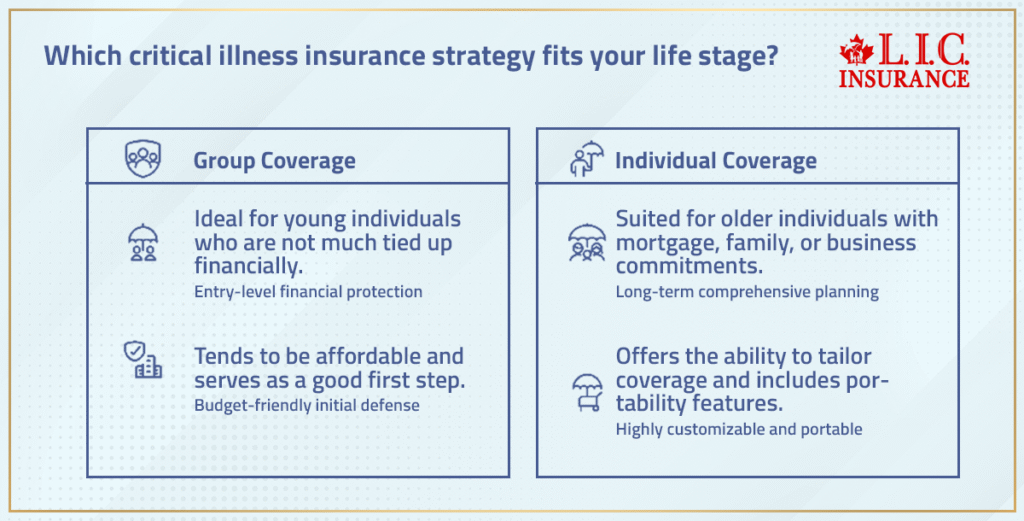
If you are young and not much tied up financially, then group Critical Illness Coverage might serve as a good first step. Group workplace cover tends to be affordable and could help you create your first line of defence.
If you are older and/or are tied up financially through a mortgage or family or business commitments, then individual critical illness cover might make more sense in the long run. The ability to tailor insurance coverage, as well as having portability features, could work to your advantage.
Very often, we see that the most effective approach is neither of those options separately, but rather combining the two into a package.
Workplace coverage would form a basic line of defence. Individual coverage would provide supplementary coverage if needed.
This approach usually provides a better level of protection than using one option only.
Why Canadian LIC Often Recommends A Layered Protection Strategy
The effectiveness of an insurance strategy depends on how many pieces come together.
Health insurance allows one to pay for medical expenses. The disability plan can assist with replacing one’s lost earnings. Critical Illness Insurance ensures easy access to cash flows in hard times. Life insurance assists family members after one’s death.
Each of them protects people from particular risks.
If Critical Illness Insurance is considered as part of a financial plan, then it is possible to understand its purpose. The objective is not the receipt of a cash flow at all, but the ability to maintain stability in case of any unforeseen event.
In most cases, we advise clients to consider themselves from a broader perspective than just at the current moment. As people’s careers and families grow, mortgages and other expenses increase.
Thus, a properly designed Critical Illness Insurance strategy must also adapt to such a situation.
Final Thoughts
When it comes to the question of Group vs. Individual Critical Illness Insurance, we are not trying to decide which one is the best overall. The real issue is which approach best serves your personal interests going forward.
Group Critical Illness Insurance provides savings, simplicity, and accessibility via employer-sponsored benefits programs. Individual Critical Illness Insurance provides the benefits of flexibility, ownership, tailoring, and higher potential payout.
Both methods of coverage can be highly beneficial when used within the context of a complete financial strategy.
We have witnessed firsthand the positive impact that a Critical Illness Payout Canada benefit can have for individuals who were able to manage their finances through some difficult times. We have also seen cases where a lack of appropriate coverage resulted in avoidable financial problems due to insufficient planning.
A serious illness may be unpredictable, but the financial impact does not have to be.
Whether you are reviewing an existing Employee Benefits Plan in Critical Illness Coverage or considering a personal policy for the first time, understanding your coverage options today can make a significant difference tomorrow. The right Critical Illness Insurance Coverage can provide financial flexibility, protect your family’s future, and allow you to focus on what matters most—recovery and peace of mind.
Author: Harpreet Puri, Licensed Insurance Adviser | MDRT Qualifier
Experience: 14 Years In Life Insurance & Financial Planning
LinkedIn Profile:https://www.linkedin.com/in/harpreetpuricanadianlic/
Disclaimer:
This content is provided for general informational purposes only and should not be considered financial, insurance, tax, or legal advice. Critical Illness Insurance Coverage, eligibility requirements, premiums, exclusions, and benefits vary by insurer and policy. Consult a licensed insurance advisor to assess your individual needs and review available coverage options before making any insurance decisions.
FAQs
If a member of the family cuts back on working hours in order to look after someone suffering from an illness, the family will have unexpected losses in income. The amount paid in one single payment will ensure that the family still has money despite the cutbacks.
Most Critical Illness Insurance Canada companies might accept medically approved documentation in support of an insured illness from doctors who are qualified to practice medicine in other nations. This will depend on the terms of the contract since different insurance companies have varying criteria for coverage claims.
Some companies still offer coverage for Critical Illness Insurance even beyond one’s prime working years, but the conditions and policies of such insurance would vary. Illness insurance serves as an extra precaution for retirees against unforeseen costs associated with their health care.
While in many cases a critical illness benefit that is received tax-free would not automatically disqualify a person from health benefits provided by the government in Canada, people claiming income-tested benefits would need to check if their benefit would affect their other benefits.
Claim problems can occur just like in any other insurance claim due to the lack of compliance with the contract definition and conditions. Some situations that may pose difficulties include a diagnosis that does not match the description of a medical problem outlined in the insurance contract.
Insurers create insurance plans according to their underwriting philosophy and needs. While some insurance plans for critical illness cover fewer diseases than other plans, other critical illness policies cover more diseases through broader definitions of those diseases.
Canadian residents rely on their pension plans as a financial buffer against emergencies. The payout from Critical Illness Insurance will help pay for unforeseen expenses incurred after suffering from any critical illness without requiring withdrawals from the investment fund.
The amount of money provided by the insurance plan may be sufficient for use in emergencies several years ago, but is now insufficient due to an increase in health costs, mortgage amounts, and other rising costs of living.
A number of companies will permit their policyholders to apply for further coverage of Critical Illness Insurance in the coming years. This is conditional upon age, health issues, and changes in underwriting policies. It is advisable that one reviews his or her coverage periodically.
A stay-at-home parent, without any source of income from work, still makes valuable contributions within the family. The occurrence of a critical illness may lead to additional costs such as child care costs, transport costs, and household expenses.
Many business owners purchase illness insurance to help protect operations during a serious illness. A lump sum benefit may assist with hiring temporary management, maintaining cash flow, or covering business-related financial obligations while the owner focuses on recovery.
Some Critical Illness Insurance Policies include partial benefit provisions for certain early-stage conditions. These benefits are typically smaller than the full lump sum payout but may provide financial assistance when a condition is diagnosed before reaching an advanced stage.
Many insurers offer Critical Illness Insurance Canada solutions to permanent residents and newcomers who meet eligibility requirements. Available coverage options may vary depending on residency status, medical history, and the insurer’s underwriting guidelines.
Couples often assume one policy is sufficient, but a serious illness can affect each spouse differently. Separate Critical Illness Insurance plans allow each insured person to maintain individual coverage and financial flexibility if a covered illness occurs.
In some situations, a lump sum payment can help individuals access private assessments, travel for treatment, or explore additional treatment options while waiting for certain medical services. This flexibility is one reason many Canadians value Critical Illness Insurance Coverage.
Most Critical Illness Insurance Policies are designed primarily for protection rather than investment growth. However, some plans may offer return-of-premium features that allow policyholders to recover a portion of premiums under specific circumstances.
A serious illness can influence income stability and overall financial circumstances, which lenders may consider during borrowing decisions. Having Critical Illness Insurance benefits available may help individuals maintain financial stability during periods of medical recovery.
Higher-income households typically have larger financial obligations, including mortgages, business responsibilities, education funding goals, and lifestyle expenses. A larger lump sum benefit can help preserve financial security while protecting long-term wealth-building strategies.
In certain situations, a spouse, parent, or business partner may have an insurable interest and be able to obtain coverage on another individual. The application process generally requires consent from the insured person and compliance with insurer requirements.
While Critical Illness Insurance is primarily designed for living benefits, preserving personal savings during a serious illness can indirectly support long-term estate objectives. Avoiding large withdrawals from investments may help protect assets intended for future generations.
The answer depends on the type of Critical Illness Insurance plan selected. Some policies offer guaranteed premiums for the life of the contract, while others may have rates that change at specified intervals. Understanding the premium structure is an important part of selecting coverage.
Yes. A health spending account may help cover certain eligible medical expenses, while Critical Illness Insurance provides a tax-free lump sum benefit that can be used for a much wider range of financial needs, including non-medical expenses.
Marriage, home purchases, business ownership, and the birth of children often increase financial obligations. Reviewing Critical Illness Insurance Coverage after major life changes helps ensure protection remains aligned with evolving financial responsibilities and future goals.
Sources and Further Reading
Canadian Cancer Society – Cancer Statistics In Canada
https://cancer.ca/en/research/cancer-statistics
Heart And Stroke Foundation – Heart Disease And Stroke Statistics
https://www.heartandstroke.ca/what-we-do/heart-disease-and-stroke-statistics
Canadian Life And Health Insurance Association (CLHIA) – Understanding Critical Illness Insurance
Financial Services Regulatory Authority Of Ontario (FSRA) – Insurance Consumer Information
https://www.fsrao.ca/consumers/insurance
Canada Life – Critical Illness Insurance
https://www.canadalife.com/insurance/critical-illness-insurance.html
Manulife – Critical Illness Insurance
https://www.manulife.ca/personal/insurance/critical-illness-insurance.html
Sun Life – Critical Illness Insurance Coverage
https://www.sunlife.ca/en/insurance/health-insurance/critical-illness-insurance/
Desjardins Insurance – Critical Illness Insurance
https://www.desjardinslifeinsurance.com/en/critical-illness-insurance.html
iA Financial Group – Critical Illness Insurance
https://ia.ca/individual-insurance/critical-illness-insurance
Equitable Life Of Canada – Critical Illness Insurance
https://www.equitable.ca/en/our-products/critical-illness-insurance/
Beneva – Critical Illness Insurance
https://www.beneva.ca/en/insurance/critical-illness-insurance
Key Takeaways
- Group Critical Illness Insurance provides convenient workplace protection, but coverage amounts, portability, and customization options are often limited compared to individual plans.
- Individual Critical Illness Insurance offers long-term ownership, portable Critical Illness Insurance Canada benefits, and greater flexibility to tailor coverage around personal financial obligations.
- A critical illness payout Canada benefit can help cover much more than medical expenses, including mortgage payments, household bills, caregiving costs, and income gaps during recovery.
- Critical illnesses covered under most policies commonly include cancer, heart attack, stroke, multiple sclerosis, and major organ failure, although definitions and coverage vary by insurer.
- Critical Illness Insurance and disability coverage serve different purposes. One provides a lump sum payment after a covered illness, while the other typically replaces a portion of lost income over time.
- Relying solely on Group Critical Illness Insurance may leave coverage gaps if employment changes or workplace benefits are reduced in the future.
- The cost of Critical Illness Insurance depends on factors such as age, health conditions, medical history, smoking status, and the amount of coverage selected.
- Reviewing coverage regularly is important because growing families, larger mortgages, career changes, and rising living costs can increase the financial impact of a serious illness.
- Many Canadians find that combining workplace coverage with Individual Critical Illness Insurance creates a stronger financial safety net than relying on either option alone.
- The right Critical Illness Insurance plan can provide financial security, flexibility, and peace of mind, allowing individuals and families to focus on recovery rather than financial pressures after a serious illness.
Your Feedback Is Very Important To Us
Thank You For Your Feedback!
A Canadian LIC advisor may contact you if you request a complimentary review of your Critical Illness Insurance Coverage and protection options.
IN THIS ARTICLE
- Group vs Individual Critical Illness Insurance Coverage
- What Is Critical Illness Insurance And Why Does It Matter?
- Understanding Group Critical Illness Insurance Coverage
- Understanding Individual Critical Illness Insurance Coverage
- Group Benefits Vs Individual Insurance: A Side-By-Side Comparison
- Critical Illnesses Covered Under Most Critical Illness Insurance Policies
- Critical Illness Insurance Benefits Extend Far Beyond Medical Bills
- Income Protection After Illness And The Financial Security Gap
- Critical Illness Insurance Claims Process In Canada
- Critical Illness Insurance Cost In Canada
- How To Choose The Right Critical Illness Insurance Plan
- Eligibility Requirements For Critical Illness Insurance In Canada
- How Much Coverage Is Enough?
- Why Portability Matters More Than Many Canadians Realize
- Real Canadian LIC Client Scenario: When Group Coverage Was Not Enough
- Common Mistakes Canadians Make When Choosing Critical Illness Coverage
- Should You Choose Group Coverage, Individual Coverage, Or Both?
- Why Canadian LIC Often Recommends A Layered Protection Strategy
- Final Thoughts
Sign-in to CanadianLIC
Verify OTP