- Connect with our licensed Canadian insurance advisors
- Schedule a Call

BASICS
- Is Infinite Banking A Smart Financial Strategy?
- Understanding the Infinite Banking Concept
- Why Infinite Banking Appeals to Canadians Seeking Financial Freedom
- How Infinite Banking Strategy Helps Build Financial Independence
- Challenges and Misconceptions About Infinite Banking
- Who Should Consider Infinite Banking for Financial Freedom?
- How to Start Your Infinite Banking Journey
- Key Advantages of the Infinite Banking Strategy
- A Day-to-Day Struggle: Why More Canadians Are Exploring Infinite Banking
- Potential Drawbacks You Should Know
- The Future of Infinite Banking in Canada
- Is Infinite Banking a Smart Financial Strategy?
COMMON INQUIRIES
- Can I Have Both Short-Term and Long-Term Disability Insurance?
- Should Both Husband and Wife Get Term Life Insurance?
- Can I Change Beneficiaries on My Canadian Term Life Policy?
- What Does Term Life Insurance Cover and Not Cover?
- Does Term Insurance Cover Death?
- What are the advantages of Short-Term Life Insurance?
- Which Is Better, Whole Life Or Term Life Insurance?
- Do Term Life Insurance Rates Go Up?
- Is Term Insurance Better Than a Money Back Policy?
- What’s the Longest Term Life Insurance You Can Get?
- Which is better, Short-Term or Long-Term Insurance? Making the Right Choice
IN THIS ARTICLE
- What is the minimum income for Term Insurance?
- How Does Income Affect Your Term Life Insurance Policy?
- Can You Buy Term Life Insurance Online with a Low Income?
- How Can You Lower Your Term Life Insurance Cost?
- How Much Term Life Insurance Do You Need?
- Can Your Term Life Insurance Policy Be Adjusted Over Time?
- Why Term Life Insurance Is Ideal for Lower-Income Canadians
- Final Thoughts
- More on Term Life Insurance
Retirement Savings Vs Paying Off Your Mortgage


By Pushpinder Puri
CEO & Founder
- 13 min read
- Nov 13, 2026
SUMMARY
Canadian homeowners often struggle between building retirement savings and Canadian assets, and accelerating a mortgage payoff strategy. The right approach depends on mortgage interest rates, retirement timelines, risk tolerance, income, and financial goals. This article examines whether it is better to pay off mortgage debt or invest, compares wealth-building outcomes, explains Mortgage Insurance Canada considerations, and outlines practical strategies for achieving long-term financial independence.
Introduction
Many people in Canada who make a lot of money, save for retirement by building wealth through home ownership, and pay their mortgages regularly, still find themselves lying awake at night wondering if they are making the right choices financially.
They usually ask this question around the time they reach their late 30s, 40s, or early 50s, when they still owe something on their mortgages, when retirement becomes closer, and there is more money available in salaries or bonuses or because of lower childcare costs. They then face a decision: will the extra money be used to prepare for retirement or put towards mortgage repayment?
It has become an increasingly difficult choice over the years. As Statistics Canada reports, Canadian families today have high levels of debt at the same time as they are worried about their ability to prepare for retirement. In addition, the higher levels of debt costs seen in previous years have made many homeowners reconsider the interest costs associated with their mortgages. On top of everything else, Canadians have a much longer life expectancy and will therefore need retirement income that lasts for 25 or even 30 years.
We regularly meet homeowners who assume there must be one universally correct answer. They often arrive expecting us to tell them that they should either pay off their mortgage early or invest every extra dollar available.
What usually surprises them is that the most successful wealth-building strategies rarely sit at either extreme.
Is It Better To Pay Off a Mortgage Or Invest?
Many Canadians will find that it is much more profitable for them to invest even while they make their mortgage payments, as their retirement savings will have several decades of compounding time to work on their behalf. Nevertheless, individuals who have mortgages with high interest rates, those nearing their retirement, or those interested in financial security will be better off repaying their mortgages sooner.
Why This Decision Is More Complicated Than It Appears
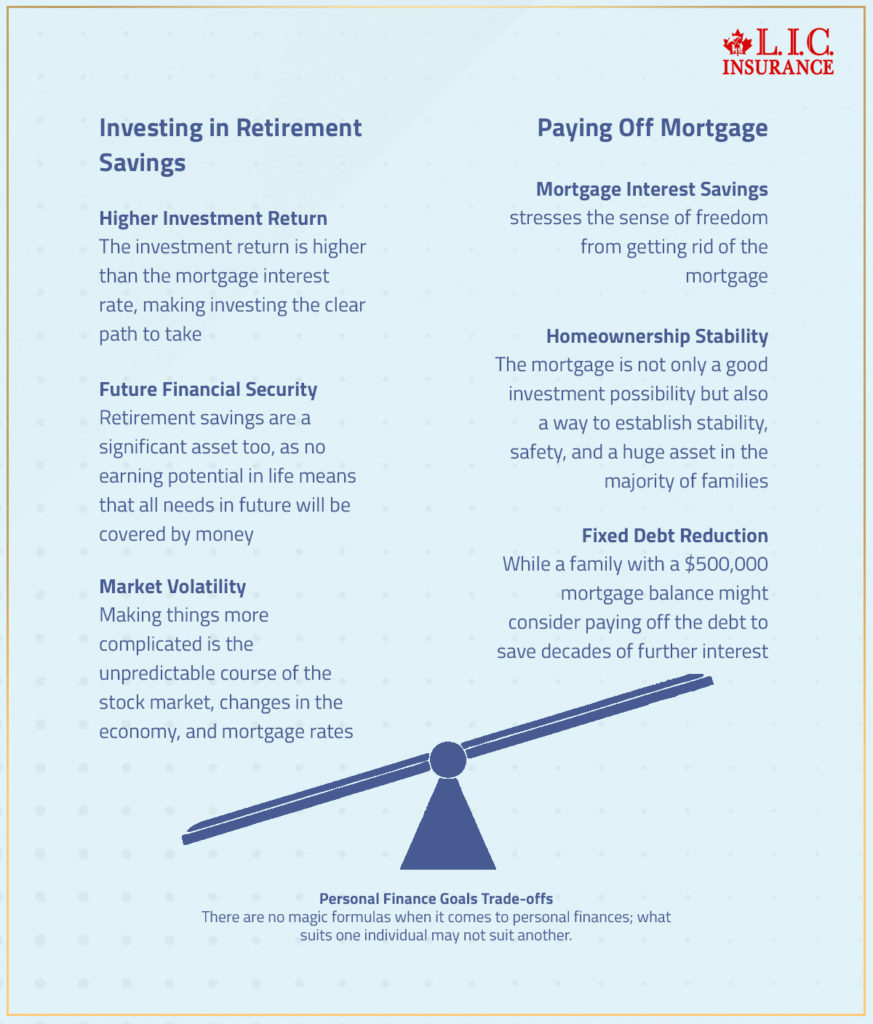
The discussion usually becomes a matter of mathematics, where one group will claim that the investment return is higher than the mortgage interest rate, making investing the clear path to take, while the other side stresses the sense of freedom from getting rid of the mortgage.
Both sides are right to some extent.
The mortgage is not only a good investment possibility but also a way to establish stability, safety, and a huge asset in the majority of families. Retirement savings are a significant asset too, as no earning potential in life means that all needs in future will be covered by money.
That is how so many people who own their houses find themselves at a crossroads between two valid goals.
While a family with a $500,000 mortgage balance might consider paying off the debt to save decades of further interest, this very family may realize that postponing any savings on retirement may mean wasting the ability to accumulate compound gains that cannot be restored afterwards.
Making things more complicated is the unpredictable course of the stock market, changes in the economy, and mortgage rates.
People turn to the Internet looking for answers and ready solutions, but unfortunately, there are no magic formulas when it comes to personal finances.
In other words, what suits a 35-year-old specialist does not necessarily have to be considered by a 60-year-old man who will be retiring soon.
The Hidden Impact Of Mortgage Interest On Long-Term Wealth
One reason mortgage payoff strategies remain attractive is that mortgage interest is guaranteed. Every extra dollar directed toward principal reduction immediately reduces future borrowing costs.
Consider the following example.
| Mortgage Balance | Interest Rate | Remaining Amortization | Estimated Interest Paid |
|---|---|---|---|
| $400,000 | 4.0% | 25 Years | $233,000+ |
| $400,000 | 5.0% | 25 Years | $298,000+ |
| $400,000 | 6.0% | 25 Years | $373,000+ |
Illustrative purposes only.
The difference between a 4% and 6% mortgage interest rate can translate into well over $100,000 in additional interest paid over the life of the loan.
When a homeowner encounters statistics such as these, the attraction towards paying off the mortgage debt becomes self-evident.
Each time a lump-sum payment is made, each time payments are accelerated, and each time extra principal amounts are paid, that money earns a return equal to the mortgage’s interest rate, which would have been paid had those funds not been applied.
Unlike the financial markets, there are absolutely no unknown factors in this scenario.
There is a psychological aspect as well.
Canadians find immense peace in reducing their debt balances. For many, the idea of owning one’s home free and clear at some point in the future is much more comforting than worrying about the ups and downs of their investment account balances.
Why Retirement Savings Often Benefit More From Time Than From Amount
While mortgage reduction offers certainty, retirement savings offer something equally powerful: time.
The most valuable resource in a retirement plan is not necessarily money. It is the number of years available for money to grow.
Two people could end up investing the same amount during their lifetime, but if one of them starts earlier than the other, then he ends up having more money. This is due to the compound growth that accrues from the returns on investment.
Someone living in Canada who can start saving in his RRSP starting at age 30 will have an upper hand over another Canadian who starts at age 45, even if the latter invests more. This is the reason why retirement savings in Canada should be given much attention by everyone.
People can benefit through investments in Registered Retirement Saving Plans and Tax Free Savings Account where tax deferral or tax free withdrawal is allowed. Coupled with the Canadian Pension Plan benefit and company retirement plans then one can generate income after retiring.
The problem is that there isn’t an instantaneous gratification with planning for retirement.
For example, when paying down a mortgage, a person sees their debt decrease every month. When saving for retirement, the process may feel slow, especially if the market environment is unstable. Nevertheless, over many years, the accumulated savings have become quite impressive.
That is why, when giving investment advice, financial planners stress the importance of making contributions to one’s retirement fund despite other expenses.
Should I Pay Off My Mortgage Early Or Invest? Looking Beyond Simple Math
The phrase “should I pay off my mortgage early or invest” has become one of the most searched personal finance questions in Canada, and for good reason.
The answer sits at the intersection of mathematics, behaviour, and personal priorities.
Purely from a mathematical perspective, investing may produce higher long-term returns if a diversified portfolio consistently earns more than the mortgage interest rate. Historically, long-term stock market returns have exceeded many mortgage rates over extended periods.
However, investing involves risk.
The future return can never be assured. Market trends fluctuate, economic environments evolve, and investment strategies deemed favourable one day could turn out to be quite different another day.
Mortgage payments operate on a different principle.
Each additional dollar paid brings down an already known debt. There is no uncertainty, earnings quarters or any political event that can change this scenario.
The trade-off here is that of opportunity costs.
Funds allocated for a mortgage are funds which could have been utilized somewhere else to create other investment returns.
This is why the whole debate of expected returns must also take into account factors like cash flow requirements, retirement preparation, and risk appetite.
An investment that looks good on paper might become too difficult to maintain emotionally during times of economic uncertainties.
Why Age Changes The Entire Conversation
| Age Group | Mortgage Priority | Retirement Savings Priority |
|---|---|---|
| 30–39 | Moderate | High |
| 40–49 | Balanced | High |
| 50–59 | Balanced | Moderate |
| 60+ | High | Moderate |
This does not imply that an individual above 60 years of age will no longer be able to invest or that younger property owners should not take into account their mortgage obligation. This is only an indication that priorities change with age in relation to finance.
Most of those individuals who enter their retirement period with the burden of a mortgage find themselves constrained by the need for sufficient liquidity as against when they were employed.
It thus compels the elderly property owner to think about settling the debts before retiring.
When Paying Off Your Mortgage Early Makes More Sense
There are situations where paying off your mortgage early becomes the clearly superior option.
A popular scenario is that of homeowners with high mortgage interest rates. The guaranteed savings from mortgage reduction become more appealing when the cost of borrowing increases substantially.
Consider the example of a borrower paying back at 6% after being used to paying only 2%. Now, each dollar put into reducing principal will produce an impressive return that conservative investments may find difficult to beat.
Alternatively, we have cases of Canadians nearing retirement and with modest expected future income. If retirement planning shows that finances will be tight, it becomes advantageous for mortgage payments to be cleared prior to retirement.
These are clients who seek security and stability in their investments. They are not interested in maximizing gains from every single penny invested; rather, they want to ensure that living expenses will be comfortable no matter what happens in the market.
Owning a house free of mortgage debt is an assurance that money alone cannot provide.
There is also a behavioural component.
Some people simply dislike debt.
The emotional satisfaction from not having to pay a monthly mortgage cannot be quantified through any spreadsheet. The lack of a mortgage payment every month could lead to less stress, better sleep quality, and increased confidence regarding the future.
Even though finances must not be governed by emotions alone, emotions play an integral role in achieving financial success.
When Investing May Create More Wealth
On the other end of the equation are the homeowners who benefit from staying invested due to their own situation.
When there is a young family with twenty-five or thirty more years before retirement, then there is a large advantage to continuing investments in the retirement accounts.
This is simply because investments grow over time.
Losing out on ten years of investments has much more significance compared to making extra payments for a mortgage for a few years.
There are cases where a person is able to contribute through an employer match program.
When someone chooses a mortgage payment over the employer contribution, he/she misses out on an immediate return on investments.
Tax considerations also matter.
Retirement accounts offer good possibilities to cut taxes and build retirement income at the same time. The growth can help increase your wealth considerably.
It doesn’t imply that investments are better.
Your gains from investments are never guaranteed. Markets go through corrections, recessions, and even times when markets don’t perform well. It’s crucial for a person who takes the path of investments to understand that.
The important difference is that investments promise more wealth, while paying off mortgages is more certain.
There isn’t any better option here.
What We Commonly Recommend
After years of helping Canadians build financial plans, one pattern appears repeatedly.
Extreme approaches rarely produce the strongest outcomes.
When an aggressive investor homeowner makes no effort to fulfill his debt obligations, he is always left feeling vulnerable when he needs to renew his mortgage loan. In contrast, a homeowner who spends all his excess money on paying off debts realizes that he has done very little for his retirement at the age of 50 or older.
That is why our advisors are quick to advocate for a mixed investment approach.
Through such a plan, a homeowner is able to address both goals at once.
Instead of opting to invest more in his debt obligations or save for retirement, the homeowner decides to allocate his additional income towards achieving both.
Suppose a homeowner has an excess of $1,000 per month; he can decide to spend half on retirement savings while allocating the remaining half to mortgage repayment.
Such an approach may mean that neither of the two will be maximized, but it will leave the homeowner better off in most cases because it will address both issues.
Mortgage Insurance Canada Vs Life Insurance: A Question Many Homeowners Overlook
When considering mortgage payoff plans, one can often discover a problem that most Canadians never took into consideration before.
What will happen to your mortgage if something unexpected happens?
The first thing that usually comes to mind is the need for Mortgage Insurance Canada. But is that really true? Life Insurance and Mortgage Insurance seem to be alike; however, they operate quite differently.
| Feature | Mortgage Insurance | Life Insurance |
|---|---|---|
| Beneficiary | Lending Institution | Family Or Chosen Beneficiary |
| Coverage Amount | Typically Declines Over Time | Usually Remains Level |
| Portability | Limited | Portable |
| Flexibility | Restricted | Highly Flexible |
| Premium Structure | Often Remains Similar | May Be Guaranteed |
One of the most important differences is control.
In the case of Mortgage Insurance, the beneficiary is usually the lending institution. In the case of Life Insurance, you will be able to determine the use of the money.
Such flexibility may turn out to be very useful indeed. The widow may not consider paying off the mortgage a priority. She might want to cover living expenses, child care, tuition fees, etc.
For these reasons, many people comparing Mortgage Insurance rates in Canada tend to analyze their choices and then proceed to make decisions.
Three Canadian Homeowner Scenarios
To understand how individual circumstances influence recommendations, consider three common situations.
The first situation describes a young couple who have just purchased a house and have two young children. Their mortgage is worth over $600,000, while retirement is far off. With situations such as these, it can be very important to focus on retirement savings due to time being on their side.
In the second situation, we have a 50-year-old professional with a mortgage still left to pay of about $250,000 along with a rising RRSP investment account. With this situation, people usually find themselves trying to make an equally important decision.
The third situation describes a homeowner aged 62, who is planning on retiring in five years from now and whose mortgage is only worth $100,000. This makes a lot of sense when you think about retiring in the near future.
All three households earn income.
All three carry mortgages.
All three want financial independence.
Yet the appropriate strategy differs significantly because their circumstances differ.
This illustrates why generic advice rarely works.
The Danger Of Viewing Home Equity As Retirement Income
Many Canadians build substantial home equity over their working lives and assume that equity alone guarantees a comfortable retirement.
Unfortunately, the relationship is not always that simple.
Home equity contributes to net worth, but net worth and retirement income are not the same thing.
Homes give individuals stability, security, and appreciation. But homes do not create a regular income stream by themselves.
In their later years, some retired people start thinking about tapping into their home equity through loans like reverse mortgages. It is possible that they can earn money, but it creates several other issues which need to be thought about.
It would be ideal for individuals to have a combination of income and assets.
A person who has a decent amount of retirement savings as well as substantial home equity has greater freedom than one who has just one of the two.
Most good retirement plans do not depend solely on one kind of investment.
A combination of all four is needed.
Mortgage Payoff Vs Investing: A Realistic Wealth-Building Example
To gain a better insight into the reasons for this controversy among financial planners, consider the following illustration:
Let us suppose that there is an extra amount of $500 each month available from the Canadian homeowners who have paid off all living expenses and mortgage payments. These homeowners have about 20 years left on their mortgage and around 20 years until retirement.
The first choice is to put the entire $500 towards paying off the mortgage. This would result in faster pay-off of the mortgage, lower future interest payments, and reduced amortization period. Therefore, the homeowners would be out of debt earlier and save substantial money on mortgage interest.
Alternatively, the homeowners can invest the entire $500 in their retirement savings.
If the invested money earns a higher return than the interest payment made on the mortgage over time, then the investment portfolio will accumulate more money than saving on the mortgage interest payments.
The third option is the hybrid approach.
Half of the money is used for saving for retirement, and half of it for paying off the mortgage earlier.
In the long term, this strategy will not always yield the maximum possible value in the investment account and will not be able to pay off the mortgage as fast as the first option. But usually, it brings the homeowner a certain balance.
Namely, while saving up for retirement, the homeowner pays off his/her debts gradually.
The balance is what makes many families adhere to a financial strategy throughout the changing economic times.
The main danger here is not that the chosen option is not mathematically perfect. It is that it is abandoned.
The Mistakes That Cost Canadians Thousands Over Time
Even well-intentioned homeowners can make financial decisions that quietly reduce long-term wealth without realizing it.
Ignoring Retirement Savings While Aggressively Paying Down A Mortgage
One of the most common mistakes is directing every extra dollar toward mortgage payments while neglecting retirement savings. Although the mortgage balance falls faster, valuable years of compound growth may be lost, making it harder to build sufficient retirement income later.
Focusing Only On Investing And Ignoring Debt Reduction
Some homeowners become so focused on maximizing investment returns that they overlook mortgage repayment altogether. If mortgage renewal occurs during a period of higher interest rates, larger monthly payments can place unexpected pressure on household cash flow.
Chasing Recent Investment Performance
Many investors assume that assets performing well today will continue generating strong returns indefinitely. In reality, investing involves risk, and past performance has never been a reliable predictor of future results. Building a retirement plan based solely on recent market trends can lead to disappointing outcomes.
Underestimating Future Retirement Expenses
Retirement often costs more than people expect. Travel, healthcare, inflation, home maintenance, and family support can consume a significant amount of income. Even homeowners who have paid off their mortgages still need adequate retirement savings to maintain their desired lifestyle.
Failing To Create A Balanced Financial Plan
Financial success rarely comes from maximizing a single objective. The most effective strategies typically balance mortgage payments, retirement savings, investments, insurance protection, and other financial priorities to support long-term financial independence.
Why Individual Circumstances Matter More Than Any Rule Of Thumb
Financial media often promotes universal rules.
Pay off your mortgage first.
Invest first.
Never carry debt.
Always invest.
The reality is far more nuanced.
A 35-year-old physician earning a high income has different opportunities than a 60-year-old business owner preparing for retirement. A dual-income family with strong pension benefits faces different considerations than a self-employed contractor relying entirely on personal savings.
Even risk tolerance changes outcomes.
Some people can remain relatively relaxed even as investment accounts fall amidst market drops since they know how to invest for the long term. Other people feel stressed whenever their investments fall in value, irrespective of what finance theory says.
Both views cannot be faulted.
The right financial plan comes when the plan fits the individual who executes the plan.
The right financial plan does not have to be the one offering maximum return according to finance theory. Rather, it should fit you financially.
This is why the help of experts still counts a great deal in such cases. A financial adviser or planner may assist in determining which approach between mortgage reduction, retirement saving, or a blend of the two suits your needs.
What We Believe
When clients ask us whether they should pay off their mortgage early or invest, they are often expecting a definitive answer.
Instead, we usually begin by asking questions.
How much have you already saved for retirement?
What is your mortgage interest rate?
How many years remain until retirement?
What other debts exist?
How comfortable are you with investment risk?
The answers to these questions will generally tell more than any online calculator would ever tell.
As a result of working with Canadian families to help them plan their insurance, prepare for their retirement, plan around mortgages, and make money, it has been seen that balance always produces more sustainable results.
The person who retires after being able to save some money for retirement, along with having no mortgage to deal with, usually finds himself much better off than someone who concentrated on just one thing.
It is seldom that financial freedom comes from only one step. Usually, financial freedom comes about through many years of making progress in various fields.
The point here is not to clear loans and save money in your account.
The point here is to build a future where all the above-mentioned things combine to provide the desired standard of living.
Final Thoughts
The debate between retirement savings, Canada planning and mortgage reduction will likely continue for as long as Canadians own homes and prepare for retirement.
The reason is simple. Both goals matter.
A mortgage-free house will alleviate financial pressure, cut costs, and offer you peace of mind. Well-placed retirement savings can produce an income source and even help secure your way of life in retirement.
The problem is not about choosing one choice over another, both being good choices. The problem is prioritizing each choice based on your own personal situation.
For certain people, retiring debt by mortgage payments will be the best financial move to make. However, for other individuals, building up retirement savings may be more beneficial.
For many Canadians, the strongest solution lies somewhere in the middle.
A strategy that gradually reduces debt while consistently building retirement assets often provides the flexibility, security, and financial independence that most families ultimately seek.
Rather than asking whether mortgage repayment or investing is universally better, a more useful question may be this:
How can I make progress on both goals while staying aligned with my long-term financial plan?
That question often leads to the most successful outcomes.
Written By: Harpreet Puri
Licensed Insurance Adviser | MDRT Qualifier
With over 14 years of experience in Life Insurance, wealth planning, and tax-efficient strategies for Canadians.
Disclaimer:
The information provided is for educational and informational purposes only and does not constitute financial, investment, tax, legal, or insurance advice. Individual financial situations, retirement goals, and mortgage obligations vary significantly. Readers should consult a qualified financial advisor, tax professional, or insurance specialist before making decisions regarding retirement savings, mortgage repayment, investments, or insurance products.
FAQs
Yes. A mortgage renewal that occurs close to retirement can significantly affect future cash flow. Many homeowners review their retirement savings Canada strategy several years before renewal to understand how potential interest rate changes could impact long-term retirement income and overall financial flexibility.
Maintaining accessible cash reserves remains important even when following a mortgage payoff strategy. Unexpected repairs, medical expenses, or temporary income interruptions can occur at any stage of life, and liquid savings may prevent the need for additional borrowing.
Not always. Selling a larger home may release home equity, but housing costs, moving expenses, and future living arrangements can reduce the amount ultimately available. Retirement savings Canada plans still play an important role in generating ongoing retirement income.
Canadians with strong workplace pensions may have greater flexibility when deciding whether to invest or pay off debt. Guaranteed retirement income sources can sometimes allow homeowners to focus more aggressively on mortgage reduction without sacrificing long-term security.
Many Canadians provide financial support to adult children for education, housing, or family needs. Balancing those commitments with retirement savings and mortgage payments requires careful planning to avoid delaying personal financial goals.
Not necessarily. One spouse may prioritize becoming debt-free while the other focuses on investment growth. Open discussions about risk tolerance, retirement expectations, and future lifestyle goals often help couples develop a financial plan that works for both partners.
Opportunity cost refers to what could have been earned if money had been used elsewhere. When homeowners make large lump sum mortgage payments, they may reduce future interest costs but also give up potential investment opportunities that could have generated long-term growth.
Yes. As income rises, many households increase spending rather than directing extra money toward retirement savings or mortgage reduction. Managing lifestyle inflation can help homeowners build wealth more efficiently without making major sacrifices.
The mortgage interest rate may greatly determine the allocation of additional funds. In case the interest rate is higher, then paying off the mortgage would generate a sure gain from reduced interest charges in the future. On the other hand, when the interest rate is low, some people may decide to save for retirement.
Homeowners might think about utilizing the equity in their house for investments. However, this is a very risky idea since no matter how well or poorly the investments turn out, the debt taken up by the homeowner must be paid back. One should assess all the above factors before using home equity as retirement savings.
Suitable investment products depend upon personal situations, when one is planning to retire, and how risky the person can afford to be. Most Canadians make use of various products such as RRSPs, TFSAs, company-sponsored pensions, and well-diversified investment portfolios. Financial planning usually revolves around developing a steady stream of income for retirement years.

Sources and Further Reading
Government And Regulatory Sources
- Statistics Canada – Household Debt And Wealth Data
- Canada Revenue Agency (CRA) – RRSP Contribution Limits And Rules
- CRA – Tax-Free Savings Account (TFSA) Information
- Financial Consumer Agency Of Canada (FCAC) – Retirement Planning Resources
- Canada Mortgage And Housing Corporation (CMHC)
- Government Of Canada – Canada Pension Plan (CPP) Benefits
- Office Of The Superintendent Of Financial Institutions (OSFI)
Retirement And Investment Research
- Canadian Investment Regulatory Organization (CIRO) Investor Education
- FP Canada – Financial Planning Resources
- Morningstar Canada – Retirement And Investment Insights
- Vanguard Canada – Retirement Investing Research
- BlackRock Canada – Retirement Planning And Market Research
Mortgage And Housing Research
- Canadian Bankers Association – Mortgages And Homeownership Resources
- Royal Bank Of Canada – Homeownership And Mortgage Insights
- Toronto-Dominion Bank Mortgage Learning Centre
- Bank Of Canada – Interest Rates And Economic Data
Insurance And Financial Protection Resources
- Canadian Life And Health Insurance Association (CLHIA)
- Financial Services Regulatory Authority Of Ontario (FSRA)
- Sun Life Canada – Retirement And Insurance Planning Resources
- Manulife Canada – Wealth And Retirement Education Centre
- Canada Life – Retirement And Financial Planning Resources
Additional Reading
Key Takeaways
- The decision between retirement savings Canada goals and a mortgage payoff strategy depends on your age, mortgage interest rate, retirement timeline, risk tolerance, and overall financial situation.
- Paying off a mortgage early provides a guaranteed return through reduced mortgage interest and can help homeowners become debt free sooner.
- Retirement savings benefit from long-term compound growth, which is why delaying contributions can have a lasting impact on future retirement income.
- There is no universal answer to the question, “is it better to pay off mortgage or invest?” The right choice varies based on individual circumstances and financial objectives.
- Homeowners approaching retirement often place greater emphasis on reducing mortgage payments to lower future living expenses.
- Younger Canadians with decades before retirement may benefit from prioritizing retirement savings while continuing regular mortgage payments.
- A balanced approach that combines investing and accelerated mortgage reduction is often the best financial strategy for homeowners seeking both wealth accumulation and financial security.
- Strong home equity can improve net worth, but it should not be viewed as a substitute for retirement savings or other income-producing assets.
- Comparing Life Insurance or Mortgage Insurance is an important part of financial planning because the two products offer different levels of flexibility and protection.
- Before making major financial decisions, it is wise to seek guidance from a qualified financial advisor who can evaluate your retirement plan, debt obligations, tax considerations, and long-term goals.
Your Feedback Is Very Important To Us
Thank You For Your Feedback!
A Canadian LIC advisor may contact you if you request a complimentary review of your Critical Illness Insurance Coverage and protection options.
IN THIS ARTICLE
- Retirement Savings Vs Paying Off Your Mortgage
- Is It Better To Pay Off a Mortgage Or Invest?
- Why This Decision Is More Complicated Than It Appears
- The Hidden Impact Of Mortgage Interest On Long-Term Wealth
- Why Retirement Savings Often Benefit More From Time Than From Amount
- Should I Pay Off My Mortgage Early Or Invest? Looking Beyond Simple Math
- Why Age Changes The Entire Conversation
- When Paying Off Your Mortgage Early Makes More Sense
- When Investing May Create More Wealth
- What We Commonly Recommend
- Mortgage Insurance Canada Vs Life Insurance: A Question Many Homeowners Overlook
- Three Canadian Homeowner Scenarios
- The Danger Of Viewing Home Equity As Retirement Income
- Mortgage Payoff Vs Investing: A Realistic Wealth-Building Example
- The Mistakes That Cost Canadians Thousands Over Time
- Why Individual Circumstances Matter More Than Any Rule Of Thumb
- What We Believe
- Final Thoughts
Sign-in to CanadianLIC
Verify OTP