- Connect with our licensed Canadian insurance advisors
- Schedule a Call

BASICS
- Is Infinite Banking A Smart Financial Strategy?
- Understanding the Infinite Banking Concept
- Why Infinite Banking Appeals to Canadians Seeking Financial Freedom
- How Infinite Banking Strategy Helps Build Financial Independence
- Challenges and Misconceptions About Infinite Banking
- Who Should Consider Infinite Banking for Financial Freedom?
- How to Start Your Infinite Banking Journey
- Key Advantages of the Infinite Banking Strategy
- A Day-to-Day Struggle: Why More Canadians Are Exploring Infinite Banking
- Potential Drawbacks You Should Know
- The Future of Infinite Banking in Canada
- Is Infinite Banking a Smart Financial Strategy?
COMMON INQUIRIES
- Can I Have Both Short-Term and Long-Term Disability Insurance?
- Should Both Husband and Wife Get Term Life Insurance?
- Can I Change Beneficiaries on My Canadian Term Life Policy?
- What Does Term Life Insurance Cover and Not Cover?
- Does Term Insurance Cover Death?
- What are the advantages of Short-Term Life Insurance?
- Which Is Better, Whole Life Or Term Life Insurance?
- Do Term Life Insurance Rates Go Up?
- Is Term Insurance Better Than a Money Back Policy?
- What’s the Longest Term Life Insurance You Can Get?
- Which is better, Short-Term or Long-Term Insurance? Making the Right Choice
IN THIS ARTICLE
- What is the minimum income for Term Insurance?
- How Does Income Affect Your Term Life Insurance Policy?
- Can You Buy Term Life Insurance Online with a Low Income?
- How Can You Lower Your Term Life Insurance Cost?
- How Much Term Life Insurance Do You Need?
- Can Your Term Life Insurance Policy Be Adjusted Over Time?
- Why Term Life Insurance Is Ideal for Lower-Income Canadians
- Final Thoughts
- More on Term Life Insurance
Who Should Buy Participating Whole Life Insurance In Canada?

By Harpreet Puri
CEO & Founder
- 14 min read
- Oct 23, 2026
SUMMARY
Participating Whole Life Insurance Canada can provide lifelong coverage, a guaranteed death benefit, Cash Value Whole Life Insurance growth, and potential Whole Life Insurance dividends. The discussion compares participating vs Term Life Insurance Canada, explains Whole Life Insurance costs in Canada, participating accounts, estate planning benefits, and tax-efficient wealth transfer strategies. It also identifies who should buy Whole Life Insurance and when Permanent Life Insurance may be the right choice.
Introduction
Why More Canadians Are Looking Beyond Traditional Life Insurance
More Canadians have started realizing that Life Insurance is about more than replacing income once the policyholder passes away. In addition, Life Insurance Policies can be considered part of one’s estate and financial planning strategies, especially when it comes to wealth preservation, tax efficiency, and financial security. In today’s Canada, more and more households are becoming financially advanced compared to what they were a generation ago.
As explained by the Canadian Life and Health Insurance Association, Canadian households are enjoying the financial stability provided by Life Insurance in tough times, as insurers pay billions of dollars in benefits. Meanwhile, the figures published by Statistics Canada have been constantly indicating growth in Canadian households’ net worth, ranging from real estate, investments, and family business to vacation homes and other assets.
While accumulating wealth is an excellent process, there may arise several issues regarding the taxation of capital gains, estate taxes, probate fees, and overall wealth transfers, which surprise Canadian families. Moreover, other households decide to start looking for ways to leave behind a greater legacy.
This is where Participating Whole Life Insurance in Canada often enters the conversation.
While Term Life Insurance is only valid for a specified period of time, Participating Whole Life Insurance can offer you a lifetime coverage plan with an assured death benefit, increasing cash value, and even participation in a dividend-paying account. For many people, this can become one of the most valuable tools that they have ever had. However, for others, it may not be their best choice.
One of the most common questions we hear is simple:
Who should buy Whole Life Insurance, and is Participating Whole Life Insurance worth it?
The answer depends entirely on a person’s goals, family situation, business interests, and long-term financial plans.
Understanding Participating Whole Life Insurance Canada
What Is A Participating Whole Life Insurance Policy?
Participating Whole Life Insurance is a type of Permanent Life Insurance Plan created to provide Permanent Life Insurance cover for an insured individual throughout their lifetime. In contrast to term insurance, which expires after a certain period of time, Participating Whole Life Insurance provides Permanent Life Insurance Coverage.
The Participating Whole Life Insurance Plan consists of various characteristics within the same plan. First, there is a guaranteed death benefit, providing protection in case of the policyholder’s death at any point in time. Second, there is the accumulation of guaranteed cash values. Finally, there is the option to collect dividends if certain conditions are met.
Canadians usually assess Whole Life Insurance Policies against Term Life Insurance by comparing premium payments first and foremost. Although it is certainly true that premiums for Whole Life Insurance Plans tend to be higher than those of term insurance, the comparison is usually limited to just that aspect.
The Participating Whole Life Insurance Canada is ideal for individuals who do not wish to settle for short-term insurance. The policy caters to individuals who are certain about their insurance needs for the rest of their lives.
This is one of the reasons why the combination of insurance protection and asset building is a major factor that attracts individuals to purchase Participating Life Insurance Policies.
How Does A Participating Account Work?
One of the most misunderstood aspects of Participating Whole Life Insurance is the participating account.
When customers buy Participating Life Insurance, a certain amount of the premium goes into the participating account, which is held by the insurer. The funds are invested safely in various types of assets such as bonds, mortgages, property holdings, loans, etc.
It is essential to understand that aggressive performance is not sought when creating participating accounts. The main purpose of the funds allocation is to achieve safe and steady growth that would be able to provide for policy guarantees for decades ahead.
Should the participating account exceed expectations during its work, some of the profit will be given out by the insurer in the form of Whole Life Insurance dividends. Although these dividends are non-guaranteed, many Canadian banks that offer Participating Whole Life Insurance products have been paying dividends to customers for dozens of years.
Dividend Scale interest is quite interesting for many participants since they affect dividends calculations. Yet, it is necessary to keep in mind that there are many other factors affecting the dividend performance. Many policyholders decide to buy additional paid-up insurance with dividends.
Participating Whole Life Features
| Feature | Participating Whole Life |
|---|---|
| Guaranteed Cash Value | Yes |
| Guaranteed Death Benefit | Yes |
| Lifetime Coverage | Yes |
| Dividend Eligibility | Yes, if declared by the insurer |
| Tax-Deferred Growth | Generally, subject to applicable tax rules |
| Policy Loan Access | Usually Available |
For Canadians focused on long-term planning rather than short-term returns, this structure can provide a unique balance of guarantees and growth potential.
Permanent Life Insurance Compared To Term Insurance
Most people start off with Term Life Insurance before moving on to something more sophisticated. Term Insurance is relatively inexpensive, easy to understand, and usually sufficient in providing coverage for important times in one’s life, like child-rearing years and mortgage repayments.
The topic changes dramatically when financial obligations persist past a certain point in time.
For instance, a business owner looking to finance a buy-sell agreement in thirty years’ time, a cottager needing money to pay capital gains tax, and parents desiring to leave an estate behind are all scenarios where Permanent Life Insurance makes sense.
Permanent Life Insurance Compared To Term Insurance
| Feature | Participating Whole Life | Term Life Insurance |
|---|---|---|
| Coverage Length | Entire Lifetime | Fixed Term |
| Cash Value | Yes | No |
| Dividends | Possible, if declared | No |
| Premium Cost | Higher | Lower |
| Estate Planning Value | Can Be Significant | Depends on the Policy and Estate Goals |
| Tax-Advantaged Growth | Potentially, subject to Canadian tax rules | No Cash Value Growth |
Unlike Term Life Insurance, Participating Whole Life Insurance will not make individuals think about future renewals when they might experience illnesses due to age later on in life.
It often happens that many Canadians who took out term insurance when they were in their thirties end up paying very high premiums when they enter their sixties and seventies. However, Participating Whole Life makes sure that there is no such risk.
There is no need for anyone to assume that Participating Whole Life is more advantageous than term insurance. What this means is simply that each has its own role to play.
Why Some Canadians Prefer A Whole Life Insurance Policy
The appeal of a Whole Life Insurance Policy often extends beyond the insurance itself.
Many people enjoy certainty. They like knowing that their coverage will always be in place. They like knowing that regardless of when they die, their beneficiaries will receive a death benefit. They like building up guaranteed cash value while continuing to provide financial protection.
Many times, we encounter clients who purchased term insurance many years ago. Now that their financial positions have improved, they are considering ways to preserve their wealth beyond merely replacing their incomes.
This type of client is ideal for Participating Whole Life Insurance.
It allows a guaranteed death benefit plus a rising value of the policy itself. Cash value builds up over time, adding a new element of flexibility. In some cases, our clients will be able to access money through various methods while keeping their Life Insurance Coverage in effect.
Many of our clients also enjoy dividend payment potential. While never guaranteed, dividends play a crucial role in long-term policy accumulation when reinvested consistently.
The net result is a Life Insurance product that does several things all at once.
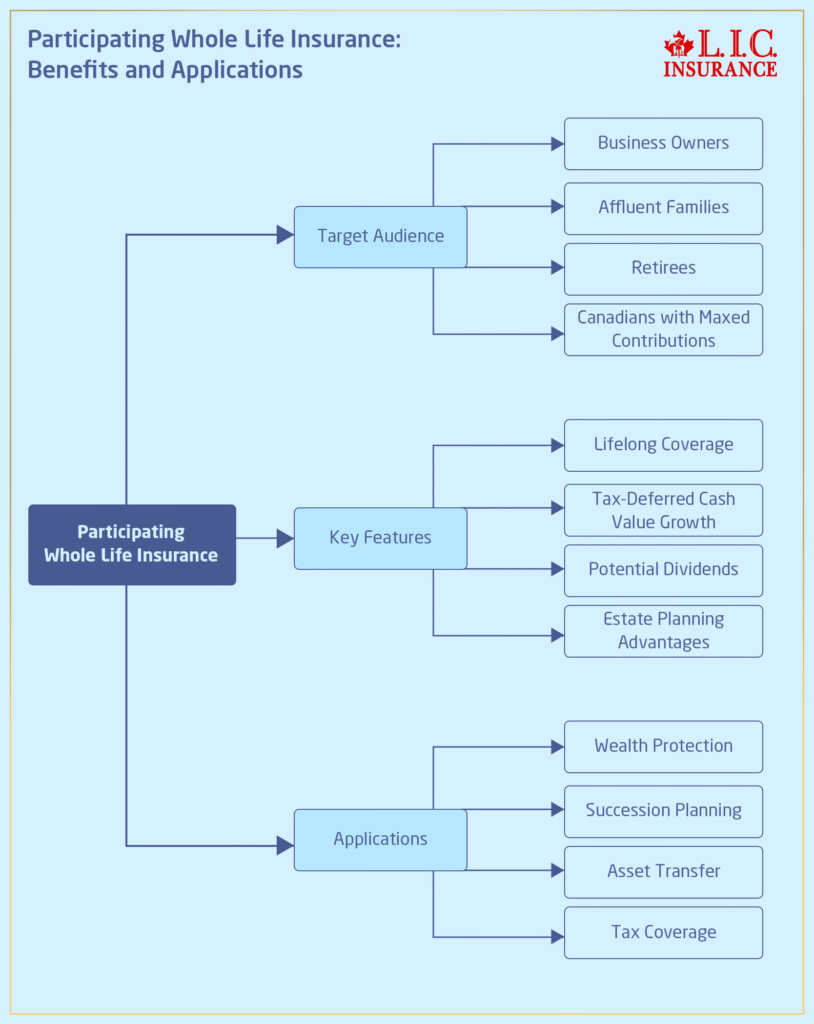
Who Should Buy Participating Whole Life Insurance?
This is where Canadians tend to pay the most attention when assessing Participating Whole Life Insurance. The fact is that everyone doesn’t need Life Insurance Coverage for their entire lives. Not everyone’s family needs an increasing cash reserve. Not every household needs an estate plan.
That being said, some Canadians often find themselves benefiting greatly from Participating Whole Life Insurance, thanks to the rare blend of coverage, guaranteed cash values, dividends, and taxation benefits provided by such policies.
What Canadians need to ask themselves is not whether Participating Whole Life Insurance is good or bad. Instead, they should consider whether it fits their financial goals.
Business Owners Looking For Tax-Advantaged Growth
Many people who own businesses find themselves at odds with financial issues which people with salaries never face.
It is common for some successful companies to have retained earnings as the years go by. However, such retained earnings might prove costly because of the taxation involved in investing them in normal corporate investment accounts. Taxation is involved in interest, foreign earnings, and investment gains made each year.
This leads to many incorporated business owners finding ways to handle their money in a different manner.
Participating Whole Life Insurance is frequently part of that discussion.
A well-constructed Corporately Owned Participating Whole Life Insurance Plan will provide both tax-deferred growth within the policy itself as well as a significant death benefit. In many cases, this death benefit may be received via the capital dividend account, which will allow for even greater efficiency for the recipients.
Our practice frequently advises physicians, dentists, CPAs, entrepreneurs, owner-operators of trucking firms, construction business owners, and other incorporated individuals who utilize Participating Life Insurance.
The objective is rarely just insurance.
Instead, the policy becomes a long-term asset that supports succession planning, wealth preservation, and intergenerational transfers.
For business owners focused on protecting accumulated wealth, Participating Whole Life Insurance Canada often deserves serious consideration.
Families Seeking Lifelong Coverage
Many families initially purchase Term Life Insurance because their primary concern is replacing income if a parent dies unexpectedly.
That strategy often makes perfect sense.
A young family with children and a mortgage may obtain substantial Life Insurance Coverage at an affordable premium through term insurance. The protection helps safeguard financial obligations during years when income replacement is most important.
However, financial priorities often evolve.
As children become adults, mortgages decline, and household income increases, some families begin looking beyond temporary protection. They start thinking about legacy planning, financial support for future generations, charitable giving, and preserving family wealth.
Participating Whole Life Insurance becomes attractive because the coverage never expires.
This policy stays active throughout the life of the individual, ensuring that the beneficiaries get the death benefit at some point in time.
Another thing that attracts many parents is the fact that the policy can grow in value through dividends and guaranteed cash values even when financial commitments are long gone.
In such cases, the focus shifts from income protection to wealth protection.
This has become the primary reason why people move from temporary insurance to permanent insurance policies.
High-Net-Worth Canadians Concerned About Estate Taxes
One of the most powerful uses of Participating Whole Life Insurance involves estate planning.
Many wealthy Canadians take many years accumulating their assets through investments in companies, real estate, recreational facilities, cottages, and other types of investments.
The problem is when such assets are passed down to future generations.
Large liabilities for capital gains tax become a problem that can result in inheriting large amounts of assets, along with significant tax obligations.
Consider a simplified example.
A family cottage purchased decades ago for $200,000 may eventually be worth $1.8 million. While that appreciation represents financial success, it can also create a significant taxable gain.
Without proper planning, heirs may be forced to sell assets simply to pay taxes.
Participating Whole Life Insurance can help address this problem.
The death benefit creates immediate liquidity when it is needed most. Instead of selling assets, beneficiaries may use insurance proceeds to cover capital gains taxes, estate taxes, legal expenses, and settlement costs.
At Canadian LIC, many high-net-worth families use Participating Life Insurance specifically for this purpose.
Their goal is not just to leave behind something as a source of money after their death. They have a goal of protecting something that they have built over the years.
To achieve this, Participating Whole Life Insurance becomes more than just insurance for these people.
Parents And Grandparents Building Wealth Transfer Strategies
Many grandparents today possess significantly more wealth than previous generations.
Real estate appreciation, business ownership, disciplined investing, and decades of savings have allowed many retirees to accumulate substantial assets.
As a result, they increasingly ask a different question.
Rather than focusing exclusively on retirement income, they begin considering how wealth can be transferred efficiently to children and grandchildren.
Participating Whole Life Insurance frequently becomes part of that conversation.
The tax-free nature of the Life Insurance death benefit makes it an efficient means for transferring wealth. Meanwhile, the guaranteed cash value and dividends of the policy will keep on growing until retirement age.
For many grandparents, Participating Whole Life Insurance becomes a means of bequeathing more money without subjecting heirs to undue tax burdens.
For others, Life Insurance Policies become a tool for creating equality in inheritance distribution when assets like businesses and properties are hard to split equally among family members.
In these situations, the value of Participating Whole Life extends well beyond its traditional insurance role.
It becomes part of a comprehensive family legacy strategy.
Canadians Who Have Maximized RRSPs And TFSAs
Many successful Canadians eventually reach contribution limits within their registered plans.
After taking full advantage of RRSPs and TFSAs, they start looking at other ways to make use of tax benefits in order to build their savings.
Participating Whole Life Insurance is one choice they may opt for due to its special tax features.
The cash value will grow tax-deferred inside the insurance policy contract. After some time, such tax benefits can make a considerable contribution to growth.
Others may like the flexibility provided by such instruments as policy loans. It is necessary to note that Participating Whole Life Insurance cannot be an automatic replacement for other types of investments.
Instead, it often complements them.
Many wealthy Canadians invest in diversified portfolios that consist of registered investments, non-registered investments, properties, corporate investments, and Participating Whole Life Insurance.
Each of these serves a unique purpose.
Participating Whole Life Insurance has been chosen due to its combination of deferred growth, permanent life coverage, and estate planning options.
When Participating Whole Life May Not Be The Right Choice
One of the most important parts of any insurance discussion involves identifying situations where a product may not be appropriate.
We believe honest advice requires discussing both advantages and limitations.
Participating Whole Life Insurance is not ideal for everyone.
A young couple who are facing issues in making ends meet may require a cheaper term insurance policy providing significant coverage.
In case someone is concentrating on getting rid of expensive debts, they can create financial benefits by settling liabilities before opting for an insurance plan.
Likewise, people searching for temporary coverage do not necessarily have to choose permanent policies.
When talking about Participating Whole Life Insurance, it makes sense when the insured wants to keep the policy going throughout their lifetime.
The whole concept is not for short-term purposes but rather for longer terms.
Therefore, it will be beneficial for the Canadian people to understand their priorities before buying any kind of permanent insurance.
Always look for something that matches your needs and budget.
Understanding Whole Life Insurance Costs In Canada
One of the first questions Canadians ask is straightforward:
Why does Participating Whole Life Insurance cost more than Term Life Insurance?
This solution is to be found in the benefits offered by the policy.
In Term Insurance, the emphasis is on the death benefit provided by the policy. The Participating Whole Life Insurance offers the death benefit, guaranteed growth of the cash value, dividends, permanence, and several other features.
For obtaining these benefits, larger premiums have to be paid.
Illustrative Premium Comparison
| Applicant | Coverage | Product Type | Approximate Cost |
|---|---|---|---|
| Age 35 | $500,000 | Term 20 | Lower |
| Age 35 | $500,000 | Participating Whole Life | Higher |
| Age 55 | $500,000 | Participating Whole Life | Significantly Higher |
Pricing can be affected by various aspects, such as age, health, whether one smokes, the amount of coverage, payment method, and the insurer.
The underwriting process might involve medical proof or even a medical examination based on the amount of coverage chosen.
Even though whole-Life Insurance has high premiums during the early years, many people perceive it as investments into insurance and assets.
This means that pricing should always be analyzed based on its value and not independently.
Life Pay Options Explained
One area where people in Canada tend to get surprised is in terms of premium structuring.
There is an expectation among many that all Life Insurance Plans have premiums throughout the individual’s lifetime. That is indeed an option, but Participating Whole Life Insurance could be structured in various ways based on what the client wants to achieve financially.
While some people choose the traditional approach of Life Pay, where they make premium payments throughout their lifetime, others opt to complete the premium payments early in life, especially at times when they earn more.
For instance, a successful entrepreneur who is about forty would not want any premium payments once he retires. Doctors or other professionals can opt to pay more in their peak earning periods.
Payment Options Available
| Payment Option | Premium Duration |
|---|---|
| Life Pay | Lifetime |
| 10 Pay | 10 Years |
| 20 Pay | 20 Years |
Paid-up insurance may have its advantages in that it helps to avoid paying further premiums but provides permanent insurance at the same time.
Often enough, the choice of the right way of payment has nothing to do with the age of the person and everything to do with cash flows, retirement needs, and other considerations.
What counts is that the chosen type of insurance matches the overall financial strategy and not simply saves money on premiums.
The Investment Component Behind Participating Whole Life
One reason Participating Whole Life Insurance generates so much discussion is its investment component.
Some people mistakenly view Participating Whole Life Insurance as a pure investment. Others dismiss it entirely because it is not designed to generate stock-market-like returns.
The reality lies somewhere in between.
Participating Whole Life Insurance is primarily a form of Life Insurance, although the increasing cash value within it is one of its most valuable features.
The premium paid will go towards the payment of insurance expenses, while the other will accumulate into the cash value. With dividend payments used to acquire paid-up insurance, the amount in cash value will be considerable.
This creates several potential planning opportunities.
Some policyholders use policy loans during retirement. Others access funds for business opportunities or emergencies. Some simply allow the value to continue growing for estate planning purposes.
The appeal for many Canadians is stability.
Unlike conventional investment accounts, which can see considerable market fluctuations, Participating Whole Life Insurance provides the individual with a guarantee-based product.
Typically, the growth of its cash value happens under tax-deferral, providing yet another benefit for those looking at long-term wealth-building tools.
However, this does not mean that Participating Whole Life Insurance has to substitute other types of investment. On the contrary, it usually works as an element of a diverse portfolio.
Many wealthy Canadians invest money into registered and non-registered investment portfolios, real estate holdings, corporate assets, and Participating Whole Life Insurance in order to fulfill various financial goals.
Different asset classes are used for distinct purposes.
Participating in Whole Life Insurance fulfills a specific goal, which includes guarantees, tax efficiency, and estate planning aspects.
Participating Life Insurance And Estate Planning
Estate planning is one of the strongest arguments for Participating Whole Life Insurance.
Many Canadians spend decades building wealth but relatively little time considering how that wealth will transfer after death.
The result can be surprising.
Investment properties worth millions of dollars can be held by a family. Corporate assets may be owned by a business owner. A retired couple may own a cottage that has appreciated immensely through the decades.
While these assets symbolize financial success, these assets can mean potential tax liability in the future.
Under Canadian law, there could be deemed disposition rules applied to specific assets upon death, hence capital gain taxes are applicable on such assets. Capital gains taxes may prove costly, especially when property values have increased considerably over time.
The solution for addressing tax liability in this instance is Participating Life Insurance.
Let us assume there is a family cottage which was bought years back at $250,000, but is currently worth $2 million. The potential tax liability can prove to be costly.
When nothing is planned for this contingency, then the sale of the asset may become unavoidable for paying taxes.
Using Participating Whole Life Insurance, the death benefit will pay out precisely for the tax liability.
The same is true for private corporations, investment accounts, farmland, and other appreciating property as well.
To many wealthy families, Participating Life Insurance Policies become an important estate planning instrument because they permit the assets to stay in the family, without having to be sold in order to settle any taxes that may accrue.
The tax-free nature of the death benefit makes it even more effective in estate planning schemes.
That is why accountants, lawyers, and other financial professionals advise clients to consider Permanent Life Insurance when discussing their wealth transfer goals.
Joint Coverage Strategies For Couples
Couples frequently ask whether they should purchase separate policies or consider joint coverage.
The answer depends on their objectives.
Some families want individual protection for each spouse. Others focus primarily on estate planning and minimizing costs.
Common Joint Coverage Structures
| Coverage Type | Best For |
|---|---|
| Single Life Insurance Coverage | Individual Needs |
| Joint First-To-Die | Income Protection |
| Joint Last-To-Die | Estate Planning |
A joint first-to-die policy pays the death benefit when the first insured person passes away. This structure is often considered when income replacement is the primary objective.
In a joint last-to-die policy, the payment will only be made when both insured people have died. Since the estate tax normally follows the second death, it makes sense to utilize such policies in estate planning techniques.
Joint Last to Die Participating Whole Life Insurance can be used by wealthy couples in order to get death benefits and preserve their estates.
It will all depend on the needs of the family.
Comparing Whole Life, Universal Life, And Term Life Insurance
Choosing among the various Life Insurance options available in Canada can feel overwhelming.
Each product offers advantages depending on the policyholder’s goals.
Comparing Major Life Insurance Types
| Feature | Participating Whole Life | Universal Life | Term Life Insurance |
|---|---|---|---|
| Permanent Coverage | Yes | Yes, subject to policy conditions | No |
| Cash Value | Yes | Yes, subject to policy performance and charges | No |
| Guaranteed Cash Value | Yes, as specified in the policy | Depends on the policy | No |
| Investment Flexibility | Lower | Higher, depending on available options | None |
| Lifetime Coverage | Yes, if the policy remains in force | Potentially, subject to policy conditions | No |
| Death Benefit | Yes | Yes, subject to policy conditions | Yes, during the coverage term |
Term Life Insurance is usually chosen by people who seek affordable insurance to cover their short-term needs.
Universal Life Insurance is usually chosen by investors who wish to have more flexibility in making investments in their insurance policy.
Participating Whole Life Insurance is usually chosen by people looking for long-term assurances, dividend opportunities, estate-planning advantages, and lifetime security.
No product is universally better.
Choosing the right solution will depend on the person’s goals, risk appetite, tax circumstances, and financial considerations.
This is precisely why professional guidance is crucial when analyzing insurance plans.
Key Factors To Consider Before Buying
Before purchasing any Participating Whole Life Insurance Policy, Canadians should carefully evaluate several key factors.
The first consideration is purpose.
Why are you buying the policy?
Some people want lifelong coverage. Others want to create a tax-efficient inheritance. Some want to protect a business, while others focus on preserving family wealth.
The second consideration involves affordability.
Participating Whole Life Insurance requires a long-term commitment. Policyholders should feel comfortable maintaining premium payments for many years.
Health is another important factor.
Depending on the company and coverage limits, medical proof and an examination might be needed. Getting coverage when one is healthy could lead to better terms.
Furthermore, people need to consider their total financial picture. Investments, retirement accounts, personal property, liabilities, estate planning plans – everything needs to be considered when determining if Participating Whole Life Insurance suits them.
Last but not least, selecting a good insurance provider is important.
Financial stability, dividend payouts, customer service, and even product design could differ significantly from one company to another.
This is why consulting a qualified insurance advisor would come in handy.
How Canadian LIC Helps Clients Determine Whether Participating in Whole Life Insurance Is Worth It
We have spent years helping Canadians evaluate complex insurance decisions.
One of the key things we have learned is that it is imperative not to sell Participating Whole Life Insurance just because it offers dividends and has cash value.
This must start by first knowing what the objectives of the clients are.
In meetings with business owners, professionals, retired individuals, or even families, the first thing we try to do is determine their objectives. Is it about estate taxes? Financial security? Or perhaps tax-deferred growth?
Only after answering those questions do we begin evaluating specific solutions.
There are circumstances when Participating Whole Life Insurance turns out to be the right choice. There are times when Term Life Insurance or Universal Life Insurance would better meet the needs of our clients.
We assist our clients in comparing Life Insurance products of prominent Canadian financial companies, which include, among others, Equitable Life of Canada and other providers of Participating Life Insurance products.
The goal of our company is not to sell a specific type of product.
Our company is oriented towards helping Canadians devise plans ensuring financial stability and safety for their descendants.
Final Thoughts: Who Benefits Most From Participating Whole Life Insurance In Canada?
Participating Whole Life Insurance Canada is not designed for every household, and that is perfectly acceptable.
Many younger families will still find that affordable Term Life Insurance continues to be their most viable choice. For others, Universal Life Insurance could prove more flexible as an investment option.
Nonetheless, Participating Whole Life Insurance plays a distinct role in the world of Canadian financial planning.
It offers the security of Permanent Life Insurance Coverage, guarantees death benefits, promises guaranteed appreciation of cash values, allows for possible dividends, tax-sheltered growth of funds, and many other benefits in a single insurance plan.
Those Canadians who stand to benefit from it most are individuals who consider plans for a much longer period than the next five or ten years ahead. They include entrepreneurs considering strategies of business succession, retired persons securing their family inheritance, professionals exploring further tax-effective options, and families planning for a future inheritance of financial value.
Used correctly, it can indeed bring about substantial financial advantage throughout one’s lifetime.
The best approach to see whether it would be suitable in your case is to look at your particular goals, assets, financial responsibilities, and other aspects of your situation under a professional eye.
Author: Harpreet Puri, Licensed Insurance Adviser | MDRT Qualifier
Experience: 14 Years In Life Insurance & Financial Planning
LinkedIn Profile:https://www.linkedin.com/in/harpreetpuricanadianlic/
Disclaimer:
This content is provided for general educational purposes only and should not be considered financial, tax, legal, or insurance advice. Participating Whole Life Insurance Policies, dividends, costs, and tax implications vary by insurer, policy design, and individual circumstances. Consult a licensed insurance advisor, tax professional, or legal advisor before making financial decisions. Policy features and availability may change over time.
FAQs
Some insurance companies provide their policyholders with an option to make their policies become a reduced paid-up policy that will enable them to cease making future premium payments. Even though the cover amount is going to be lowered, the policyholder will continue enjoying his Life Insurance Coverage plus cash value.
In certain situations, a lender may allow the Cash Value Whole Life Insurance accumulated within a participating policy to support borrowing arrangements. This approach is often used by business owners and investors who want to maintain their Life Insurance Coverage while creating additional financial flexibility. Terms vary depending on the lender and the insurance provider.
At times, families may have possessions that are hard to share equally, like businesses, holiday homes, or real estate properties. This is where purchasing Whole Life Insurance Canada comes into play, as you can have the proceeds of your policy paid out to one heir, while others inherit tangible possessions.
The alteration of interest rates may have effects on investment, yet Participating Whole Life Insurance has been created to ensure the financial security of its investors in the long term. This insurance operates within the participating account that has existed for many decades, instead of only several months.
Many grandparents buy Whole Life Insurance for their grandkids in order to have a plan for the future. By starting at an earlier age, one can have the benefit of paying smaller premiums and accumulating cash value that will be available even with poor health in the future.
Most Participating Whole Life Insurance Policies will continue to be in effect irrespective of whether the policyholder moves to another province in Canada. However, in certain cases, depending on the particular insurer, there may be some variation in certain procedures.
The families who have a special needs individual to look after often resort to taking out a Permanent Life Insurance Policy to make sure that the person will be supported financially into the future.
Prior to receiving your Whole Life Insurance quote, inquire about the purpose of dividends, guaranteed cash value, optional features available, and the impact on the coverage amount over time. Having an insight into these factors will enable you to compare various Life Insurances.
Some Canadians use Participating Life Insurance to leave a larger charitable gift than they might otherwise be able to donate during their lifetime. The death benefit can create a lasting legacy while preserving other assets for family members and estate planning objectives.
Participating Whole Life Insurance in Canada proves to be highly useful for those whose concern lies in wealth conservation as opposed to security. People who are involved in business, incorporated professionals, retired people whose worries revolve around estate planning, and those who are looking for permanent insurance, may find Participating Whole Life Insurance appealing.
There are various participating insurance products in Life Insurance that are available in Canada from insurers such as Canada Life Insurance, Manulife Financial Corporation, Sun Life Financial, and Equitable Life of Canada. The most suitable product for Whole Life Insurance can only be selected after considering the history of dividends.
The preferred individual is generally one who is interested in getting covered permanently and adopts a long-term perspective while making plans. Canadians who are desirous of constructing an asset with certain tax benefits, establishing financial security in the future for their beneficiaries, maintaining their family’s wealth, or developing a good estate planning strategy will benefit from a Participating Whole Life Insurance Policy.
Payment of dividends is not assured but depends on the performance of the participating account of the insurance company. In case the policy pays out dividends, the option for the policyholder would be to buy extra paid-up insurance, accumulate value, cut down premiums or receive money, among others, based on the terms of the policy.
The cost of Whole Life Insurance Plans in Canada depends on several factors, such as age, health condition, whether you smoke or not, coverage, payment structure, and your chosen insurer. Since Participating Whole Life Insurance entails having Permanent Life Insurance protection, guaranteed cash accumulation, and dividend payouts, Whole Life Insurance premium amounts are usually higher than Term Life Insurance premiums.
Sources and Further Reading
Industry & Consumer Education
- Canadian Life And Health Insurance Association (CLHIA) – Canadian Life And Health Insurance Facts – Annual industry statistics, consumer trends, and insurance market data in Canada.
- CLHIA – A Guide To Life Insurance – Explains participating policies, dividends, permanent coverage, and Life Insurance fundamentals.
Participating Whole Life Insurance Resources
- Canada Life – Participating Life Insurance – Overview of Participating Whole Life Insurance, guaranteed cash value, dividends, and participating accounts.
- Canada Life – Participating Account Management Policy – Details on participating account management and policyholder dividend principles.
- Manulife Par Whole Life Insurance – Product information covering premium options, coverage structures, and Permanent Life Insurance features.
- Manulife Participating Dividends Guide – Explains how participating dividends are calculated and how participating accounts operate.
Permanent Life Insurance & Cash Value Education
- Canada Life – Permanent Life Insurance – Comparison of Participating Life Insurance and Universal Life Insurance, including lifetime coverage and cash value growth.
- Sun Life – What Is Cash Value In Life Insurance? – Educational resource explaining how cash value accumulates inside Permanent Life Insurance Policies.
- Sun Life – Is Permanent Life Insurance Right For You? – Covers Permanent Life Insurance benefits, cash value access, and long-term planning considerations.
Estate Planning & Business Planning
- Canada Life – Business-Owned Participating Life Insurance – Explains how Participating Whole Life Insurance may support business succession and corporate planning objectives.
- Canada Life – Premium Offset For Participating Life Insurance – Details how policy dividends may be used to offset future premium payments.
- Canada Life – My Par Gift Participating Life Insurance – Resource on charitable giving and legacy planning using Participating Whole Life Insurance.
Additional Canadian LIC Educational Resources
- Canadian LIC – Using Life Insurance As Loan Collateral In Canada – Explains how Permanent Life Insurance Policies may support borrowing strategies.
- Canadian LIC – What Happens If I Take A Loan From My Whole Life Insurance Policy? – Discusses policy loans, collateral loans, and accessing policy cash value.
Regulatory & Consumer Information
- Financial Services Regulatory Authority Of Ontario (FSRA) – Ontario’s insurance regulator and consumer protection resource.
- Canada Revenue Agency (CRA) – Official tax guidance related to estate planning, capital gains, and Life Insurance taxation.
- Government Of Canada – Financial Consumer Agency Of Canada (FCAC) – Consumer education and financial planning resources for Canadians.
Key Takeaways
- Participating Whole Life Insurance Canada is designed for long-term financial planning, offering lifelong coverage, a guaranteed death benefit, and the opportunity to build cash value over time.
- Unlike Term Life Insurance, Participating Whole Life Insurance does not expire after a set period, making it suitable for Canadians seeking permanent coverage and long-term financial protection.
- A participating policy may earn Whole Life Insurance dividends, which can be used to increase coverage, grow the policy’s cash value, reduce premiums, or accumulate additional value within the policy.
- Business owners often use Participating Life Insurance as part of tax-efficient corporate planning, succession planning, and wealth transfer strategies.
- High-net-worth individuals frequently purchase Participating Whole Life Insurance to help cover capital gains taxes, support estate planning goals, and preserve family assets for future generations.
- Families seeking lifelong financial support for spouses, children, or grandchildren may benefit from the guaranteed death benefit and long-term stability offered by a Whole Life Insurance Policy.
- The policy’s cash value account grows on a tax-advantaged basis and can become an important financial asset during the insured’s lifetime.
- Participating Whole Life Insurance can complement RRSPs, TFSAs, real estate holdings, and other investments as part of a diversified long-term financial strategy.
- Premiums are generally higher than term insurance because the policy provides Permanent Life Insurance protection, guaranteed cash value accumulation, and dividend eligibility.
- Multiple payment structures are available, including Life Pay, 10 Pay, and 20 Pay options, allowing Canadians to align premium payments with their financial goals.
- Participating Whole Life Insurance is not ideal for everyone. Individuals primarily seeking affordable coverage for temporary needs may find Term Life Insurance more suitable.
- Choosing the right policy requires evaluating personal Life Insurance needs, estate planning objectives, affordability, tax implications, and long-term financial priorities.
- Working with a licensed insurance advisor can help determine whether Participating Whole Life Insurance aligns with your overall financial and wealth preservation strategy.
- For Canadians focused on legacy planning, estate preservation, and tax-efficient wealth transfer, Participating Whole Life Insurance often provides benefits that extend well beyond traditional Life Insurance Coverage.
Your Feedback Is Very Important To Us
Help Us Better Understand Your Life Insurance Goals
We’d appreciate your feedback. Your responses will help us understand the challenges Canadians face when evaluating Participating Whole Life Insurance Canada, estate planning, and long-term financial protection strategies.
IN THIS ARTICLE
- Who Should Buy Participating Whole Life Insurance In Canada?
- Understanding Participating Whole Life Insurance Canada
- Permanent Life Insurance Compared To Term Insurance
- Why Some Canadians Prefer A Whole Life Insurance Policy
- Who Should Buy Participating Whole Life Insurance?
- When Participating Whole Life May Not Be The Right Choice
- Understanding Whole Life Insurance Costs In Canada
- Life Pay Options Explained
- The Investment Component Behind Participating Whole Life
- Participating Life Insurance And Estate Planning
- Joint Coverage Strategies For Couples
- Comparing Whole Life, Universal Life, And Term Life Insurance
- Key Factors To Consider Before Buying
- How Canadian LIC Helps Clients Determine Whether Participating in Whole Life Insurance Is Worth It
- Final Thoughts: Who Benefits Most From Participating Whole Life Insurance In Canada?
Sign-in to CanadianLIC
Verify OTP