- Connect with our licensed Canadian insurance advisors
- Schedule a Call

BASICS
- Is Infinite Banking A Smart Financial Strategy?
- Understanding the Infinite Banking Concept
- Why Infinite Banking Appeals to Canadians Seeking Financial Freedom
- How Infinite Banking Strategy Helps Build Financial Independence
- Challenges and Misconceptions About Infinite Banking
- Who Should Consider Infinite Banking for Financial Freedom?
- How to Start Your Infinite Banking Journey
- Key Advantages of the Infinite Banking Strategy
- A Day-to-Day Struggle: Why More Canadians Are Exploring Infinite Banking
- Potential Drawbacks You Should Know
- The Future of Infinite Banking in Canada
- Is Infinite Banking a Smart Financial Strategy?
COMMON INQUIRIES
- Can I Have Both Short-Term and Long-Term Disability Insurance?
- Should Both Husband and Wife Get Term Life Insurance?
- Can I Change Beneficiaries on My Canadian Term Life Policy?
- What Does Term Life Insurance Cover and Not Cover?
- Does Term Insurance Cover Death?
- What are the advantages of Short-Term Life Insurance?
- Which Is Better, Whole Life Or Term Life Insurance?
- Do Term Life Insurance Rates Go Up?
- Is Term Insurance Better Than a Money Back Policy?
- What’s the Longest Term Life Insurance You Can Get?
- Which is better, Short-Term or Long-Term Insurance? Making the Right Choice
IN THIS ARTICLE
- What is the minimum income for Term Insurance?
- How Does Income Affect Your Term Life Insurance Policy?
- Can You Buy Term Life Insurance Online with a Low Income?
- How Can You Lower Your Term Life Insurance Cost?
- How Much Term Life Insurance Do You Need?
- Can Your Term Life Insurance Policy Be Adjusted Over Time?
- Why Term Life Insurance Is Ideal for Lower-Income Canadians
- Final Thoughts
- More on Term Life Insurance
How To Add A Subscriber To An RESP Account In Canada

By Harpreet Puri
CEO & Founder
- 12 min read
- Oct 19, 2026
SUMMARY
RESP subscriber rules in Canada affect who controls RESP funds, government contributions, educational assistance payments, and beneficiary changes. Covers how to add a subscriber to an RESP, RESP subscriber change form requirements, joint RESP structures, transfer RESP subscriber rules after divorce, RESP contribution rules, accumulated income payment concerns, and what happens if the original subscriber dies while protecting a child’s post-secondary education savings.
Introduction
Families in Canada are approaching educational planning in a whole new way compared to what they did just a decade ago. Post-secondary tuition rates are increasing steadily all across Canada, whereas housing costs, transportation, technology, and other daily expenses have made it increasingly difficult for families to save money for their children’s education. As per Statistics Canada, tuition rates at all universities and colleges in Canada have been increasing steadily over the years, particularly in professional and specialized courses. However, the Government of Canada is promoting registered education savings plan programs through Employment and Social Development Canada.
This rising pressure is the reason why millions of Canadian families today depend on RESP Canada accounts to finance their child’s education. While almost all parents know the significance of starting their own RESP account, very few parents realize the importance of the RESP subscription process.
We frequently find that there are subscribers’ issues discovered by families in response to some dramatic events. A divorce results in changing the family situation. A second marriage brings new financial obligations. A grandparent who opened the RESP dies suddenly. The beneficiary chooses not to continue his/her education. In a blink, the originally simple RESP turns into a legally and financially complex situation.
A number of questions arise very soon. Is it possible to add a subscriber to the RESP? Can one single subscriber become a joint subscriber in the future? What should be done if the original subscriber dies? Is it possible to transfer the RESP account after a divorce? How do the RESP subscriber rules function in Canada?
The reason why these questions are important lies in the role played by the subscriber. While the beneficiary will be the eventual recipient of the educational assistance payments, it is the subscriber who controls the RESP contributions, investments, withdrawals, and government contributions.
Understanding these rules early can help protect a child’s education savings plan, RESP, while also helping families avoid problems that could easily appear years later.
What Is An RESP Subscriber And How Does The Role Work?
There is confusion in Canada regarding the differences between the RESP subscriber and beneficiary due to the fact that the account is opened for the child’s education. However, the child does not manage the account themselves. The subscriber manages the funds in the account, whereas the beneficiary receives educational assistance payments upon pursuing higher education at an eligible learning institution.
This distinction becomes extremely important later in life.
It is the RESP subscriber who determines the amount of contribution, investment management, and withdrawal of funds. The RESP subscriber also deals directly with the RESP issuer and financial institution regarding the RESP contribution rules, government grants, and documentation of the beneficiary.
The responsibility of the beneficiary is totally different. The beneficiary is the individual who is expected to benefit from the funds for their education in the future.
We always tell parents that the subscriber manages the account and the beneficiary enjoys the account. The distinction may appear easy at first, but it becomes a legal issue after divorce, separation, or the death of the original subscriber.
| Role | RESPonsibilities | Ownership Rights |
|---|---|---|
| RESP Subscriber | Controls RESP account, contributions, investments, and withdrawals | Yes |
| RESP Beneficiary | Receives educational assistance payments | No direct control |
The subscriber can be the parent, grandparent, guardian, family member, or, in some cases, the primary caregiver for the public. Some of the RESPs in Canada have a single-subscriber setup, while others have joint subscribers.
Currently, there is a restriction on joint subscribers being only between spouses or common-law partners. This is particularly relevant during instances where a family tries to transfer the ownership of an RESP subscriber or change their setup after a divorce.
Successor subscriber planning is just as vital in this case. There are many instances where families build up their RESP funds without thinking about the eventuality of the subscriber’s death. This ends up causing problems for the family concerning the estate of the subscriber.
Can You Add A Subscriber To An RESP In Canada?
One of the most common RESP questions Canadian families ask is whether it is possible to add a subscriber to an existing RESP account.
This is not always an easy question to answer since RESP subscription regulations differ from one RESP provider to another, based on the account structure and the relationship among all involved parties.
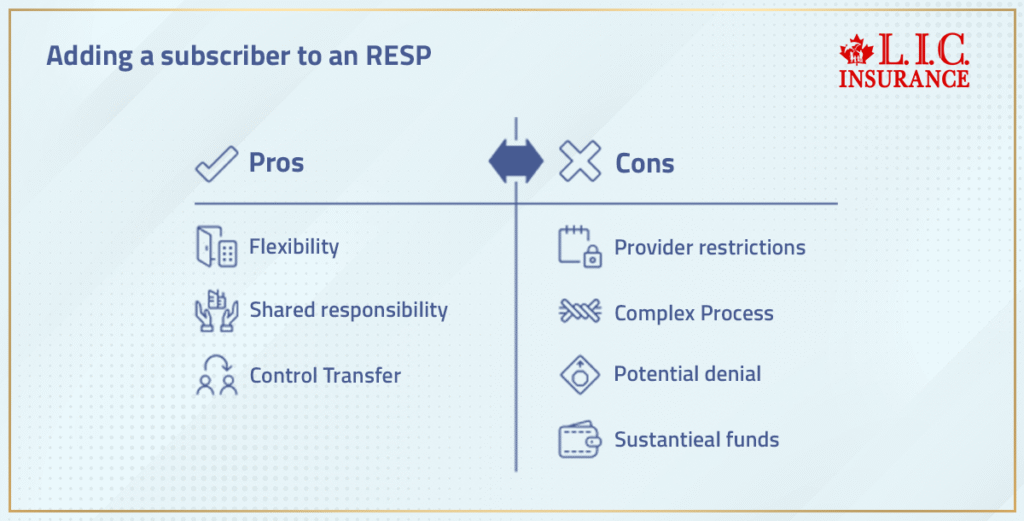
Some financial institutions allow a single subscriber to add other joint subscribers by using the RESP subscriber change form or writing a letter. There are also some providers that do not allow the addition of other subscribers once the RESP account has been set up. In such cases, the only option for families would be to open a new RESP rather than changing the current one.
Families face this problem when their circumstances have changed, something they did not expect when they set up their RESP account. For example, when a parent remarries, he or she may want to give control of the account to the new spouse. A grandparent may want to give control of the account to the parents of the child whose education he or she is funding.
Unfortunately, many people assume RESP ownership works like a regular bank account. It does not.
The RESP subscriber is responsible for managing both the RESP and any government grants that are tied to the account. This includes government grants, such as Canada Education Savings Grants, Canada Learning Bonds, and provincial incentives. Because of this, many financial institutions will require proof in order to transfer an RESP subscriber.
Financial institutions may require proof in the form of a marriage certificate, separation agreement, court order, or written agreement in order to process a request for transferring the RESP subscriber. Some institutions may even deny the request outright based on the nature of the account setup.
The complexity increases further if the RESP account already contains substantial RESP funds or multiple beneficiaries within a family plan.
This is why RESP planning should never focus only on contributions and investment growth. Subscriber structure matters just as much.
How Do RESP Subscriber Rules Work In Canada?
The subscriber manages the RESP, but RESP contribution limits still apply irRESPective of who is managing the account.
A key rule regarding contributions relates to the lifetime contribution limit. At present, Canadians can make contributions worth up to $50,000 per child in their lifetime under the RESP.
Another major misunderstanding involves taxation.
While RRSP contributions are deductible, RESP contributions are not tax-deductible. Contributions to education savings plans in Canada will not provide any reduction in annual taxable income. The two key benefits associated with the program are tax-deferred growth and eligibility for government contributions.
Earnings on investment within the RESP account grow tax-deferred over time. Eligible contributions can be eligible for the Canada education savings grant, commonly known as the education savings grant CESG.
| RESP Rule | Current Rule Overview |
|---|---|
| Lifetime Contribution Limit | $50,000 per beneficiary |
| RESP Contributions | Not tax-deductible |
| Investment Growth | Tax-deferred growth |
| Government Contributions | CESG and other incentives available |
The grants from the government can greatly add to the worth of the RESP funds in the coming years, particularly when the parents start making their contributions early.
It is frequently stressed to our clients that planning by the subscriber takes on great importance when dealing with an RESP in a family environment that has several beneficiaries.
Educational Assistance Payments And Subscriber Responsibilities
Educational assistance payments represent one of the most valuable features within an RESP Canada strategy, yet they are also one of the most misunderstood.
When a beneficiary qualifies through an approved educational institution and begins post-secondary education, the RESP subscriber may authorize educational assistance payments from the account.
These payments generally include government contributions, grant money, and investment earnings that accumulated inside the RESP account over time.
The taxation treatment is important here. Educational assistance payments are generally taxable to the beneficiary rather than the subscriber. Since many students earn a lower income during college or university years, these amounts often face little or no tax.
However, the subscriber still controls the withdrawal process.
This is where many families get themselves into trouble. The parents think that as soon as the child starts going to school, he or she will be the one making all decisions regarding withdrawing money from the RESP.
Educational assistance payments can be used for paying tuition fees, buying textbooks, travelling costs, accommodation costs, and any other costs that are related to education.
It is common to find cases of disagreements between separated parents regarding the withdrawal of educational assistance payments from the RESP. This is one of the reasons why proper planning on the part of the subscriber becomes important before the child gets to university age.
Post-Secondary Education Costs And Why Subscriber Planning Matters
The expenses related to post-secondary education in Canada keep rising continuously, and this trend is having an impact on how people plan their finances in the long term.
As reported by Statistics Canada, tuition fees have increased significantly over the years, especially in professional studies. Once all other expenses, such as accommodation, travel, computer use, and meal plans related to education, are taken into consideration, the overall cost of education could be too much for some families.
This is precisely why the role of government grants and RESPs in planning has become crucial.
Grants and incentives such as the Canada education savings grant, the Canada learning bond, and the Quebec education savings incentive could help save significantly through tax-deferred growth.
Yet investment performance alone is not enough.
We often find that the issues arise with RESPs when the subscribers’ arrangements have not been reviewed after a significant change in the lives of the family members. Divorce affects the dynamics of the family. Remarriage brings along its own set of financial considerations. The grandparent who was the initial subscriber dies unexpectedly. The beneficiaries disagree about education plans.
Now, the whole issue of the RESP has gone beyond saving money.
Subscriber planning can help prevent future disputes over RESP monies and governmental contributions to them.
Joint Subscribers Vs Sole Subscriber RESP Accounts
Sole subscriber plans ensure that one person has absolute control over the RESP plan. Such arrangements are usually made by single parents, grandparents, or situations where only one parent creates the plan on his/her own.
Joint RESP give joint subscribers an opportunity to share control over the plan. Under Canadian law, such types of plans cannot exceed the level of spouses or common law partners.
The advantage of family RESP plans is that several beneficiaries can have the same RESP plan for their educational savings.
| RESP Type | Best For | Subscriber Flexibility |
|---|---|---|
| Individual RESP | One child beneficiary | Moderate |
| Family RESP | Multiple beneficiaries | Higher |
| Joint RESP | Married or common law couples | Shared control |
We have stated that the subscriber structure goes beyond mere administrative work. This will be an important decision that involves financial protection for the future.
When only one parent manages all of the RESP and the parents separate, then the other parent may not have much to say about the management of the RESP funds and any educational help.
Having joint subscribers can help mitigate some of these concerns.
How To Change RESP Subscriber After Divorce Or Separation
Divorce frequently creates confusion around RESP subscriber ownership.
Many separated couples believe that an RESP account becomes joint property when there is a separation, but in actuality, the rules surrounding the RESP subscriber are heavily dependent on the initial setup of the RESP account.
In the case where a single subscriber has set up the RESP independently, any future change of ownership can be highly complicated, requiring much documentation from the RESP administrator and bank.
There are some financial institutions that will accommodate a change of subscription arrangement after separation, while others would require a written agreement or court order.
It gets even more complicated when there are already significant government contributions, income earned, or multiple beneficiaries within a family RESP account.
We strongly recommend that parents consider their options regarding RESP subscriber ownership during the separation proceedings, and not leave it for when they need to make educational assistance payments in the future.
Delaying these conversations often creates avoidable legal stress for everyone involved.
Public Primary Caregiver Rules And RESP Eligibility
Certain RESP Canada rules operate differently when a public primary caregiver is involved.
Even children who are beneficiaries of governmental care systems will still be eligible to receive government benefits, including the Canada Learning Bond. Eligibility requirements may be subject to specific rules based on the arrangement and the care system within the province.
Financial institutions and RESP providers might also need further documentation related to legal capacity, eligibility of the beneficiary, or the care system under which the child is a beneficiary.
This can become a very delicate matter since the ultimate goal is to ensure the education of the child in the future.
What Happens If The Original Subscriber Dies?
Sadly, the majority of families only consider this after being faced with this exact problem.
In cases where there is no successor subscriber, the RESP may end up being an asset of the subscriber’s estate, which will result in unnecessary complications.
The subscribers’ estate may have to deal directly with the RESP provider before allowing the beneficiaries access to the RESP funds.
| Situation | Possible Outcome |
|---|---|
| Successor Subscriber Named | RESP may continue smoothly |
| No Successor Subscriber | Estate complications possible |
| Joint Subscribers Exist | Surviving subscriber may retain control |
Families are encouraged to make their RESP plans in conjunction with their overall estate plans.
Canadians save for years in their RESPs and never think about what happens after they die. This is unfortunate because it puts their child’s education at risk during an emotionally trying time.
Understanding Accumulated Income Payment Rules
Accumulated income payment is defined as the growth of money within the RESP account when the beneficiaries fail to attend post-secondary education.
The accumulated income payment AIP could lead to taxes being charged if the RESP money is withdrawn from the account for any purpose other than education.
Accumulated income could include interest gains, mutual fund growth, exchange-traded funds gains, and other income within the RESP account.
Whereas educational assistance payments are generally tax-free, accumulated income payments may be taxed at ordinary rates and penalties for early withdrawal may apply.
There could, however, be opportunities to roll the money into a registered retirement savings plan if certain requirements are fulfilled.
It should be noted that we often advise families that an RESP is intended to be used for educational purposes. Misusing the money within the account will greatly diminish its tax benefits.
How RESP Funds Can Be Withdrawn Properly
It is important for families to understand how withdrawals from the RESP should be conducted because certain parts of the RESP are subject to different tax treatment.
Withdrawals of RESP can be tax-free in most cases since the contributions have already been paid with after-tax dollars. Educational assistance payments from the grant and investment income will typically incur taxes for the beneficiary.
Withdrawal strategy becomes critical.
There are families who withdraw too much money from the RESP during the early years of university and end up running out of money before the child graduates. There are also parents who do not know the right way to use their accumulated income and end up creating tax issues.
We recommend that families develop a good withdrawal plan before children start college.
Education Savings Plan RESP Mistakes Families Commonly Make
Over the years, we have seen several recurring RESP mistakes at Canadian LIC.
One of the most frequent problems is the complete disregard of the subscriber structure.
The other problem is related to not having a successor subscriber named prior to any sickness or death.
There are also issues regarding the choice of investments. For example, some group plans limit the type of investments a family can make, but others may allow greater latitude with investments, including mutual funds and ETFs.
It is critical to remember that the best plan for your family will depend on your situation.
It is important to note that the planning process for RESPs should adapt to the needs of the family as time passes.
Government Contributions Available Through RESP Canada Accounts
The Canada Education Savings Grant allows for matching government contributions that are proportional to the amount of eligible RESP contributions in each calendar year.
Further government incentives can include the Canada Learning Bond and the Quebec education savings incentive, among others.
| Government Program | General Benefit |
|---|---|
| Canada Education Savings Grant | Matches eligible RESP contributions |
| Canada Learning Bond | Additional support for eligible families |
| Quebec Education Savings Incentive | Provincial education savings support |
Over time, these government grants can significantly increase RESP funds through compounded tax-deferred growth.
Starting early often gives families the greatest long-term advantage.
Future Years Planning Strategies For RESP Subscribers
Planning for the future is what distinguishes good strategies from poor ones when it comes to REPS.
Most families do not know how to plan their contributions, grants, and returns properly since most of them do not contribute regularly.
We advise all families to look beyond contributions annually. The education inflation will certainly increase in the coming years, and proper planning will be key.
The planning of the RESP should be integrated into the family’s overall financial plans, including RRSP contributions and estate planning.
RESP Subscriber Tax Implications In Canada
Tax consequences of an RESP subscription in Canada can be quite different from those of other registered plans.
Contributions to an RESP account are not deductible from taxable income, which may come as a shock to Canadians accustomed to registered retirement savings plan subscriptions. Nevertheless, the benefits of tax deferral of gains on investments make the tax advantages very attractive indeed.
Generally, educational assistance payments are taxed to the recipient rather than the contributor, which means that favourable taxation will apply during the period of post-secondary studies.
Problems can occur when money is withdrawn from an RESP account for non-educational purposes or when payment of income earned accumulations is poorly understood.
Professional advice is particularly useful before any significant changes to the RESP subscription or beneficiary are made.
Why Canadian LIC Recommends Reviewing RESP Subscriber Structures Early
We believe RESP planning should involve much more than simply opening an account and making deposits occasionally.
Subscriber structure matters enormously over time.
Most of the issues surrounding RESPs only come to light years down the road when there is a divorce, estate settlement, beneficiary disagreements, or even the death of the original subscriber.
A timely review of the structure of RESP accounts can ensure that government grants are protected, taxes are minimized, and the child’s education in the future is safeguarded.
When the RESP Canada account is properly structured, it can be one of the most potent financial instruments around for assisting children in pursuing higher education.
Author: Harpreet Puri, Licensed Insurance Adviser | MDRT Qualifier
Experience: 14 Years In Life Insurance & Financial Planning
LinkedIn Profile:https://www.linkedin.com/in/harpreetpuricanadianlic/
Disclaimer:
The information provided is for general educational purposes only and should not be considered legal, tax, estate, or financial advice. RESP subscriber rules, government contributions, and beneficiary eligibility may vary depending on the RESP provider, provincial regulations, and individual circumstances. Readers should consult qualified financial, legal, or tax professionals before making RESP subscriber changes, withdrawals, or estate planning decisions. Canadian LIC does not guarantee eligibility for government incentives or specific RESP outcomes.
FAQs
In certain cases, the use of RESP money may affect the calculation of need-based student aid based on provincial regulations and the particular school that the child will attend. Families tend to consider only government contributions and ignore the interaction between education savings plan money and financial aid calculations in the future.
Yes, it is possible for families to pause their RESP contributions during tough financial times without terminating their RESP. The existing investments may still grow tax-deferred while the educational plans of the beneficiary remain the same. However, it might not always be possible to catch up on any missed CESGs from previous years.
Group RESPs might have more stringent transfer rules than individual RESP Canada accounts managed by banks or securities dealers. Some families find out about transfer difficulties, such as administrative charges, contribution limitations, or deadlines, when they try transferring their RESP savings to a different RESP manager.
Yes, there are some programs offered by educational institutions that would permit RESP beneficiaries to receive educational assistance payments while attending classes on a part-time basis. The eligibility criteria will depend on the nature of the program itself as well as CRA rules.
An RESP for a family will not demand that each beneficiary get the same amount of financial aid for his/her education. Some children might need more money than others in their studies, as one might study for a long time, while another might take less from the account.
Yes, there are many Canadian families who utilize both RESP Canada savings plans along with other types of savings accounts like Tax-Free Savings Accounts and registered retirement savings plan contributions. The use of several accounts simultaneously could make things more flexible in the future.
Indeed, many RESP providers provide investment options that are conservative, balanced, or growth-oriented based on the age and educational needs of the beneficiary. Parents who are close to the period when their children need post-secondary education may wish to decrease risks to avoid any market shocks.
Yes, it is possible to keep an RESP account open even after completing education if there is a possibility of more education in the future or if someone else from the family will benefit from the account.
Some of the contributions made by the government have to be paid back in case the rules regarding the RESP are not followed correctly or in cases where the beneficiary becomes disqualified under certain conditions.
The purpose of the annual RESP review is to assist families in tracking their contribution room, incentive programs from the government, investment results, and educational goals for beneficiaries as situations change. We have realized that making slight changes annually can make a great difference in the future.
The majority of RESPs in Canada require the current holder of the RESP to make an official request before joint subscribers can be added, or if there is a change in the owners of the RESP. This process may include identification, signing of relevant agreements, and updating of beneficiaries.
While some providers in Canada offer online access to update RESP subscriptions, there are those who only offer RESP subscriber change forms in paper format. This is dependent upon the account type, whether it is a sole subscriber or a joint RESP subscription. There are also those cases wherein the bank needs to assess the situation directly.
The inclusion of a non-relative as a beneficiary of the RESP may have implications for the eligibility criteria, particularly in a family RESP plan. There are different criteria that apply to certain government payments and the education savings grant for CESG when the beneficiaries are not related.
All RESP providers offer forms to modify an account through their website, branches, or customer service departments. The required form for modification for the RESP subscriber will vary from one bank, financial institution, or group plan to another. Additional documentation may be needed by some institutions based on the type of modification being made.
Yes, the beneficiary limit depends on the kind of RESP account that is chosen. In the case of a Family RESP, more than one beneficiary can be there, provided they satisfy the relationship criteria set by the government of Canada. Nonetheless, the contribution limit and government contributions for each beneficiary will remain separate.
The processing times will depend upon the RESP administrator, the type of application being processed, and the paperwork provided. Simple changes that involve spousal arrangements can be processed relatively fast, whereas applications involving court orders or the death of a subscriber will take more time to be processed. There could also be delays if there are any government incentives involved in the RESP.
Most financial institutions in Canada need the presentation of government-issued IDs, signed authorizations, and new account details to process a change request. In other instances, supporting documentation may include documents such as marriage papers, separation papers, probate, or written agreements. The requirements can differ from one RESP provider to another.
Sources and Further Reading
- Government of Canada – Registered Education Savings Plans (RESPs) and Related Benefits — Official overview of RESP Canada rules, government contributions, educational assistance payments, and beneficiary eligibility.
- Canada Revenue Agency – Canada Education Savings Grant (CESG) — Detailed breakdown of CESG contribution rules, lifetime contribution limit, carry-forward grant room, and RESP subscriber tax implications.
- Government of Canada – Registered Education Savings Plans and Related Benefits — Information about Canada learning bond eligibility, government incentives, and Education Savings Account Canada planning strategies.
- RBC Royal Bank – RESP Grants And Bonds — Overview of government grants, provincial incentives, RESP beneficiaries, and post-secondary education funding options.
- Sun Life – RESP Grants And Contributions — Explains Canada education savings grant rules, Canada learning bond details, and RESP contribution structures.
- Scotiabank – What Is An RESP And How Does It Work? — Helpful explanation of RESP account structures, educational assistance, contribution room, and government contributions.
- RBC Royal Bank – Registered Education Savings Plan (RESP) — Covers family RESP flexibility, accumulated income scenarios, and long-term RESP funds growth examples.
- Canadian Foundation For Economic Education – Canada Education Savings Grant — Educational overview of CESG calculations, grant money accumulation, and RESP contribution planning.
- British Columbia Government – B.C. Training and Education Savings Grant — Provincial information about education savings incentives and government contributions available in British Columbia.
- Canada Life – What Is The Canada Education Savings Grant? — Overview of CESG usage for educational institution expenses, apprenticeship programs, and higher education planning.
Key Takeaways
- The RESP subscriber controls the RESP account, RESP contributions, investment decisions, and educational assistance payments, while the RESP beneficiary receives the funds for post-secondary education purposes.
- Many Canadian families overlook subscriber planning until major life changes, such as divorce, remarriage, or the original subscriber’s death, create complications involving RESP funds and government contributions.
- Some RESP providers may allow joint subscribers or subscriber modifications through an RESP subscriber change form, while others may restrict ownership changes entirely.
- RESP contribution rules in Canada include a lifetime contribution limit of $50,000 per beneficiary, and overcontributions may trigger penalties on the excess amount.
- RESP contributions are not tax-deductible, but investment earnings inside the RESP account grow tax-deferred and may qualify for government contributions such as the Canada Education Savings Grant.
- Educational assistance payments are generally taxed in the hands of the beneficiary, which may result in little or no tax during post-secondary education years.
- Family RESP structures can provide flexibility for multiple beneficiaries, especially if one child does not pursue higher education or uses less RESP money than expected.
- Naming a successor subscriber can help reduce estate complications and delays if the original subscriber’s death occurs unexpectedly.
- Accumulated income payment rules become important when RESP beneficiaries do not pursue post-secondary education, and RESP funds are withdrawn for non-educational purposes.
- Reviewing RESP subscriber arrangements regularly can help families protect government incentives, improve long-term education savings planning, and reduce future legal or tax complications.
Your Feedback Is Very Important To Us
Thank you for reading our guide on How to Add A Subscriber To An RESP Account in Canada. Your feedback helps Canadian LIC understand the real challenges families face with RESP subscriber rules, government contributions, educational assistance payments, and long-term education savings planning.
IN THIS ARTICLE
- How To Add A Subscriber To An RESP Account In Canada
- What Is An RESP Subscriber And How Does The Role Work?
- Can You Add A Subscriber To An RESP In Canada?
- How Do RESP Subscriber Rules Work In Canada?
- Educational Assistance Payments And Subscriber Responsibilities
- Post-Secondary Education Costs And Why Subscriber Planning Matters
- Joint Subscribers Vs Sole Subscriber RESP Accounts
- How To Change RESP Subscriber After Divorce Or Separation
- Public Primary Caregiver Rules And RESP Eligibility
- What Happens If The Original Subscriber Dies?
- Understanding Accumulated Income Payment Rules
- How RESP Funds Can Be Withdrawn Properly
- Education Savings Plan RESP Mistakes Families Commonly Make
- Government Contributions Available Through RESP Canada Accounts
- Future Years Planning Strategies For RESP Subscribers
- RESP Subscriber Tax Implications In Canada
- Why Canadian LIC Recommends Reviewing RESP Subscriber Structures Early
Sign-in to CanadianLIC
Verify OTP