- Connect with our licensed Canadian insurance advisors
- Schedule a Call

Basics
Common Inquiries
BASICS
- Is Infinite Banking A Smart Financial Strategy?
- Understanding the Infinite Banking Concept
- Why Infinite Banking Appeals to Canadians Seeking Financial Freedom
- How Infinite Banking Strategy Helps Build Financial Independence
- Challenges and Misconceptions About Infinite Banking
- Who Should Consider Infinite Banking for Financial Freedom?
- How to Start Your Infinite Banking Journey
- Key Advantages of the Infinite Banking Strategy
- A Day-to-Day Struggle: Why More Canadians Are Exploring Infinite Banking
- Potential Drawbacks You Should Know
- The Future of Infinite Banking in Canada
- Is Infinite Banking a Smart Financial Strategy?
COMMON INQUIRIES
- Can I Have Both Short-Term and Long-Term Disability Insurance?
- Should Both Husband and Wife Get Term Life Insurance?
- Can I Change Beneficiaries on My Canadian Term Life Policy?
- What Does Term Life Insurance Cover and Not Cover?
- Does Term Insurance Cover Death?
- What are the advantages of Short-Term Life Insurance?
- Which Is Better, Whole Life Or Term Life Insurance?
- Do Term Life Insurance Rates Go Up?
- Is Term Insurance Better Than a Money Back Policy?
- What’s the Longest Term Life Insurance You Can Get?
- Which is better, Short-Term or Long-Term Insurance? Making the Right Choice
IN THIS ARTICLE
- What is the minimum income for Term Insurance?
- How Does Income Affect Your Term Life Insurance Policy?
- Can You Buy Term Life Insurance Online with a Low Income?
- How Can You Lower Your Term Life Insurance Cost?
- How Much Term Life Insurance Do You Need?
- Can Your Term Life Insurance Policy Be Adjusted Over Time?
- Why Term Life Insurance Is Ideal for Lower-Income Canadians
- Final Thoughts
- More on Term Life Insurance
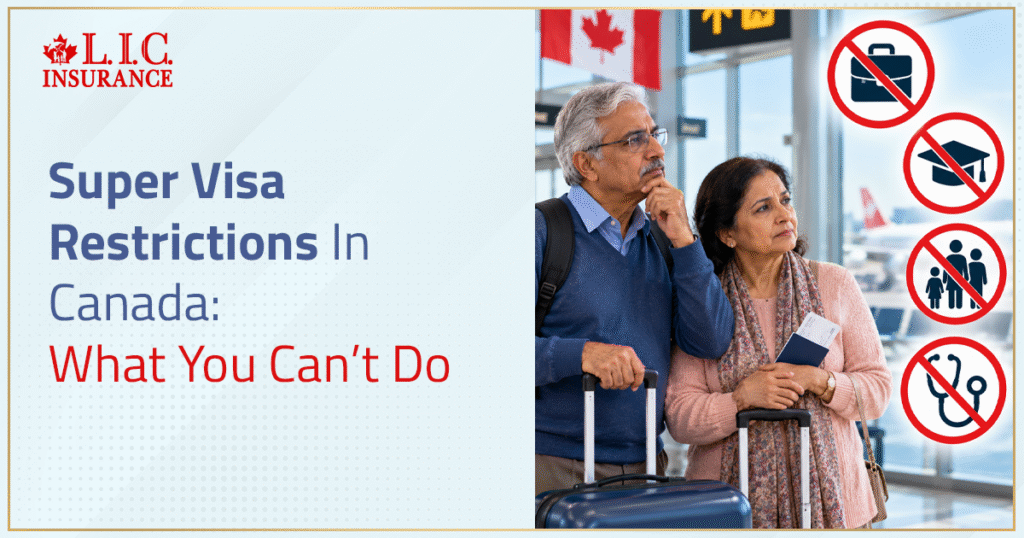
Super Visa Restrictions In Canada: What You Can’t Do

By Pushpinder Puri
CEO & Founder
- 16 min read
- Oct 27, 2026
SUMMARY
Understanding Super Visa Restrictions in Canada is essential for parents and grandparents visiting family for an extended stay. Coverage includes Canada Super Visa Rules, what you cannot do on Super Visa Canada, Super Visa Permitted Activities, work and study limitations, healthcare rules for super visa visitors, whether super visa holders get free healthcare in Canada, financial support requirements, entry conditions, and the importance of maintaining valid Super Visa Insurance Canada coverage.
Introduction
For many families, the approval of a Super Visa feels like the final step in bringing loved ones together in Canada. Parents and grandparents can spend meaningful time with children and grandchildren without constantly worrying about short visitor visa durations. However, obtaining approval is only one part of the journey. Understanding the restrictions that come with the visa is equally important.
According to Immigration, Refugees and Citizenship Canada (IRCC), the Super Visa Program remains one of Canada’s key family reunification pathways for parents and grandparents of a Canadian citizen or permanent resident. The program allows eligible visitors to enter Canada multiple times and remain for extended periods compared to a regular TRV (Temporary Resident Visa). Yet despite its flexibility, the Super Visa remains a visitor visa under Canadian immigration law.
Families who reach out to us after securing their visas often have several queries that they believe were covered under the visa. Can someone on a Super Visa study in Canada? Can one avail free healthcare in Canada on a Super Visa? Can he/she/they work part-time? Are they eligible for permanent residence? These queries indicate one major confusion that people have about the Super Visa.
The truth is that the rules regarding Super Visa in Canada are clearly stated. Knowing about these Super Visa limitations in Canada may prevent families from making errors, complying with Canada’s immigration laws, and enjoying their stay in the country.
Understanding The Canadian Super Visa Program
The Super Visa Program of Canada was created with the purpose of enabling parents and grandparents to spend more time with their families in Canada. As compared to the conventional visa, the Super Visa allows a person to enter and stay in the country for a relatively longer period.
It should be noted that the visa is applicable to all the qualified parents and grandparents of Canadian citizens or residents of the country. The individual has to fulfill some conditions in order to get the visa, such as demonstrating the financial support from his/her children or grandchildren, having the required health insurance and also passing an immigration medical examination if necessary.
The main reason why the super visa program has become increasingly popular is that the visa can serve as a middle ground between temporary travel and the permanent immigration pathway. Many people have to wait for years before they are allowed to proceed with their family class sponsorships. During that time, the Super Visa allows them to visit Canada for an extended period.
However, despite these advantages, it is important to remember that the Super Visa remains a visitor document. It does not grant the same rights as permanent residency, nor does it create a direct path to Canadian citizenship. Visitors remain temporary residents throughout their stay and must comply with all Canadian immigration requirements.
Who Qualifies: Canadian Citizen And Permanent Resident Sponsorship Requirements
A successful Super Visa Application begins with the sponsoring family member in Canada. The applicant cannot qualify independently. Instead, eligibility depends heavily on the status and financial capacity of the child or grandchild residing in Canada.
Canadian Citizen Or Permanent Resident Responsibilities
The sponsor must be a citizen of Canada or a permanent resident who resides in Canada. The person is required to provide an invitation letter to the applicants and prove that he or she can offer financial help while the visitors are there.
It should be noted that it is not enough just to fill out the necessary documentation. The Canadian immigration office demands evidence of the sponsor’s income meeting the LICO requirements, which guarantees that the visitors will not suffer from financial difficulties during their visit.
The sponsor must have tax documents or other supporting documents regarding his or her employment.
| Sponsor Requirements | Applicant Requirements |
|---|---|
| Canadian citizen or permanent resident | Valid passport |
| Invitation letter | Immigration medical exam if required |
| Income proof | Medical insurance |
| Status documents | Application forms |
| Financial support commitment | Supporting identity documents |
We frequently remind families that financial support obligations do not disappear after approval. Immigration officers may review documentation again when visitors enter Canada. Maintaining organized records remains important throughout the process.
Parents And Grandparents Super Visa: Rights Versus Restrictions
Super Visa offers the parents and grandparents an element of flexibility; however, flexibility must not be misconstrued to mean total freedom of movement.
A large number of applicants, who apply for the visa for the first time, tend to think that, once their visa is approved, there is nothing they cannot do as a resident. Such an attitude gives rise to confusion regarding the Super Visa Permitted Activities.
The visitors can move around all over Canada, spend time with relatives, engage in tourism, attend events, and stay longer with their relatives. It is common to find that many grandparents opt to use the visa program to assist their grandchildren, celebrate family events, and enhance family relationships.
On the other hand, restrictions applicable to Super Visa holders in Canada still apply since the visa is meant for short visits.
| Allowed Activities | Restricted Activities |
|---|---|
| Visit family | Work without authorization |
| Tourism | Vote in elections |
| Attend events | Receive most public benefits |
| Travel across Canada | Ignore immigration conditions |
| Multiple entries | Permanently reside without a proper status |
Understanding this distinction early can prevent future immigration complications.
What You Cannot Do on a Super Visa Canada
Among the most frequently sought-after details concerning the program is what cannot be done while holding a Super Visa Canada. This information starts with comprehending the purpose of the visa first and foremost.
The Super Visa was meant to make family visits easier. It was not supposed to replace permanent residency, employment, or unimpeded use of social programs in Canada.
It is impossible for a visitor to simply relocate to Canada due to having a Super Visa. One cannot ignore the entry conditions set by Canadian immigration officials. One should not misrepresent facts when applying for the visa, and one must leave the country in case of failing to adhere to immigration regulations.
It is a common misconception among many visitors that a visa stamped in their passports means automatic entry to Canada at any later point. In reality, each entry needs to be reviewed again and again by a border services officer. Immigration officers can check that all conditions are still met.
Violations of Canada Super Visa Rules may influence any further applications, future entries to Canada, or immigration attempts.
Can Super Visa Holders Work In Canada?
This might be one of the least understood aspects of the program.
A Super Visa is not considered a work permit. It is issued for family reunification purposes, not for work. Therefore, a visitor usually cannot work in Canada merely based on having a Super Visa.
There are occasions when family members think that their parent would be able to help them out in business affairs or get some additional income during their visit. Unauthorized employment, however, can cause severe immigration ramifications.
Immigration officers in Canada take unauthorized work very seriously, and even small-scale unauthorized employment could have implications for compliance issues.
| Super Visa | Work Permit |
|---|---|
| Visitor status | Employment authorization |
| Family reunification purpose | Work purpose |
| Cannot normally work | Can legally work, subject to permit conditions |
| Requires qualifying medical insurance | Different eligibility criteria |
Individuals interested in employment opportunities should explore immigration pathways specifically designed for work authorization rather than relying on a visitor status.
Can Super Visa Holders Study In Canada?
Another frequent inquiry concerns whether Super Visa holders can undertake any studies in Canada.
This is usually determined based on the type of educational activity being undertaken. Some educational activities, like certain courses for recreation, hobbies, self-improvement, and short-term courses, may be possible. But longer academic programs often need special authorization.
It is here that the confusion sets in because families learn that visitors have options for studying at times, and therefore think that they are not restricted at all.
| Activity | May Be Allowed Under Super Visa |
|---|---|
| Short recreational courses | Often yes |
| Hobby classes | Often yes |
| Long academic programs | Usually requires additional authorization |
| Degree programs | Additional requirements may apply |
Before enrolling in any educational program, visitors should verify current Canadian immigration requirements to ensure compliance.
Medical Insurance Requirements Every Applicant Must Meet
All the requirements associated with a Super Visa Application are crucial, but when it comes to health insurance, there is one more important thing to pay attention to.
Many families mistakenly believe that after their relatives’ arrival, they will receive the required coverage within provincial plans. However, in many cases, such a mistake may turn into a big financial issue.
Healthcare in Canada is extremely expensive. Even one visit to the emergency department, one hospital stay, one surgery, one test, or one ambulance ride may cost tens of thousands of dollars. For this reason, medical insurance is still a crucial requirement, rather than a recommendation.
When we consult clients who have just received an approval letter for a Super Visa, they usually ask us how to save money on insurance premiums. Of course, affordability is important, but the coverage should be sufficient enough to cover unexpected situations.
The policy must generally come from a qualifying Canadian insurance company and satisfy government requirements regarding emergency healthcare coverage.
Why Medical Insurance Is Essential
The Super Visa program provides for a long stay for family visits. With an extended period, it becomes more probable that at some time, one will require medical services.
Grandparents and parents are generally elderly individuals. As people get older, their chances of needing medical attention tend to rise. The Canadian Immigration Department understands this, which is why they made it compulsory to have coverage.
If one does not have the required coverage, a medical emergency may cost them a lot of money.
| Insurance Requirement | Purpose |
|---|---|
| Emergency medical coverage | Medical emergencies |
| Hospitalization benefits | Inpatient treatment |
| Repatriation coverage | Return transportation if necessary |
| Valid policy documentation | Immigration compliance |
Families should review coverage carefully and ensure policies remain valid throughout the intended stay in Canada.
Healthcare Rules For Super Visa Visitors
One of the most common questions we receive at Canadian LIC is whether super visa holders get free healthcare in Canada.
The short answer is usually no.
Can Super Visa Holders Get Free Healthcare In Canada?
The Canadian healthcare system is not widely understood by foreigners. As much as Canadian citizens and residents are entitled to publicly subsidized healthcare systems, temporary visitors are not usually afforded similar access.
The requirements for eligibility vary according to the province, and a temporary visitor does not always guarantee health coverage from that particular province.
It is why healthcare rules for super visa visitors very essential as regards private insurance.
The high cost incurred in case of emergency care, specialist appointments, diagnostic imaging, drugs, among others, has been a major reason why the Government of Canada insists on qualifying insurance coverage as a prerequisite for a Super Visa.
Why Insurance Remains Important Throughout The Stay
Visitors may assume that getting insurance is necessary only to get their travel permission.
This assumption is incorrect.
Insurance must be kept active as unexpected emergencies could occur anytime. Continuous coverage ensures protection against any financial loss for the visitors and their sponsors.
| Provincial Healthcare | Super Visa Insurance Coverage |
|---|---|
| Limited eligibility for visitors | Designed for visitors |
| Residency requirements | Supports temporary stays |
| Province-specific rules | Broad emergency protection |
| Not guaranteed | Required for Super Visa |
Families should review policy terms carefully and understand exactly what their Super Visa Insurance Coverage includes before arrival.
Financial Support Requirements During An Extended Period Of Stay
A successful application for the Super Visa includes more than just demonstrating one’s ability to earn an income once.
Financial obligations extend to all aspects of the visitors’ time in the country.
When parents or grandparents come to visit Canada for an extended period of time, they usually rely on their children or grandchildren for shelter, transport, meals, and other day-to-day expenses.
The Canadian immigration service asks for proof that the sponsor is able to adequately support the visitor during his/her time in the country.
This prevents visitors from experiencing any sort of financial problems while visiting.
We always recommend that families think ahead when it comes to finances.
Expenses may include:
- Housing costs
- Transportation
- Daily living expenses
- Insurance premiums
- Prescription medications
- Emergency expenses
Sponsors should retain organized records demonstrating their ability to provide ongoing support if requested by immigration authorities.
Canada Super Visa Stay Limitations And Consecutive Years Rules
Families have shown interest in taking out the Super Visa for the reason that it provides them with the opportunity to stay for longer periods as compared to other visitor visas.
Nevertheless, it is highly essential to get insight into Canada Super Visa Stay Limitations.
Although visitors are provided with extra time in the country, their immigration responsibilities do not go away.
Understanding Long-Term Visits
The most widespread myth about the program is that repeated entries will finally result in rights comparable to those associated with residency status.
However, this is wrong.
Even when a person makes several entries into the country using the Super Visa Program, he or she still continues to be considered a visitor rather than a resident.
It should also be noted that the visa implies some flexibility and no permanent status.
Multiple Entries Do Not Mean Unlimited Rights
The ability to make multiple entries is one of the program’s most valuable benefits.
However, multiple entries do not remove the requirement to satisfy Canadian immigration authorities each time a person seeks admission into Canada.
Visitors should continue carrying:
- Valid passport
- Insurance documentation
- Invitation letters
- Supporting documents
- Evidence of a relationship
Maintaining compliance helps ensure smoother future travel experiences.
Canadian Immigration Rules That Super Visa Holders Must Follow
Understanding Canadian immigration rules remains essential for every visitor.
Many applicants focus heavily on approval and overlook the responsibilities that continue afterward.
Border Services Officers Have Significant Authority
Every person seeking to enter Canada must satisfy a border services officer that they continue to meet entry requirements.
This applies even when a valid visa is already present in the passport.
Border officers may review:
- Passport validity
- Insurance documentation
- Travel purpose
- Family relationships
- Supporting documents
A valid visa does not automatically guarantee admission.
Immigration officers retain authority to assess eligibility at the port of entry.
Maintaining Compliance Matters
Visitors who comply with immigration requirements generally experience fewer difficulties during future travel.
Those who fail to comply may encounter:
- Additional scrutiny
- Delays
- Future visa complications
- Refusals
Maintaining accurate records and respecting immigration conditions remains one of the most effective ways to protect future travel opportunities.
Grandparents Of Canadian Citizens: Common Mistakes That Cause Problems
We often face the same kinds of problems amongst the grandparents of Canadian citizens and permanent residents.
Mostly, such mistakes do not result from malintent; rather, it is due to misunderstandings regarding visa requirements.
A case in point is that of expired insurance. Some visitors may think that once approved, there is no need for insurance once inside the country.
Yet, this is a risky approach as the coverage period must be observed.
An even more common error is a lack of documentation on future visits. Visitors may think that, because they had successfully entered Canada before, documentation is unnecessary on future visits.
Of course, past travel history will come in handy, but documentation is key.
Lastly, some families start thinking of the Super Visa as a form of immigration document.
| Mistake | Possible Consequence |
|---|---|
| Expired insurance | Entry complications |
| Missing documents | Delays |
| Inaccurate information | Refusal risks |
| Ignoring conditions | Immigration issues |
| Assuming resident rights | Compliance problems |
Understanding these risks can help families avoid unnecessary problems.
Application Process Mistakes That Lead To Refusals
The process of applying might seem easy, but people still do many things wrong.
Refusal letters are very often written because the applicants underestimate the significance of supporting documents.
The lack of documents, insufficient proof of finances, insurance, and relations between the applicant and other persons can cause difficulties.
It is always good to remind the applicants that immigration officials have to make decisions depending on the evidence submitted by them.
| Refusal Factor | Potential Solution |
|---|---|
| Missing documents | Complete checklist |
| Income concerns | Strong financial evidence |
| Insurance issues | Approved coverage |
| Medical concerns | Complete required exams |
| Incomplete application | Careful review |
Careful preparation remains one of the most effective ways to improve application quality.
Immigration Medical Exam Requirements Before Approval
Immigration medical examination forms are yet another essential aspect of the Super Visa Program.
The reason for the need for an immigration medical exam is to assist Canadian immigration officials in evaluating the requirements for admissibility.
One might need to undertake an immigration medical exam based on his/her particular situation.
Most often, applicants do not consider just how much time the process of undergoing the medical examination could take.
This entails making an appointment, conducting tests, and then getting results.
For this reason, one needs to start planning early enough for all the processes involved.
Medical examinations should never be taken as something urgent.
Home Country Ties And Why They Still Matter
One thing about the Super Visa program that is often forgotten is the significance of maintaining links to the home country. This is because with the Super Visa application, it seems that immigration officers do not care whether a traveller is planning on returning home after visiting Canada. However, the intent to leave Canada still plays a crucial role in the immigration process in Canada.
The main idea behind introducing the Super Visa is to enable grandparents and parents to spend more time in Canada without establishing residency in Canada. What the immigration authorities expect from visitors is the fact that these visitors should be able to demonstrate their ongoing links with their home countries.
These links can exist in different ways. There might be people who own property in their home countries, work in other countries, maintain family in other countries, make investments in their native land, and so on.
There have been cases where the applicant solely concentrates on providing evidence that proves the connection to the child or grandchild residing in Canada, yet they fail to provide evidence regarding their connections in their home country. Both aspects may form an excellent application.
Connections with one’s home country also come into play when visiting in the future. Even when spending a considerable amount of time in Canada, the visitor should still show that their permanent residence is in another country.
The concept can give clarity about the Super Visa and its differences from permanent residency. The Super Visa was created specifically for the purpose of visiting family.
Apply For A Super Visa: Important Restrictions To Understand Before You Submit
Families often focus heavily on approval and spend less time understanding the practical realities that come afterward. Before you apply for a super visa, it is worth taking a closer look at the restrictions that accompany the program.
Firstly, it concerns employment. Candidates need to know beforehand that the Super Visa does not allow them to get employed on arrival. If earning money in Canada is among the objectives pursued by parents or grandparents, then there might be other immigration streams to explore.
Secondly, it relates to healthcare. Many candidates come to Canada thinking that they have access to free healthcare services as Canadians. However, because visiting immigrants do not automatically qualify for it, retaining qualifying insurance becomes crucial.
Thirdly, it is about planning travels. While the visa allows making multiple entries into Canada and staying there for a long time, keeping all supporting documents at hand during travel remains essential. The immigration officers might check whether the candidate still qualifies for a visa during further entries.
Another issue worth considering is organizing paperwork. All documents related to the trip, such as proof of insurance, letters of invitation, proof of financial status, and passports must be kept easily accessible to avoid troubles in the future.
Finally, applicants need to remember that immigration regulations change. Conditions and requirements applicable some years ago might no longer apply nowadays. Getting acquainted with current guidelines of the Government of Canada will save many efforts and problems.
Are You Eligible For A Super Visa? Final Compliance Checklist
By the time families reach the final stages of planning, it can be helpful to review the core eligibility requirements and restrictions together.
A successful applicant is typically someone who not only qualifies initially but also understands how to remain compliant throughout future visits.
The following checklist summarizes many of the key areas discussed throughout this article.
✓ Valid passport
✓ Parent or grandparent of a Canadian citizen or permanent resident
✓ Invitation letter from the sponsoring child or grandchild
✓ Financial support documentation
✓ Qualifying medical insurance
✓ Immigration medical exam if required
✓ Supporting relationship documents
✓ Compliance with Canada Super Visa Rules
✓ Understanding of Super Visa Stay Limitations
✓ Awareness of healthcare rules for super visa visitors
✓ Understanding that the visa does not provide permanent resident status
✓ Recognition that employment restrictions continue to apply
✓ Awareness that future entries remain subject to review
Families who understand both eligibility requirements and ongoing obligations generally experience a smoother process from application to arrival and future travel.
Why Understanding Super Visa Insurance Canada Matters
In Canadian LIC, there is one thing that stands out. This is why families put effort into filling in applications, gathering papers, proving income, and filling in applications. However, they pay less attention to understanding their insurance requirements.
Unfortunately, insurance becomes one of the key parts of the program.
A Super Visa allows for longer visits to Canada. Long visits mean more risk of unexpected medical problems. Anyone can have an accident, fall ill, get infected, or have some other emergency situation requiring medical care.
Without proper insurance, such visits may become a burden.
However, besides being a financial issue, insurance is also essential to immigration. It becomes a part of the criteria set by the Government of Canada. It helps to satisfy both application and medical needs.
Some people may wonder if a cheap policy would be enough. It would be better if they asked whether the policy gives the necessary protection within the existing immigration requirements.
When evaluating Super Visa Insurance Canada options, families should consider:
- Coverage limits
- Emergency medical benefits
- Hospitalization coverage
- Policy duration
- Stability clause requirements
- Deductibles
- Refund provisions
- Insurer reputation
- Claims support
A strong insurance policy does more than satisfy a visa requirement. It helps protect both visitors and sponsoring family members from significant financial exposure.
We encourage families to view insurance as part of an overall risk-management strategy rather than simply another application document.
Final Thoughts
The Canadian Super Visa remains one of the most valuable family reunification programs available through Canadian immigration. It allows parents and grandparents to spend meaningful time with loved ones, participate in important family events, and enjoy extended visits that would be difficult under a standard visitor visa.
However, flexibility should never be mistaken for unrestricted access.
Super Visa limitations in Canada need to be understood by any visitor so that they avoid potential problems in the future. The visitor needs to know that this type of visa will not give him/her permanent residency status, the right to work unlimitedly in the country or automatically have access to healthcare services provided by the state, etc.
The most successful visitors are those who understand the whole scheme of the program, its advantages and limitations. They follow all rules and regulations set by the government, keep their insurance up to date and know all the current immigration policies and procedures.
When your family plans to get involved in the super visa program, you need to find out what cannot be done on a super visa in Canada, as well as understand what you can do on it.
Author: Harpreet Puri, Licensed Insurance Adviser | MDRT Qualifier
Experience: 14 Years In Life Insurance & Financial Planning
LinkedIn Profile:https://www.linkedin.com/in/harpreetpuricanadianlic/
Disclaimer:
The information provided is for general educational purposes only and should not be considered legal, immigration, or insurance advice. Super Visa rules, eligibility requirements, healthcare policies, and insurance regulations may change without notice. Always consult IRCC, the Government of Canada, or a licensed insurance and immigration professional before making decisions regarding a Super Visa application or coverage.
FAQs
The biggest limitations involve employment restrictions, limited access to public healthcare, temporary resident status requirements, and the obligation to comply with Canadian immigration conditions during every stay and future entry.
Some short-term recreational or hobby-based educational activities may be permitted. Longer academic programs often require additional authorization or separate immigration permissions depending on the nature of the studies.
In most cases, no. Temporary visitors generally do not receive the same healthcare access as Canadian residents. This is why qualifying medical insurance remains a core requirement of the Super Visa Program.
The Super Visa is not a work permit. Visitors generally cannot accept employment solely because they hold a Super Visa. Separate work authorization may be required for employment activities.
Expired insurance can create significant risks. Visitors may face exposure to medical expenses and could encounter complications during future entries if insurance requirements are not properly maintained.
Yes. One of the major advantages of the Canadian Super Visa is the ability to make multiple entries over the validity period, subject to ongoing compliance with immigration requirements.
The Super Visa allows substantially longer stays than a regular visitor visa. Visitors should always review current Government of Canada rules because entry conditions and permitted stay durations can change over time.
Yes. While both are visitor documents, the Super Visa is specifically designed for parents and grandparents of Canadian citizens and permanent residents and generally allows longer stays.
Applicants must obtain qualifying medical insurance that satisfies current Government of Canada requirements, including emergency healthcare coverage and related protections.
Yes. A valid visa does not guarantee admission. A border services officer may assess eligibility, documentation, and compliance with immigration requirements at the port of entry.
Any sponsor who is a Canadian citizen or permanent resident and wishes to bring in their parents and grandparents must be able to satisfy the income threshold set by the IRCC. It is mandatory for the sponsors to provide proof of their income using relevant documentation, including a Notice of Assessment letter and a pay slip.
The Super Visa that is issued to eligible parents and grandparents permits them to stay in Canada for a longer period of time than that offered by a standard visitor visa. The amount of time that an individual is allowed to stay will depend on the existing rules related to the Canada Super Visa program.
To meet Super Visa Insurance requirements Canada, the policy should satisfy current IRCC criteria regarding emergency medical coverage, hospitalization, and validity requirements. Applicants should carefully review policy documents and obtain confirmation from the insurer that the coverage qualifies for Super Visa Insurance Canada purposes.
Super Visa Insurance Canada plan is available through a Canadian insurance company which has plans that meet the requirement of IRCC. Families may compare the limitations, deductibles, stabilization clause, refund policies, and claim assistance provided by the insurance companies to determine Super Visa Insurance plans suitable for them.
The common requirements for applying for a Super Visa include a passport that is still valid, an invitation letter issued by the sponsor, proof of your relation to the sponsor, proof of qualifying medical insurance, financial support evidence, completed application forms, and a medical test result, where required.
Super Visa holders cannot claim automatic eligibility for provincial health care benefits because they are considered visitors rather than residents. Knowledge of healthcare requirements in relation to super visa visitors is vital; hence, having active Super Visa Insurance is critical for the duration of their stay in Canada.
Sources and Further Reading
Government Of Canada & IRCC
- IRCC – Super Visa For Parents And Grandparents
Official Government of Canada resource covering Super Visa eligibility, insurance requirements, income requirements, and application procedures. - IRCC – Who Can Apply For A Super Visa
Details on host requirements, minimum income thresholds, invitation letters, and eligibility rules. - IRCC – Forms And Documents For Super Visa Applications
Official checklist of required forms, supporting documents, and application requirements. - IRCC – How To Apply For A Super Visa
Step-by-step application instructions, document uploads, biometrics requirements, and submission process. - IRCC – How Long You Can Stay In Canada On A Super Visa
Official guidance regarding length of stay, extensions, and maintaining valid visitor status. - IRCC – Proof Of Financial Support Requirements For Hosts
Current income requirements and acceptable proof of financial support for sponsors. - IRCC – Visit Canada Services
General information on visitor visas, Super Visas, and temporary resident requirements.
Canada Border Services Agency (CBSA)
- Canada Border Services Agency (CBSA) – Border Information For Visitors To Canada
Information on entry requirements, traveller expectations, and border inspections. - CBSA – Travel And Identification Documents For Entering Canada
Official guidance regarding passports, identification requirements, and travel documentation. - CBSA – Border Reminder Checklist For Travellers
Information on preparing documents and interacting with border services officers. - CBSA – Crossing The Border Into Canada
Information regarding customs declarations, border procedures, and traveller responsibilities.
Additional Government Resources
- Government Of Canada – Visitor Visa Arrival Requirements
Guidance on documents visitors should carry when travelling to Canada. - Government Of Canada – Entry Requirements For Canada By Country
Official resource covering admissibility and travel document requirements. - IRCC – Visitor Visa Application Guide
Visitor visa and temporary resident visa application guidance relevant to Super Visa applicants. - Government Of Canada – Changes To Super Visa Income Requirement Calculations (2026)
Updated information regarding financial eligibility calculations for hosts sponsoring parents and grandparents.
Key Takeaways
- The Canadian Super Visa allows eligible parents and grandparents of a Canadian citizen or permanent resident to visit Canada for extended periods, but it remains a temporary visitor status rather than permanent residency.
- Understanding Super Visa Limitations in Canada is essential because visitors must continue complying with Canada Super Visa Rules throughout every stay and future entry.
- One of the most important restrictions for Super Visa holders in Canada is that they generally cannot work in Canada without obtaining proper authorization through a separate immigration program.
- Many families ask whether super visa holders can study in Canada. Certain short-term recreational courses may be permitted, but longer academic programs often require additional authorization.
- Visitors should not assume they will receive public healthcare benefits. Understanding healthcare rules for super visa visitors is critical because most Super Visa holders do not automatically qualify for provincial healthcare coverage.
- Maintaining valid Super Visa Insurance Canada coverage is both an immigration requirement and an important financial safeguard against unexpected medical expenses.
- The Super Visa Insurance requirements established by IRCC in Canada must be met throughout the application process, and families should carefully review their Super Visa Insurance Coverage before travelling.
- Financial support from the sponsoring child or grandchild remains a key part of Super Visa Eligibility, and sponsors must provide proof that they meet applicable income requirements.
- A valid Super Visa does not guarantee admission into Canada. A border services officer can review documents and determine eligibility each time a visitor seeks to enter Canada.
- Common mistakes, such as expired insurance, incomplete documents, inaccurate information, or misunderstanding visitor status, can create future immigration complications.
- The ability to make multiple entries and remain in Canada for an extended period of time does not eliminate the temporary nature of the visa or create permanent resident rights.
- Families who understand what you cannot do on a Super Visa Canada are better positioned to maintain compliance, avoid unnecessary risks, and enjoy successful long-term visits with loved ones.
Your Feedback Is Very Important To Us
IN THIS ARTICLE
- Super Visa Restrictions In Canada: What You Can’t Do
- Understanding The Canadian Super Visa Program
- Who Qualifies: Canadian Citizen And Permanent Resident Sponsorship Requirements
- Parents And Grandparents Super Visa: Rights Versus Restrictions
- What You Cannot Do on a Super Visa Canada
- Can Super Visa Holders Work In Canada?
- Can Super Visa Holders Study In Canada?
- Medical Insurance Requirements Every Applicant Must Meet
- Healthcare Rules For Super Visa Visitors
- Financial Support Requirements During An Extended Period Of Stay
- Canada Super Visa Stay Limitations And Consecutive Years Rules
- Canadian Immigration Rules That Super Visa Holders Must Follow
- Grandparents Of Canadian Citizens: Common Mistakes That Cause Problems
- Application Process Mistakes That Lead To Refusals
- Immigration Medical Exam Requirements Before Approval
- Home Country Ties And Why They Still Matter
- Apply For A Super Visa: Important Restrictions To Understand Before You Submit
- Are You Eligible For A Super Visa? Final Compliance Checklist
- Why Understanding Super Visa Insurance Canada Matters
- Final Thoughts
Sign-in to CanadianLIC
Verify OTP