- Connect with our licensed Canadian insurance advisors
- Schedule a Call

BASICS
- Is Infinite Banking A Smart Financial Strategy?
- Understanding the Infinite Banking Concept
- Why Infinite Banking Appeals to Canadians Seeking Financial Freedom
- How Infinite Banking Strategy Helps Build Financial Independence
- Challenges and Misconceptions About Infinite Banking
- Who Should Consider Infinite Banking for Financial Freedom?
- How to Start Your Infinite Banking Journey
- Key Advantages of the Infinite Banking Strategy
- A Day-to-Day Struggle: Why More Canadians Are Exploring Infinite Banking
- Potential Drawbacks You Should Know
- The Future of Infinite Banking in Canada
- Is Infinite Banking a Smart Financial Strategy?
COMMON INQUIRIES
- Can I Have Both Short-Term and Long-Term Disability Insurance?
- Should Both Husband and Wife Get Term Life Insurance?
- Can I Change Beneficiaries on My Canadian Term Life Policy?
- What Does Term Life Insurance Cover and Not Cover?
- Does Term Insurance Cover Death?
- What are the advantages of Short-Term Life Insurance?
- Which Is Better, Whole Life Or Term Life Insurance?
- Do Term Life Insurance Rates Go Up?
- Is Term Insurance Better Than a Money Back Policy?
- What’s the Longest Term Life Insurance You Can Get?
- Which is better, Short-Term or Long-Term Insurance? Making the Right Choice
IN THIS ARTICLE
- What is the minimum income for Term Insurance?
- How Does Income Affect Your Term Life Insurance Policy?
- Can You Buy Term Life Insurance Online with a Low Income?
- How Can You Lower Your Term Life Insurance Cost?
- How Much Term Life Insurance Do You Need?
- Can Your Term Life Insurance Policy Be Adjusted Over Time?
- Why Term Life Insurance Is Ideal for Lower-Income Canadians
- Final Thoughts
- More on Term Life Insurance
Universal Life Insurance Tax Benefits for High Earners


By Pushpinder Puri
CEO & Founder
- 10 min read
- Oct 08, 2026
SUMMARY
Universal Life Insurance Canada strategies are increasingly used by high-income earners seeking tax efficiency, estate planning support, and long-term wealth preservation. Topics include Universal Life Insurance tax benefits, CRA rules for Universal Life Insurance, Cash Value Life Insurance Canada, tax-deferred growth, Permanent Life Insurance policies, Universal Life Insurance costs in Canada, corporate planning, probate reduction, retirement income strategies, and tax-efficient wealth transfer for affluent Canadian families.
Introduction
The moment many affluent Canadians begin earning substantial income, the conversation around money changes completely. The earlier stage of financial planning involves growth, income, and savings, but the later stages gradually shift towards another crucial area: retaining the gains that were previously made.
A doctor earning $500,000 per year, a highly successful incorporated consultant, or a self-made business person enjoying corporate retained earnings might suddenly come across an unpleasant discovery: the higher their level of prosperity, the more taxation hinders their financial progress over the long term. Income from investments becomes increasingly taxed, as do passive investments under the new regulations in the corporate environment. Estate debts start building up silently in the background. Even if the portfolio performs exceptionally well, its growth will be severely hampered by the yearly taxation of compounding returns.
It’s this pressure that has driven the discussion about Universal Life Insurance in Canada among top earners to grow significantly in recent years.
According to the Canadian Life And Health Insurance Association (CLHIA), Canadians collectively hold trillions of dollars in life insurance coverage, with permanent insurance products increasingly becoming part of broader financial and estate planning conversations. Meanwhile, the Canada Revenue Agency (CRA) continues to maintain strict tax rules involving passive investment income, estate taxation, and exempt life insurance policies.
For many affluent households, the challenge is no longer simply generating returns. The challenge becomes improving tax efficiency while preserving financial flexibility across decades.
That is where the tax advantages of Universal Life Insurance in Canada begin attracting attention.
At Canadian LIC, it is not uncommon to see clients who undertake the task of advance planning all end up coming to the same conclusion. RRSPs and TFSAs continue to be important, but when it comes to those earning highly who are taking full advantage of their traditional registered plans, new ways of dealing with taxes may be called upon. The Universal Life Insurance Policy is one of the options that has increasingly been considered for these reasons.
The Universal Life Insurance Policy is one of the most misunderstood financial instruments in Canada.
Some see it only as insurance, while others consider it a way of investing in a product that does not attract taxes. The truth is that this is neither insurance nor a tax-free instrument. But when it is put in place correctly, it could be an amazing tool.
Knowing the difference between the two makes all the difference, especially among rich individuals in Canada who run corporations, invest in assets, and have estate planning tasks.
Why High-Income Canadians Are Re-Evaluating Traditional Investment Strategies
As many successful Canadians discover at some point in time when they reach higher tax brackets, the problem is not necessarily with how their investments have performed but rather how taxation reduces efficiency over time.
Income from interest is taxed. Gains from non-registered investments result in annual tax reporting. Reallocations might give rise to capital gains. Earnings on foreign investments represent yet another level of taxation. Regardless of good performance, the ability to grow wealth will gradually diminish due to taxation interfering with compound growth.
It is an even trickier situation for incorporated professionals and business owners.
Earnings from corporations are usually taxed before being reinvested through passive activities. This may affect access to certain tax benefits offered by the small business deduction rules. A corporation with passive investment holdings that are significant in size may actually become less tax-efficient over time than initially anticipated.
It is thus natural for wealthy Canadians to start exploring opportunities to enhance after-tax results.
This is where the entire discussion changes.
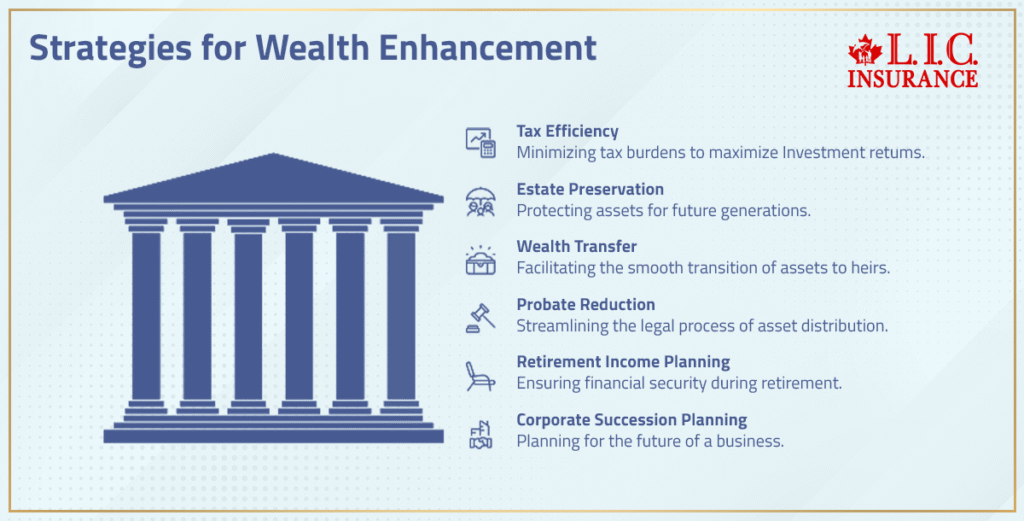
Instead of focusing only on accumulation, many high-income earners begin focusing on:
- Tax efficiency
- Estate preservation
- Wealth transfer
- Probate reduction
- Retirement income planning
- Corporate succession planning
Universal Life Insurance Policies have been gradually gaining more ground in such debates due to the relationship between their taxation and wealth creation.
For most wealthy Canadians, the attraction lies beyond simply purchasing insurance. The attraction lies in being able to create wealth effectively within a tax-sheltered environment, while at the same time ensuring liquidity for their estates.
How Universal Life Insurance Works In Canada
It is necessary to understand how Universal Life Insurance works before going into its tax benefits.
Universal Life Insurance is a form of Permanent Life Insurance that offers lifelong insurance coverage and also allows the insured person to build an investment account within the insurance plan.
In contrast to term life insurance, which has a finite period of coverage, Universal Life Insurance is intended to offer coverage throughout the life of the insured person, provided that funding requirements are satisfied.
Universal Life Insurance involves two different parts.
The first part involves the insurance component. The insurance component is responsible for providing the insurance coverage or death benefit, as well as meeting the expenses associated with insurance coverage.
The second part involves the investment component of the insurance plan. The premium payments above the insurance expense are deposited into the investment account within the insurance plan.
This is where Universal Life Insurance differs significantly from basic insurance products.
The wealthy members of Canadian society find flexibility in the product very appealing, since it is possible to make changes to the policy as circumstances dictate. In certain cases, individuals will put just enough money into the policy to keep it going, while others may take advantage of the fact that their contributions are exempt from CRA rules, allowing them to make very large deposits.
In many cases, it will be possible for the insurer to offer a wide range of investments, including guaranteed interest plans, indexed plans, bond-based plans, equities, or even daily interest plans.
One reason why Universal Life Insurance tends to attract entrepreneurs and professionals is precisely this aspect of flexibility.
But with flexibility comes the potential for complexity.
Whereas some insurance products are fairly straightforward in nature, Universal Life Insurance demands careful management.
That is why advanced planning becomes essential.
Understanding The Universal Life Insurance Tax Benefits Available Under CRA Rules
The key attraction around the Universal Life Insurance tax benefits is the special way that exempt life insurance policies work from a Canadian tax perspective.
According to CRA guidelines, qualified exempt life insurance policies can be set up so that growth within the policy is taxed only when the policy becomes non-exempt. In effect, the taxpayer doesn’t need to pay tax annually on the investment gains made while the policy remains exempt.
That can make all the difference for wealthy Canadians over time.
If money were invested in a regular, taxable investment portfolio, the annual taxation would chip away at compound growth rates over many years.
However, when the money is invested through a well-designed universal life policy, growth can be allowed to keep growing year after year without interruption by annual taxes.
This makes an enormous impact over time.
Finally, even the death benefit enjoys favourable tax treatment. The death benefit will normally be paid out as a lump sum tax-free amount to the policy’s beneficiaries.
This feature alone often becomes highly attractive for estate planning purposes.
For high-income families, large estates may eventually face:
- Final tax liabilities
- Probate costs
- Capital gains taxation
- Liquidity shortages
- Estate equalization issues
Universal Life Insurance can assist in creating liquidity when such demands occur.
Yet, it is essential to note that the term “tax-free” often causes misconceptions for many Canadians.
Universal Life Insurance is not necessarily tax-exempt under all conditions. Taxation rules associated with exempt policies, cost basis calculations, withdrawals, policy disposition, and cash surrender value continue to carry significant weight.
That is precisely the reason why wealthy planning strategies incorporating Universal Life Insurance must never be taken lightly.
Is Universal Life Insurance Tax-Free In Canada?
One of the common myths about Universal Life Insurance revolves around its taxability.
Many individuals question whether Universal Life Insurance is entirely exempt from taxes in Canada.
However, this is not always the case.
The death benefit proceeds of the Universal Life Insurance Policy are typically exempt from taxes to the beneficiaries. This tax advantage is one of the main benefits that come with life insurance planning.
Nevertheless, some transactions concerning the Universal Life Insurance Policy might result in taxable events.
Any withdrawal exceeding the policy’s adjusted cost basis may become taxable income. The surrendering of a policy may generate taxes. Some forms of policy loans could also become subject to tax depending on their nature.
This point is particularly relevant when wealthy Canadians utilize Universal Life Insurance mainly for wealth-building purposes.
In Canada Life Insurance Co., many affluent customers realize how essential proper management of their Universal Life Insurance Policy becomes once substantial investments start flowing into the policy.
While the policy can become highly tax-effective, any incorrect funding, withdrawal, or restructuring could undermine these tax benefits significantly.
How Cash Value Growth Works on a Tax-Deferred Basis
It is the investment portion within Universal Life Insurance that usually lures the wealthy Canadian clients who want something more sophisticated from their money.
When premium payments surpass the basic insurance cost of the policy, the surplus amount is deposited into the investments of the policy.
If the policy is maintained within the terms of the exempt test criteria specified by the Income Tax Act, the growth within the policy will continue in a tax-deferred manner.
This becomes more apparent when we consider Universal Life Insurance against taxable investments.
Taxable Investment Account Vs Universal Life Insurance
| Scenario | Taxable Investment Account | Universal Life Insurance |
|---|---|---|
| Annual Investment Growth | Taxable | Generally Tax Deferred |
| Annual Tax Reporting | Required | Limited During Accumulation |
| Estate Tax Efficiency | Lower | Higher |
| Probate Exposure | Possible | Often Reduced |
| Tax-Free Death Benefit | No | Generally Yes |
| Long-Term Tax Efficiency | Moderate | Potentially High |
Understanding Universal Life Insurance Cash Value Taxation Canada
While growth within the policy itself may accrue without taxes, drawing upon that gain could trigger taxation issues based on how it is withdrawn.
It is at this point that terms like adjusted cost basis, gains on the policy, and cash surrender values play a vital role.
Adjusted cost basis or ACB usually refers to the policy owner’s tax basis within the insurance contract based on certain computations.
If the withdrawals made from the policy surpass the adjusted cost basis, there could be taxable gains.
Simplified Example Of Cash Value Taxation
| Item | Amount |
|---|---|
| Cash Surrender Value | $500,000 |
| Adjusted Cost Basis | $320,000 |
| Potential Taxable Gain | $180,000 |
Why Universal Life Insurance Appeals to High-Income Earners
The financial priorities of affluent Canadians often differ dramatically from those of average-income households.
The conversation is no longer focused strictly on replacing employment income after death.
Instead, high-income earners often focus on:
- Preserving accumulated wealth
- Improving tax efficiency
- Reducing estate liabilities
- Creating estate liquidity
- Supporting family business succession
- Protecting future generations financially
This is just one of the reasons that Universal Life Insurance has become increasingly appealing to incorporated professionals and prosperous entrepreneurs.
For instance, when an incorporated business earns a significant amount each year, it will sooner or later build up some passive capital that earns investment income and incurs taxation every year.
The effect of these taxes erodes efficiency over time.
A well-designed Permanent Life Insurance strategy may be able to create a more tax-efficient climate for some of the excess capital while providing estate planning advantages at the same time.
This is precisely what makes Universal Life Insurance such a popular choice for many affluent Canadians today.
Corporate-Owned Universal Life Insurance Strategies In Canada
The use of Corporate-Owned Universal Life Insurance is not uncommon among wealthy business owners in Canada.
In such arrangements, the corporation holds the policy and covers the premiums. In many situations, the corporation is also named as the policy beneficiary.
Tax savings and estate planning benefits may be derived under certain circumstances.
One of the major considerations that must be considered is the concept of the Capital Dividend Account, also known as CDA.
Upon the insured’s death, any portion of the payout that exceeds the adjusted cost of the policy will be channelled into the CDA and thus result in tax-free capital dividends for the shareholders or heirs.
Such a tax savings arrangement can prove very beneficial for family business owners.
Corporate-Owned Universal Life Insurance is often used alongside:
- Shareholder agreements
- Buy-sell funding
- Estate freeze planning
- Business succession strategies
- Estate equalization planning
These structures become especially relevant for affluent families seeking to transfer wealth efficiently between generations while minimizing future tax exposure.
Using Permanent Life Insurance For Estate Planning And Probate Reduction
Estate planning becomes increasingly important as wealth grows.
Large estates involving corporations, investment portfolios, cottages, or real estate holdings may eventually create significant taxation and probate exposure.
Without proper planning, surviving family members may face:
- Capital gains taxation
- Probate fees
- Liquidity shortages
- Delays in estate distribution
Universal Life Insurance can help solve these issues through the provision of immediate liquidity upon death in a tax-efficient manner.
Since the beneficiaries are usually listed on the insurance document, the payments may go straight to them without requiring probate.
In wealthy families, the need for replacing lost income is often secondary to ensuring the preservation of the family’s estate.
This makes all the difference in high-level wealth management.
Universal Life Insurance Vs Whole Life Insurance Vs Term Life Insurance
| Feature | Universal Life Insurance | Whole Life Insurance | Term Life Insurance |
|---|---|---|---|
| Coverage Duration | Lifetime | Lifetime | Temporary |
| Cash Value Growth | Flexible | Guaranteed/Participating | None |
| Investment Flexibility | High | Low | None |
| Premium Flexibility | Often Flexible | Fixed | Fixed |
| Tax Deferred Growth | Yes | Yes | No |
| Initial Insurance Cost | Higher | Higher | Lower |
| Estate Planning Efficiency | High | High | Moderate |
| Suitable For Wealth Accumulation | Strong | Strong | Limited |
What Determines Universal Life Insurance Cost In Canada?
There are many factors that can impact the cost of Universal Life Insurance Plans in Canada.
Factors such as age, medical history, whether someone is a smoker or not, the medical examination report, funding mechanism and level of coverage can have significant impacts on pricing.
A young person with no medical issues will most likely be charged significantly less for insurance than an older individual who has some medical conditions.
The funding approach itself becomes extremely important as well.
Sample Universal Life Insurance Cost Examples
| Age | Coverage | Estimated Monthly Premium |
|---|---|---|
| 35 | $500,000 | $250–$450 |
| 45 | $1 Million | $600–$1,200 |
| 55 | $1 Million | $1,300–$2,500 |
Common CRA Compliance Mistakes Canadians Make With Universal Life Insurance Policies
One of the largest blunders made by wealthy Canadians is to believe that Universal Life Insurance works like an unfettered tax shelter.
The exemption policy of the CRA is still very relevant.
Incorrect structuring of the policy, overselling the policy, bad withdrawal practices, and misinterpretation of the adjusted cost basis calculation can adversely affect tax efficiency.
It is for this reason that sophisticated planning with Universal Life Insurance must incorporate input from insurance specialists, accountants, tax experts, and estate planners.
At Canadian LIC, planning sessions of wealthy clients often include consultations with outside professional advisors due to potential taxation issues in the future.
When Universal Life Insurance May Not Be The Right Investment Strategy
Despite its advantages, Universal Life Insurance is not ideal for every Canadian.
Individuals primarily seeking the lowest-cost short-term insurance coverage may find simpler term insurance solutions more appropriate.
Universal Life Insurance generally works best for Canadians with:
- Long-term financial objectives
- Stable surplus cash flow
- Estate planning concerns
- Tax efficiency priorities
- Wealth accumulation goals
The strategy requires patience, discipline, and proper long-term planning.
It is not designed as a short-term speculative investment product.
How Canadian LIC Helps High-Income Canadians Structure Tax-Efficient Universal Life Insurance Plans
At Canadian LIC, insurance planning for the wealthy is more than just comparing insurance rates.
There are many wealthy customers who need a sophisticated plan that includes company structure analysis, estate planning integration, retirement planning, and tax-structured funding.
Together, Harpreet Puri and the team at Canadian LIC have assisted many wealthy Canadians with their planning needs relating to Universal Life Insurance Coverage, wealth protection, business continuity, and tax-planned estates.
Universal Life Insurance products overlap significantly with tax laws and estate planning, making coordination necessary between experts in both fields.
Final Thoughts
For most well-to-do Canadians, the biggest financial problem at some point in their lives is not just building wealth but rather ensuring its preservation.
This trend accounts for the continuous interest in Universal Life Insurance Canada Plans among incorporated individuals, company executives, doctors, entrepreneurs, and wealthy Canadian families.
CRA rules for Universal Life Insurance have the potential to be a great strategy that combines protection, growth of funds on a tax-deferred basis, estate planning, and financial flexibility in the long run.
However, such strategies need to be appropriately designed, realistically approached, and expertly managed.
Properly structured Universal Life Insurance can be a valuable long-term financial management instrument for wealthy Canadians.
Author: Harpreet Puri, Licensed Insurance Adviser | MDRT Qualifier
Experience: 14 Years In Life Insurance & Financial Planning
LinkedIn Profile:https://www.linkedin.com/in/harpreetpuricanadianlic/
Disclaimer:
This content is intended for general informational purposes only and should not be considered tax, legal, investment, or financial advice. Universal Life Insurance tax treatment in Canada depends on individual circumstances, CRA rules, policy structure, and funding strategy. Readers should consult qualified tax professionals, accountants, lawyers, and licensed insurance advisors before making financial or estate planning decisions. Policy features, investment performance, and insurance costs may vary by insurer and underwriting approval.
FAQs
A lot of wealthy Canadians have used Universal Life Insurance Canada methods to enhance their retirement options. With good Cash Value Life Insurance Canada planning, it might be possible to provide other alternatives for liquidity when making taxable investments would have greatly increased taxes paid.
The vast majority of Universal Life Insurance Policies in Canada continue to require a physical examination, particularly when dealing with higher amounts of insurance and wealthy clients’ insurance plans. However, there might be some exceptions among various insurers based on age, medical history, and total premium cost.
Some rich families buy Permanent Life Insurance for their kids or other young family members in terms of planning for an estate or building up money over the long run. Starting early might help them to lower the cost of the Universal Life Insurance Policy in the future.
Universal Life Insurance is more flexible compared to other life insurance products, but late premium payments might impact the overall success of the plan. The policy may ultimately terminate in the event that there isn’t enough cash surrender value within the policy.
For wealthy Canadians, regular savings may generate continuous taxable interest income without having much potential for growth. With careful planning, a Universal Life Insurance Plan can be more effective and offer extra estate benefits when integrated with other financial strategies.
Wealthy Canadians can take advantage of the Universal Life Insurance benefits when it comes to charitable planning while ensuring that their estates maintain their value for their heirs. There are specific tax planning options that arise from naming charities as beneficiaries of their policies.
It is important to understand that not all investment opportunities within Universal Life Insurance Plans come with guarantees. Some insurance companies provide guaranteed investment choices, while some also offer market-based investments whose returns keep changing over time.
Universal Life Insurance is intended for lifetime coverage if sufficient funding is ensured. Universal Life Insurance Plans have been favoured by many wealthy Canadians due to the permanence of these insurance policies, which makes them suitable for estate planning and family protection purposes.
Absolutely, corporations do make use of Universal Life Insurance products when they are covering their higher-paid individuals or executives. The loss of an individual shareholder or executive can bring financial disturbance to the corporation, and having Permanent Life Insurance can solve this problem easily.
Since the beneficiaries are often listed in the insurance documents, there are various permanent insurance designs that could minimize probate risk in Canada. It will prove very helpful for the ultra-rich in Canada who want to pass down their wealth to their successors.
A number of wealthy Canadians implement Universal Life Insurance Canada techniques in order to immediately have liquid assets that are tax-efficient. The death benefit offered by such policies is typically paid out in tax-free cash, thereby compensating for any tax expenses and other estate costs involved in the process.
Personalized Universal Life Insurance quotes online are typically made in relation to the following characteristics: age, medical background, level of coverage, investment approach and long-term financial objectives. Wealthy individuals will frequently need customized Universal Life Insurance Policies geared towards meeting their estate and tax planning objectives.
According to CRA policy exemptions, any growth experienced within Universal Life Insurance that is structured properly will be able to be compounded without being taxed each year, unlike most other taxable investments available to the wealthy Canadian population.
Canadian residents with higher income tend to consider policy flexibility, investment options, exempt test limits, funding structures, and future cash value accumulation. Deciding on an appropriate type of Permanent Life Insurance is also crucial based on retirement considerations and taxation expectations.
Some wealthy Canadians employ collateral loan techniques by using the cash surrender value of an insurance contract rather than withdrawing from the contract itself. Although there could be some effective techniques that would make the tax consequences more favourable, the end result hinges on how the policies are structured.

Sources and Further Reading
- Canada Revenue Agency (CRA) – Policyholders’ Income From Life Insurance Policies
- Canada Revenue Agency (CRA) – Life Insurance Proceeds Received By A Private Corporation
- Financial Consumer Agency Of Canada – Life Insurance Guide
- Canadian Life And Health Insurance Association (CLHIA)
- CLHIA – Guide To Life Insurance
- CLHIA – Consumer Guides
- Sun Life Canada – Cash Value In Life Insurance
- Sun Life Canada – Permanent Life Insurance Guide
- Canada Life – Universal Life Insurance
- RBC Insurance – New Tax Legislation For Life Insurance Policies
- RBC Insurance – Tax Exempt Life Insurance Guide
- Empire Life – Understanding Insurance And Taxes
- Sun Life – Overview Of Canadian Taxation Of Life Insurance Policies
- Justice Laws Website – Income Tax Regulations For Exempt Policies
- CRA Technical Interpretation – Exempt Life Insurance Policies
- Canada Life – Is Life Insurance Tax Deductible?
- Edward Jones Canada – Universal Life Insurance Overview
- Industrial Alliance – Permanent Life Insurance And Cash Surrender Value
Key Takeaways
- Universal Life Insurance Canada strategies have become increasingly popular among high-income earners seeking better long-term tax efficiency, estate planning flexibility, and wealth preservation opportunities.
- Properly structured Universal Life Insurance Policies may allow investment growth to accumulate on a tax-deferred basis under CRA-exempt policy rules, helping reduce annual tax drag over time.
- Unlike basic term life insurance, Universal Life Insurance combines permanent coverage with a flexible cash value component that may support long-term financial and estate planning objectives.
- The policy’s death benefit is generally paid tax-free to beneficiaries, which may help affluent families manage estate taxes, probate fees, and intergenerational wealth transfer more efficiently.
- High-income professionals and business owners often use Cash Value Life Insurance Canada strategies as part of broader retirement income, corporate planning, and family business succession planning.
- Understanding concepts such as adjusted cost basis, exempt policy rules, policy withdrawals, and Universal Life Insurance cash value taxation in Canada is critical before implementing advanced insurance strategies.
- Corporate-owned Permanent Life Insurance policies may create additional estate and tax planning opportunities through structures such as the Capital Dividend Account (CDA).
- Universal Life Insurance is not designed for short-term investing or low-cost temporary protection. It generally works best for affluent Canadians with long-term financial goals and stable surplus cash flow.
- The effectiveness of any universal insurance policy depends heavily on proper structuring, ongoing monitoring, funding discipline, and coordination with qualified tax and estate planning professionals.
- For many wealthy Canadians, Universal Life Insurance has evolved from a basic insurance product into a long-term financial strategy focused on tax efficiency, estate preservation, and financial security across generations.
Your Feedback Is Very Important To Us
IN THIS ARTICLE
- Universal Life Insurance Tax Benefits for High Earners
- Why High-Income Canadians Are Re-Evaluating Traditional Investment Strategies
- How Universal Life Insurance Works In Canada
- Understanding The Universal Life Insurance Tax Benefits Available Under CRA Rules
- Is Universal Life Insurance Tax-Free In Canada?
- How Cash Value Growth Works on a Tax-Deferred Basis
- Taxable Investment Account Vs Universal Life Insurance
- Understanding Universal Life Insurance Cash Value Taxation Canada
- Simplified Example Of Cash Value Taxation
- Why Universal Life Insurance Appeals to High-Income Earners
- Corporate-Owned Universal Life Insurance Strategies In Canada
- Using Permanent Life Insurance For Estate Planning And Probate Reduction
- Universal Life Insurance Vs Whole Life Insurance Vs Term Life Insurance
- What Determines Universal Life Insurance Cost In Canada?
- Common CRA Compliance Mistakes Canadians Make With Universal Life Insurance Policies
- When Universal Life Insurance May Not Be The Right Investment Strategy
- How Canadian LIC Helps High-Income Canadians Structure Tax-Efficient Universal Life Insurance Plans
- Final Thoughts
Sign-in to CanadianLIC
Verify OTP