- Connect with our licensed Canadian insurance advisors
- Schedule a Call


Basics
- What Is the Maturity Period of Term Insurance?
- What Is The Rule Of Term Life Insurance?
- Understanding the Uses of a Term Insurance Calculator
- What Is Underwriting in Term Life Insurance?
- How Do You Buy Term Life Insurance?
- What Is the Main Disadvantage of Term Life Insurance?
- How Do You Choose Term Insurance?
- Can You Cash Out a Term Insurance Policy?
Reviews
BASICS
COMMON INQUIRIES
- Can I Have Both Short-Term and Long-Term Disability Insurance?
- Should Both Husband and Wife Get Term Life Insurance?
- Can I Change Beneficiaries on My Canadian Term Life Policy?
- What Does Term Life Insurance Cover and Not Cover?
- Does Term Insurance Cover Death?
- What are the advantages of Short-Term Life Insurance?
- Which Is Better, Whole Life Or Term Life Insurance?
- Do Term Life Insurance Rates Go Up?
- Is Term Insurance Better Than a Money Back Policy?
- What’s the Longest Term Life Insurance You Can Get?
- Which is better, Short-Term or Long-Term Insurance? Making the Right Choice
IN THIS ARTICLE
- Does Term Life Insurance Expire At Age 65?
- Does Term Life Insurance Expire at Age 65 (Summary)
- What Happens After 65?
- How Age Affects Term Life Insurance Rates in Canada
- Age-Affecting Term Life Insurance Rates in Canada
- Why You Should Consider the Best Term Life Insurance Policy Brokers in Ontario, Canada
- What to Do if Your Term Life Insurance Expired at Age 65
- Conclusion
- More on Term Life Insurance
Does Term Life Insurance Expire At Age 65?

By Harpreet Puri
CEO & Founder
- 11 min read
- February 25th, 2025
SUMMARY
This blog explains whether Term Life Insurance expires at age 65 in Canada, outlining the options available when your policy ends. It discusses how age affects premiums, including Term Life Insurance Plan rates by age chart in Canada. The blog also covers renewal options, conversions to Permanent Insurance, and the importance of working with the best Term Life Insurance Policy Brokers in Ontario, Canada. It offers practical advice for those approaching or over age 65 seeking coverage.
Introduction:
One question that often comes up with Term Life Insurance is whether the policy expires at age 65. You might be considering your own coverage or assisting a loved one in finding the right solution. You may be aware that Term Life Insurance is temporary coverage, but the particulars vary based on your policy’s terms and your provider. So, if you’re nearing age 65 or just want to know how to maximize your Term Life Insurance Plan now that you are here, you can make wiser decisions when it comes to your future and your family’s financial future.
Today in this blog, we are going to discuss the truth about Term Life Insurance if it’s going to expire at age 65, what options you have if it does and why you need to partner with the best Term Life Insurance Policy Brokers in Ontario, Canada. We’ll also help you understand how age will affect your Term Life Insurance Plan rates by age chart in Canada, as well as how you can avoid being caught unprepared for the expiration of your Term Life Insurance Policy.
Does Term Life Insurance Expire at Age 65
The short answer is:
Key Point: Term Life Insurance does not expire because you turn 65 — it expires because your selected term ends. If you purchase a 20-year term at age 50, it will expire at age 70. If you purchase a 10-year term at age 55, it will expire at 65. The expiry age depends entirely on when you bought the policy and the term length chosen
It depends. Many Term Life Insurance Policies end at the completion of their selected term (such as 10, 20, or 30 years), which may or may not coincide with age 65, depending on the age at purchase. Some older-style policies were designed to end at age 65, but this is not automatic for all Term Policies in Canada. But there are policies that go beyond this age. It’s critical to understand your policy’s terms and conditions.
Here’s what you need to know:
- Traditional Term Life Insurance: For the most part, traditional Term Life Insurance policies come with a fixed duration of time, usually 10, 20, or 30 years. These policies are scheduled to cover a set amount of time. For example, 20-year Term Life Insurance covers you until you turn 65 if you’re 45 years old when you buy it. That means your beneficiaries wouldn’t get the payout if you die after the term ends. In Canada, most modern Term Policies are structured as “Level Term” (e.g., Term 10, Term 20, Term 30), meaning coverage lasts for the chosen term length rather than automatically expiring at age 65.
- Renewable Term Life Insurance: Some policies allow a renewal of your Term Life Insurance Policy when the original term is over, but generally at a higher renewal price because you’re older. That kind of policy allows you to keep coverage without going through a medical examination, but it may come with much higher premiums once you reach age 65. In Canada, most Term Policies are automatically renewable annually after the initial term ends, up to a maximum age (often age 75, 80, or even 85, depending on the insurer). Premiums increase significantly at renewal.
- Term Life Insurance Products That Extend Past Age 65: Some Term Policies can be renewed up to age 75 or 80, and certain insurers offer longer-duration term options such as Term-to-100 (T100). However, Term-to-100 is technically permanent Life Insurance without cash value, not traditional term insurance. These kinds of policies tend to be pricier, so you should carefully consider Life Insurance Costs versus benefits based on your individual circumstances and financial goals.
| Policy Type | Description |
|---|---|
| Traditional Term Life Insurance | Fixed duration policies (10, 20, or 30 years). Ends at a specific age (often 65). No coverage after the term ends. |
| Renewable Term Life Insurance | Allows renewal after the original term, but premiums rise. No medical exams are required for renewal. |
| Term Life Insurance Products That Extend Past Age 65 | Provides coverage beyond age 65 (up to 80 or 100). Comes at a higher cost, so weigh life insurance costs versus benefits. |
What Happens After 65?
If your Term Life Insurance expires at age 65, you have a few choices. The specific options you have may vary with your insurance provider and whether you have riders on your policy, but, in general, here’s how it works:
Renew Your Policy: Many Term Policies have a renewal option, as noted. In the case that you wish to maintain coverage after turning 65, you could use it for renewal each year. That said, this will probably be at a greater premium as a result of your increased age and the likely changes in your health.
Convert to Permanent Life Insurance: Certain Term Life Insurance Policies include a conversion option, enabling you to convert your Term Life Policy into a Permanent Policy (like Whole Life Insurance) without undergoing additional medical underwriting. This can be a good option if you are concerned about losing your coverage but don’t want to have to go through the requalification process.
Find a New Policy: Getting a New Policy. Depending on the terms of your insurance, your term life policy could end up being from your insurer, and if you need coverage to continue, you may want to shop around. Bear in mind that new policies are generally more expensive the older you get — especially if you’re in less-than-perfect health.
How Age Affects Term Life Insurance Rates in Canada
When you purchase a Life Insurance Policy, a variety of factors go into the levelling of your premium, including your age, health and length of the policy. As someone in your 30s or 40s, you’ll pay much less than someone in her 60s.
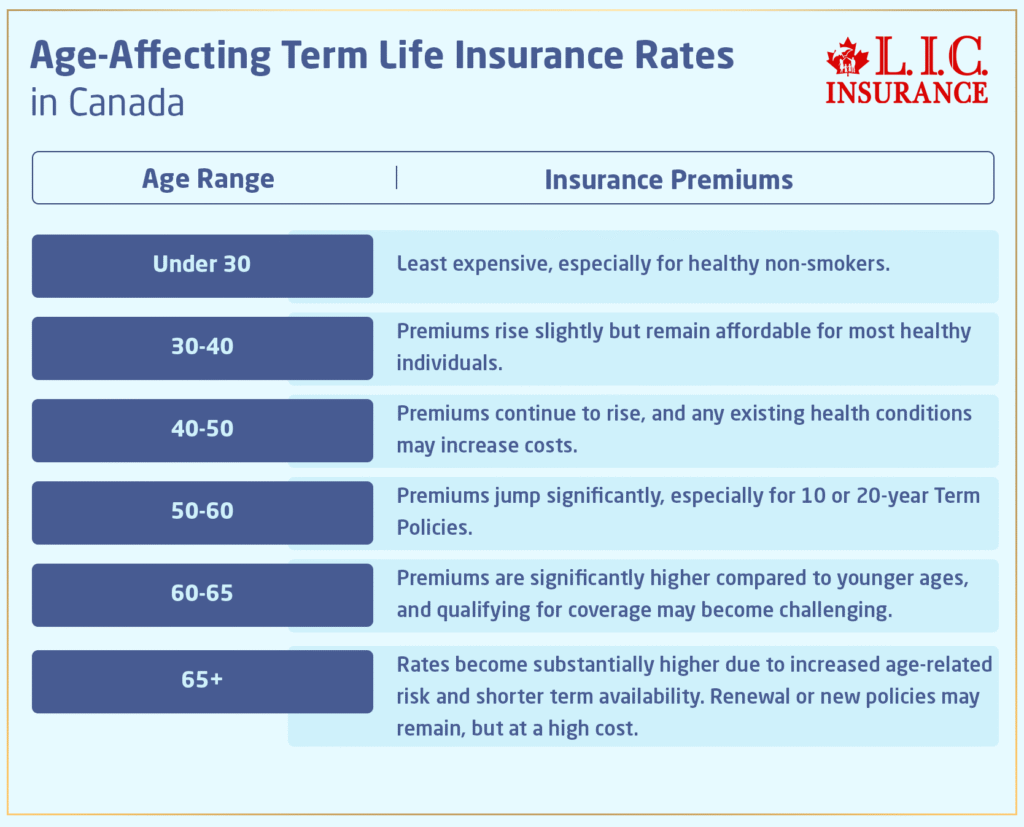
Here is a general overview of Term Life Insurance Plan Rates by Age Chart in Canada to better understand how premiums fluctuate as you age:
- Age under 30: Term Life Insurance policies are generally the least expensive at this age. If you are healthy and a non-smoker, rates for coverage will be positively below.
- 30-40: Premiums rise a bit but still remain quite affordable for most healthy individuals.
- 40-50: Your premiums keep getting higher as you age, plus any health conditions you have may add to the premiums.
- 50-60: By the time you’re in your 50s, you could be paying several times what you would have had to pay in your 30s. Life Insurance premiums really jump here, particularly for a 10 or 20-year term.
- At ages 60-65: Premiums reach their peak, and it may be challenging to qualify for coverage due to pre-existing health conditions.
65+ years old: You’re even older, which means if your term policy ends and you need to renew or purchase a new one, your rates will be extremely high since, at this age, the risk of health problems increases. That said, certain policies might remain, and partnering with the top Term Life Insurance Policy Brokers in Ontario, Canada, can aid your search.
Age-Affecting Term Life Insurance Rates in Canada
Term Life Insurance for Seniors, Retirement, and Age Limits in Canada
As premiums rise with age, many Canadians begin asking practical questions such as: what age does Life Insurance expire, can you buy Term Life Insurance after 65, and what is the maximum age for Life Insurance in Canada?
The answer depends on the type of policy and when it was purchased.
Term Insurance Age Limit in Canada
In Canada, insurers set two different age limits:
- Maximum issue age – the oldest age you can apply for a policy
- Maximum coverage age – the age at which coverage must end
For example:
- A 20 year Term Life Insurance Policy purchased at age 45 will expire at 65.
- The same 20-year term purchased at 50 will expire at 70.
So when people ask, at what age does Term Life Insurance end, the correct answer is: it ends at the completion of the chosen term — not at a universal expiry age.
Most insurers allow new applications for shorter Limited Term Life Insurance Plans into the late 60s or early 70s, though term length options become restricted. That’s why many individuals researching Term Life Insurance for seniors over 65 often see shorter duration products available.
Life Insurance After Retirement
Another common concern is: what happens to Life Insurance when you retire?
If you own an individual Term Life Insurance Canada Policy, retirement does not cancel it. Your coverage continues until the end of the term.
However, employer-sponsored group coverage often reduces or ends at retirement. This is why some individuals discover they “lose Life Insurance when they retire” — but it is the group plan ending, not the concept of Life Insurance itself.
For retirees exploring Life Insurance after retirement, the decision usually depends on:
- Remaining debts
- Income protection for a spouse
- Estate or tax planning goals
- Final expense funding
In these cases, shorter-term coverage or smaller face amounts may help manage affordability.
Does Term Life Insurance Premium Increase With Age?
This is one of the most misunderstood areas.
With Canadian Level Term Life Insurance, your premium remains fixed during the selected term (10, 20, or 30 years). It does not increase annually during that level period.
However, if you renew after the term expires, premiums increase sharply because they are recalculated based on your attained age. That is why many people notice significant jumps when coverage continues beyond 60 or 65.
Age affects:
- Mortality risk
- Available term length
- Qualification criteria
- Overall Term Life Insurance Policy rates
Health, smoking status, and coverage amount also influence what affects Term Life Insurance rates by age.
Buying Term Life Insurance in Old Age
When people search for Life Insurance old age, or the cheapest Life Insurance for seniors in Canada, they are often balancing cost with practicality.
The most affordable structure at older ages is typically:
- Shorter term duration
- Lower coverage amount
- Strong health rating
- Comparison of multiple Term Life Insurance quotes
Longer terms become expensive because insurers price in higher probability of claim during the coverage window.
For seniors over 65, approval is still possible, but underwriting becomes more selective. Certain insurers may cap term length or reduce maximum face amounts.
Clarifying a Common Confusion: Health Insurance After 65 Canada
Some readers researching Health Insurance after 65 Canada mistakenly believe this relates to Life Insurance expiry.
Health insurance covers medical expenses.
Life Insurance provides a death benefit to beneficiaries.
Provincial health plans continue after 65. Term Life Insurance Coverage ends only when the selected term expires or if premiums are not paid.
These are separate financial tools serving different purposes.
Why You Should Consider the Best Term Life Insurance Policy Brokers in Ontario, Canada
Navigating the complex world of Term Life Insurance can make all the difference with the help of an experienced insurance broker. Here, the top Term Life Insurance brokers in Ontario, Canada, can assist you in the following ways:
- Get the appropriate policy for your needs: Insurance brokers evaluate your specific situation and find additional coverage that suits your requirements. They can assist you in deciding if you might need a term life policy expiring at age 65 or covering after this age.
- Shop for the Best Rates: Since rates go up with age — a lot — it’s important to shop for the best premiums. A broker can assist you in comparing quotes and ensuring that you are receiving the most competitive rates for your coverage.
- Assist With Conversions and Renewals: If the time is nearing when your term life policy will expire, and you need to decide whether to renew, convert to Permanent Insurance or purchase a new policy, brokers can help guide you through the decision-making process.
- Provide Continuing Support: Insurance brokers are not just there for the first few years of your policy; they are your continuing support throughout the lifetime of the insurance policy as you experience changes in your business. They can assist with any claims, renewals or updates you require as you age and your needs evolve.
What to Do if Your Term Life Insurance Expired at Age 65
If you turn 65 and your policy has expired, don’t panic. Here is what you should do:
- Evaluate Your Coverage Needs: Evaluate whether you still need life insurance coverage. If you have dependents, a mortgage or other large expenses, you may want life insurance.
- Review Your Current Policy: If your policy is about to expire, see if it includes an option for renewal or conversion to Permanent Coverage.
- Consult an Insurance Broker: If you are not sure about your options or need to check out new policies, consider contacting a qualified insurance broker, which can give you the most affordable quotes.
- Shop for Canada Term Life Insurance Policy quotes online: If you are buying a fresh policy, ensure that you compare Canada Term Life Insurance Policy prices online. That’ll help you find the best policy for your age, health and coverage needs.
Conclusion
For many people, Term Life Insurance is a vital financial instrument, offering significant Life Insurance protection over a defined timeframe. If you’re turning 65 soon or have already reached that milestone, knowing what to do once your policy’s expiration date arrives can keep you out of the confusion and headache — and possibly — out of a financial bind. Whether you decide to renew, convert, or purchase a new term life policy from the best Term Life Insurance Policy Brokers in Ontario, Canada, Be sure the Term Life Insurance Policy you are purchasing meets your coverage needs.
Your age and health status are some of the most important factors that determine both the availability and cost of coverage as you weigh your options. The time to act is now — don’t wait until you end up with fewer options at an older age. Because you deserve the peace of mind that health insurance provides, and your family deserves to be taken care of for years to come.
More on Term Life Insurance
- What Is Level Term Life Insurance Policy And How To Buy It
- Can A Smoker Get Term Life Insurance?
- How Many Years Is A Term Life Insurance Policy?
- Which Company Has The Highest Claim Ratio In Term Insurance?
- What Is The Best Amount For Term Life Insurance Policy?
- How Expensive Is Term Life Insurance?
- What Is The Rule Of Term Life Insurance?
Get The Best Insurance Quote From Canadian L.I.C
Call +1 844-542-4678 to speak to our advisors.
Get Quote Now
FAQs
Not necessarily. Term Life Insurance expires at the end of the selected term (such as 10, 20, or 30 years). If the term ends when you are 65, then coverage stops at that time. However, it does not automatically expire at 65 unless your chosen term ends at that age. Some policies, however, allow you to renew or convert them to Permanent Life Insurance. The details depend on your policy’s terms and the provider.
In some cases, yes. If you have a term policy that allows you to renew it, you may be able to carry your coverage past age 65. Note that premiums can rise considerably as you get older. Confirm with your policy, or look for assistance from the best term life insurance policy brokers in Ontario, Canada.
You may still need life insurance if you have dependents, debts, or other financial responsibilities. Talk to an insurance broker who can help you evaluate your needs and cover options.
Yes, the rate of Term Life Insurance Plans by age chart in Canada indicates that as you get older, your premiums generally increase. The older, the higher the premium. That’s why, if you can, you should get a policy when you’re younger.
Yes, but it could be more expensive than you think. The majority of insurers will issue term life policies to older people, but the premiums will be far greater than for younger applicants. Make sure to get Canadian Term Life Insurance Policy Quotes Online to compare prices from different Life Insurance companies.
If your Term Life Insurance Plan ends at age 65, for example, you may be able to either renew your policy or convert it to a Permanent Life Insurance Policy. Alternatively, you might get a new term life insurance policy. But premiums will likely be higher because of your age.
Yes, some term life policies can be converted to Permanent Insurance without having to take a medical exam. If you’re nearing 65 and your term policy is running out, it’s an option worth considering. Speak to the leading Term Life Insurance Policy Brokers in Ontario, Canada, for tips.
Begin by searching online for Canadian term life insurance policy quotes to get the best rates. Even at an older age, an insurance broker can guide you through the options available and assist in securing the lowest-cost insurance that meets your needs.
As you age, your risk to the insurer grows, which can result in higher premiums. Health problems, lifestyle choices, and the length of the term also influence your premiums.
The simplest way to find the best brokers is to ask friends or family who have been using the services, or you can search them on the internet. A good broker will assist you with comparing different policies, deciphering what they entail, and walk you through the application process. They’ll make sure you get the best coverage for the lowest price.
Yes, there is a difference. Term Life Insurance covers you for a specific length of time, and whole life insurance covers you for your entire life. Whole life insurance is typically pricier, but it doesn’t end at 65 as a term policy can.
If, when your policy is set to expire, you’re stuck with inflated premiums for renewal, you might like to ponder changing your policy into a permanent life insurance policy or obtaining some new quotes. The right Term Life Insurance Policy Brokers in Ontario, Canada, can help you with cost options to meet your needs.
If you have health problems, renewing your term policy or purchasing a new policy may be difficult or costly. But if your existing policy has a conversion option, you might be able to roll it over into Permanent Life Insurance without taking a medical exam. Talk to your broker about this option to make sure you’re making the correct choice.
Most Canadian Term Policies have a maximum renewal age (commonly 75 or 80). There is no traditional term policy with unlimited age coverage. Policies such as Term-to-100 provide lifetime coverage but are classified as permanent insurance. These policies typically cost more but can offer peace of mind for individuals who still want coverage later in life. Just be sure to compare policies to find a good fit for your needs.
You can qualify for a Term Life Insurance policy after 65, but approval will be based on your health and the company’s criteria. If you want Term Life Insurance, contact us for online Canadian Term Life Insurance Policy quotes to see what’s available.
Sources and Further Reading
- Insurance Bureau of Canada (IBC) – Life Insurance
Learn about life insurance policies, coverage options, and how to make informed decisions regarding your insurance.
Website - Canadian Life and Health Insurance Association (CLHIA)
Offers resources and information on life insurance policies and their features, including Term Life Insurance and its duration.
Website - Financial Consumer Agency of Canada (FCAC) – Life Insurance
Get an overview of different types of life insurance policies, including Term Life Insurance, and how to choose the best one for your needs.
Website - Sun Life Financial – Life Insurance
Provides a detailed guide on Term Life Insurance Policies, including conversion options and renewal terms.
Website - Manulife – Term Life Insurance
Offers insights into how Term Life Insurance works, including coverage duration, renewal options, and premiums.
Website - Canada Life – Life Insurance Plans
Learn about life insurance products available in Canada, focusing on Term Life Insurance and what happens as you age.
Website - Financial Post – Life Insurance Articles
A comprehensive resource for financial topics in Canada, including in-depth articles on life insurance policies and market trends.
Website
Key Takeaways
- Term Life Insurance Expiry at Age 65: Many Term Life Insurance Policies in Canada expire at age 65, but options like renewal, conversion to Permanent Coverage, or purchasing a new policy exist.
- Premiums Increase with Age: As you age, Term Life Insurance premiums rise significantly. It’s crucial to understand how age impacts your rates by referring to the Term Life Insurance Plan Rates by Age Chart in Canada.
- Conversion Options: Some term policies allow you to convert to Permanent Insurance without medical exams, offering continued coverage beyond age 65.
- Work with Brokers: Partnering with the best Term Life Insurance Policy Brokers in Ontario, Canada, can help you navigate your options, find competitive rates, and secure the right coverage.
- Evaluate Your Needs: As you approach age 65, reassess your life insurance needs based on dependents, financial obligations, and health to make informed decisions on renewing or purchasing new coverage.
- Health and Coverage: If you have health issues or the policy expires, expect higher premiums or limited options. Consulting with a broker can guide you through the best strategies for continued coverage.
Your Feedback Is Very Important To Us
We want to understand your struggles and challenges when it comes to finding out whether Term Life Insurance expires at age 65. Your feedback will help us provide better information and services tailored to your needs. Please take a moment to fill out the questionnaire below.
Thank you for completing the questionnaire! Your feedback will help us provide more helpful information to you and others. If you’d like us to reach out for more assistance, please leave your name and email address above.
IN THIS ARTICLE
- Does Term Life Insurance Expire At Age 65?
- Does Term Life Insurance Expire at Age 65
- What Happens After 65?
- How Age Affects Term Life Insurance Rates in Canada
- Age-Affecting Term Life Insurance Rates in Canada
- Term Life Insurance for Seniors, Retirement, and Age Limits in Canada
- Why You Should Consider the Best Term Life Insurance Policy Brokers in Ontario, Canada
- What to Do if Your Term Life Insurance Expired at Age 65
- Conclusion
Sign-in to CanadianLIC
Verify OTP