- Connect with our licensed Canadian insurance advisors
- Schedule a Call


BASICS
- Is Infinite Banking A Smart Financial Strategy?
- Understanding the Infinite Banking Concept
- Why Infinite Banking Appeals to Canadians Seeking Financial Freedom
- How Infinite Banking Strategy Helps Build Financial Independence
- Challenges and Misconceptions About Infinite Banking
- Who Should Consider Infinite Banking for Financial Freedom?
- How to Start Your Infinite Banking Journey
- Key Advantages of the Infinite Banking Strategy
- A Day-to-Day Struggle: Why More Canadians Are Exploring Infinite Banking
- Potential Drawbacks You Should Know
- The Future of Infinite Banking in Canada
- Is Infinite Banking a Smart Financial Strategy?
COMMON INQUIRIES
- Can I Have Both Short-Term and Long-Term Disability Insurance?
- Should Both Husband and Wife Get Term Life Insurance?
- Can I Change Beneficiaries on My Canadian Term Life Policy?
- What Does Term Life Insurance Cover and Not Cover?
- Does Term Insurance Cover Death?
- What are the advantages of Short-Term Life Insurance?
- Which Is Better, Whole Life Or Term Life Insurance?
- Do Term Life Insurance Rates Go Up?
- Is Term Insurance Better Than a Money Back Policy?
- What’s the Longest Term Life Insurance You Can Get?
- Which is better, Short-Term or Long-Term Insurance? Making the Right Choice
IN THIS ARTICLE
- What is the minimum income for Term Insurance?
- How Does Income Affect Your Term Life Insurance Policy?
- Can You Buy Term Life Insurance Online with a Low Income?
- How Can You Lower Your Term Life Insurance Cost?
- How Much Term Life Insurance Do You Need?
- Can Your Term Life Insurance Policy Be Adjusted Over Time?
- Why Term Life Insurance Is Ideal for Lower-Income Canadians
- Final Thoughts
- More on Term Life Insurance
Who Can Be A Beneficiary In A Term Life Insurance Policy In Canada? Roles, Rights, And What You Should Know


By Pushpinder Puri
CEO & Founder
- 13 min read
- April 20th, 2026
SUMMARY
A detailed overview of who can be a beneficiary in Term Life Insurance Canada, explaining Term Life Insurance beneficiary rules, the roles of primary and contingent beneficiaries, the impact of revocable and irrevocable choices, and how clear beneficiary designations protect loved ones. It highlights the benefits of Term Life Insurance, payout rights, and how proper planning shapes a secure financial legacy.
Introduction
The discussions we have are usually initiated by one common file of silence, the silent enquiry of whether something will happen to me, and everything will fall at the correct places as I planned. It is an issue based on duty, on honour, and the wish to leave a financial legacy that will safeguard the ones we love most. And the figures indicate this fact. As the statistics provided by the government of Canada (2024) indicate, over 22 million Canadians have at least some kind of life insurance policy, and the vast majority of them mention the same reason: a need to protect their loved ones in case of the sudden loss of income in case of their unexpected death.
Nonetheless, despite millions of people being covered, most people who have Term Life Insurance in Canada do not understand the most important part of the insurance cover: who is allowed to be named as a beneficiary, their rights, and the consequences of these policies on their family over the decades. In a survey conducted by the Canadian Life and Health Insurance Association (CLHIA) in 2024, it was discovered that almost two out of every five policyholders do not completely comprehend their beneficiary designations, particularly what constitutes a primary beneficiary, a contingent beneficiary, and an irrevocable beneficiary. Such a misconception may cause legal time wastage, family feuds, and the misappropriation of money that was intended to save your loved ones.
This is the world where we give our clients their daily walk. And when you need to compare Term Life Insurance rates, consider Term Life Insurance beneficiary regulations, or just put the next phase in your financial life, it is not a matter of choice, but a necessity to get an idea of the role of beneficiaries.
It is time to disaggregate it and clarify, compassionately and with the experience that we have with thousands of Canadian families.
Understanding A Life Insurance Policy And Why Beneficiaries Matter
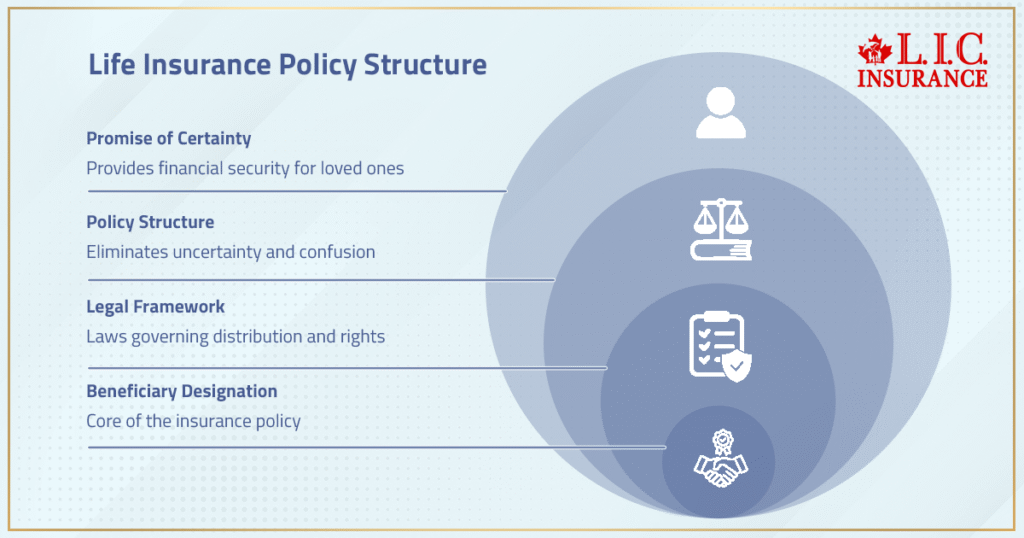
Whenever an individual buys a life insurance policy, he is not buying paper or coverage, but he is buying certainty. It is not just money paid out when a death benefit is paid out, but a promise. It is insurance for your loved ones, your children, and the future of your family. It keeps the people you love free, dignified, and capable of sustaining life without going bankrupt.
In Canada, your beneficiary will be the individual or organization which is entitled by law to the death benefit. That is to say that laws that control distribution, equality and human rights directly make a difference in what follows. It affects it all, your property, your duties, your will, and the insurance you have made.
An insurance policy that is well structured eliminates uncertainty. The one that is not structured properly confuses. And an absentee beneficiary at all? That forwards it all to your estate, delays the process with charges, probate, and legal snarls which none of us would wish to encounter in the depths of grief.
It is because beneficiary designations are the core of any insurance policy that we are assisting the Canadians in constructing.
Who You Can Choose As A Beneficiary In Canada
People often assume the beneficiary must be a spouse or a family member, but Canadian law gives you a wide range of choices — as long as the selection respects your personal wishes and complies with provincial law.
You may choose:
✔️ A spouse
✔️ Children
✔️ A parent
✔️ Any family member
✔️ A friend
✔️ A business partner
✔️ A charitable organization
✔️ A trust
✔️ A corporation
✔️ Your estate
✔️ Multiple beneficiaries
Each person or organization that you choose is a named beneficiary, and each has rights different than the other based on the type of category you choose. It is then that the roles come into play, particularly when you are dealing with the benefits of Term Life Insurance and the death benefit on its way directly where you want it to go.
Understanding The Role Of A Primary Beneficiary
The first to get the death benefit is the main beneficiary. Typically, it is your spouse, a family member, a child, or an advisor who you rely on, taking care of a variety of finances.
To select a primary beneficiary, one needs only one thing: clarity. You need to be aware of their age, their legal status, their relationship to you, as well as any of the situations which can make paying them complicated, such as divorce, separation, or estrangement.
We frequently remind clients that it is not only legal to choose a primary beneficiary, but also emotional. It is about respect, responsibility, and making somebody have the direct resources to cover the basic necessities like:
- Mortgage
- Daily expenses
- Education for children
- Settlement of debts
- Final medical care
The role is straightforward, but the consequences of choosing incorrectly—or not choosing at all—can be overwhelming for your family.
Why Contingent Beneficiary Choices Matter
The backup is a contingent beneficiary. When your main beneficiary is unable to get the payout because of death, state law, or rejection, your contingent beneficiary takes his place.
This plan shields your family against doubt. It makes sure that your benefits remain with individuals or organizations compared to your values, even in the event life takes its turn.
Common choices for a contingent beneficiary include:
- Adult children
- A sibling
- A charitable organization
- A trust for minors
- A second family member
- A business partner
Without a contingent beneficiary, your payout moves straight to the estate, creating avoidable delays, taxation risks, and unnecessary fees.
How Family Member Beneficiaries Shape Your Legacy
Choosing a family member is the most common approach to beneficiary planning. But each family member comes with different legal implications depending on their age, financial capability, or provincial rules.
For example:
- Minor children typically require a trustee.
- A dependent family member may receive the payout under stricter rules meant to protect the benefits.
- An estranged family member may still have legal grounds to challenge your wishes without clear documentation.
This stage requires care, planning, and often a trusted financial advisor to ensure everything aligns with long-term goals.
In every scenario, your family member beneficiary is at the heart of your financial legacy.
Understanding The Rights Of An Irrevocable Beneficiary
An irrevocable beneficiary changes everything. Once named, this beneficiary holds powerful legal rights, giving them certain rights you cannot remove without their written authority.
Their rights include:
- The right to approve changes
- The right to block policy cancellations
- The right to maintain their legal interest even in cases of divorce
This decision is to be considered thoughtfully and only in the case when the relationship is stable and based on trust.
By appointing an irrevocable beneficiary in Canada, the protections which are analogous to the international principles, especially the concept of equal and inalienable rights, are applied to the financial arrangements aimed at safeguarding liberty and personal dignity.
We see clients choose this option in situations involving:
- Long-term spousal protection
- Court-ordered arrangements
- Obligations after relationship changes
- Legacy planning involving dependents
It’s powerful — and permanent.
When A Revocable Beneficiary Is The Better Choice
Unlike an irrevocable designation, a revocable beneficiary can be changed at any time without permission. It gives you full freedom and control throughout your life.
Most people selecting Term Life Insurance in Canada opt for a revocable beneficiary because:
- Life circumstances evolve
- Family structures change
- Financial relationships shift
- Personal bonds strengthen or fade
This flexibility helps protect your loved ones with minimal legal friction. And as advisors, we always ensure clients understand the distinction — because the wrong selection can complicate the distribution of your death benefit for years.
How The United Nations Influences Beneficiary Rights In Canada
It may surprise many Canadians that the structure of beneficiary protections echoes principles found in the United Nations Declaration of Human Rights — especially the focus on equality, freedom, and fundamental freedoms.
In the insurance world, this translates into:
- Respect for your personal wishes
- Protection of your loved ones
- Legal safeguards to prevent discrimination
- The right to designate beneficiaries regardless of religion, age, political belief, or society
Canada’s insurance laws were built with those global standards in mind, ensuring every person has the right to assign coverage to any family, organization, or entity they choose.
How An Insurance Policy Distributes The Death Benefit
Your insurance policy outlines how the death benefit is distributed, to whom, and under what circumstances.
Key factors include:
- Percentage allocations
- Whether you selected multiple beneficiaries
- Whether a trustee is involved
- If the beneficiary is revocable or irrevocable
- Whether the payout goes to an estate
- Whether beneficiary designations comply with provincial law
The insurer holds the account, processes the claim, and ensures the benefits reach the correct person, organization, or trust — without interference.
We walk clients through each form, ensuring no detail jeopardizes the future security of the human family they’re protecting.
Your Loved Ones And The Importance Of Clear Beneficiary Designations
Your loved ones depend on your clarity. When you outline your beneficiary designations properly, you prevent:
- Family disputes
- Delays in payout
- Legal intervention
- Confusion during grief
- Unintended distributions
Stability, respect, and fairness in a family, particularly at the time of vulnerability, cannot be achieved without clear naming and appropriate documentation.
This is where Term Life Insurance actually comes in handy. It is not merely about the cost or terms of life insurance rates, but it is also about securing relations and ensuring harmony.
Common Beneficiary Mistakes We Help Canadians Avoid
After years of guiding clients across Canada, we repeatedly see the same mistakes:
1. Not Updating Beneficiaries After Major Life Events
Marriage, divorce, children, and new responsibilities — all require updates.
2. Forgetting To Add A Contingent Beneficiary
This forces payouts through the estate, adding months of delay.
3. Naming A Minor Without Assigning A Trustee
This leads to court involvement and restricted benefits.
4. Confusing Revocable And Irrevocable Rights
A single signature can permanently lock in someone’s future rights.
5. Not Considering Tax Or Legal Consequences
While the payout is tax-free, misunderstandings around policy loan balances or estate rules can reduce the total benefit.
We help clients avoid every one of these complications.
Final Thoughts: Beneficiary Planning Is About Love, Not Paperwork
Picking a beneficiary is not a transaction; it is an act of freedom, responsibility, and care. It is all about respecting your values and your history and those people who defined your life. It drives the rewards of your planning to precisely where your heart desires them to go.
When you have Term Life Insurance Canada, you are not merely trying to compare Term Life Insurance quotes or even calculate Term Life Insurance rates. You are defining the financial future of those that you love, you are attending to their needs, and you are creating a legacy based on the same principles that the United Nations describes as being necessary: dignity, equality, and inalienable rights.
We work with you as we do with any family to know you, safeguard your intentions, and give you that very assurance that your insurance policy will deliver everything you had in mind.
What you do today is what will be the strengths of your family tomorrow.
Get The Best Insurance Quote From Canadian L.I.C
Call +1 416-543-9000 to speak to our advisors.
Get Quote Now
FAQs
Yes, your beneficiary can be updated on most of the Term Life Insurance Canada Plans, provided the designation is revocable, whereby you are at complete liberty to reflect life changes. All that is required of the insurer is a signed request and a good identification. This ensures that your beloved people are safeguarded as your intentions are never off. Updates make sure that the death benefit is in line with your changing personal and financial needs.
Definitely yes! — The benefit of creating long-term impact could be listed in a charitable organization and not just in your own family. It is an option used by many Canadians in order to bequeath their finances to causes whose lives they have changed. It is an easy method to give back to the community or perform humanitarian work in the manner you believe is true. The death benefit does not pass through your estate to the charity.
In case no beneficiary is given, the payout will go to your estate, which will lead to delays, additional charges, and legal procedures that your loved ones will have to go through. This procedure may impact the speed at which money is made available to meet immediate demands. Any insurance policy should have clear instructions to prevent confusion for the family. Giving a name can be used to make sure that personal wants will be placed at the forefront of the distribution.
Yes – even when the beneficiary is living in another country, the insurer will still preserve the death benefit provided that the legal identity requirements are fulfilled. There might be some legal or documentation processes within certain regions, depending on the local regulations. You can enlist the assistance of our advisor to start early preparation against administrative delays. This simplifies the international planning of the Canadians who have relatives abroad.
A selection of more than one beneficiary gives you a chance to allocate the benefits in a manner that is not only representative of your family dynamics or long-term commitments. It may serve blended families, various-aged dependents, or divided duties. The percentage each individual gets is under your control, and there is no conflict. This will make your life insurance policy in line with your overall vision of stability and equality.
The death benefit can be given to a trust to handle the monies of minors, dependents, or vulnerable family members who require advice on money management. It provides systematic regulation of the way the benefits are discharged over time. Such a strategy is more respectful of long-term financial responsibility. It particularly comes in handy when creating a defence mechanism in the form of Term Life Insurance in Canada.
Yes, in the vast majority of cases, the beneficiary can use the death benefit as he wishes, so long as there is no trust or legal limitation putting conditions on it. These benefits are usually used by people to house, educate, commit, or even secure themselves. The aim is to secure their freedom in order to restore their lives following the loss. It is among the silent merits of the Term Life Insurance Canada planning.
The irrevocable beneficiary naming does indeed provide that individual with a defined authority over the alterations to the insurance policy, and in most cases, written consent of such person will be needed. This may constrain any amendments of coverage, future planning, or restructuring of finances. It is an effective title that applies in a scenario of long-term commitment or legal binding. One should never make this decision without consulting an advisor in order to be sure that it matches your long-term plans.
Canada typically considers death benefits payments tax-free, although in some cases, this may affect the result, including in cases of an existing balance in a policy loan. Clients getting money from an estate could have administrative consequences. Proper tax advice assists in safeguarding the overall value which is transferred to the loved ones. Planning is important to help you keep your financial legacy alive.
It is prudent to review your beneficiary decisions periodically, particularly when significant life changes occur. Having new relationships, family structure, or long-term coverage adjustments may affect the people you would like to cover. With the aid of such reviews, you can ensure fairness, respect your own desires, and prevent unforeseen situations. A significant number of Canadians accompany this with a financial check-in every year to keep abreast.
Sources and Further Reading
Beneficiary Rules, Life Insurance Basics & Policy Structure
- What Is a Beneficiary? — FCAC
https://www.canada.ca/en/financial-consumer-agency/services/insurance/life-insurance.html - Understanding Life Insurance in Canada — Insurance Bureau of Canada
https://www.ibc.ca/on/home/insurance/life-health
Legal Rights, Human Rights & International Principles
- Universal Declaration of Human Rights — United Nations
https://www.un.org/en/about-us/universal-declaration-of-human-rights - Canadian Human Rights Overview — Government of Canada
https://www.canada.ca/en/canadian-heritage/services/about-human-rights.html
Estate, Trustees & Distribution Rules
- Wills, Estates & Trusts — Canadian Bar Association
https://www.cba.org/For-The-Public/Legal-Information/Wills-and-Estates - Provincial Insurance Act (Ontario Example – FSRA)
https://www.fsrao.ca/industry/regulated-sectors/insurance
Consumer Rights & Policyholder Protections
- OmbudService for Life & Health Insurance (OLHI)
https://www.olhi.ca - Understanding Your Insurance Rights — FCAC
https://www.canada.ca/en/financial-consumer-agency/services/insurance.html
Taxation, Estate Handling & Death Benefit Guidance
- CRA – Estate & Trust Tax Information
https://www.canada.ca/en/revenue-agency/services/tax/individuals/topics/estate-planning.html - CRA – Life Insurance & Tax Considerations
https://www.canada.ca/en/revenue-agency/services/forms-publications/publications/it508r2.html
Industry Data & Statistics
- Statistics Canada – Financial Security Reports
https://www150.statcan.gc.ca/n1/en/type/data - CLHIA – Canadian Life & Health Insurance Industry Reports
https://www.clhia.ca/web/CLHIA_LP4W_LND_Webstation.nsf/page/Research?OpenDocument
Provincial Insurance Regulators (For Beneficiary & Policy Rules)
- FSRA Ontario
https://www.fsrao.ca - AMF Québec
https://lautorite.qc.ca - BC Financial Services Authority
https://www.bcfsa.ca
Key Takeaways
- Your beneficiary choice shapes the entire future of your life insurance policy.
The payout is more than a number — it’s part of your financial legacy, and choosing the right person or organization ensures your loved ones receive the support you intended. - Canada allows a wide range of beneficiary options, from family members to charitable organizations.
Flexibility is built into the system, but each option comes with unique legal rights and responsibilities that must align with your personal wishes. - Knowing the difference between primary, contingent, revocable, and irrevocable beneficiaries is essential.
These roles determine how the death benefit moves, who has authority, and how easily you can make changes as life evolves. - Clear beneficiary designations prevent delays, legal conflicts, and unexpected estate involvement.
Proper planning protects your loved ones from unnecessary stress, fees, and long wait times during an already difficult moment. - Regular updates keep your policy aligned with your current life circumstances.
Marriage, children, separation, business changes, and shifting family dynamics all require fresh beneficiary reviews to ensure accuracy and fairness. - Guidance from a financial advisor strengthens your long-term planning.
With expert support, your coverage, beneficiary choices, and long-term goals stay in sync — protecting both your family and your intentions with clarity and confidence.
Your Feedback Is Very Important To Us
We appreciate you taking a moment to share your thoughts. Your feedback helps us understand where Canadians feel uncertain or overwhelmed when choosing a beneficiary for a Term Life Insurance Policy — and it helps us guide families with more clarity and confidence.
Please answer the questions below:
IN THIS ARTICLE
- Who Can Be A Beneficiary In A Term Life Insurance Policy In Canada? Roles, Rights, And What You Should Know
- Understanding A Life Insurance Policy And Why Beneficiaries Matter
- Who You Can Choose As A Beneficiary In Canada
- Understanding The Role Of A Primary Beneficiary
- Why Contingent Beneficiary Choices Matter
- How Family Member Beneficiaries Shape Your Legacy
- Understanding The Rights Of An Irrevocable Beneficiary
- When A Revocable Beneficiary Is The Better Choice
- How The United Nations Influences Beneficiary Rights In Canada
- How An Insurance Policy Distributes The Death Benefit
- Your Loved Ones And The Importance Of Clear Beneficiary Designations
- Common Beneficiary Mistakes We Help Canadians Avoid
- Final Thoughts: Beneficiary Planning Is About Love, Not Paperwork
Sign-in to CanadianLIC
Verify OTP