- Connect with our licensed Canadian insurance advisors
- Schedule a Call

BASICS
- Is Infinite Banking A Smart Financial Strategy?
- Understanding the Infinite Banking Concept
- Why Infinite Banking Appeals to Canadians Seeking Financial Freedom
- How Infinite Banking Strategy Helps Build Financial Independence
- Challenges and Misconceptions About Infinite Banking
- Who Should Consider Infinite Banking for Financial Freedom?
- How to Start Your Infinite Banking Journey
- Key Advantages of the Infinite Banking Strategy
- A Day-to-Day Struggle: Why More Canadians Are Exploring Infinite Banking
- Potential Drawbacks You Should Know
- The Future of Infinite Banking in Canada
- Is Infinite Banking a Smart Financial Strategy?
COMMON INQUIRIES
- Can I Have Both Short-Term and Long-Term Disability Insurance?
- Should Both Husband and Wife Get Term Life Insurance?
- Can I Change Beneficiaries on My Canadian Term Life Policy?
- What Does Term Life Insurance Cover and Not Cover?
- Does Term Insurance Cover Death?
- What are the advantages of Short-Term Life Insurance?
- Which Is Better, Whole Life Or Term Life Insurance?
- Do Term Life Insurance Rates Go Up?
- Is Term Insurance Better Than a Money Back Policy?
- What’s the Longest Term Life Insurance You Can Get?
- Which is better, Short-Term or Long-Term Insurance? Making the Right Choice
IN THIS ARTICLE
- What is the minimum income for Term Insurance?
- How Does Income Affect Your Term Life Insurance Policy?
- Can You Buy Term Life Insurance Online with a Low Income?
- How Can You Lower Your Term Life Insurance Cost?
- How Much Term Life Insurance Do You Need?
- Can Your Term Life Insurance Policy Be Adjusted Over Time?
- Why Term Life Insurance Is Ideal for Lower-Income Canadians
- Final Thoughts
- More on Term Life Insurance
Why Do Seniors Need Funeral Insurance In Canada?


By Harpreet Puri
CEO & Founder
- 13 min read
- Sep 17, 2026
SUMMARY
Funeral Insurance for seniors can help cover funeral costs in Canada, burial or cremation costs, medical bills, outstanding debts, and other final expenses. It explains Funeral Insurance Coverage, no medical Life Insurance for seniors, Guaranteed Acceptance Life Insurance, Whole Life Insurance for seniors, tax-free death benefits, CPP death benefits, coverage amounts, premiums, and how to compare affordable Funeral Insurance quotes.
Introduction
The funeral is one of the most substantial immediate expenditures the family will incur following the death of their loved one. Despite opting for a basic service, the cost will soon escalate as they add on transport services, fees from the funeral home, burial or cremation, cemetery plot, casket or urn, flowers, notifications, and paperwork.
In Canada, there is a wide variation in the cost of funerals across provinces, cities, and the providers of such funeral services. According to Sun Life, the costs associated with a traditional funeral and burial in Canada may amount to about $5,000 to $25,000, while cremation may cost about $2,000 to $5,000. The cost estimate, as per Reuters, was about $2,000 to $12,000.
In cases where there are older people who have little money saved up, whose retirement is a fixed monthly income, suffer from poor health, or have no individual Life Insurance, this can pose a huge financial burden on the family. Funeral Insurance can give them an additional death benefit, which can be used to pay for all the funeral expenses, debt, medical bills, and so on.
Here, we guide seniors on the working process of Funeral Insurance in Canada and find out what type of Life Insurance will be more suitable for them.
Why Funeral Planning Becomes More Important In Retirement
The process of funeral planning becomes more important for seniors post-retirement due to the change in their financial status compared to when they were still working. They might no longer have any employer Life Insurance; their Term Life Insurance will end soon, and their source of regular income could become the pension, government benefits, or retirement fund.
In addition, many assets of the senior, including the house, registered investments, or other assets, could be locked up and not accessible to the family. The funeral home or cemetery will ask for immediate payment for the funeral services even before the inheritance process starts.
Pre-planning enables seniors to feel more in control about how the costs will be covered and provides information to the family on how the costs will be handled – using savings, Life Insurance, prepayment, or Funeral Insurance.
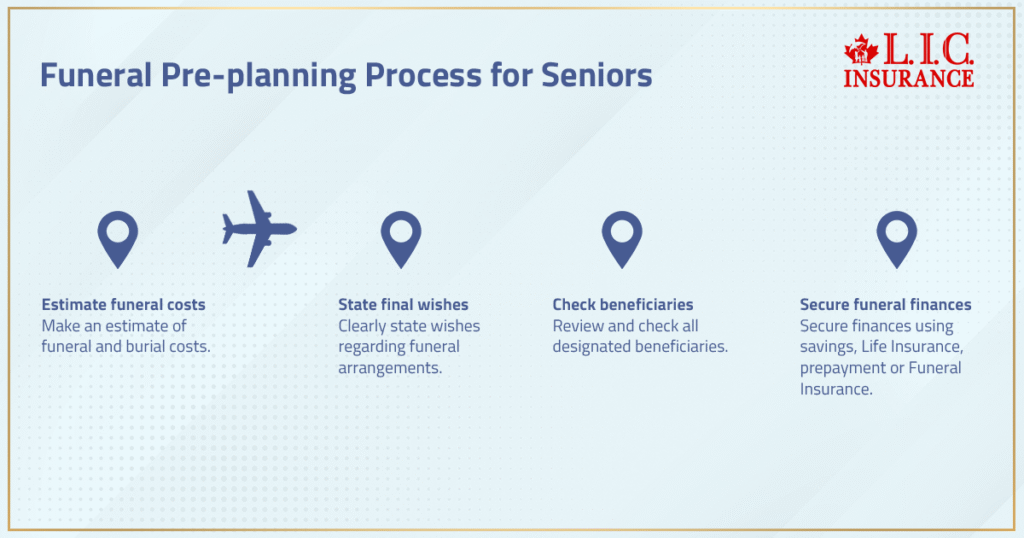
This process is vital to the elderly who do not want to leave their children or relatives with any unforeseen funeral costs. It allows the elderly to make their last arrangements more manageable for the loved ones left behind by making an estimate of funeral and burial costs, stating wishes, checking beneficiaries, and securing finances.
Why Seniors May Need Help To Cover Funeral Costs
The majority of seniors think that the funds available through their savings, estate, or governmental aid will suffice for paying for funeral costs. In reality, the funds may not be available until the funeral bills start coming in.
The home, car, investment portfolio, or some other asset within the estate may have significant value. But it takes time to process the required paperwork, settle the debts, sell the assets, or go through the probate process. Funeral companies may demand payments way before the estate is settled.
It is up to the family members to finance funeral costs out of their personal savings or credit cards. This process becomes even more complicated because the relatives are usually dealing with other expenses related to travel, absence from work, bills at home, legal services, and the grief of losing someone.
For seniors, the Funeral Insurance provides an additional source of funds. The beneficiary gets the money after the claim for Life Insurance is paid out.
This protection may be particularly useful when a senior:
- Has limited cash savings
- Lives on a fixed retirement income
- No longer has employer Life Insurance
- Has an existing policy that may expire
- Wants to leave savings or property for other purposes
- Does not want children to pay funeral expenses personally
- Has health conditions that make traditional coverage difficult to obtain
Funeral Insurance cannot remove the emotional difficulty of losing a family member, but it can reduce some of the immediate financial pressure.
Understanding Funeral And Burial Costs In Canada
| Expense Category | Possible Charges |
|---|---|
| Funeral Home Services | Professional services, planning, facilities and administration |
| Transportation | Transfer of the deceased and funeral vehicles |
| Preparation | Embalming, dressing, cosmetics or other care |
| Casket Or Urn | Product costs vary widely by material and design |
| Burial | Cemetery plot, grave opening, closing and interment |
| Cremation | Crematorium fee, container, urn and related services |
| Ceremony | Venue, officiant, flowers, notices and refreshments |
| Memorial | Headstone, marker, plaque or other memorial item |
| Documents | Death certificates and permit-related charges |
| Estate Administration | Probate, accounting or legal fees where required |
The funeral home service charge is only one part of the total. In some cases, cemetery land, a casket, interment charges, or a monument may be among the largest expenses.
Before choosing how much Funeral Insurance Coverage to purchase, seniors should request local price estimates and discuss their funeral and burial wishes with family members.
How Funeral Insurance Coverage Works
A Funeral Insurance Policy works much like other personal Life Insurance products.
Firstly, the senior makes his/her choice on the available death benefit amount. This could depend on the anticipated costs for funeral and burial, any debts owed, savings, and Life Insurance already in place.
The policyholder proceeds to pay premiums on a monthly or yearly basis. There are some plans that offer level premiums, which are supposed to remain constant throughout the plan period. In addition, there are other types of products that offer different premium schedules; hence, seniors need to know how their premiums will change in the future.
After the death of the insured, the beneficiary reports back to the insurer and makes the Life Insurance claim. The insurer may require the completion of claim forms, proof of death, details about the policy, and other necessary documentation.
The insurance claim is accepted, and the insurer releases the required death benefit amount in a single lump-sum payment.
The time required to process a claim depends on the insurer, the documents provided, the cause of death, the age of the policy, and whether additional review is required. Claims involving incomplete information, a recent policy, or a death during a waiting or contestability period may take longer.
How Funeral Insurance Can Cover Final Expenses
Although the coverage is commonly called Funeral Insurance, beneficiaries can generally use the Life Insurance payout for more than the funeral service itself.
The death benefit may help cover:
- Funeral home charges
- Burial or cremation costs
- A cemetery plot or marker
- Transportation and travel expenses
- Medical bills
- Credit cards or personal loans
- Utility bills
- Mortgage payments
- Legal and accounting fees
- Estate administration costs
- Memorial gatherings
- Immediate living expenses for a surviving spouse
- Other final expenses
This flexibility can be useful because the financial consequences of death do not stop with the funeral.
The remaining spouse can require assistance with the payment of regular family living costs. Children may come in from other provinces or even other countries. There can be outstanding taxes, debts, costs related to the property, or even fees payable to professionals.
It is up to the beneficiary how he/she will use the proceeds of the Life Insurance Policy, unless there has been an assignment of the policy or some other legal structure put in place.
This is one of the key distinctions between funeral expense insurance and a pre-paid funeral program. Insurance offers funds once the claims have been approved. Prepaid funeral contracts offer the purchase of specific goods/services.
Benefits Of Final Expense Insurance For Seniors
Final expense insurance may provide practical protection when a senior needs a modest amount of permanent Life Insurance rather than a large income-replacement policy.
Smaller Coverage Amounts
Not all seniors will require coverage in excess of hundreds of thousands of dollars. The senior’s mortgage may be fully paid for, their children may no longer depend on them, and their retirement income may terminate at death.
Funeral Insurance that is tailored to meet their needs may concentrate on the burial and funeral costs, debts, and the costs of administering the estate, without having the senior buy coverage they do not need.
There are Funeral Insurance Policies offered in the range of about $5,000 to $25,000. This should be considered only a general product range, as availability will be contingent on many factors.
Permanent Life Insurance Protection
Many Funeral Insurance Policies operate on a permanent Life Insurance scheme. Permanent insurance schemes usually guarantee that the cover remains valid throughout the lifetime of the insured as long as payments and other conditions of the policy are met.
Permanent insurance schemes could be preferable for the purpose of covering funeral expenses as compared to Term Life Insurance schemes since funeral costs may come at any age, while a term policy may lapse before death.
Predictable Payments
Certain plans provide for guaranteed premiums that may assist seniors in budgeting effectively while receiving CPP, OAS, pension, RRIF, or other retirement income.
Yet, one cannot assume that each plan provides for fixed premiums. The illustration and the contract must clearly explain the premium period, premium guarantees, and penalties for non-payment.
Simplified Application Options
Most final expense policies are without the need for a medical exam. Based on the policy, the senior is asked a number of health-related questions or is enrolled under guaranteed acceptance.
This would allow the Funeral Insurance to be more affordable to individuals who have health issues or do not wish to undergo blood testing, urine testing, or a paramedical exam.
Financial Support For Family Members
The death benefit would be helpful for the family when they need it most. The money will ensure that the family members don’t use their credit cards, personal funds, or even their retirement accounts to meet funeral expenses.
The policy is also useful since the family will be able to fulfill the funeral and burial desires of the senior citizen without always considering the cost factor.
No Medical Life Insurance For Seniors: What It Really Means
| Coverage Type | Medical Exam | Health Questions | General Features |
|---|---|---|---|
| Fully Underwritten Insurance | May Be Required | Detailed | May offer more coverage or better pricing for healthy applicants |
| Simplified-Issue Insurance | Usually Not Required | Usually Required | Shorter application and limited medical underwriting |
| Guaranteed Acceptance Life Insurance | Generally Not Required | Few Or No Questions | Easier eligibility, but often higher premiums and restricted early benefits |
The simplified issue insurance may inquire into any previous hospitalization, any history of cancer, heart problems, respiratory problems, physical disability, or other such health-related information. Acceptance into such a plan will depend on how the applicant responds to these inquiries.
Guaranteed Acceptance Life Insurance can even be obtained in cases where an individual has a poor state of health. Nevertheless, such insurance plans are often more expensive than their face value and come with a waiting period.
For instance, if the insured person dies of anything but accidental death during the waiting period, then the insurance will return the premiums along with interest, rather than paying the whole death benefit.
A no-medical policy should therefore not be selected simply because its application is easier. Seniors should compare it with medically underwritten and simplified-issue alternatives whenever possible.
Funeral Insurance For Seniors With Health Issues
Funeral Insurance may be valuable for seniors who have been declined for traditional coverage or who believe their health will prevent them from qualifying.
Diabetes, heart disease, history of cancer, respiratory issues, or decreased mobility do not automatically rule out all possible insurance programs. Different insurance carriers provide forms for simple insurance policies that have separate eligibility criteria.
The person can be ineligible for one policy but eligible for the other, where the death benefit will be lower, there will be a higher premium, the coverage will be graded, or there will be a waiting period.
Guaranteed Acceptance Life Insurance is the type of insurance that has the fewest medical underwriting requirements. This type of insurance may be appropriate if no other coverage is available; however, it must usually be evaluated carefully since the price per dollar of insurance is higher.
We suggest evaluating different options instead of buying the first easy-to-get policy. There may be an opportunity to get better coverage for a senior, especially if medical conditions are controlled.
How Much Funeral Insurance Coverage Do Seniors Need?
| Financial Need | Illustrative Estimated Amount |
|---|---|
| Funeral Home And Service | $4,000 |
| Cremation Or Burial | $3,000 |
| Cemetery Or Memorial | $2,000 |
| Family Travel | $1,000 |
| Medical Bills | $500 |
| Outstanding Debts | $1,500 |
| Legal And Estate Costs | $1,000 |
| Short-Term Family Support | $1,000 |
| Total Estimated Need | $14,000 |
| Existing Savings And Life Insurance | − $5,000 |
| Suggested Coverage To Review | $9,000 |
In this case, the overall expenses that the senior is expected to incur in total will be about $14,000. With $5,000 in savings and Life Insurance coverage, the remaining financial need will be about $9,000. Therefore, the senior will have to look at Funeral Insurance Policies with $10,000 coverage.
These are just estimates of costs because the funeral costs in Canada differ depending on place, funeral homes, cemetery, services, and personal preferences. Traditional burials will be more costly compared to direct cremations, particularly if one includes a cemetery plot, casket, viewing services, transportation, and memorial services.
Another important factor that should be considered in this case is the potential increase in cost due to inflation. For instance, a funeral that will cost $9,000 today will be more costly a few years down the road. Therefore, seniors should review their policies periodically.
Existing protection should also be confirmed before buying a new Funeral Insurance Policy. Employer coverage may end at retirement, Term Life Insurance may expire, and mortgage insurance generally protects the lender rather than providing unrestricted financial support to family members.
Funeral Insurance Vs Traditional Life Insurance
| Feature | Funeral Insurance | Traditional Life Insurance |
|---|---|---|
| Main Purpose | Funeral and other final expenses | Income, debts, estate, business and family protection |
| Typical Coverage | Usually modest | May be substantially larger |
| Underwriting | Often simplified | May be fully underwritten |
| Medical Exam | Often not required | May be required |
| Cost Per Dollar Of Coverage | Often higher | May be lower for qualifying applicants |
| Coverage Period | Commonly permanent | Term or permanent |
| Possible Uses | Funeral, burial, debts, and bills | Funeral, mortgage, income replacement, and estate needs |
Traditional Life Insurance can offer much wider financial security. With a bigger Life Insurance Policy, one may compensate for the income loss, take care of a partner, pay off a loan, finance education, cover tax expenses, or leave an inheritance.
On the other hand, final expense insurance has a narrower scope. This type of insurance is usually taken out by seniors who need less money or do not meet the requirements to get a fully underwritten policy.
Premium rates on Funeral Insurance are relatively high compared to the sum insured. The reason is that policyholders are typically older and underwriting is restricted.
The first step for a healthy senior is to consider permanent Life Insurance, Term Life Insurance, simplified issue insurance, and final expense insurance.
Funeral Insurance Vs Whole Life Insurance For Seniors
Whole Life Insurance for seniors and Funeral Insurance may overlap.
Many Funeral Insurance Policies are technically small Whole Life Insurance Policies. The phrase “Funeral Insurance” describes the intended purpose, while “Whole Life Insurance” describes the type of policy.
A broader Whole Life Insurance Plan may offer:
- A higher death benefit
- Guaranteed lifetime coverage
- Fixed premiums
- A cash value component
- Estate-planning uses
- More extensive underwriting
- Greater flexibility for family or charitable goals
A Funeral Insurance Policy may offer a smaller death benefit, a simpler application, and fewer policy features.
Whole Life Insurance may be more suitable when the senior wants to leave a larger inheritance, cover taxes, support a dependant, or create long-term estate liquidity.
Final expense insurance may be more practical when the primary concern is paying funeral expenses and small debts.
Why Funeral Insurance Premiums May Be Higher
Funeral Insurance is usually very expensive relative to the amount of coverage.
One of the major factors causing that is age. The greater the risk of claiming becomes, the more expensive the insurance gets. An insurance policy written for someone aged seventy or eighty will be relatively more expensive than a similar insurance for a young individual.
The absence of medical underwriting is another factor which causes high pricing. If the insurance company asks for little or no medical information from the applicant, then it cannot differentiate low risks from high risks.
The insurer may manage this additional risk through:
- Higher premiums
- Lower maximum coverage
- Waiting periods
- Graded death benefits
- Age restrictions
- Policy exclusions
Permanent Life Insurance is more expensive than temporary term insurance since it is meant to pay out a death benefit as long as the policy is still in effect.
It is important for seniors to look at how much the premiums will be on average before buying Life Insurance. It can look cheap initially, but it might become hard to manage later on.
The best kind of policy is the one where protection is high, and payments remain affordable.
Are Funeral Insurance Payouts Tax-Free In Canada?
A personal Life Insurance death benefit paid to a named beneficiary is generally received as a one-time tax-free payment in Canada.
The Financial Consumer Agency of Canada describes Life Insurance as providing beneficiaries with a one-time, tax-free death benefit.
This generally means that a beneficiary does not include the death benefit itself as ordinary taxable income.
However, additional considerations may arise when:
- The estate is named as the beneficiary
- The insurer holds the payment and pays interest
- The policy is owned by a corporation
- The proceeds are paid through a trust
- The policy has been transferred or assigned
- The beneficiary lives outside Canada
Probate, estate administration, creditor claims, and tax reporting may also depend on how the beneficiary designation and ownership are structured.
Seniors with business interests, trusts, substantial estates, or unusual beneficiary arrangements should obtain personalized legal and tax advice.
Can The Canada Pension Plan Cover Funeral Costs?
The Canada Pension Plan provides a one-time death benefit when the deceased contributor meets the eligibility rules.
Beginning from January 1, 2025, the CPP death benefit is made up of a basic amount of $2,500 and an optional amount of $2,500, which is a top-up. It is therefore possible for the total maximum benefit to be $5,000 under certain conditions. The optional amount will normally apply when the deceased had not received retirement or disability benefits and did not leave an eligible beneficiary.
The Government of Canada 2026 payment table shows the standard death benefit at around $2,606.18 after CPP enhancements, as well as the optional amount of $2,500 when the requirements are fulfilled.
It is important to verify eligibility directly since the contribution record, QPP membership, international social security agreement, and beneficiary’s situation may affect the payment.
The death benefit provided under the CPP can take care of the cost of funeral arrangements, but this may not be enough to cover all the final expenses, including funeral costs, burial costs, a cemetery lot, and debts.
There are also issues of taxation of this death benefit that require careful consideration. According to the Canada Revenue Agency, the CPP/QPP death benefit is usually paid to the estate and not reported as income on the final income tax return of the decedent. Depending on who gets the death benefit, it might have to be reported.
Considering this, seniors cannot depend on the CPP death benefit alone for funeral arrangements.
Funeral Insurance And Estate Taxes In Canada
There is no specific federal inheritance tax in Canada for the mere fact that a person has inherited. But there may be various taxes and estate costs as a result of death.
A tax return will have to be prepared by the person responsible for the estate for the period during which the deceased individual was alive. This will account for any income, as well as an increase in the value of property, investments, and other assets up to the time of death.
The deceased person is deemed to have sold his or her capital property just before dying.
Other expenses may include:
- Income tax owing
- Tax arising from registered accounts
- Probate or estate administration charges
- Legal fees
- Accounting fees
- Property expenses
- Executor costs
- Outstanding debts
- Tax on income earned by the estate
A Life Insurance death benefit can create liquidity for these expenses, but a small Funeral Insurance Policy may not be enough for a complex estate.
Seniors with cottages, rental properties, private corporations, large RRSP or RRIF balances, or substantial investments may need broader permanent Life Insurance and professional estate planning.
Who Should Consider Funeral Insurance?
Funeral Insurance for seniors may be appropriate for someone who:
- Has little money set aside for funeral expenses
- Wants to leave a dedicated amount for final expenses
- No longer has employer Life Insurance
- Has a term policy that will soon expire
- Has health issues that limit other options
- Does not require a large income-replacement benefit
- Wants permanent coverage
- Prefers predictable premiums
- Does not want relatives paying costs out of pocket
This could be useful especially when the majority of the seniors’ money is in property or investments that cannot be readily accessed by family members.
If the senior already has sufficient savings and/or Life Insurance coverage or a prepaid funeral, then Funeral Insurance may be less required.
If there will be problems maintaining such coverage due to expensive premiums, then this may not be a worthwhile solution since it might lapse before it is needed.
The key here is the financial situation of the senior, the health of the individual, existing coverage, affordability, and available alternatives.
How Funeral Insurance Helps Family Members At The End Of Life
The days following a death can involve many decisions. Family members may need to contact a funeral home, locate the will, obtain proof of death, notify banks and government agencies, arrange transportation, and begin managing the estate.
They may also have to make choices about burial or cremation, ceremonies, cemetery arrangements, notices, and memorial services.
Without proper preparation, these choices might be made hastily and under great emotional stress.
Funeral Insurance may help financially by ensuring that a certain amount of money is set aside for this purpose. This will help the family members perform the funeral of the senior as per his/her wishes without having to rely solely on credit or personal savings.
The whole process of planning can prove helpful in its own right. As the senior makes decisions about funeral arrangements, estimates costs, organizes documentation, and clarifies about beneficiaries, the family is bound to feel assured in the future.
Insurance is just one component of end-of-life planning. Senior citizens must ensure that they have a current will, power of attorney, list of accounts, insurance, debt, contact numbers, etc.
How To Compare Funeral Insurance Quotes
| Policy Feature | What To Check |
|---|---|
| Death Benefit | Is the amount enough for expected final expenses? |
| Monthly Premium | Can the payment be maintained comfortably? |
| Premium Guarantee | Is the premium fixed for life? |
| Coverage Duration | Does the protection remain in force permanently? |
| Medical Requirements | Are there questions, records, or examinations? |
| Waiting Period | When does the full benefit become available? |
| Early Death Benefit | What is paid if death occurs during the waiting period? |
| Exclusions | Are any causes of death excluded? |
| Age Limits | Is the applicant eligible at the current age? |
| Beneficiary Rules | Can primary and contingent beneficiaries be named? |
| Cash Value | Does the policy build any accessible value? |
| Cancellation Terms | Is there a free-look or review period? |
| Claims Process | What documents will the beneficiary need? |
The lowest Funeral Insurance quote may not provide the strongest value. One plan may cost slightly more but offer immediate coverage, stronger guarantees, or fewer restrictions.
Applicants should also confirm whether premiums are payable for life or for a limited number of years. A limited-pay policy may have higher initial premiums but no payments after the specified period.
How Canadian LIC Helps Seniors Compare Funeral Insurance
We understand that Funeral Insurance is not only about selecting a death benefit. Seniors also need to understand affordability, medical eligibility, waiting periods, beneficiary arrangements, and how the policy fits with their broader estate plans.
Our licensed advisors can help seniors:
- Estimate how much coverage may be required
- Compare Funeral Insurance quotes
- Review simplified-issue and guaranteed acceptance options
- Understand medical underwriting requirements
- Compare immediate and deferred coverage
- Review fixed-premium options
- Compare Funeral Insurance with Whole Life Insurance
- Identify possible gaps in existing coverage
- Understand beneficiary designations
- Select protection that fits a retirement budget
We compare available options based on the senior’s age, health, desired death benefit, province, and financial priorities.
The objective is not simply to find the easiest policy to obtain. It is to find suitable coverage that the senior understands and can maintain.
Create Financial Support Before It Is Needed
Funeral costs in Canada can put undue financial pressure on a family if one has no savings or the money from the estate is not readily available.
Funeral Insurance for seniors is a way to have a tax-free death benefit that can help cover funeral and burial expenses, cremation, any outstanding medical expenses, debts, legal fees, and other final expenses. It may work well for seniors who face health problems, who have little savings, or are not covered by their workplace anymore, or who need simple, permanent insurance.
Still, Funeral Insurance is not always the best solution. The premiums can be higher than the coverage. Some plans will also require a waiting period.
When you are going to buy Funeral Insurance, consider different plans, check the premiums, review the exclusions, calculate the death benefit needed, and determine what you already have in terms of savings and insurance.
Canadian LIC can help you compare Funeral Insurance quotes, review no-medical Life Insurance for seniors, and determine whether final expense insurance or Whole Life Insurance better suits your needs.
Author: Harpreet Puri, Licensed Insurance Adviser | MDRT Qualifier
Experience: 14 Years In Life Insurance & Financial Planning
LinkedIn Profile:https://www.linkedin.com/in/harpreetpuricanadianlic/
Disclaimer: Insurance availability, premiums, underwriting, waiting periods, exclusions, tax treatment, and benefit amounts vary by insurer and individual circumstances. This information is general and should not replace personalized insurance, legal, or tax advice.
FAQs
Funeral Insurance may be worthwhile when a senior has limited savings, no permanent Life Insurance, or health conditions that make traditional coverage difficult to obtain. It can provide a dedicated payment for funeral costs and other final expenses. Its value depends on the premiums, death benefit, waiting period, existing resources, and how long the policy remains active.
Yes, some seniors with poor health may qualify for simplified-issue or Guaranteed Acceptance Life Insurance. A medical exam may not be required. However, premiums may be higher, coverage amounts may be lower, and the policy may include a waiting period before the full death benefit applies.
The insurance company usually pays the named beneficiary rather than the funeral home. The beneficiary can then use the funds to pay funeral bills and other expenses. A direct payment or assignment may be possible under a separate arrangement, but it should not be assumed without confirmation.
Yes. Beneficiaries may generally use the death benefit for direct cremation, a full-service cremation funeral, an urn, memorial services, transportation, and other final expenses. The policy does not usually limit payment to a traditional burial.
The terms are often used interchangeably. Both usually refer to a smaller Life Insurance Policy intended to help cover funeral, burial, cremation, and other end-of-life expenses.
Claim timing varies by insurer and circumstances. A complete and straightforward claim may be processed more quickly than one involving missing documents, a recent policy, a waiting period, or additional investigation. Beneficiaries should contact the insurer promptly and provide all requested information.
The policy may enter a grace period and eventually lapse if payments are not made. Some Whole Life Insurance Policies may have non-forfeiture or cash-value options, but these depend on the contract. Seniors should contact the insurer before missing a payment.
Many policies allow multiple primary beneficiaries and one or more contingent beneficiaries. The policyholder can specify the percentage each person should receive. Beneficiary information should be reviewed after marriages, divorces, deaths, or other major family changes.
Some whole life Funeral Insurance Policies may build cash value, while other final expense products may provide little or no accessible value. Applicants should not assume that cash value is included unless it appears in the policy illustration and contract.
The answer depends on timing and affordability. Savings remain flexible and do not require insurance approval, but it can take years to accumulate the required amount. Insurance may create a larger immediate benefit after coverage becomes effective, but it requires continuing premiums and may include policy restrictions.

Sources and Further Reading
- Life Insurance — Financial Consumer Agency Of Canada
Explains Life Insurance coverage, beneficiaries, death benefits, term insurance, permanent insurance, and how payouts may cover funeral expenses and debts. - CPP Death Benefit — Government Of Canada
Covers CPP death benefit eligibility, application requirements, payment rules, and the additional benefit available in qualifying circumstances. - CPP Payment Amounts — Government Of Canada
Provides current CPP payment amounts, including information about the one-time CPP death benefit. - Death Benefits And Tax Reporting — Canada Revenue Agency
Explains how CPP and QPP death benefits may need to be reported for income-tax purposes. - Doing Taxes For Someone Who Died — Canada Revenue Agency
Provides information about final tax returns, estate responsibilities, outstanding taxes, and notifying government agencies. - Funeral Consumer Information — Office Of Consumer Affairs
Offers Canadian consumer guidance on funeral services, planning, prearrangements, costs, and provincial regulations. - Preparing For End Of Life — Government Of Canada
Covers wills, funeral planning, insurance policies, important documents, and advance preparation for end-of-life responsibilities. - Having A Will And Making Funeral Plans — Government Of Canada
Provides funeral-planning and will-related information specifically relevant to older Canadians. - What To Do When Someone Dies — Government Of Canada
A central resource covering documents, government notifications, benefits, taxes, and estate responsibilities after a death. - Benefits And Programs After A Death — Government Of Canada
Summarizes the CPP death benefit, survivor’s pension, children’s benefits, and other programs that may apply. - How Much Does A Funeral Cost In Canada? — Sun Life
Discusses estimated funeral, burial, and cremation costs and the factors that can affect the final amount. - Life Insurance For Funeral And Burial Costs — Sun Life
Explains how a Life Insurance death benefit may help pay funeral, burial, cremation, and other final expenses. - Tips For Planning A Funeral — Sun Life
Provides practical information about planning arrangements, estimating funeral costs, and checking available insurance benefits. - How Life Insurance Works In Canada — Sun Life
Explains premiums, beneficiaries, death benefits, and how Life Insurance may cover funeral costs, debts, and broader family needs.
Key Takeaways
- Funeral Insurance for seniors can provide a dedicated death benefit for funeral and burial costs, cremation, medical bills, debts, legal fees, and other final expenses.
- Funeral costs in Canada vary widely based on location, funeral home services, burial or cremation choices, cemetery fees, and memorial arrangements.
- Many Funeral Insurance Policies offer relatively modest coverage amounts, often designed for final expenses rather than income replacement or large estate needs.
- Final expense insurance is commonly structured as permanent Life Insurance, so coverage may remain active for life as long as premiums are paid and policy conditions are met.
- Many no medical Life Insurance options do not require a medical exam, but applicants may still face health questions, age limits, waiting periods, or graded death benefits.
- Guaranteed Acceptance Life Insurance may suit seniors with serious health conditions, although premiums are often higher relative to the coverage amount.
- Fixed premiums can help seniors budget on a limited retirement income, but applicants should confirm whether the premium is guaranteed for life.
- Life Insurance death benefits paid to named beneficiaries are generally received tax-free in Canada, although estate and tax considerations may apply in certain arrangements.
- The CPP death benefit may help with funeral expenses, but eligibility and payment amounts vary, and it may not cover the full cost of a funeral.
- Seniors should calculate their expected funeral expenses, debts, family support needs, and existing savings before deciding how much Funeral Insurance Coverage to review.
- Funeral Insurance should be compared with Whole Life Insurance, Term Life Insurance, personal savings, and prepaid funeral arrangements.
- Comparing Funeral Insurance quotes should involve more than price. Seniors should review premiums, waiting periods, exclusions, underwriting, benefit amounts, and long-term affordability.
Your Feedback Is Very Important To Us
Your feedback will help us understand the financial concerns, coverage questions, and planning difficulties seniors and their families face. Please answer only the questions you are comfortable sharing.
IN THIS ARTICLE
- Why Do Seniors Need Funeral Insurance In Canada?
- Why Funeral Planning Becomes More Important In Retirement
- Why Seniors May Need Help To Cover Funeral Costs
- Understanding Funeral And Burial Costs In Canada
- How Funeral Insurance Coverage Works
- How Funeral Insurance Can Cover Final Expenses
- Benefits Of Final Expense Insurance For Seniors
- No Medical Life Insurance For Seniors: What It Really Means
- Funeral Insurance For Seniors With Health Issues
- How Much Funeral Insurance Coverage Do Seniors Need?
- Funeral Insurance Vs Traditional Life Insurance
- Funeral Insurance Vs Whole Life Insurance For Seniors
- Why Funeral Insurance Premiums May Be Higher
- Are Funeral Insurance Payouts Tax-Free In Canada?
- Can The Canada Pension Plan Cover Funeral Costs?
- Funeral Insurance And Estate Taxes In Canada
- Who Should Consider Funeral Insurance?
- How Funeral Insurance Helps Family Members At The End Of Life
- How To Compare Funeral Insurance Quotes
- How Canadian LIC Helps Seniors Compare Funeral Insurance
- Create Financial Support Before It Is Needed
Sign-in to CanadianLIC
Verify OTP