- Connect with our licensed Canadian insurance advisors
- Schedule a Call

BASICS
- Is Infinite Banking A Smart Financial Strategy?
- Understanding the Infinite Banking Concept
- Why Infinite Banking Appeals to Canadians Seeking Financial Freedom
- How Infinite Banking Strategy Helps Build Financial Independence
- Challenges and Misconceptions About Infinite Banking
- Who Should Consider Infinite Banking for Financial Freedom?
- How to Start Your Infinite Banking Journey
- Key Advantages of the Infinite Banking Strategy
- A Day-to-Day Struggle: Why More Canadians Are Exploring Infinite Banking
- Potential Drawbacks You Should Know
- The Future of Infinite Banking in Canada
- Is Infinite Banking a Smart Financial Strategy?
COMMON INQUIRIES
- Can I Have Both Short-Term and Long-Term Disability Insurance?
- Should Both Husband and Wife Get Term Life Insurance?
- Can I Change Beneficiaries on My Canadian Term Life Policy?
- What Does Term Life Insurance Cover and Not Cover?
- Does Term Insurance Cover Death?
- What are the advantages of Short-Term Life Insurance?
- Which Is Better, Whole Life Or Term Life Insurance?
- Do Term Life Insurance Rates Go Up?
- Is Term Insurance Better Than a Money Back Policy?
- What’s the Longest Term Life Insurance You Can Get?
- Which is better, Short-Term or Long-Term Insurance? Making the Right Choice
IN THIS ARTICLE
- What is the minimum income for Term Insurance?
- How Does Income Affect Your Term Life Insurance Policy?
- Can You Buy Term Life Insurance Online with a Low Income?
- How Can You Lower Your Term Life Insurance Cost?
- How Much Term Life Insurance Do You Need?
- Can Your Term Life Insurance Policy Be Adjusted Over Time?
- Why Term Life Insurance Is Ideal for Lower-Income Canadians
- Final Thoughts
- More on Term Life Insurance
RRSP Loan Vs LOC Canada: Which Saves More?

By Pushpinder Puri
CEO & Founder
- 10 min read
- July 21, 2026
SUMMARY
RRSP loan Canada vs Line of Credit Canada comparison covering RRSP loan rates in Canada, tax refund RRSP loan strategies, contribution room usage, interest rates, and cash flow impact. Explains how borrowing money affects taxable income and retirement savings, with real scenarios showing when RRSP loans or a Line of Credit can save more based on income and financial stability.
Introduction
Why More Canadians Are Borrowing To Build Retirement Savings
More and more Canadians find themselves in an increasingly common scenario: high income, high expenses, and the feeling that their retirement savings could still use some improvement. It turns out that millions of dollars in RRSP contribution room are never taken advantage of every single year, according to the Canada Revenue Agency. Checking your own contribution room through the government’s RRSP Contribution Room Details is a great way to see what you might be missing out on in terms of tax savings and contributions. Unutilized RRSP contribution room means lost tax savings, which results in increased taxable income and lower returns on investment.
According to the latest figures from the Canadian Life and Health Insurance Association, RRSP accounts still play a major role for Canadians, with well over a trillion dollars in RRSP savings across the country.
While this may be the case, interest rates and inflation have changed the way people think about saving. The wait-and-save model used to make sense, but nowadays, that is no longer realistic for many. This is why plans such as RRSP loans in Canada and the comparison between an RRSP loan versus a Line of Credit in Canada have become popular. Rather than waiting until they have saved enough money, individuals now borrow and contribute to their RRSP right away.
However, the true decision comes down to the choice of financing rather than borrowing per se. Regardless of whether it is a conventional loan or a Line of Credit, there will be different implications when it comes to cash flow and interest rates.
Understanding RRSP Loan Canada And How It Works
RRSP loan is a type of loan which assists Canadian citizens in making a lump sum contribution to their RRSP in Canada, especially before the RRSP deadline date. Most financial organizations offer this loan type to their clients during the RRSP season.
In an RRSP loan, the borrower gets the loan amount, deposits it into his/her RRSP, and starts repaying it within a certain period. This loan type is structured, hence, it is easy to pay back since it has regular monthly payments.
From the mechanism of working of an RRSP loan, it becomes easy to see its strategic benefit. By contributing to your RRSP, you will reduce the amount of money that you pay tax on. This contributes to receiving a significant tax refund. The refund received, especially from those who are in high tax brackets, can help repay the borrowed loan quickly.
Nonetheless, it is crucial to clear up a popular misunderstanding. Even though RRSP contributions are tax-deductible, RRSP loan interest is not. As such, even though you enjoy the benefit of a tax deduction, you continue to incur interest costs on the loan.
In essence, an RRSP loan provides individuals with the opportunity to combine several years’ worth of RRSP contributions into one single act. This will enable them to capitalize on unused RRSP contribution room and enjoy enhanced growth potential.
What Is An RRSP Line of Credit And How It Works
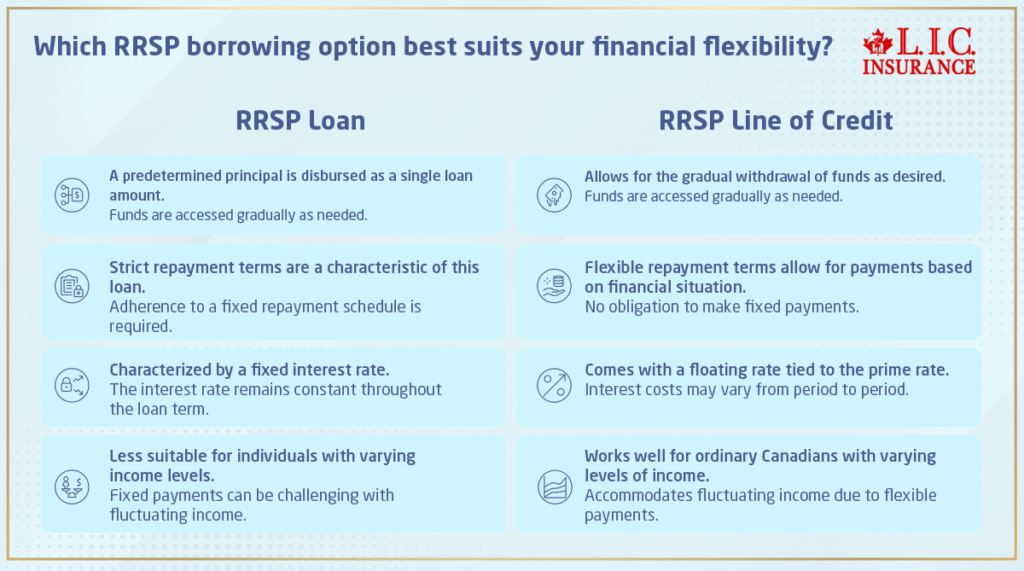
The RRSP Line of Credit offers another strategy. Rather than taking out a loan with a predetermined principal, it offers access to an account that allows for the gradual withdrawal of funds.
In this case, it becomes possible to take out money whenever one wants, to make RRSP deposits, and then to pay off the borrowed sum based on one’s financial situation. There is no need to adhere to strict repayment terms because they are flexible.
While a conventional RRSP loan is characterized by a fixed rate, the RRSP Line of Credit comes with a floating rate tied to the prime rate. As such, the interest costs may vary from period to period.
This option works well for ordinary Canadians because they have varying levels of income and are not obligated to make fixed payments.
Key Differences Between RRSP Loan Vs Line of Credit Canada
| Feature | RRSP Loan | Line of Credit |
|---|---|---|
| Structure | Fixed loan | Revolving credit |
| Interest Rate | Fixed or variable | Variable (prime rate-based) |
| Payment | Fixed monthly payments | Flexible payments |
| Contribution Style | Lump sum | Gradual contributions |
| Cash Flow Impact | Predictable | Flexible |
| Risk Level | Lower | Higher (rate fluctuations) |
The distinction comes down to control versus certainty. A loan offers discipline and predictability, while a Line of Credit provides adaptability and convenience.
Borrowing Money For Retirement Savings: Is It Worth It?
The concept of borrowing money to invest in the RRSP scheme seems daunting at first glance. From a surface perspective, borrowing money for investment purposes is a risky affair. In reality, however, borrowing money for investment is a good strategy if it is done well.
By putting your money in an RRSP as early as possible, you will have enough time for it to grow. The power of compounding is maximized if you invest your money early.
Nevertheless, it should be noted that borrowing money for investment in the RRSP scheme will be beneficial only if the pros are greater than the cons.
How Contribution Room Impacts Your Decision
A key consideration is the availability of contribution room. There are many Canadians who have saved contribution room year after year through various competing financial considerations.
The advantage of an RRSP loan is that one will utilize the available contribution room right away, rather than saving it up for future years. This may be particularly useful if one is just entering into a new, higher tax bracket.
Using this method, people will have a greater tax refund, thus accelerating their retirement savings.
Interest Rates Comparison: RRSP Loan Vs Line of Credit
Interest rate is another very important aspect when making a choice. An RRSP loan usually carries low interest rates during the RRSP period because lending institutions are always trying to lure customers into using these services.
A Line of Credit will mostly be determined by the prime interest rate. Banks like National Bank of Canada and Royal Bank of Canada have structured their credit facilities around this rate, with an additional premium that depends on the customer’s credit rating.
The problem with the Line of Credit is that it is uncertain since any increase in the prime interest rate translates to higher interest charges, hence higher interest payments for the client.
2026 RRSP Loan Vs Line of Credit Rate Snapshot (Canada)
| Product Type | Typical Rate Range (2026) | Structure | Risk Level |
|---|---|---|---|
| RRSP Loan (Fixed) | 5.95% – 7.45% | Fixed payments | Lower |
| RRSP Loan (Variable) | Prime + 0.50% to 1.50% | Semi-flexible | Medium |
| Line of Credit | Prime + 0.00% to 2.50% | Fully flexible | Higher |
Real Lender Quote Example (Canada – 2026)
To provide real-world context, major lenders like the Royal Bank of Canada and the National Bank of Canada typically offer RRSP borrowing products based on the prime rate.
As of early 2026, a common range observed across leading financial institutions:
- RRSP Loan (Fixed Term): ~6.25% – 7.25%
- RRSP Loan (Variable): Prime + 0.75% to 1.25%
- Line of Credit: Prime + 0.00% to 2.00%
A customer who can show good credit approval will have access to a loan that is almost as good as a prime loan; some will be offered better loans based on their incomes and financial statuses. Comparing the loan options from lenders like RBC RRSP Loan and Credit Options or National Bank RRSP Lending Solutions would be helpful in validating offers.
Tax Refund Strategy: How RRSP Loans Can Create More Money
The strongest reason for taking out an RRSP loan is the tax refund approach. With each contribution made, the taxable income will drop. The resulting tax refund can turn out to be significant, particularly for high-income earners.
Suppose a person makes contributions totaling $20,000. Based on their tax bracket, they stand to get a refund worth thousands of dollars. That money can be used to repay the loan, thus lowering both interest and principal amount owed.
By borrowing money and using that to earn refunds through contributions, it becomes possible to pay off debts faster. And if implemented well, such an approach can generate more earnings than simply making late contributions.
Cash Flow Considerations Before You Borrow
Cash flow is one of the most critical factors involved in determining which option to take. Structured loans need regular repayments that may become difficult if one’s income is erratic.
On the other hand, credit lines enable one to be more flexible regarding repayment. One can pay the least amount when times are tough and pay higher amounts as their financial situation gets better.
Flexibility might help borrowers avoid any kind of pressure, but the lack of a proper payment schedule may lead individuals into debt much longer than planned.
When RRSP Loan Makes Sense (And When It Does Not)
RRSP loans are appropriate when one earns regular income, pays taxes at a higher rate, and has adequate means to meet repayment terms. They work best for people who need to play catch-up in their Registered Retirement Savings Plan in Canada
On the other hand, it would be unwise for someone who has existing debts or irregular income streams to go ahead and make RRSP loans.
Personal financial knowledge is important.
Line of Credit Advantages for a Flexible Contribution Strategy
The Line of Credit strategy has been favoured by many due to its flexibility. Contributions can be made progressively in line with one’s pattern of income generation.
This strategy enables progressive contributions without the need to make hefty lump sum contributions. In addition, this strategy enables one to be flexible in light of changes in interest rates.
Many Canadians use this approach when contributing to their RRSPs.
RRSP Loan Vs LOC Tax Savings Calculation
In order to highlight the distinction, take the example of an employee who earns $90,000 per year. By putting aside $20,000 into his RRSP account, he manages to bring down his taxable income by a considerable amount.
Taking into account the marginal tax rate that might be around 40%, he will manage to save about $8,000, which can be used to repay the loan.
In case the funds were borrowed from the Line of Credit, any increase in interest rates could end up increasing the interest payable.
Ontario Tax Impact
Think of someone earning $95,000 per year in Ontario province. Given the combined federal and provincial tax rates, his marginal tax rate is estimated at 43.41%.
If he decides to contribute to his RRSP by borrowing $20,000, there will be a noticeable drop in the amount of taxable income. As a result, this person is expected to get back a tax refund of about $8,600. By utilizing the tax savings to repay the borrowed amount, there will be a reduction in the interest costs and borrowed funds.
As compared to another taxpayer who falls under a low tax bracket in the same province, he will only benefit from lower tax refunds, which means borrowing money will not save much.
What Financial Institutions Offer In Canada
Most financial institutions in Canada will give RRSP loans at RRSP loan time. Financial institutions like the National Bank of Canada and the Royal Bank of Canada will give loans and lines of credit at different interest rates and conditions.
The application will depend on factors like credit rating, salary, and the level of debt. Some financial institutions will even expedite the process to ensure that clients meet RRSP time requirements.
Special Use Cases: Home Buyers Plan And Lifelong Learning Plan
The RRSP fund is utilized through various schemes such as the Home Buyers’ Plan and the Lifelong Learning Plan. In these plans, withdrawals can be made without facing any tax penalties, as long as there is repayment of the amount.
Involving oneself in these plans using borrowed money can prove to be very useful, but the individual must be aware of the repayment scheme.
Common Mistakes Many Canadians Make
There are many Canadians who under-estimate the effect of interest and over-estimate their capacity to repay the loaned amount. Other people do not use their tax refund effectively.
A third mistake is that of disregarding cash flow constraints. Lack of adequate planning on the individual’s behalf can lead to difficulties, even when following a proper RRSP strategy.
To avoid these mistakes, one should think clearly and realistically.
Which Option Saves More In Practice
The individual, who had a steady salary of $95,000, came to us during the RRSP period and had considerable room to make contributions. Upon assessing his income consistency, tax bracket, and other debts, it was suggested that he take out an RRSP loan in Canada. The structured nature of the loan suited him as he could easily repay his monthly dues. He received a tax deduction of around $8,500 from his RRSP contributions, and this amount went directly towards paying off the loan principal. Consequently, not only were the costs incurred less, but the repayment duration was shortened as he paid off his debt in 11 months.
On the other hand, for a self-employed individual with variable monthly earnings, a different method had to be employed. The fixed payments approach would create undue stress during months where the income is not steady, posing additional financial risks. In this case, the RRSP Line of Credit Canada method was advised. This enabled him to make deposits from $500 to $1,500 based on his financial condition and maintain a balanced deposit without going overboard financially. He could borrow money whenever necessary and repay at his own convenient pace, thus avoiding any additional costs.
Near-Retirement, Lower Income Strategy Adjustment
A client aged 58 years, about to retire and earning an annual salary of $52,000, came to us seeking advice regarding how best to use their unused RRSP contribution room. Initially, we considered using an RRSP loan Canada scheme. However, considering their low tax bracket, the expected tax savings would not be substantial. The additional monthly loan repayments would further burden them financially.
We advised our client to take a more cautious approach. The client should make use of the Registered Retirement Savings Plan contribution room gradually by making contributions whenever there is a good cash flow. They should avoid taking any debts to finance their contributions since this will leave them financially strained.
RRSP Loan Vs LOC: Final Decision Framework
There are many considerations when deciding whether to use a RRSP loan or a Line of Credit.
For someone who prefers discipline, the RRSP loan might be more suitable since this will give him structure and guidance on how to save. Conversely, if he requires flexibility, then perhaps the Line of Credit will serve him better.
Ultimately, it should fit into his plans for saving money for retirement.
Personalized Advice From A Financial Planner
Decision-making regarding borrowing and investing needs proper planning. Even though broad principles serve as a basis for decision-making, specific advice would ensure that the strategy matches the unique situation.
One may seek help from a financial advisor to come up with an appropriate financial strategy.
Quick Decision Checklist: RRSP Loan Vs Line of Credit Canada
Any RRSP loan or Line of Credit must be carefully considered, with regard to your overall financial position. The process of borrowing needs to take place within the context of a broader financial plan, rather than as an independent activity.
The assistance of a professional helps to explore your choices, compare rates on RRSP loans in Canada, and come up with the best course of action for you.
Professional advice turns a borrowing opportunity into a powerful tool for financial success.
Speak With An Advisor Before You Borrow
Decision-making regarding borrowing and investing needs proper planning. Even though broad principles serve as a basis for decision-making, specific advice would ensure that the strategy matches the unique situation.
One may seek help from a financial advisor to come up with an appropriate financial strategy.
Written By: Harpreet Puri
Licensed Insurance Adviser | MDRT Qualifier
With over 14 years of experience in Life Insurance, wealth planning, and tax-efficient strategies for Canadians.
Disclaimer:
This content is for informational purposes only and does not constitute financial, tax, or legal advice. Individual financial situations vary, and readers should consult a qualified financial advisor before making decisions related to RRSP loans, lines of credit, or any borrowing strategy.
FAQs
Where returns are below expectations, the individual will still have to repay the borrowed money and pay the interest accrued on the loan. This leads to a disparity between the gains from investing and the cost of borrowing. The importance of risk tolerance before borrowing is evident here.
There are cases where there is an option for deferring the payment. In such instances, the borrower will begin making payments after some months. The benefit of this arrangement is that one can utilize his/her tax refund on the loan from the onset.
Borrowing allows for immediate utilization of excess contribution room, but contribution splitting allows for minimizing debt risk. The choice will depend on how stable an individual’s income is and what their expected future income levels are.
Inflation will decrease the real cost of repayment for structured loans. In addition, inflation will result in an increase in interest rates, thus affecting the lines of credit. The effect of inflation on lending will be useful in guiding decisions concerning which type of loan is more advisable.
People who work for themselves usually experience fluctuating income streams, which makes the Line of Credit a better choice when it comes to contributing to their RRSPs. They can only borrow what they need. This approach ensures that borrowing is in line with their income pattern.
Late repayments might affect one’s credit rating and increase the total amount of debt incurred via interest payments. The terms or penalties agreed upon between the parties could be changed by the lender. Proper financial planning should therefore precede loan acquisition.
RRSP loans can be described as investment-related loans; however, RRSP loans differ from other types of investment loans. First, the interest on RRSP loans cannot be written off against income tax. This difference plays a role in calculating the cost of the loan.
Unforeseen income, such as bonuses, may be utilized for additional repayments, leading to faster reductions in the principal amount. Interest is minimized while returns are maximized. Repayment periods are also greatly reduced. The judicious use of surplus funds increases the efficiency of borrowing.
The young population will benefit in the long run if they begin investing at an earlier age, but borrowing money too early could prove to be dangerous for them. Making small investments initially would be more realistic. Borrowing will become easier as one earns a steady income.
When you take out an RRSP loan or use your Line of Credit, your total credit utilization rises. This could affect your eligibility for additional loans, such as mortgage loans. Lenders scrutinize the total amount of your debts before approving any lending decisions.
Yes, one can take a loan through a Line of Credit for funding the RRSP. This method makes it convenient to fund the RRSP at one’s own speed rather than all at once. However, there is a downside when the loan rate is variable, since that will influence the amount borrowed.
Most banks in Canada allow for the application process of RRSP loans on their online portals. Some examples of such banks include the Royal Bank of Canada and the National Bank of Canada. By considering more than one bank, better rates can be obtained for such loans. The online application process is much faster.
A fixed-term loan is best for people who want regular payments and known rates of interest expense. A revolving credit arrangement will be good for you as this includes a flexible credit limit and allows borrowing money at intervals. It is important that you choose based on your ability to make consistent contributions.
Many major financial organizations, such as the Royal Bank of Canada and the National Bank of Canada, usually offer competitive line-of-credit alternatives. The interest rates may be linked to the prime rate with the addition of margins depending on the creditworthiness of the borrower. Shopping will lead to discovering better deals.
The RRSP loan usually follows a fixed payment schedule that is fixed, which means that you have to make regular payments for a predetermined period of time. On the other hand, the Line of Credit provides more flexibility since you can choose whether you want to pay the interest or reduce the principal amount.
Sources and Further Reading
Registered Retirement Savings Plan (RRSP) Overview – Canada Revenue Agency
Comprehensive guide to RRSP rules, contributions, withdrawals, and tax implications in Canada.
RRSP Loans – RBC Royal Bank
Details on RRSP loan options, benefits, and how borrowing can support retirement savings and tax efficiency.
RBC RRSP Loan Strategy & Tax Savings Insights
Explains how RRSP loans can help reduce tax bills and accelerate retirement savings using borrowed funds.
Borrowing To Contribute To Your RRSP – RBC Financial Planning
Covers when borrowing makes sense, including the role of tax rates, investment returns, and repayment considerations.
Personal Loans And Lines Of Credit – RBC Overview
Explains how lines of credit work, including flexible borrowing, repayment, and interest-only payment options.
RRSP Contribution Limits And Rules – RBC Guide
Key details on eligibility, contribution limits, and how RRSP contributions impact taxable income.
RRSPs And Other Registered Plans Guide – Canada Revenue Agency
In-depth technical reference on RRSP taxation, contribution limits, and compliance rules.
Home Buyers’ Plan (HBP) – Canada Revenue Agency
Explains how RRSP funds can be withdrawn for home purchases and repaid over time.
Key Takeaways
- RRSP loan Canada and RRSP Line of Credit Canada strategies both help accelerate retirement savings, but the better option depends on cash flow, discipline, and interest rate conditions.
- An RRSP loan works best for individuals with stable income, offering fixed payments and predictable interest costs while maximizing contribution room in one step.
- A Line of Credit provides flexibility, allowing Canadians to borrow money gradually and manage RRSP contributions based on changing cash flow and income patterns.
- The tax refund RRSP loan strategy can significantly reduce effective borrowing cost when refunds are applied directly toward the loan principal.
- Interest rates play a critical role, with fixed loans offering stability and lines of credit exposing borrowers to rising interest costs tied to the prime rate.
- Contribution room and tax bracket determine overall savings, with higher tax brackets benefiting more from large, immediate RRSP contributions.
- Real-life scenarios show that structured loans suit salaried individuals, while flexible credit options are often better for self-employed or variable-income earners.
- Choosing between RRSP loan vs Line of Credit Canada should focus on long-term financial alignment, not just short-term borrowing convenience.
- Professional guidance ensures borrowing decisions support sustainable wealth building rather than increasing unnecessary debt.
Your Feedback Is Very Important To Us
IN THIS ARTICLE
- RRSP Loan Vs LOC Canada: Which Saves More?
- Understanding RRSP Loan Canada And How It Works
- What Is An RRSP Line of Credit And How It Works
- Key Differences Between RRSP Loan Vs Line of Credit Canada
- Borrowing Money For Retirement Savings: Is It Worth It?
- How Contribution Room Impacts Your Decision
- Interest Rates Comparison: RRSP Loan Vs Line of Credit
- Real Lender Quote Example (Canada – 2026)
- Tax Refund Strategy: How RRSP Loans Can Create More Money
- Cash Flow Considerations Before You Borrow
- When RRSP Loan Makes Sense (And When It Does Not)
- Line of Credit Advantages for a Flexible Contribution Strategy
- RRSP Loan Vs LOC Tax Savings Calculation
- What Financial Institutions Offer In Canada
- Special Use Cases: Home Buyers Plan And Lifelong Learning Plan
- Common Mistakes Many Canadians Make
- Which Option Saves More In Practice
- RRSP Loan Vs LOC: Final Decision Framework
- Personalized Advice From A Financial Planner
- Speak With An Advisor Before You Borrow
Sign-in to CanadianLIC
Verify OTP