- Connect with our licensed Canadian insurance advisors
- Schedule a Call

BASICS
- Is Infinite Banking A Smart Financial Strategy?
- Understanding the Infinite Banking Concept
- Why Infinite Banking Appeals to Canadians Seeking Financial Freedom
- How Infinite Banking Strategy Helps Build Financial Independence
- Challenges and Misconceptions About Infinite Banking
- Who Should Consider Infinite Banking for Financial Freedom?
- How to Start Your Infinite Banking Journey
- Key Advantages of the Infinite Banking Strategy
- A Day-to-Day Struggle: Why More Canadians Are Exploring Infinite Banking
- Potential Drawbacks You Should Know
- The Future of Infinite Banking in Canada
- Is Infinite Banking a Smart Financial Strategy?
COMMON INQUIRIES
- Can I Have Both Short-Term and Long-Term Disability Insurance?
- Should Both Husband and Wife Get Term Life Insurance?
- Can I Change Beneficiaries on My Canadian Term Life Policy?
- What Does Term Life Insurance Cover and Not Cover?
- Does Term Insurance Cover Death?
- What are the advantages of Short-Term Life Insurance?
- Which Is Better, Whole Life Or Term Life Insurance?
- Do Term Life Insurance Rates Go Up?
- Is Term Insurance Better Than a Money Back Policy?
- What’s the Longest Term Life Insurance You Can Get?
- Which is better, Short-Term or Long-Term Insurance? Making the Right Choice
IN THIS ARTICLE
- What is the minimum income for Term Insurance?
- How Does Income Affect Your Term Life Insurance Policy?
- Can You Buy Term Life Insurance Online with a Low Income?
- How Can You Lower Your Term Life Insurance Cost?
- How Much Term Life Insurance Do You Need?
- Can Your Term Life Insurance Policy Be Adjusted Over Time?
- Why Term Life Insurance Is Ideal for Lower-Income Canadians
- Final Thoughts
- More on Term Life Insurance
How Employee Benefits Trends Shape Group Insurance Canada


By Harpreet Puri
CEO & Founder
- 10 min read
- Oct 05, 2026
SUMMARY
Group Insurance Canada is evolving as Employee Benefits in Canada shift toward mental health support, flexible benefits, financial wellness programs, and personalized Group Benefits Plans in Canada. Rising healthcare costs, employee expectations, virtual healthcare, and workplace burnout are reshaping Group Health Insurance Plans in Canada, strategies for canadian employers. Coverage trends involving Group Term Life Insurance policies, Corporate Life Insurance, and Medical Insurance for employees are also influencing employee loyalty and long-term workforce stability.
Introduction
The discussion on workplace benefits in Canada has changed significantly in recent years. No longer do employers discuss benefits plans at the end of each year when it’s time to renew or review company budgets. Nowadays, Employee Benefits in Canada are related to difficulties with recruitment, retention, workplace burnout, and the stability of an organization in general.
Canadian employees face such problems as high living expenses, financial issues, increased workload, and mental health issues. Based on statistics released by Statistics Canada, Canadian families continue to face financial issues as inflation and housing prices are still high. However, according to reports from Benefits Canada, many Canadian employers are starting to invest more in mental health services, EAPs, virtual care, and flexible benefits due to the changing needs of their workers.
Some time ago, people didn’t even question the necessity of receiving basic health and dental benefits at their workplaces. Now this is a thing of the past. Nowadays, employees expect companies to provide not only physical but also emotional, financial, and work-life benefits. Companies which cannot realize the importance of changes are struggling to keep their employees.
We have seen numerous companies in various sectors reconsider how they deal with Group Insurance in Canada. Rather than being preoccupied with minimizing the Group Insurance cost, employers are now considering issues such as employee happiness, work environment, and job security. This is because the modern-day employer understands that an effective benefits plan for their employees can affect factors such as productivity, morale, retention, and even reputation.
The importance of a Group Health Insurance Plan in Canada is no longer just limited to the provision of basic health benefits. A growing number of companies are including mental health coverage, telemedicine, wellness spending, retirement assistance, personalized benefits, and financial wellness, among other things, in their Group Insurance Plans.
Why Employee Benefits In Canada Are Becoming A Business Survival Strategy
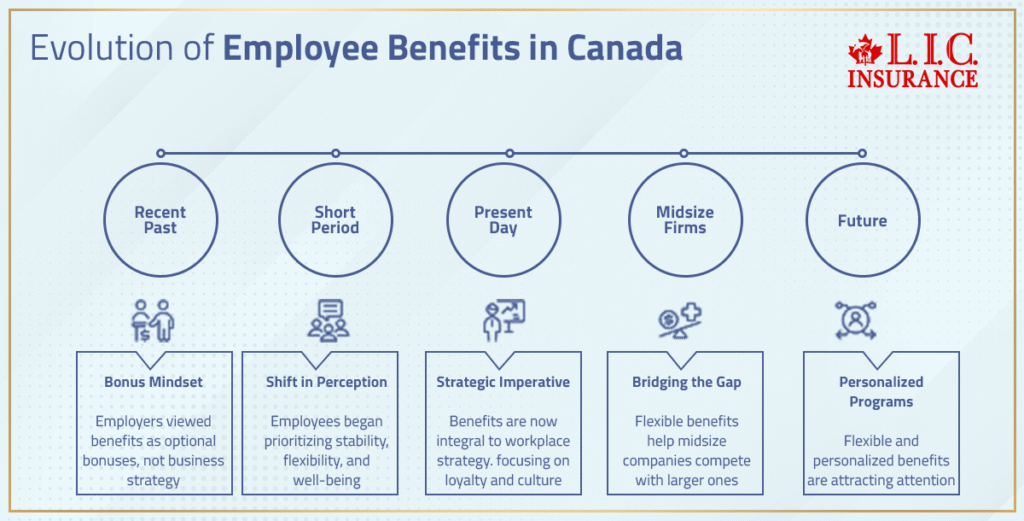
Until recently, employers used to perceive employee benefits as just another bonus at work rather than a fundamental approach to running their businesses. The idea was that providing employees with market wages would be sufficient for keeping them loyal. This notion has drastically changed within a relatively short period.
Today’s employees tend to think differently about employment. Workers seek stability, flexibility, emotional well-being, and financial security. Nowadays, many people become increasingly concerned about issues such as rising inflation rates, high levels of debt, occupational burnout, expensive childcare services, and financial instability. As a result, employees have become much more selective when choosing their employers than previously.
For example, at Canadian LIC, most business owners have switched from asking a totally different set of questions regarding the price of Group Insurance to discussing potential benefits associated with promoting employee loyalty, retention, and building a strong company culture.
What is causing this change is companies recognizing that the wellness of employees is related to the performance of their organization. Organizations going through employee burnout, stress, and turnover will ultimately end up paying for it in terms of reduced productivity, increased recruiting fees, and decreased engagement among workers.
Contemporary Employee Benefits in Canada is becoming an element of the overall workplace strategy, and not just an investment made by the Human Resources department.
The problem is particularly evident among midsize firms. Many small organizations are unable to compete with large companies in terms of wages. However, good group benefit plans in Canada can assist them in bridging this gap since employees tend to be committed to places that actually care about them.
That is why flexible and personalized employee benefits programs have started attracting attention recently. Workers are interested in benefit plans which suit them according to current conditions and not something which is based on old-fashioned workplaces. Some employees need assistance related to mental health issues; others require retirement advice.
How Rising Healthcare Costs Are Reshaping Group Insurance Plans
| Rising Cost Factor | Impact On Employers | Common Response |
|---|---|---|
| Prescription Drugs | Higher annual premiums | Drug formularies |
| Mental Health Claims | Increased utilization | Expanded EAP programs |
| Long Term Disability Claims | Rising plan costs | Early intervention support |
| Dental Coverage | Higher claims frequency | Co-pay adjustments |
| Virtual Healthcare Demand | Increased administrative costs | Digital healthcare partnerships |
Despite all these difficulties, most companies are trying to avoid drastic cost-saving steps since they realize the repercussions of cutting employee assistance programs so drastically. Cost management efforts aimed at increasing effectiveness rather than hurting employee morale have become a popular approach in modern corporate America.
Health spending accounts, wellness spending accounts, claim education, and virtual care partnerships have become common practices in order to allow employers to cut their costs while giving their employees valuable benefits.
Nowadays, it is not enough just to provide the cheapest Group Insurance packages possible. Companies need sustainable options for their employees.
Employee Benefits Trends That Are Changing Workplace Expectations
Workplace expectations that workers have now are quite different from what they had a decade ago.
Newer entrants into the workforce may attach great value to psychological benefits coverage, flexible work policies, and remote healthcare delivery options. For senior staff members, the emphasis could be on retirement savings plans, financial well-being programs, and assistance in managing chronic conditions. With changing demographics among workers, employers understand that inflexible benefit plans may no longer meet the demands of the current labour environment.
This is one of the major reasons why flexible benefits are becoming popular in Canada.
Workers are demanding customization in benefits packages as they do not wish to be forced into having the same benefit structure irrespective of age, lifestyle, or family obligations.
This trend of customizing plans is gaining momentum due to shifting expectations of employees who desire personalized benefits programs.
Wellness has also played a vital role in the trend towards the benefits of employees. The increasing costs of living have created stress among workers that has an influence on their productivity. Companies are starting to acknowledge that there is a strong link between financial health and mental health.
Consequently, there has been a rise in companies implementing retirement savings, financial reviews, and financial wellness as part of the company benefits program.
Lastly, virtual care has been one of the most prominent changes in the evolution of Employee Benefits in Canada. Healthcare for employees is expected to be quicker and easier than ever before. Through virtual care, workers have the option of speaking to a professional through video calls or chats.
A standard health benefit plan is not enough for many employees anymore. Workers require more from employers than ever before.
Why Mental Health Support Is Now Central To Benefits Plans
Hardly any other aspect of Group Insurance Plans has developed as fast as mental wellness.
Back then, many of the benefit plans did not cover much mental wellness. The amount was minimal, and most businesses did not really care much about employees’ emotional state at work. This has changed a lot.
The Canadian employers have learned by experience just how much their business productivity, absence levels, engagement rate, and cases of disabilities depend on employees’ mental state. Emotional burnout and money-related problems are posing serious difficulties to almost any business these days.
Therefore, Canadian employers ask for more mental wellness benefits in their benefits packages because of their employees’ increasing expectations concerning emotional well-being in the workplace. They include such things as assistance programs, online counselling, mental health professionals’ treatment, and other mental health coverage options in the employee benefits plan.
It also stems from a shift in corporate culture and mentality. Businesses have realized by now that caring for their employees mentally is also good for their bottom line.
When employees have emotional support, they tend to become more productive and dedicated towards their jobs as well as towards their employers. Organizations not considering mental health will suffer in terms of loss of employees, loss of morale, and more disability leaves.
As per a report by Benefits Canada, mental health utilization continues growing within many employer sponsored group benefit plans within Canada. The rising trend is encouraging organizations to adopt more integrated approaches compared to traditional health only approaches.
More emphasis is being placed on the provision of mental health days, early interventions, and wellness programs because employers are discovering that prevention costs less than the alternative of managing disability later.
How Flexible Benefits Help Strengthen Employee Loyalty
Maintaining employee loyalty has become increasingly challenging in today’s labour market.
There are more employment possibilities now than there have been before. Due to the presence of hybrid work, remote working possibilities, and digital recruitment sites, job mobility has increased considerably. As such, employers have started focusing more on how group benefits affect retention.
Instead of just considering salary, employees now evaluate whether or not potential employers provide them with psychological benefits, flexible plans, virtual services, pension contributions, and wellness programs.
It is important for us to educate employers on why personalizing benefits will lead to increased employee satisfaction because they will feel valued as individuals rather than being neglected.
Younger individuals might be more concerned with getting help with their psychological needs, while parents might prioritize healthcare and dental plans more. It all depends on the preferences of the employee.
Personalization will increase the commitment levels of employees because they are demanding more of an atmosphere at work that feels like support and not just a transaction.
For medium-sized companies, this becomes a significant competitive edge. The employee benefit strategy tends to make small companies competitive vis-à-vis bigger companies that offer higher compensation.
Why Financial Wellness Programs Matter More Than Ever
Financial strain is emerging as one of the biggest hidden issues facing workplaces across Canada.
Workers who have been suffering from financial problems such as debt, inflation, high property prices, or worries about retirement may be less attentive, more stressed, and at risk for burnout. Most companies are slowly recognizing that financial well-being is a crucial factor for employee well-being and productivity.
This is why financial well-being initiatives have gained significance within Group Insurance in Canada.
Most employers have started incorporating financial evaluation tools, retirement savings advice, and financial planning resources into their employee benefit packages since employees are seeking financial advice.
Modern-day employees do not want only insurance benefits, but rather, want guarantees regarding their ability to face future uncertainties better.
It is also increasingly necessary to educate staff about corporate and Group Life Insurance Policies since employees wish to be financially prepared in case anything unexpected happens.
When organizations offer financial security programs to their employees, they often have positive changes in areas such as employee engagement, workplace culture, and employee retention.
How Canadian Employers Use Group Benefits To Improve Employee Satisfaction
The connection between employee satisfaction and benefit plans has become increasingly significant.
Businesses that fail to adapt their benefit plans could face issues when it comes to hiring and retaining employees, owing to changes in workplace demands.
A lot of businesses in Canada have started moving from a yearly review process for their benefits program to a more strategic approach. More businesses have been analyzing their claims experience, demographic information about their employees, and other factors.
Some of the most popular approaches involve integrating paramedical services, telemedicine, quick claims processing, inclusive coverage, and wellness expense accounts.
More employees tend to favour ease and convenience when seeking medical assistance. Today’s workers prefer modern and easy-to-use healthcare systems, not cumbersome and confusing ones.
Thus, today’s Group Insurance Policies represent far more than mere insurance services. Rather, they become integral parts of the general corporate employee experience.
By focusing on their staff members’ well-being, organizations can enjoy increased morale, retention, lower absenteeism rates, and greater engagement of workers.
The Growing Role Of Group Term Life Insurance Policy In Workforce Protection
While trends within employee benefit programs are always changing, the Group Term Life Insurance Policy continues to be one of the pillars of Group Insurance Plans in Canada.
Employees have continued to emphasize the importance of securing their families’ financial future. In uncertain times such as these, securing oneself is all the more critical.
It is quite common for us to explain to employers the fact that most employees still do not have adequate individual Life Insurance programs. This, in turn, makes the employer-paid Group Life Insurance Plan relevant in today’s day and age.
A Corporate Life Insurance Plan gives assurance to employees that their families will get the necessary support in the eventuality of unforeseen circumstances.
Holistic employee benefit programs often include Life Insurance as well as disability, psychological support, health and dental care, and more.
How Mid-Sized Employers Manage Costs Without Reducing Coverage
The majority of middle-market companies are concerned about their ability to match the offerings of larger companies providing generous employee benefit programs.
But success in benefits does not always depend on how generous your benefits program is. In most cases, effective design produces better outcomes.
We frequently assist our clients in reducing expenses by implementing flexible benefit designs, wellness programs, telemedicine alliances, and health savings account approaches rather than strict coverage cuts.
Such solutions allow companies to keep competitive group benefits and make their programs more sustainable.
Administrative expenses and suboptimal claims utilization impact costs more significantly than many companies know. Employee training on plan use can increase efficiency and eliminate unnecessary claims burdens.
Today’s employers seek benefit programs that are sustainable from a financial standpoint but still ensure employee happiness and retention.
Why Holistic Well-Being Is Becoming The Future Of Employee Benefits Plans
The future of Employee Benefits in Canada is shifting towards holistic wellbeing.
Companies realize that there is a close relationship between physical health, mental health, and financial health. Financial stress can lead to emotional burnout in the future, whereas mental issues may cause physical health concerns.
Therefore, companies have started developing more integrated benefit models for their workers.
Issues such as mental health assistance, flexible benefits, financial well-being programs, telemedicine, preventive health initiatives, and inclusive coverage have become more prominent.
Companies have started realizing the need to focus on their workforce’s overall health rather than reducing costs in the short term.
It is anticipated that this trend will continue to develop further over the coming years.
What Canadian Employers Should Expect From Group Insurance Providers
The dynamics between employers and Group Insurance companies are evolving at a fast pace.
The need for improved claims processes, customization of benefits packages, improved cost estimations, increased virtual healthcare options, increased mental healthcare services, and easier access to healthcare is becoming expected.
As we see it, the future of Group Insurance in Canada lies in personalization, preventative care, digital access to healthcare, and the well-being of employees.
There is no longer any question in the minds of Canadian businesses about whether the plans for employees are simply business costs or rather investments in their workforce.
Those who embrace the changing dynamics within this realm of benefits will have greater competitiveness in the years to come.
Author: Harpreet Puri, Licensed Insurance Adviser | MDRT Qualifier
Experience: 14 Years In Life Insurance & Financial Planning
LinkedIn Profile:https://www.linkedin.com/in/harpreetpuricanadianlic/
Disclaimer:
The information provided is for general educational purposes only and does not constitute financial, insurance, tax, or legal advice. Group Insurance plans, coverage options, eligibility, and Group Insurance cost may vary by employer, insurer, province, and policy terms. Readers should consult a licensed insurance professional or qualified advisor before making decisions regarding Employee Benefits in Canada or Group Insurance plans.
FAQs
Group Insurance Canada is defined as employment-based insurance that can cover health and dental care, disability insurance, psychological well-being services, wellness programs, and Life Insurance.
Employee benefits trends are changing because of rising healthcare costs, inflation, changing workforce demographics, mental health concerns, and shifting employee expectations.
A Group Health Insurance Plan in Canada commonly includes prescription drugs, dental coverage, mental health services, vision care, paramedical services, and disability protection.
Mental health coverage helps improve employee well-being, strengthen workplace culture, reduce burnout, and lower long-term disability claims related to stress and emotional exhaustion.
Sun Life, Manulife, Canada Life, Desjardins Insurance, and GreenShield provide innovative Group Insurance services in Canada that incorporate psychological assistance, telemedicine, adaptable benefit plans, and customized employee benefit packages. Digital availability and wellness have become key criteria for many organizations in Canada in choosing between different Group Insurance companies.
Some emerging employee benefit trends that can be expected from small businesses are flexible benefits, mental health benefits, financial wellness benefits, and virtual health care services. The increasing cost of healthcare and changing employee demands have made it necessary for employers in Canada to revamp their benefits plans.
In modern times, there are several services included under Group Insurance schemes such as employee assistance programs, counselling on virtual platforms, mental health care professionals coverages, wellness spending accounts, and increased provision of mental health services. This is because mental health problems impact employees’ health, productivity, and disability benefits.
The growing popularity of working from home is driving demand for virtual healthcare, online therapy, claim management, and flexible benefit offerings. It has been observed that many companies in Canada are changing their employee benefits programs to make healthcare more easily accessible to their employees.

Sources and Further Reading
- Canadian Life and Health Insurance Association (CLHIA) — Industry insights, workplace benefits data, health and Life Insurance trends in Canada.
- Benefits Canada — Coverage of employee benefits trends, mental health support, rising healthcare costs, and group benefits strategy updates.
- Statistics Canada — Canadian workforce, inflation, financial stress, and labour market statistics relevant to Employee Benefits in Canada.
- Abacus Data – Workplace and Group Insurance Plans Survey — Research on how employees value Group Benefits Plans in Canada and workplace coverage.
- GroupHEALTH – Employee Benefits Trends Canadian Employers Are Watching — Insights into flexible benefits, rising healthcare costs, and holistic well-being strategies.
- Gallagher Canada Workforce Trends Report — Benchmarking data related to benefits strategy, medical plans, and employee expectations.
- Benifex Canada Employee Benefits Technology Guide — Analysis of virtual healthcare, mental health support, and evolving benefits plans in Canada.
Key Takeaways
- Group Insurance Canada is evolving beyond traditional health coverage as Employee Benefits in Canada increasingly focus on mental health support, financial wellness programs, and holistic well-being.
- Rising healthcare costs, prescription drugs, long-term disability claims, and changing workforce demographics are forcing canadian employers to redesign Group Insurance plans more strategically.
- Flexible benefits, personalized benefits, wellness spending accounts, and virtual healthcare are becoming essential parts of modern Group Benefits Plans in Canada.
- Mental health coverage and employee assistance programs now play a major role in improving employee satisfaction, reducing burnout, and strengthening employee loyalty.
- Financial wellness programs and retirement savings support are becoming increasingly important because many employees are struggling with financial stress and rising living costs.
- Mid-sized employers are using smarter plan design and cost containment strategies to manage Group Insurance costs without reducing meaningful coverage for plan members.
- Group Term Life Insurance Policy and Corporate Life Insurance continue to provide important financial security within modern employee benefits plan structures.
- Canadian employers increasingly view group benefits as a workforce strategy that influences retention, recruitment, workplace culture, and long-term business stability.
Your Feedback Is Very Important To Us
Help Us Understand Your Workplace Benefits Challenges Better
IN THIS ARTICLE
- How Employee Benefits Trends Shape Group Insurance Canada
- Why Employee Benefits In Canada Are Becoming A Business Survival Strategy
- How Rising Healthcare Costs Are Reshaping Group Insurance Plans
- Employee Benefits Trends That Are Changing Workplace Expectations
- Why Mental Health Support Is Now Central To Benefits Plans
- How Flexible Benefits Help Strengthen Employee Loyalty
- Why Financial Wellness Programs Matter More Than Ever
- How Canadian Employers Use Group Benefits To Improve Employee Satisfaction
- The Growing Role Of Group Term Life Insurance Policy In Workforce Protection
- How Mid-Sized Employers Manage Costs Without Reducing Coverage
- Why Holistic Well-Being Is Becoming The Future Of Employee Benefits Plans
- What Canadian Employers Should Expect From Group Insurance Providers
Sign-in to CanadianLIC
Verify OTP