- Connect with our licensed Canadian insurance advisors
- Schedule a Call

BASICS
- Is Infinite Banking A Smart Financial Strategy?
- Understanding the Infinite Banking Concept
- Why Infinite Banking Appeals to Canadians Seeking Financial Freedom
- How Infinite Banking Strategy Helps Build Financial Independence
- Challenges and Misconceptions About Infinite Banking
- Who Should Consider Infinite Banking for Financial Freedom?
- How to Start Your Infinite Banking Journey
- Key Advantages of the Infinite Banking Strategy
- A Day-to-Day Struggle: Why More Canadians Are Exploring Infinite Banking
- Potential Drawbacks You Should Know
- The Future of Infinite Banking in Canada
- Is Infinite Banking a Smart Financial Strategy?
COMMON INQUIRIES
- Can I Have Both Short-Term and Long-Term Disability Insurance?
- Should Both Husband and Wife Get Term Life Insurance?
- Can I Change Beneficiaries on My Canadian Term Life Policy?
- What Does Term Life Insurance Cover and Not Cover?
- Does Term Insurance Cover Death?
- What are the advantages of Short-Term Life Insurance?
- Which Is Better, Whole Life Or Term Life Insurance?
- Do Term Life Insurance Rates Go Up?
- Is Term Insurance Better Than a Money Back Policy?
- What’s the Longest Term Life Insurance You Can Get?
- Which is better, Short-Term or Long-Term Insurance? Making the Right Choice
IN THIS ARTICLE
- What is the minimum income for Term Insurance?
- How Does Income Affect Your Term Life Insurance Policy?
- Can You Buy Term Life Insurance Online with a Low Income?
- How Can You Lower Your Term Life Insurance Cost?
- How Much Term Life Insurance Do You Need?
- Can Your Term Life Insurance Policy Be Adjusted Over Time?
- Why Term Life Insurance Is Ideal for Lower-Income Canadians
- Final Thoughts
- More on Term Life Insurance
Best Ways To Turn Savings Into Retirement Income In Canada


By Pushpinder Puri
CEO & Founder
- 11 min read
- Aug 7th, 2026
SUMMARY
Focus on retirement income planning in Canada by turning savings into a steady cash flow using RRSP benefits, retirement withdrawal strategies, and diversified income sources. Covers how does RRSP work, tax implications, generating retirement income, and guaranteed income options for retirees, along with investment strategy, dividend stocks, and cash value solutions for long-term financial stability.
Introduction
The country is experiencing a subtle but profound change. Canadians are retiring with savings but not with the confidence in managing these savings to secure their income needs. According to Statistics Canada data, the sources of retiree income include government benefits, personal savings, and investments. However, it appears that the issue is not with accumulating wealth for retirement but rather in converting such wealth into an adequate income stream. Moreover, according to the Canada Revenue Agency guidelines, one must consider the timing and methods of income withdrawal to minimize the tax burden.
This contradiction can be noticed in every dialogue Canadian LIC holds with retirees. While the majority of them have managed to accumulate retirement savings, only a few have developed plans for managing their retirement income. The creation of such a strategy is a complex process that involves withdrawal decisions, taxation issues, risks, and lifetime expectancy. Retirees who can develop a sophisticated and well-thought-out retirement income plan will be able to enjoy their savings without financial problems and stress.
Understanding Retirement Income Planning And Income Needs
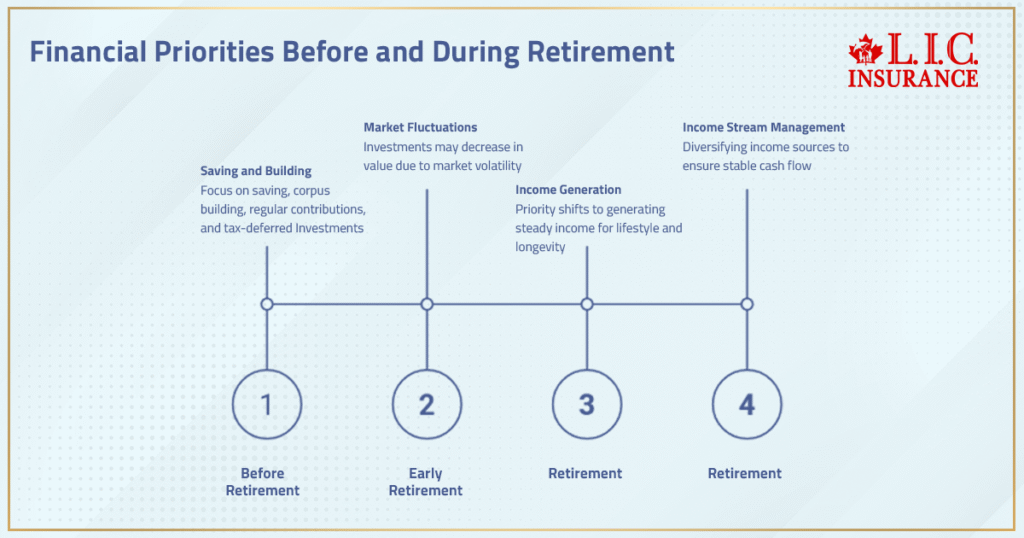
A person’s financial priorities change during retirement. Before retirement, the emphasis lies on saving, building the retirement corpus, making regular contributions to it, and using tax-deferred investments. In retirement, the priorities lie in generating a steady stream of income that helps the retiree maintain a good quality of life without exhausting their funds prematurely.
The process is often misunderstood. When the amount of money saved in the retirement corpus seems large enough, such as $600,000, the retiree feels content about it. But what if that money does not yield as much as $2,000 or $3,000 in monthly income? The actual need for money in retirement depends on the retiree’s lifestyle and longevity.
The average retirement period extends between two and three decades. The following uncertainties come with this period. Fluctuations in the markets could decrease the value of investments at the early stages of retirement. Interest rate uncertainty could affect the yields from fixed assets. Taxation on income may increase over time and reduce withdrawal amounts. Therefore, income stream management is very important.
Income stream management is geared towards ensuring stable cash flow generation. Income sources should be diversified so that a single issue, such as market fluctuation, income taxation, or any other factor, would not impact the total income-generating process negatively.
What Is A Registered Retirement Savings Plan (RRSP) And How Does It Work?
The Registered Retirement Savings Plan in Canada continues to be one of the most popular ways of making financial preparations for retirement. To most pensioners, it is the biggest savings vehicle that they have. The true worth of this tool, however, cannot be seen until the process of withdrawal starts.
Knowing how the RRSP works in retirement becomes very important. Money invested during working periods decreases taxable income, meaning that people can make investments from their earnings prior to taxes being applied. This leads to the development of a great compounding effect. Earnings are accumulated tax-free.
The criteria for being eligible are quite simple; the individual must have income and must not exceed their maximum RRSP contribution. People who make regular contributions can take advantage of tax benefits, which can be used to generate further savings for their retirement years. The RRSP contribution age limit normally ends at 71; after reaching this age, it should be rolled into another form of withdrawal plan, like RRIF.
The reason why an RRSP becomes crucial during retirement is that it has great flexibility. One can withdraw their money through different methods, such as systematic withdrawals and annuities or a mixture of both.
RRSP Benefits And Tax Implications In Retirement
Understanding how RRSP withdrawals work is essential to protecting your retirement income and minimizing unnecessary tax exposure.
- Immediate Tax Advantages During Working Years
RRSP contributions reduce your taxable income in the years you earn the most, allowing you to keep more money in your pocket while building retirement savings efficiently. - Tax-Deferred Growth Inside The RRSP
Investments within an RRSP grow on a tax-deferred basis, meaning you are not taxed annually on investment earnings. This allows compounding to work more effectively over time. - Withdrawals Are Taxed As Income In Retirement
When you begin withdrawing from your RRSP, the amount is treated as taxable income and taxed at ordinary income rates, which directly impacts your net retirement income. - Risk Of Moving Into A Higher Tax Bracket
Large or unplanned withdrawals can push your total income into a higher tax bracket, increasing the percentage of income tax you pay and reducing overall cash flow. - Withholding Tax On Withdrawals
RRSP withdrawals are subject to withholding tax at different levels—typically 10%, 20%, or 30%—depending on the amount withdrawn, which affects immediate liquidity. - Strategic Withdrawals Can Reduce Tax Burden
A well-planned withdrawal strategy helps spread income over multiple years, keeping taxable income stable and avoiding unnecessary spikes in taxation. - Combining RRSPs with Tax-Free Accounts Improves Efficiency
Using RRSPs alongside tax-free accounts such as TFSAs allows retirees to manage when and how income is taxed, improving overall retirement income efficiency. - Planning Ensures Maximum Tax Deferral Benefits
Without proper planning, tax deferral can turn into tax pressure later. A structured approach ensures you benefit from lower taxes over time rather than facing large tax liabilities in retirement.
Retirement Withdrawal Strategies That Protect Your Income
The conversion of savings into income involves more than just taking out cash. The method used to withdraw will determine how much the savings will last and whether or not there will be stability in terms of income generation.
One such method that receives considerable attention is the systematic withdrawal method. Using this method, people can withdraw a specific amount from their savings every year without reducing their principal value by much. This method allows flexibility to adjust depending on the market.
Other methods that are considered include categorization of savings according to time periods. Stable assets should be withdrawn for the first few years, while other funds should be left to grow.
Tax efficiency is just as vital. Withdrawing money from various types of pension savings in a systematic manner can help save on taxes. For instance, withdrawing funds based on after-tax money while letting the tax-deferred savings accumulate could be effective.
Every withdrawal method should account for the sources of income, the age of retirement, and the financial position of the person who retired. No one-size-fits-all formula exists. The success of any withdrawal plan hinges on its applicability.
Turning $500,000 RRSP Into Monthly Retirement Income
Let’s take a case of a 65-year-old person who has $500,000 in his or her RRSP savings account. This is quite a typical starting point for creating one’s retirement income plan.
At the rate of four percent annual withdrawals, such a retiree would be able to withdraw about $20,000 per year from their portfolio, which amounts to roughly $1,667 monthly after-tax. It all looks fine in theory until the person starts paying their income tax.
The problem becomes especially apparent when one considers the possibility that a retiree could have another source of income aside from what is generated through their RRSP, including government benefits or dividends.
This example shows us that it is very important to incorporate taxation considerations into the retirement income planning process to ensure that the maximum amount of income is actually left at the disposal of a retiree.
Generating Retirement Income Using Dividend Paying Stocks
Dividends are yet another source of income that can be generated through stocks. Unlike retirement account withdrawals, dividends do not involve the sale of assets, creating both an income stream and asset ownership.
Dividends have two possible advantages for investors: a fixed income source as well as growing stock prices. This results in a stable combination of dividend payments and the growth of one’s wealth over time.
Of course, the above-mentioned approach is risky, especially during tough market conditions when dividend payments are likely to change. In addition, it should be taken into consideration that the growth of dividends cannot be guaranteed because companies might underperform during certain periods of time.
In spite of all possible drawbacks, dividends represent a reasonable alternative to retirement accounts in terms of income generation.
Guaranteed Income Options And Income Annuities Explained
Retirees desiring security have many choices in the form of guaranteed-income investments, which include income annuities. This type of investment converts a lump sum into a stream of income for a specific time frame or even for the life of the investor.
The product itself is usually provided by an insurance company, and its aim is to solve the issue of longevity risk. No matter what the market situation is, the retiree will receive a regular monthly income. In this regard, such an option can be seen as a cornerstone of the retirement income plan, especially if the money will be used to cover basic needs.
However, the drawback of guaranteed-income investments consists of a lack of flexibility and liquidity of funds. The return on such an investment is lower than in the case of market investments. Therefore, guaranteed income investments are useful only in combination with other financial instruments.
Creating Cash Flow Using Multiple Income Sources
Effective strategies for ensuring income in retirement require the use of many income streams. This creates less dependence on one particular stream and makes an income strategy more robust.
The income from an RRSP withdrawal can be combined with dividends, rent payments, and even government assistance. Every source has its unique function. Some serve as stabilizers, others as growing sources. All of them together create a steady cash flow.
This way, risks can also be mitigated. If one source of income becomes volatile, others will still remain strong and compensate for potential losses.
Investment Strategy To Generate Income In Retirement
A good investment plan for someone who is retired centers on producing income and not growing aggressively. At this point, one has to consider asset allocation seriously.
In most cases, an investor should consider allocating assets such as equity, fixed income, and other forms of investments. While fixed income investments bring stability, equity investments have the potential to grow. In essence, one should aim at sustaining his/her investment portfolio by balancing between income generation and growth.
Market risk management is another important consideration. Huge market movements might affect the withdrawals of an individual. Through proper asset allocation, one would be able to manage risks associated with market movements.
Cash Value Life Insurance As A Retirement Income Tool
A distinctive feature of cash value life insurance is that it provides a method for earning retirement income by incorporating protection and savings features. Unlike other investments, it includes a savings feature that grows over time.
The cash value feature allows access to funds during retirement years through a tax-efficient strategy. This provides another income stream, apart from regular retirement savings, while simultaneously providing life insurance coverage.
Therefore, cash value life insurance is important in retirement planning since it incorporates the advantages of protection and retirement income in one single insurance product.
Comparison – RRSP Vs TFSA Vs Annuities Vs Dividend Income
| Feature | RRSP | TFSA | Annuities | Dividend Income |
|---|---|---|---|---|
| Tax Treatment | Tax-deferred growth, taxable withdrawals | Tax-free growth and tax-free withdrawals | Payments taxed as income | Eligible dividends taxed at lower rates |
| Contribution Type | Pre-tax money | After-tax dollars | Lump sum investment | Invested capital |
| Income Type | Flexible withdrawals | Flexible withdrawals | Guaranteed income stream | Variable income stream |
| Impact On Taxable Income | Increases taxable income | Does not affect taxable income | Fully taxable | Partially taxable |
| Risk Level | Moderate (market-linked) | Moderate (market-linked) | Low (guaranteed by the insurance company) | Higher (market volatility) |
| Liquidity | High flexibility | High flexibility | Low liquidity | Medium liquidity |
| Best Use Case | Long-term retirement income planning | Tax-efficient withdrawals | Stable retirement income plan | Growth + income strategy |
| Growth Potential | Moderate to high | Moderate to high | Low | High (capital appreciation + dividend payments) |
Each of the income sources has a specific function within retirement income planning. The RRSP allows for consistent income generation but is taxed through the income. Income from the TFSA is tax-free, allowing you greater flexibility. Annuities generate consistent income, which eliminates risk. The dividend income source will allow you to grow your money and also produce income. A successful retirement income planning approach will incorporate several income streams in order to create stability and growth.
Building Multiple Income Streams For A Retiree
Take, for instance, a retired individual who has $400,000 in his/her RRSP, $100,000 in their TFSA, and $200,000 invested in dividend stocks. This diverse portfolio results in several income sources.
Withdrawing money from an RRSP is reliable. Income from the TFSA is tax-exempt and thus could be planned to suit the investor. Dividend stocks provide another source of income while allowing the capital to grow.
Common Mistakes That Reduce Retirement Income
Even with thorough preparation, there will always be mistakes made by retirees, which will result in lower income. The first is the tendency to withdraw large sums of money at once. This results in higher taxes due to higher income. Bad asset allocation results in increased exposure to the markets.
Failure to diversify one’s sources of income is also a mistake often made by retirees. All sources of income become prone to fluctuations based on any factors influencing the individual or the markets.
The above mistakes can easily be avoided with careful thought and action.
When To Work With A Financial Professional For Retirement Planning
Retirement income planning requires the consideration of several variables, such as taxes, investments, withdrawals, and risk. Handling all these variables may be complicated.
However, having a financial planner guide one on the various aspects would help achieve optimal results. A good financial planner will help optimize income resources, minimize tax risk, and align plans with the client’s long-term objectives. Our main goal is the development of retirement income strategies.
Professional assistance helps in making informed decisions based on risks and opportunities.
How Canadian LIC Helps You Build A Retirement Income Plan
Retirement income planning through Canadian LIC involves collaborating with the retirees and developing customized plans that involve various streams of income, along with tax efficiency and insurance.
As opposed to working on formulas, Canadian LIC takes a more practical approach by addressing the real needs of the individual to ensure he/she transitions from being unsure about the future to feeling secure.
Final Thoughts On Generating Retirement Income From Savings
The retirement plan does not have to do with how much money you have saved. Retirement is all about having an effective income strategy. The process of transforming savings to income demands a lot of planning, discipline, and knowledge of taxation.
An excellent income strategy should incorporate a combination of various income sources and effectively manage risks.
Written By: Harpreet Puri
Licensed Insurance Adviser | MDRT Qualifier
With over 14 years of experience in Life Insurance, wealth planning, and tax-efficient strategies for Canadians.
Disclaimer:
This content is for general informational purposes only and does not constitute financial, tax, or investment advice. Individual retirement income planning depends on personal financial situations and goals. Guidelines from Canada Revenue Agency and Statistics Canada may change over time. Consult a qualified financial professional before making any financial decisions.
FAQs
Retirement income requirements may transition from lifestyle expenses to health-care and assistance expenditures. It becomes increasingly crucial to adapt your retirement income strategy in favour of security and consistent income streams.
When you begin earning your retirement income could have a major effect on future performance. By waiting to receive some income, one may be able to earn more over time.
The creation of an income source by way of structured payments, dividends, and income annuities will decrease the frequency of asset sales. Such an arrangement will help protect your investment portfolio from excessive market risk.
Yes, certain strategies allow you to generate income while preserving assets for beneficiaries. Balancing income sources with long-term financial security ensures both retirement needs and legacy goals are addressed.
Each income source behaves differently in terms of access, taxation, and reliability. Combining flexible and stable income sources improves adaptability in changing financial situations.
The circumstances under which you fall financially, how taxes are assessed, and other variables may evolve. An assessment of your retirement income strategy is key to ensuring that the strategy stays consistent with your goals.
The process of withdrawing from RRSPs to ensure the flow of money in regular intervals requires the withdrawal process to be managed in a manner that guarantees regular cash flow. This can be achieved through the transfer of funds to income-generating sources.
The best way to do this would be through diversification of income sources and not depending on just one source of income. This can be achieved by investing in dividends from stocks, fixed income securities, and income annuities.
The tax consequences will vary depending on whether the savings are taken out as income during retirement. There are some which result in increased tax on income, while there are others from which one can withdraw income without paying any tax at all.
Yes, one can convert the savings accumulated in RRSP into a guaranteed income stream by structuring the payments through an insurance company. This is helpful since it ensures a steady stream of income and also provides protection from longevity risk.

Sources and Further Reading
- Canada Revenue Agency –
https://www.canada.ca/en/revenue-agency/services/tax/individuals/topics/rrsps-related-plans.html
(RRSP rules, contribution limits, withdrawals, and tax implications)
(Industry insights on retirement income, annuities, and insurance solutions) - Government of Canada –
https://www.canada.ca/en/services/benefits/publicpensions.html
(Overview of public pension income sources and retirement benefits) - Financial Consumer Agency of Canada –
https://www.canada.ca/en/financial-consumer-agency.html
(Retirement planning tools, budgeting, and financial education resources) - Bank of Canada –
https://www.bankofcanada.ca
(Interest rate trends, inflation insights, and economic outlook) - Morningstar Canada –
https://www.morningstar.ca
(Investment strategies, dividend stocks, and retirement portfolio insights) - Vanguard Canada –
https://www.vanguard.ca
(Research on retirement income strategies, asset allocation, and withdrawal planning) - Sun Life Financial –
https://www.sunlife.ca
(Insights on annuities, retirement income, and insurance-based solutions) - Manulife Financial –
https://www.manulife.ca
(Retirement planning resources, RRSP strategies, and income solutions)
Key Takeaways
- Retirement income planning focuses on converting savings into a consistent cash flow, not just building retirement savings
- A structured retirement income plan helps balance income sources, taxes, and long-term financial stability
- RRSP benefits include tax deferral, but withdrawals impact taxable income and must be managed carefully
- Retirement withdrawal strategies play a key role in preserving savings while generating retirement income
- Combining multiple income streams improves flexibility and reduces dependence on a single source
- Dividend-paying stocks and other investments can support ongoing income while maintaining growth potential
- Guaranteed income options, such as income annuities, provide stability and protect against longevity risk
- Managing income tax through strategic withdrawals helps maximize net retirement income
- A diversified portfolio reduces market risk and supports sustainable income over time
- Cash value solutions can provide tax-efficient income and additional financial security
- Avoiding large lump sum withdrawals and poor planning helps prevent unnecessary tax burdens
- Working with a financial professional ensures retirement income strategies align with your financial situation and goals
Your Feedback Is Very Important To Us
Your input helps us understand real retirement income challenges and improve guidance tailored to your financial situation.
IN THIS ARTICLE
- Best Ways To Turn Savings Into Retirement Income In Canada
- Understanding Retirement Income Planning And Income Needs
- What Is A Registered Retirement Savings Plan (RRSP) And How Does It Work?
- RRSP Benefits And Tax Implications In Retirement
- Retirement Withdrawal Strategies That Protect Your Income
- Turning $500,000 RRSP Into Monthly Retirement Income
- Generating Retirement Income Using Dividend Paying Stocks
- Guaranteed Income Options And Income Annuities Explained
- Creating Cash Flow Using Multiple Income Sources
- Investment Strategy To Generate Income In Retirement
- Cash Value Life Insurance As A Retirement Income Tool
- Comparison – RRSP Vs TFSA Vs Annuities Vs Dividend Income
- Building Multiple Income Streams For A Retiree
- Common Mistakes That Reduce Retirement Income
- When To Work With A Financial Professional For Retirement Planning
- How Canadian LIC Helps You Build A Retirement Income Plan
- Final Thoughts On Generating Retirement Income From Savings
Sign-in to CanadianLIC
Verify OTP