- Connect with our licensed Canadian insurance advisors
- Schedule a Call

BASICS
- Is Infinite Banking A Smart Financial Strategy?
- Understanding the Infinite Banking Concept
- Why Infinite Banking Appeals to Canadians Seeking Financial Freedom
- How Infinite Banking Strategy Helps Build Financial Independence
- Challenges and Misconceptions About Infinite Banking
- Who Should Consider Infinite Banking for Financial Freedom?
- How to Start Your Infinite Banking Journey
- Key Advantages of the Infinite Banking Strategy
- A Day-to-Day Struggle: Why More Canadians Are Exploring Infinite Banking
- Potential Drawbacks You Should Know
- The Future of Infinite Banking in Canada
- Is Infinite Banking a Smart Financial Strategy?
COMMON INQUIRIES
- Can I Have Both Short-Term and Long-Term Disability Insurance?
- Should Both Husband and Wife Get Term Life Insurance?
- Can I Change Beneficiaries on My Canadian Term Life Policy?
- What Does Term Life Insurance Cover and Not Cover?
- Does Term Insurance Cover Death?
- What are the advantages of Short-Term Life Insurance?
- Which Is Better, Whole Life Or Term Life Insurance?
- Do Term Life Insurance Rates Go Up?
- Is Term Insurance Better Than a Money Back Policy?
- What’s the Longest Term Life Insurance You Can Get?
- Which is better, Short-Term or Long-Term Insurance? Making the Right Choice
IN THIS ARTICLE
- What is the minimum income for Term Insurance?
- How Does Income Affect Your Term Life Insurance Policy?
- Can You Buy Term Life Insurance Online with a Low Income?
- How Can You Lower Your Term Life Insurance Cost?
- How Much Term Life Insurance Do You Need?
- Can Your Term Life Insurance Policy Be Adjusted Over Time?
- Why Term Life Insurance Is Ideal for Lower-Income Canadians
- Final Thoughts
- More on Term Life Insurance
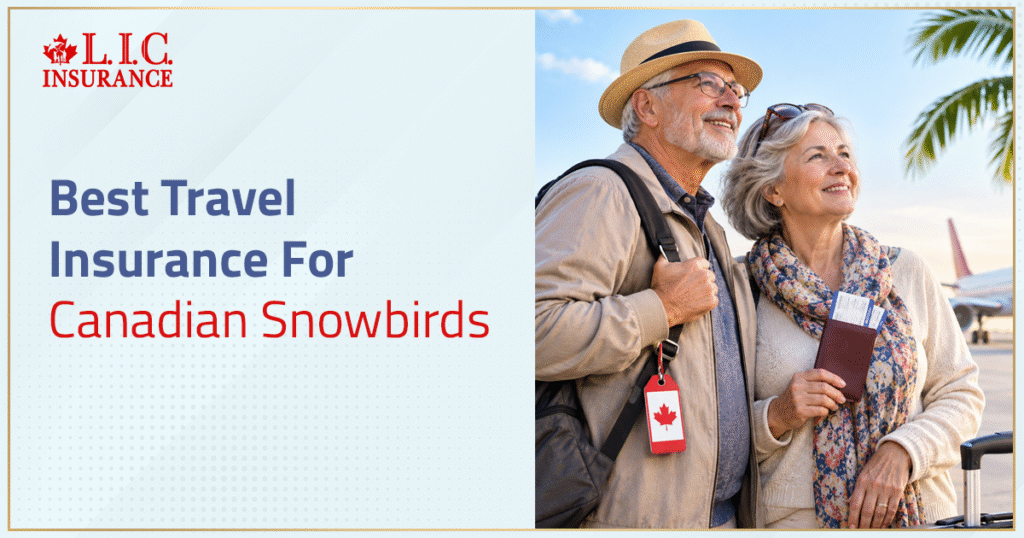
Best Travel Insurance For Canadian Snowbirds
By Pushpinder Puri
CEO & Founder
- 11 min read
- Nov 25, 2026
SUMMARY
Canadian Snowbird Travel Insurance helps protect travellers from emergency medical expenses, trip cancellation losses, and unexpected healthcare costs during extended stays abroad. Understanding how snowbird insurance works, coverage options for Canadian snowbirds, Travel Insurance with pre-existing conditions, Travel Insurance claims, claim-free discount programs, and Emergency Medical Insurance for snowbirds can help travellers choose protection that matches their health needs and travel plans.
Introduction
Winter means different things to different Canadians.
For some, it is the time when snow starts accumulating on their driveways and freezing temperatures make getting up in the morning challenging. For others, it marks the beginning of an eagerly awaited vacation from their homes to countries blessed with a warm climate and sunshine.
Each year, there are thousands of Canadians who travel out of their country and spend weeks or months in foreign lands, including Mexico, Portugal, Spain, Costa Rica, Panama, the Caribbean region, and even different states within the USA. While travelling allows one to have fun and experience new things, it also poses dangers that may not be anticipated by the traveller.
As per the Government of Canada, provincial health care plans cover only part of the medical bills incurred abroad. Travellers may incur high costs should they find themselves in a situation where they need medical attention while on foreign soil. This explains why Travel Insurance in Canada is very important.
There are times when people plan vacations abroad by making arrangements for things like hotel accommodation, flight booking, and other vacation plans, but give just a few minutes’ thought to their insurance plans. Sadly, in the course of events, it turns out that the insurance is the most important decision you can make.
A hip fracture due to a fall on the beach, an accident leading to hospitalization aboard a cruise ship, or chest pains while spending winters away from home can suddenly turn a dream holiday into an expensive one.
That is why understanding Canadian Snowbird Travel Insurance before departure is so important.
What Is Snowbird Travel Insurance?
Many travellers assume that all Travel Insurance Policies work the same way.
They do not.
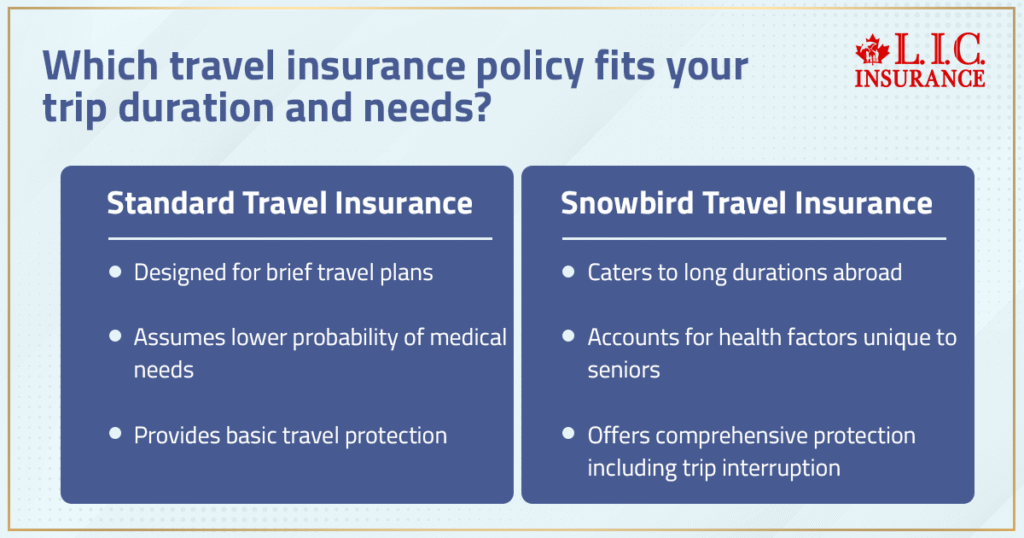
Travel Insurance Policies typically cater to brief travel plans. On the other hand, there are snowbird Travel Insurance Policies, which cater to Canadian travellers who spend long durations abroad during the winter season.
The distinction may seem small at first, but it has a huge effect when it comes to the type of coverage offered.
A traveller who spends ten days travelling abroad cannot be put in the same class as one who spends five months in a foreign land. This is because the longer they stay, the more likely they are to need medical assistance or encounter some unforeseen problems.
Snowbird insurance recognizes those realities.
Most plans focus heavily on Emergency Medical Insurance for snowbirds while also offering additional protection that may include trip interruption benefits, Travel Insurance Trip Cancellation Coverage, emergency transportation, and various assistance services
Basically, these policies seek to help travellers cope with the financial uncertainties that come along with travelling out of Canada for an extended period of time.
Furthermore, it should be noted that many policies are designed specifically for seniors, as there are health factors unique to senior travellers which should be considered in their underwriting.
Consequently, Snowbird Travel Insurance Canada can be referred to as a more comprehensive form of regular Travel Insurance for snowbirds.
How Snowbird Insurance Works
One of the most common questions we hear is: What is Canadian Snowbird Travel Insurance, and how does Snowbird insurance work in practice?
The answer begins before departure.
A traveller buys a plan depending on certain things like their age, their destination, the duration of travel, their medical history, and their needs.
Upon accepting the application, the coverage is supposed to commence on the effective date of the policy until the end of the selected travel period.
This may appear simple, but there are important things to take note of.
The duration of the trip must match the plans of the traveller. The medical information provided should be accurate.
The terms and conditions of the policy have to be checked before travelling.
This is because the kind of Travel Insurance Canada that a person needs depends on a number of factors, including the length of time that they wish to travel.
For instance, a traveller who intends to stay in Portugal for four months would need a different Travel Insurance Plan from a person intending to travel to Mexico for six weeks.
Also, an older person who has been medically stable may have a different Travel Insurance Plan from a recent med chaser or an ongoing medical investigation case.
These details affect both eligibility and pricing.
Understanding them before leaving Canada can prevent many of the problems that arise during Travel Insurance claims.
Canadian Snowbirds And Their Unique Insurance Needs
The insurance needs of canadian snowbirds are often very different from those of occasional vacationers.
Most snowbirds are certainly not travelling for a brief vacation. In essence, snowbirds are living abroad for a significant amount of time.
This raises a new set of concerns.
As time passes, it becomes increasingly likely that the individual might find the need for health services. It could be something as basic as an infection, dehydration, food poisoning, or even sustaining injuries.
In more severe cases, it could include a visit to the hospital, surgery, seeing specialists, or other emergency situations.
Health services across nations are very different.
For instance, a person getting treated in Spain might go through a completely different process from someone seeking medical attention in Mexico or the Caribbean.
It is because many countries will only start treating a patient after verifying whether they have any insurance coverage or not.
This is the main reason why medical insurance still plays such an important role when snowbirds plan their trip.
It is crucial for people to understand that medical insurance is not just a formality or part of a checklist to complete before embarking on their trip.
Medical insurance should be considered from the point of view of protection against large medical bills.
Medical Insurance And Emergency Medical Coverage
When travellers compare insurance plans, they often focus on premium costs.
While price does play a part, Emergency Medical Insurance coverage will probably be the most important aspect of any snowbird insurance plan.
Baggage insurance coverage is seldom ever used by many travellers.
Similarly, many do not make claims for cancelled trips.
However, in case there is an emergency which requires hospitalization abroad, this coverage could make all the difference in the world between getting out of it alive, without too much hassle.
Travel medical insurance could potentially provide coverage for hospital stays, doctor visits, diagnostic tests, ambulance services, emergency surgery, and medication costs, among other expenses.
This will depend on the specific insurer and terms.
Consider a simple example.
A retired couple stays in Costa Rica for four months during the winter season. After several weeks into their stay, one of them suffers from severe abdominal pains, necessitating the need for an immediate visit to the hospital.
Without proper insurance, the bills could easily pile up.
However, if there were sufficient health insurance in place, a majority of them would have been paid.
That is precisely the reason why emergency medical coverage must not be viewed as an option in Travel Insurance.
Emergency medical coverage is the basis of snowbird insurance policies.
Pre-Existing Condition Coverage: The Topic That Creates The Most Confusion
Nothing about snowbird insurance creates more confusion than coverage of pre-existing conditions.
It is a common misconception that one simply cannot be covered if he or she suffers from a pre-existing condition.
However, many insurance companies provide cover under such circumstances.
The key element here is stability.
Essentially, a pre-existing condition should remain stable, meaning that no major changes occurred to one’s treatment, medication, symptomatology, diagnosis, or physician’s advice.
However, every insurer defines stability differently.
One company may have a 90-day requirement for stability; another may require six months. Other carriers have varying guidelines depending on age, health, and the specific condition at hand.
It is critical to carefully review the policy wording for these reasons.
More often than not, we come across cases where the individual thinks that a slight tweak to their medication is a non-issue. As far as insurance companies are concerned, this could impact the stability of the condition.
This does not necessarily preclude coverage.
It simply means that different coverage options may need to be explored.
Many Canadian snowbirds manage to get covered regardless of having preexisting medical conditions like diabetes, high blood pressure, heart disease, arthritis, or cancer.
It is important to provide full disclosure and choose the right insurance plan based on personal medical history.
Most often, issues occur when there is no complete or clear information available.
Once the insurer has all the information from the start, everything is simpler in terms of eligibility criteria and dispute resolution should the need arise later on.
That is why it is important to be very careful when completing medical questionnaire forms and not to assume anything.
Sometimes, spending a bit more time disclosing everything is better than dealing with problems down the road.
How Much Does Travel Insurance Cost For Snowbirds?
One of the first questions most travellers ask is straightforward:
How much does Travel Insurance cost for snowbird travellers?
The answer is rarely simple because every traveller presents a different level of risk.
Two retirees travelling to the same destination for the same period can receive very different premiums. Age plays a role, but it is only one piece of the puzzle.
Medical history often has a greater influence.
A healthy individual of age 68 years who has not taken any new drugs recently might end up getting better premium rates than a younger individual suffering from several medical ailments. In the same way, an individual going on vacation for an extended period might end up having higher rates than another person travelling for a short duration, just because the insurance company is dealing with longer coverage time.
The place of travel is also important.
The cost of healthcare is not the same across different parts of the world. In one part of the world, the cost of health care might be affordable, while in another place, the cost of health care might be quite expensive. Such things are taken into account by the insurance company in deciding the premiums that they will charge.
One can also use deductibles to affect the premium that one will need to pay.
We encourage our clients to pay attention to value instead of only prices.
Insurance policies that save a little money today might end up providing much less cover later on.
This is why comparing policies based on cover, exclusions, claims process, and emergency service could be even more important than premium comparison alone.
Coverage Options Available For Canadian Snowbirds
Every traveller has different priorities.
While some people mainly seek to be covered against emergency medical costs, others wish to be refunded for the loss incurred when they are forced to cancel their travel plan due to a disease. In other cases, travellers are just looking to gain assurance that there will be someone who can assist them in case something happens abroad.
Current snowbird insurance products have been developed to meet these varying needs.
While Emergency Medical Insurance forms the mainstay of most insurance plans, there are other forms of coverage that could be considered by travellers based on their unique needs.
For example, a traveller heading to a cruise vacation might consider Travel Insurance benefits for trips that get interrupted. Other travellers going for prolonged visits abroad, where large amounts of money have been prepaid to secure accommodation, might prefer Travel Insurance with trip cancellation.
Other travellers might look at emergency medical evacuation benefits as well as the benefits offered through emergency assistance services.
However, the most appropriate travel coverage plans are not those that offer the most comprehensive coverage.
Insurance Plans Designed For Extended Travel
Snowbird insurance is available in several formats.
Some people select policies which are single-trip policies covering only one particular trip. This type of policy would be ideal for those people who go on one particular trip every winter.
Some opt for annual Travel Insurance, which covers multiple trips during the year. These insurance policies are good for retired people who travel regularly.
There are even special snowbird Travel Insurance Policies to cover trips that involve lengthy stays in other countries rather than in Canada.
Such policies include longer coverage periods, better emergency medical services, and more flexibility for travellers who travel out of Canada for an extensive part of the year.
It is necessary to make some comparisons between the various Travel Insurance Policies available.
For example, the needs of people travelling six weeks in another country would be much different from those of people staying there for five months.
Why a Claim-Free Discount Can Matter
Most travellers only consider the amount of coverage and premium prices, neglecting another way they might save money.
Some insurers provide a discount based on being claim-free for policyholders who have been travelling without filing any claims.
Although travellers must not put their health at risk in order to qualify for a discount, this type of plan can definitely help some snowbird travellers save money.
This depends on the company, but the idea is simple.
Those who stay claim-free could end up paying less in premiums for their trips going forward.
If this applies to seniors who travel yearly, the discounts will add up over the years.
Travellers need to inquire about this option when comparing companies.
Understanding Medipac Travel Insurance And Medipac Assist
Many Canadian snowbirds researching coverage eventually encounter references to Medipac Travel Insurance and Medipac Assist.
The reason is simple.
For many years, Medipac has been a well-known name among snowbirds looking for coverage for their stable pre existing conditions.
As with other companies, Medipac provides a number of plans tailored to extended travel needs.
The appropriateness of any plan will depend on specific conditions such as age, health record, destination country, and length of stay.
Of equal importance are the emergency assistance services provided by Medipac Assist.
Should an accident take place while traveling, insurance may not be enough.
Sometimes travelers require assistance in finding medical help, coordinating treatment, translating, arranging transportation or contacting their relatives.
It is the emergency assistance services that can offer these services.
Many travellers never have occasion to use these services. However, when needed, travellers realize that they are one of the most valuable components of Travel Insurance.
What The Canadian Snowbird Association Recommends
The Canadian Snowbird Association has consistently emphasized the importance of proper travel planning and insurance preparation.
One of the recurring themes in snowbird education is that Travel Insurance should never be treated as an afterthought.
Health conditions change.
Insurance products evolve.
Coverage requirements shift over time.
Travellers who have had a policy for several years may think that their insurance coverage suits their needs at present. This does not necessarily have to be the case.
Annual evaluation of one’s travel plans, health conditions, and destinations will ensure that what is being insured matches one’s needs and wishes.
It should be noted that the Canadian Snowbird Association has been promoting such advice for many years already.
Those recommendations mirror much of the advice we provide at Canadian LIC.
Effective Date Rules That Can Affect Coverage
One of the most overlooked details in Travel Insurance is the effective date.
Most travellers concentrate on limits and premiums, but do not pay much attention to the period when coverage will begin.
However, this lack of knowledge can cause problems further down the road.
Generally speaking, coverage starts from the time set out in the policy. Any incidents that happen prior to this moment might not be covered at all.
Extensions can play an important role as well.
A person who chooses to stay abroad longer than anticipated might have to purchase an extension before the expiry of the existing policy. Delaying extension might lead to a coverage gap and other difficulties.
Travel Insurance Claims: What Travellers Should Know
Most travellers hope they never need to submit a claim.
When they do, preparation can make a tremendous difference.
Successful Travel Insurance claims often begin with prompt communication.
Most insurance companies recommend contacting the emergency assistance center immediately following an emergency incident.
Thus, the insurance company will be able to organize the provision of services and check if the traveller has the right to make a claim.
At the same time, documentation is no less important.
Medical data, doctors’ letters, receipts, bills, prescriptions, and travel documents are often used while filing a claim.
Many problems occur during a claim procedure, not because of inappropriate treatment but because of incomplete documents.
One of the other reasons for potential difficulties is inaccurate disclosure of medical data.
Should there be any issues regarding disclosure, it would complicate the claiming process significantly.
Thus, transparency at the initial stage is always useful.
Common Exclusions Every Snowbird Should Understand
Before purchasing a Travel Insurance Policy, it is important to understand not only what is covered but also the situations that may fall outside coverage.
- Undisclosed Medical Conditions
Failing to disclose relevant medical information during the application process can affect eligibility and may lead to claim complications later. Accurate disclosure helps insurers properly assess risk and determine coverage. - Unstable Pre-Existing Medical Conditions
Many Travel Insurance Policies provide coverage for stable pre-existing conditions, but limitations may apply if a condition has experienced recent changes in medication, treatment, symptoms, or medical advice. - Travel Against Medical Advice
If a healthcare professional advises against travelling and the traveller proceeds anyway, claims related to that condition or resulting complications may not be covered. - Experimental Or Non-Approved Treatments
Certain policies may exclude treatments that are considered experimental, investigational, or not widely accepted within established medical practice. - Cosmetic Surgery Procedures
Elective cosmetic surgery and related complications are commonly excluded unless the procedure is required as a result of a covered medical emergency. - Ignoring Policy Requirements
Coverage may be affected when travellers fail to follow policy conditions, such as contacting the emergency assistance centre when required or obtaining approval for specific treatments. - Activities Or Situations Specifically Excluded By The Policy
Certain high-risk activities, events, or circumstances may be excluded depending on the insurer and policy wording. Reviewing these exclusions before departure can help avoid unexpected surprises.
Are Travel Expenses Tax Deductible In Canada?
Many retirees wonder whether travel expense deductions are eligible when they stay overseas for long periods.
The answer will always depend on what type of expense it is.
Some medical expenses can be considered eligible for tax purposes according to particular conditions that apply.
However, not all travel expenses are eligible for tax purposes.
Premiums paid for Travel Insurance do not come under the category of medical expenses.
In addition, the regulations regarding Travel Insurance premiums vary.
Given the complexity of tax laws, it is better to seek advice from a tax expert before making any decisions.
Our Client Experiences
A Canadian LIC client was going to spend five months in Portugal and Spain during their winter holiday season.
During the course of our routine insurance review, it came to light that a recent prescription modification might be relevant when other insurance companies evaluate the traveler’s health record. The traveller did not realize the implications of the modification at first, believing that all insurance policies would treat it similarly.
After reviewing the possible plans, we found one that suited the client more closely.
Not too long after, the client became ill while travelling, and the claim was processed without difficulty due to the proper arrangement.
Another traveller planning an extended trip to Mexico approached us about comparing insurance costs.
In our conversation, it became apparent that the customer was concerned about cost while not considering variations in emergency service provision and coverage restrictions.
Having compared the choices again, the client decided to go for one offering better insurance and improved emergency assistance.
Luckily, no claims were made during the journey, but the traveller later stated that the peace of mind obtained was worth much more than the slight difference in price.
This proves once more a valuable point.
Not necessarily the most affordable Travel Insurance Plan can be the best one. It is the one that suits one’s health condition, destination country, and purpose of travel.
Final Thoughts
Many Canadians look at winter trips as much more than a holiday. They become a lifestyle that enables one to escape the cold for some time and visit various places throughout the world.
Whether visiting Mexico, Portugal, Spain, Costa Rica, Panama, the Caribbean region, or anywhere else, there will always be potential health emergencies that may arise during travel.
Travel Insurance designed for snowbirds would be able to ensure that you don’t have to deal with financial problems arising from unforeseen emergencies, among other important features.
Gaining knowledge about how such insurance works, carefully choosing what to include in your policy, being truthful about your health status, and comparing policies are just some of the factors one should consider.
In our opinion, the best way to experience travel is to do it without worrying about anything going wrong along the way.
Properly preparing in advance could be the key to making a difference later on.
Written By: Harpreet Puri
Licensed Insurance Adviser | MDRT Qualifier
With over 14 years of experience in Life Insurance, wealth planning, and tax-efficient strategies for Canadians.
Disclaimer:
Travel Insurance benefits, exclusions, eligibility requirements, and coverage limits vary by insurer and policy. Information provided is for educational purposes only and should not be considered insurance, tax, or legal advice. Always review policy wording carefully and consult a licensed advisor before purchasing coverage.
FAQs
Many snowbird insurance policies allow brief returns to Canada without cancelling coverage. However, the number of permitted days and conditions vary by insurer. Always review your policy before booking return visits during an extended trip.
Many Travel Insurance Plans provide limited coverage for emergency dental treatment caused by accidents, infections, or sudden pain. Routine dental work, cosmetic procedures, and planned treatments are usually excluded.
Travel Insurance Policies are generally issued to specific individuals. If a spouse, child, or family member plans to join later, separate coverage may be required depending on the insurer and policy type.
Yes. Credit card Travel Insurance often has shorter coverage periods, lower coverage limits, and stricter age restrictions. Snowbird Travel Insurance is specifically designed for extended stays and the needs of Canadian snowbirds.
Contact your insurer’s emergency assistance centre as soon as possible. They can direct you to appropriate medical facilities, coordinate treatment, and explain documentation requirements that may support future Travel Insurance claims.
Some insurers allow coverage to be purchased after departure, while others require policies to be issued before travel begins. Eligibility, waiting periods, and coverage limitations vary by provider.
Coverage for prescription medication refills varies by plan. Emergency replacement of lost or stolen medication may be covered, while routine prescription renewals are often excluded.
Medical questionnaires help insurers assess risk and determine eligibility. Accurate answers allow the insurer to evaluate medical conditions properly and reduce the likelihood of claim disputes later.
A number of insurance companies have special snowbird insurance products for Canadian travellers who stay out of the country for weeks or months at a time during winter. Such insurance usually covers emergencies, provides emergency services, and gives coverage options for pre-existing stable conditions. The right one to choose depends on various factors, including age, destination, duration, and personal considerations.
Canadian snowbirds need to consider having good Emergency Medical Insurance, coverage for pre-existing conditions when applicable, flexibility regarding the length of the trip, emergency assistance services, and clear wording in the policies. They also need to consider their limits of coverage, exclusions, claims processes, and the possibility of extension in case of extended stays.
Sources and Further Reading
- Government Of Canada – Travel Insurance Guidance
- Government Of Canada – Travel Advice And Advisories
- Canada Revenue Agency – Medical Expenses And Tax Credits
- Canada Revenue Agency – Canadian Residents Going Down South
- Canadian Snowbird Association (CSA)
- Canadian Institute For Health Information (CIHI)
- Ontario Health Insurance Plan (OHIP) Coverage Outside Canada
- Alberta Health Care Insurance Plan – Coverage Outside Canada
- British Columbia Medical Services Plan (MSP)
Key Takeaways
- Canadian Snowbird Travel Insurance is designed for extended stays outside Canada and offers broader protection than standard vacation Travel Insurance.
- Provincial health plans typically provide limited coverage abroad, making Emergency Medical Insurance for snowbirds an important part of winter travel planning.
- Understanding how snowbird insurance works before departure can help travellers avoid coverage gaps, unexpected expenses, and claim complications.
- Many travellers with stable pre-existing conditions may qualify for coverage, but insurers have specific stability requirements that must be reviewed carefully.
- The cost of Travel Insurance for snowbirds depends on factors such as age, destination, trip length, medical history, and deductible selection.
- Comprehensive medical coverage often includes hospitalization, physician services, emergency transportation, diagnostic testing, and other emergency medical expenses.
- Coverage options for Canadian snowbirds may also include trip cancellation, trip interruption, baggage protection, and emergency assistance services.
- A claim-free discount offered by some insurers can help frequent snowbirds reduce long-term insurance costs.
- Emergency assistance programs, including services such as Medipac Assist, can provide valuable support during medical emergencies in foreign medical systems.
- Reviewing policy exclusions, effective date requirements, and disclosure obligations before departure can significantly improve the likelihood of a smooth claims experience.
- Comparing multiple providers and obtaining a Travel Insurance quote online allows travellers to evaluate coverage, pricing, and benefits based on their unique needs.
- An annual review of snowbird insurance helps ensure coverage continues to match changing health conditions, travel plans, and destination risks.
Your Feedback Is Very Important To Us
Thank you for reading our guide on Snowbird Travel Insurance. Your feedback helps us create better resources and understand the challenges Canadian snowbirds face when planning extended trips outside Canada.
Thank You For Your Feedback!
A Canadian LIC advisor may contact you if you request a complimentary review of your Critical Illness Insurance Coverage and protection options.
IN THIS ARTICLE
- Best Travel Insurance For Canadian Snowbirds
- What Is Snowbird Travel Insurance?
- How Snowbird Insurance Works
- Canadian Snowbirds And Their Unique Insurance Needs
- Medical Insurance And Emergency Medical Coverage
- Pre-Existing Condition Coverage: The Topic That Creates The Most Confusion
- How Much Does Travel Insurance Cost For Snowbirds?
- Coverage Options Available For Canadian Snowbirds
- Insurance Plans Designed For Extended Travel
- Why a Claim-Free Discount Can Matter
- Understanding Medipac Travel Insurance And Medipac Assist
- What The Canadian Snowbird Association Recommends
- Effective Date Rules That Can Affect Coverage
- Travel Insurance Claims: What Travellers Should Know
- Common Exclusions Every Snowbird Should Understand
- Are Travel Expenses Tax Deductible In Canada?
- Our Client Experiences
- Final Thoughts
Sign-in to CanadianLIC
Verify OTP