- Connect with our licensed Canadian insurance advisors
- Schedule a Call

BASICS
- Is Infinite Banking A Smart Financial Strategy?
- Understanding the Infinite Banking Concept
- Why Infinite Banking Appeals to Canadians Seeking Financial Freedom
- How Infinite Banking Strategy Helps Build Financial Independence
- Challenges and Misconceptions About Infinite Banking
- Who Should Consider Infinite Banking for Financial Freedom?
- How to Start Your Infinite Banking Journey
- Key Advantages of the Infinite Banking Strategy
- A Day-to-Day Struggle: Why More Canadians Are Exploring Infinite Banking
- Potential Drawbacks You Should Know
- The Future of Infinite Banking in Canada
- Is Infinite Banking a Smart Financial Strategy?
COMMON INQUIRIES
- Can I Have Both Short-Term and Long-Term Disability Insurance?
- Should Both Husband and Wife Get Term Life Insurance?
- Can I Change Beneficiaries on My Canadian Term Life Policy?
- What Does Term Life Insurance Cover and Not Cover?
- Does Term Insurance Cover Death?
- What are the advantages of Short-Term Life Insurance?
- Which Is Better, Whole Life Or Term Life Insurance?
- Do Term Life Insurance Rates Go Up?
- Is Term Insurance Better Than a Money Back Policy?
- What’s the Longest Term Life Insurance You Can Get?
- Which is better, Short-Term or Long-Term Insurance? Making the Right Choice
IN THIS ARTICLE
- What is the minimum income for Term Insurance?
- How Does Income Affect Your Term Life Insurance Policy?
- Can You Buy Term Life Insurance Online with a Low Income?
- How Can You Lower Your Term Life Insurance Cost?
- How Much Term Life Insurance Do You Need?
- Can Your Term Life Insurance Policy Be Adjusted Over Time?
- Why Term Life Insurance Is Ideal for Lower-Income Canadians
- Final Thoughts
- More on Term Life Insurance
When Does It Make Sense To Take Out An RRSP Loan?


By Pushpinder Puri
CEO & Founder
- 14 min read
- Oct 22, 2026
SUMMARY
Understand when an RRSP loan Canada strategy may be worth considering and when it may not. The discussion covers RRSP contribution loan benefits, RRSP contribution room, unused contribution room, taxable income reduction, RRSP loan interest rates, tax refund opportunities, repayment considerations, self-employed planning, credit score impacts, and long-term retirement savings growth within a Registered Retirement Savings Plan in Canada.
Introduction
The Growing Challenge Of Saving For Retirement In Canada
Most people tend to approach retirement savings with the best of intentions. Canadians begin the year fully committed to saving for their retirement, but find out that their regular expenses eat into their budget more than they had planned. They face higher mortgages, larger monthly bills, more expensive child-related activities, and even business owners end up reinvesting money back into their companies. Eventually, another year goes by without making any progress in building their retirement nest egg.
This is one reason why the Registered Retirement Savings Plan remains as vital as ever within the context of financial planning. It allows Canadians to save money for the future while providing benefits that may include lowering taxes, creating deductions, and a substantial tax refund.
According to figures released by the Canada Revenue Agency, Canadians have accumulated hundreds of billions in unused RRSP contribution room. However, it seems that Canadians continue to be worried about having enough money saved for their retirement.
These two realities often collide as the annual RRSP deadline approaches.
There comes a time in many people’s lives when they realize that they still have considerable unused RRSP contribution room, but they lack sufficient cash on hand to make the contribution they wish to make. In cases such as this, an RRSP loan Canada solution is sometimes discussed.
With an RRSP contribution loan, one borrows money and contributes it to their RRSP straight away instead of waiting to accumulate the cash themselves. The concept sounds appealing due to the prospect of being able to take advantage of the deductions, a possible tax refund, and build their retirement nest egg immediately. Borrowing money inevitably involves costs and risks.
Here at Canadian LIC, we often see the wrong question being posed: Is taking out an RRSP loan good or bad?
The more pertinent question should be whether making such an RRSP loan works for their situation financially.
What Is An RRSP Loan And How Does It Work?
These loans are widely available at most large financial institutions and banks within Canada, especially during RRSP season. The transaction is relatively straightforward in that once the loan is approved, the funds will be supplied by the lending institution and directly deposited into an RRSP account. The loan repayment will occur on a monthly basis thereafter.
The advantage of these loans revolves around efficiency.
If a taxpayer has an available contribution room of $20,000 but only has $3,000 saved up, it would likely take several years before reaching the full capacity of the contribution room. Using an RRSP loan, this taxpayer can contribute all of his or her room right away.
| Feature | RRSP Loan | Personal Savings |
|---|---|---|
| Immediate Contribution | Yes | No |
| Interest Cost | Yes | No |
| Tax Deduction | Yes | Yes |
| Debt Created | Yes | No |
At face value, using loans for investments might appear strange. Many Canadians are raised to avoid borrowing where it can be avoided. In the case of RRSPs, however, a different perspective emerges. Time itself has enormous value in investments.
Each year that money stays in investments is an opportunity for that money to earn money. Returns on investments create further returns through compounding. By having more time in which contributions can accrue gains through compound interest, investments can grow.
This is part of why investors take out a loan; the RRSP deadline in Canada is approaching. They are not borrowing money; rather, they are buying more time.
Of course, that doesn’t mean that every RRSP loan will necessarily work out. The interest expense has to be taken into account, as well as whether the repayments fit into the budget. Most importantly, the resulting tax savings have to justify the borrowed funds.
How RRSP contributions affect taxes, therefore, becomes the important next step.
How RRSP Contribution Affects Taxable Income
When he makes a contribution of C$15,000 to the RRSP account, his taxable income is lowered to C$85,000 per year.
| Annual Income | RRSP Contribution | New Taxable Income |
|---|---|---|
| $100,000 | $15,000 | $85,000 |
This reduction can produce two important outcomes.
First, it may lower the overall tax bill for the year.
Secondly, it can earn the individual a tax refund if taxes had been paid by way of withholding tax or instalments.
The amount of the refund will be dependent on several aspects, such as the province of residence, deductions allowed, and tax bracket. Nevertheless, the concept is the same. Lower taxable income will result in lower taxes.
For this reason, RRSPs are usually very advantageous for high-income individuals. The person with an annual income of $150,000 stands to benefit much more from a contribution than someone earning $50,000 annually.
Imagine two individuals, each contributing $10,000.
The first person earns $55,000 annually.
The second person earns $155,000 annually.
They both receive deductions, but the person with a higher income usually benefits more because of the contribution being deducted from the higher rate of their income.
It makes a difference in determining whether an RRSP contribution loan is worthwhile.
An RRSP contribution loan would be sensible if the tax savings from the contribution can produce a big payoff. The contribution can create tax savings that lead to lower taxable income and possibly even a tax refund that makes up for the cost of the loan.
However, if there is little money left after paying taxes, the contribution will be of little use, as the tax savings would be minimal.
In such situations, you need to know how much tax you save by making a contribution rather than what your loan details are.
Understanding RRSP Contribution Room And Unused Contribution Room
Canadians tend to believe that if they fail to contribute in a certain period of the year, then that opportunity becomes lost forever.
Fortunately, this is not true in the Canadian RRSP contribution scheme.
In the Canadian RRSP contribution room scheme, unused contribution room continues forever without expiration dates.
If a person fails to make use of their full allowable contribution room in one tax year, the remainder of the room continues to accumulate for other years.
This gives rise to something that people refer to as unused contribution room. For quite a number of Canadians, including young professionals and self-employed persons, the unused room tends to build up very fast.
| Year | New Contribution Room | Unused Contribution Room | Total Available |
|---|---|---|---|
| Example | $18,000 | $12,000 | $30,000 |
In this example, the individual now has $30,000 available for contribution.
That creates a significant opportunity.
A big contribution could result in a huge deduction, which would reduce the taxable income considerably, leading to a significant tax refund.
The availability of the accumulated room is one of the reasons why Canadians often decide to apply for a loan for their RRSPs.
Without taking out a loan, one could take a long time before making full use of the room.
As such, a greater capital would start working much earlier in the absence of debt.
The significance of the said method can also be appreciated by looking at compound growth.
Imagine two investors.
The first contributes $25,000 today.
The second contributes the same amount gradually over the next five years.
With comparable returns, the first investor will generally wind up with more money due to the extra time it had to work for them.
Time is still a very strong force in planning for retirement.
We keep telling our clients that the value of an RRSP account cannot just be seen in the deductions they receive. Oftentimes, they only see the real value decades later, once the contributions have been made and have had enough time to grow.
This is especially true for those Canadians who have amassed substantial unused contribution room in prior years. Each day that the contribution room sits idle means a lost opportunity for investment growth.
This does not necessarily mean that borrowing will solve the problem. But it helps to understand why many financial planners would consider this contribution room a valuable asset worth considering.
Now, the question that needs answering becomes a bit more pragmatic: when should someone consider an RRSP loan?
When An RRSP Loan Makes Sense
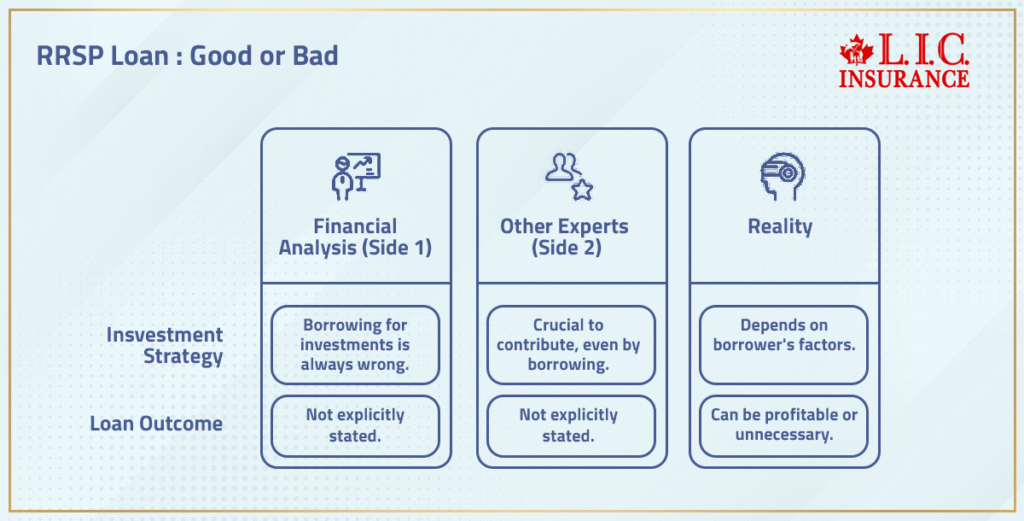
The discussion about taking out an RRSP loan in Canada tends to oversimplify the matter too often. On one side, some financial analysts insist that borrowing money to make investments is always wrong. On the other hand, other experts state that it is crucial to contribute to your RRSP account even at the cost of borrowing money.
Actually, the reality lies somewhere in between.
An RRSP loan itself is not a bad choice nor a good choice; it just depends on many factors connected with the borrower. It is possible to point to examples when the use of an RRSP contribution loan turned out to be quite profitable in the long run. On the contrary, there are also stories when borrowing money was totally unnecessary.
High-Income Earners Facing A Large Tax Bill
One of the best reasons to consider taking out an RRSP loan is when people have higher incomes.
With higher incomes, there is usually greater value in making RRSP deductions since contributions help reduce one’s taxable income and are deductible from marginal tax brackets, which tend to be higher as one makes more money.
Take, for instance, a person whose earnings reach $140,000 per year.
A sizeable RRSP contribution will not only help them deduct substantial amounts of money but also receive a significant tax rebate. The amount saved will often cover much of the costs of borrowing.
Suppose an individual makes a contribution of $20,000 through their RRSP loan.
After receiving their tax rebate, they are not required to repay their entire RRSP loan; they are required to pay back a smaller amount because some of their debt was paid through the tax savings.
If someone pays substantial sums in taxes each year, this is a much better strategy than delaying RRSP payments for a few years.
Canadians With Significant Unused Contribution Room
Many Canadians end up having large amounts of unused RRSP contribution room during the early part of their careers.
Student loans, living expenses, family commitments, and job changes make RRSP contributions tough.
Later on, many realize that they have tens of thousands of dollars worth of contribution room.
There is a special window of opportunity here.
Instead of contributing little by little each year while waiting until you can utilize your room, a few people decide to put down a larger sum at once.
The point here is not just the deduction.
The idea is to be able to invest more money now and get more time to grow the money.
Putting down a bigger sum now might generate greater gains than contributing smaller sums over the next few years.
Canadians Expecting A Significant Tax Refund
The expression of taking out a loan to invest in an RRSP and get a tax refund is popular among advertisements; however, there is a financial sense in this idea.
Assume that a person borrows $15,000 and uses all the borrowed money to put in his/her RRSP.
Following the filing of tax returns, he/she receives a tax refund of $5,000.
By immediately paying off the loan with the received money, a person owes only $10,000.
It turns out that a person managed to make a faster RRSP contribution and pay back less than he/she owed before the refund.
It looks like an extremely good idea if a refund is received promptly and the person acts wisely.
Otherwise, if a refund is spent on something else, not repaying a loan, it makes no sense anymore.
Self-Employed Canadians Seeking Tax Savings
A question we frequently hear is:
Can self-employed Canadians get RRSP loans?
In many cases, the answer is yes.
Canadian people in self-employment may have special requirements for tax planning. People working for organizations often join pension schemes in their workplaces, but that is not the case for entrepreneurs and independent professionals who need to take care of themselves in terms of saving for retirement.
Income may vary greatly from one period to another.
Some years may bring excellent incomes. Others may show mediocre results.
Using an RRSP contribution loan can be helpful in equalizing the variations by helping the person make significant RRSP contributions in a high-income year, where they can benefit from the deductions.
If you have $120,000 one year and $80,000 the other, making maximum contributions to your RRSP in the better year can offer great benefits from a taxation perspective.
When An RRSP Loan Does Not Make Sense
Financial instruments generally get recognition due to their advantages. But there are instances where individuals fail to consider the case when financial tools do not prove favourable.
RRSP loans are a good instance of financial products that might not always prove beneficial. There are occasions when taking loans to save for retirement becomes risky.
Existing High-Interest Debt
It would not be a good choice to take out an RRSP loan if there is already existing credit card debt.
Interest charges on a credit card are much higher than any possible return that can be made from the investment in the short term.
Let us consider a situation where one has $15,000 worth of debt on the credit card at a high interest rate and he or she is getting an RRSP loan.
One cannot hope that the tax savings resulting from the contribution will be sufficient to cover the costs incurred through consumer debt.
Weak Cash Flow
Cash flow is an extremely underappreciated aspect of RRSP loan planning.
Making a contribution might sound like a good idea. Getting a tax rebate might seem pretty generous. The investment forecast may be very optimistic.
But none of these things matter if loan payments cause financial strain.
The borrower needs to feel comfortable with making the payments within their current budget.
If everything is already budgeted for the basic needs of life, adding a loan might just be too risky.
Uncertain Employment Or Business Income
Income stability ensures flexibility.
Income instability creates a risk factor.
The person who is anticipating job loss, lack of certainty about a contractual agreement, falling earnings, or having income instability must make the decision to borrow money with great care.
Even a relatively small loan may become hard to repay if income falls sharply.
Planning for retirement ought to secure the person’s financial future, not undermine it.
Small Contributions With Minimal Tax Benefits
All contributions do not necessarily result in significant tax savings.
Where the size of the contribution and the projected refund amount are fairly small, the advantages that accrue from borrowing may be rather insignificant.
In such instances, contributing consistently using cash flow could make much more sense compared to borrowing.
The basic point here is to always weigh the cost against the benefit.
Borrowing must always add value; otherwise, there is no need for it.
RRSP Loan Or Personal Loan: Which Option Is Better?
Though both types of loans involve borrowing funds, their purposes are quite different.
The former is used exclusively in retirement planning, while the latter is just a form of general borrowing.
| Feature | RRSP Loan | Personal Loan |
|---|---|---|
| Tax Purpose | Yes | No |
| Tax-Deductible Contribution | Yes, if eligible | No |
| Designed for Retirement Savings | Yes | No |
| Tax Refund Potential | Possible, depending on eligibility and tax situation | No direct tax benefit |
This difference is important since RRSP loans are frequently based on the deadlines involved with making RRSP contributions and other retirement plans.
Institutions might provide promotional schemes, simplified processes, or terms specific to RRSPs during this period.
A personal loan will not have such features.
In the context of financial planning, one must take into account why the loan is needed.
For example, if the goal is to optimize RRSP contributions and save money for retirement, the better approach is to choose an RRSP loan.
Best RRSP Loan Rates Canada: What Borrowers Should Know
Interest costs are crucial when considering the feasibility of taking an RRSP loan.
Slight variations in the interest cost can impact the outcome of the transaction.
In Canada, many people pay great attention to the expected refund but do not care much about the borrowing cost. This could be detrimental.
The lower the interest cost for the RRSP loan, the better.
Several major Canadian financial institutions regularly offer RRSP loan programs, including:
- Royal Bank of Canada
- TD Bank Group
- Bank of Montreal
- Scotiabank
- Canadian Imperial Bank of Commerce
The rate you receive typically depends on several factors.
Credit history becomes a significant factor. The stability of income is also considered. Existing liabilities, the amount of the loan, and the repayment term can affect the price, too.
It is important for the borrower to shop around to see several proposals.
Just one or two percent of difference can make a huge impact on how much interest will be paid during the life of the loan.
Another crucial element of the loan is the repayment period.
A long repayment period means lower monthly payments but usually involves higher total interest costs.
Shorter repayment period, on the contrary, means higher monthly payments but lower overall costs of borrowing.
The optimal solution depends upon personal finances and the goals of the borrower.
The most effective RRSP loan scheme is one which combines moderate monthly payments and a rather rapid repayment period.
Contributing To Your RRSP Earlier Vs Waiting Until The Deadline
Among the most fascinating features of RRSP planning is the fact that the best choice for RRSP planning does not have to be an RRSP loan.
The optimal way would be to make contributions on an ongoing basis throughout the year.
In Canada, people do not normally think about their RRSP until the deadline gets close; by that time, they realize that they need to make a big contribution to their RRSP.
In that case, an RRSP loan is a perfect solution.
On the other hand, making contributions regularly throughout the year works better.
| Strategy | Contribution Timing | Growth Potential |
|---|---|---|
| Monthly | Throughout the Year | Potentially Higher |
| Deadline Loan | At the Last Minute | Potentially Lower |
The reason is simple.
Investments made early will have more time to benefit from the growth in the market.
Let us consider that one investor is putting $500 per month into the savings account.
The second investor starts in February and makes contributions at an annual rate of $500 in lump sums.
Usually, the first person has a longer period of time during which the investment is made.
In one year, it might not play a critical role.
After twenty or thirty years, it becomes more noticeable.
However, we should not assume that RRSP loans are useless.
On the contrary, there is a very valuable lesson. RRSP loan should be treated like a catch-up rather than an annual commitment.
People who develop regular contributions do not find themselves in such difficult situations.
Real RRSP Loan Example: Does Borrowing Actually Pay Off?
One of the first concerns of Canadians when considering getting an RRSP loan is whether or not this approach makes sense mathematically.
The outcome can depend on different factors such as salary, tax bracket, contribution amount, interest on the loan, payment terms, and returns from the investments. However, examining an example can reveal why many consider this option to be appealing.
Let us consider the case of a Canadian professional who makes $120,000 per year. Over several years, this person managed to earn considerable contribution room for their RRSP. With the RRSP deadline coming, they borrowed a sum of $20,000 to contribute.
Contributing the whole borrowed money to the RRSP results in a reduction of taxable income of the same amount. The refund that this person receives due to their new tax bracket and residence can reach several thousand dollars.
Using this refund to pay back the loan will result in a considerably smaller amount left to be repaid.
The situation may look something like this:
| Item | Amount |
|---|---|
| Annual Income | $120,000 |
| RRSP Loan | $20,000 |
| RRSP Contribution | $20,000 |
| Estimated Tax Refund | $7,000–$9,000 |
| Remaining Loan Balance After Applying Refund | Approximately $11,000–$13,000 |
At this stage, the borrower has been able to accomplish multiple goals at once.
They have managed to put away more for their retirement, lower their taxable income, claim their refund, and invest the extra funds sooner rather than wait for years before having the same amount of money saved up.
In the end, the result will depend on the success of the investments made and how soon the debt can be repaid.
What this case clearly shows is that the real advantage of using an RRSP loan may lie in combining tax benefits with early investing.
Can Self-Employed Canadians Get RRSP Loans?
Retirement planning issues faced by self-employed Canadians often differ from those of salaried workers.
Often, salaried workers contribute to their pensions through workplace pension plans or through contributions by employers towards retirement savings. For business owners, independent contractors, consultants, and freelancers, there is no such benefit.
Thus, retirement planning becomes fully dependent on them.
This further underlines the importance of RRSP planning.
The upside is that many self-employed Canadians have the potential to get RRSP loans if they meet the necessary conditions set by lenders.
Income verification may be required to qualify for the loan since the income of self-employed people varies annually. Nevertheless, RRSP loans are common among business owners and independent professionals.
In fact, RRSP loans can offer many other benefits apart from retirement savings for self-employed people.
A successful year in business may result in income being placed in a higher tax bracket. This can be offset by making an RRSP contribution in order to lower taxable income while building long-term investments.
For example, consider a consultant who has made much more money in that particular year than they anticipated. They might be required to pay more tax than they had initially calculated.
They could decide not to send all the money as taxes but to put part of it in as an RRSP contribution. If the money is tied up temporarily because of the business, they can take out an RRSP loan to cover the contribution amount.
This would be an example where the loan fits into a more elaborate tax and retirement plan.
Do RRSP Loans Affect Credit Score?
One question that comes up frequently concerns the potential impact of an RRSP loan on the credit standing of the borrower.
The answer is that RRSP loans do affect credit scores, although not necessarily in a bad way.
Much like any other kind of borrowing, RRSP loans will normally show up on the credit record of the borrower. The lender may perform a credit check at some point during the loan application procedure, and the resulting loan amount will be added to the credit record of the borrower.
There is nothing wrong with this for responsible borrowers.
On-time repayments indicate good financial practices and will likely improve credit standing over time.
It is only when there are problems with repayments or the loan balance is becoming increasingly difficult to handle that the problems start.
As a general rule, credit scores rely heavily on elements such as payment history and current amount of outstanding debts. Missed payments will adversely affect these.
RRSP loans, in themselves, cannot adversely affect credit scores.
It all depends on what happens after the loan has been made.
What Happens If I Miss An RRSP Loan Payment?
Most individuals only concentrate on the possible benefits of using an RRSP loan rather than considering possible worst-case scenarios.
The fact of the matter is that learning about possible risks is as essential as knowing about possible benefits.
Failure to make an RRSP loan payment will lead to a number of consequences, depending on the policies of the lender.
First off, it might mean incurring extra charges due to the interest rates. Some lenders even have policies whereby late payment is penalized. What is more, if the payments continue being missed, the information might reach credit reporting agencies.
In other words, a person’s credit rating might drop. This might cause problems when borrowing money in the future.
The reason is simple – a poor credit record makes borrowing quite hard and sometimes very expensive.
Another consequence is the accumulation of additional interest.
If the payment is not made on time, then the balance will stay out for longer periods. What this will translate into is that the client might end up paying interest for longer periods, thereby increasing the total amount he would need to pay.
This is not to say that RRSP loans are inherently risky in any way.
It just highlights the significance of only borrowing money that you can afford to repay.
This aspect becomes very critical during the decision-making process.
Strategies To Repay The Loan Faster
One of the best methods for maximizing the effectiveness of an RRSP loan is by decreasing the payback period.
The shorter the payback period, the lower the amount of interest will be paid.
Most RRSP loan users view the loan as something temporary rather than permanent.
An easy solution is paying off all the money with the tax refund received after making an RRSP deposit.
By doing so, the overall balance of the loan is reduced.
For instance, when getting a $7,000 refund from the taxes after depositing money in an RRSP account, the loan can be immediately repaid with this amount.
Other borrowers also speed up their loan repayments when there is improved cash flow.
An increment in salary, bonus, commission, or profits can be used to make additional payments on the loan.
On the other hand, some prefer the shorter terms from the beginning.
While monthly repayments would be a bit higher, the amount of interest paid would be much less.
It is not about repaying the loan alone.
Borrowers are also looking to reduce their costs from borrowing and build up their pension funds.
When both objectives complement each other, the whole plan becomes very appealing.
RRSP Loan Benefits In The Long Run
The true worth of an RRSP loan is hardly determined within a span of just a few months.
Success is generally determined within decades.
The reason for this lies in the fact that investments for the future require time.
An investment put in now could be growing for a long time. Even small interest rates could result in substantial gains when compounded.
Assume two individuals make equal contributions to their RRSP accounts.
The first makes the contribution now via an RRSP loan.
The second puts off the contribution for a few years before doing the same.
Even assuming the same rate of return, it may so happen that the person who made the earlier contribution builds up a higher portfolio simply due to the added years of growth.
This is the reason why compound growth has great significance.
Earnings made from investments create additional earnings. These, in turn, earn more.
Potential long-term RRSP loan benefits include:
- Accelerated retirement savings.
- Earlier market participation.
- Greater use of available contribution room.
- Reduced taxable income.
- Potential tax refunds.
- Improved long-term portfolio growth.
Of course, none of these outcomes is guaranteed. Investment returns fluctuate, markets rise and fall, and borrowing costs change.
Nevertheless, for disciplined investors with strong repayment plans, an RRSP loan can support long-term retirement objectives.
Questions To Ask Before Taking Out An RRSP Loan
Before deciding whether to borrow, it is important to step back and evaluate the broader financial picture.
The following questions can help guide that evaluation.
How much available RRSP contribution room do you currently have?
What is your marginal tax rate?
How much tax savings do you realistically expect from the contribution?
Can your current cash flow comfortably support loan repayments?
Are you carrying any high-interest debt that should be eliminated first?
How quickly do you plan to repay the loan?
What interest rate are you being offered?
Will the expected tax benefits exceed the borrowing costs?
How does the contribution fit within your overall retirement plan?
These questions may seem straightforward, but they often reveal whether an RRSP loan genuinely creates value.
A good financial decision is rarely determined by a single factor. It is usually the result of multiple factors working together.
Final Thoughts: When Does It Make Sense To Take Out An RRSP Loan?
An RRSP loan in Canada can be an excellent choice under certain circumstances.
It can benefit those who have a stable source of income, a significant RRSP contribution room, adequate cash flow, and a plan of repayment by allowing them to boost their savings during retirement, lower their income tax, receive money back in tax savings, and begin investing sooner.
It’s also essential to understand that borrowing is not without costs.
One needs to consider interest expenses, debt payments, and risks involved. RRSP borrowing should enhance your finances and assist in meeting your future objectives rather than adding more debt to your list of worries.
In most cases, we would recommend an RRSP loan option as one of the last resorts, though for people with high earnings, who are self-employed, have significant RRSP contribution room, and who could pay back the amount loaned using their tax refund, it could be an excellent choice.
For everyone else, RRSP contributions financed by regular savings could be a better route to take.
As always, it boils down to balance.
In cases where all of the above factors fall into place, then an RRSP contribution loan could be utilized as an important component of a Registered Retirement Savings Plan in Canada.
It is no secret that some of the most successful retirement plans out there are not based on a single contribution or even one tax season. Instead, they are created through decisions made over several years.
Written By: Pushpinder Puri
Licensed Insurance Adviser | MDRT Qualifier
With over 14 years of experience in Life Insurance, wealth planning, and tax-efficient strategies for Canadians.
Disclaimer:
This content is provided for general educational and informational purposes only and should not be considered financial, tax, legal, or investment advice. RRSP loan suitability depends on your individual income, tax situation, cash flow, risk tolerance, and financial goals. Tax rules, contribution limits, and lending conditions may change over time. Consult a qualified financial advisor, tax professional, or licensed insurance advisor before making any borrowing or RRSP contribution decisions.
FAQs
Yes, but the choice needs to be based on the whole financial plan you have in place. There are people in Canada who opt for an RRSP loan Canada scheme in order to optimize their retirement savings using the tax-efficient system, but keep their other non-registered investments as well.
Absolutely. In many instances, it is possible. If you have multiple RRSP accounts to work with, you can spread out your RRSP contributions among various investment options as long as you do not exceed your available RRSP contribution room.
RRSP Loan interest rates depend on the financial institution lending out the money and the type of loan being offered. There are some financial institutions which offer RRSP loans that have fixed interest rates, and there are those which offer variable interest rates.
It is possible for new immigrants to be eligible if they satisfy the credit and income criteria of the lenders. Nonetheless, the contribution room under RRSP usually depends on the amount of Canadian income that one earns in past years.
This is dependent on timing and financial priorities. Postponing the contribution can make it unnecessary to borrow funds since waiting for a bonus can take care of that; however, delaying the contribution might mean missing out on investment opportunities. Analyzing both financial priorities and cash flow will help decide.
In some cases, an RRSP contribution loan may be useful for tax planning during exceptionally profitable years. Lowering one’s taxable income in such profitable times may be more advantageous compared to making RRSP contributions on a consistent basis throughout lower-income years.
While many Canadians pay close attention only to the interest rate, the terms and conditions related to the possibility of repaying the loan are significant. Factors such as the possibility for prepayment, early repayment, and applying one’s tax rebate towards the balance can affect the entire process.
Even those nearing retirement age could take out a loan to contribute to their RRSPs as long as they qualify, but the shortened time period means that they must do some thorough planning before taking this step.
An annual review is always a good place to start. Any changes to income, tax rate, personal status, or even contribution room left from previous years may make current contribution amounts unsuitable for meeting your future needs.
There are cases where a couple can optimize their contributions for enhanced tax efficiency and effective retirement savings through coordination of the couple’s efforts. Analyzing both the incomes, contribution room, and retirement requirements of both parties usually yields more benefits than considering each RRSP separately.
Sources and Further Reading
Government And Regulatory Sources
- Canada Revenue Agency (CRA) – Registered Retirement Savings Plans (RRSPs)
- Canada Revenue Agency (CRA) – RRSP Contribution Limits, Deductions, And Transfers
- Canada Revenue Agency (CRA) – My Account RRSP Contribution Room Information
- Statistics Canada – Household Saving And Wealth Data
- Government Of Canada – Retirement Income Planning Resources
Industry And Retirement Planning Resources
- Canadian Investment Regulatory Organization (CIRO) – Investor Education Resources
- Canadian Life And Health Insurance Association (CLHIA)
- Financial Consumer Agency Of Canada (FCAC) – Retirement Planning Tools
Major Canadian Financial Institutions Offering RRSP Information
- Royal Bank of Canada (RBC) RRSP Resources
- TD Bank RRSP Learning Centre
- Scotiabank RRSP Information Centre
- CIBC RRSP Education Centre
Additional Retirement Planning Resources
Key Takeaways
- An RRSP loan Canada strategy can help Canadians make a larger RRSP contribution immediately, rather than waiting years to accumulate the same amount through savings.
- The primary advantage of an RRSP contribution loan is the ability to reduce taxable income, potentially generate a larger tax refund, and accelerate retirement savings growth.
- Canadians with substantial unused contribution room from previous years may benefit more from an RRSP loan because they can maximize available contribution opportunities sooner.
- The value of an RRSP loan often increases for individuals in higher tax brackets, where RRSP deductions can create more meaningful tax savings.
- A large tax refund can be applied directly toward the loan balance, reducing the amount that must be repaid and lowering overall interest costs.
- Self-employed professionals may find RRSP loans particularly useful when managing fluctuating income and building retirement savings without access to workplace pension plans.
- Borrowing only makes sense when monthly repayments fit comfortably within your existing cash flow and financial obligations.
- High-interest consumer debt should generally be addressed before considering an RRSP loan, as the cost of that debt may outweigh potential RRSP benefits.
- Comparing RRSP loan interest rates from multiple financial institutions can significantly affect the overall cost and effectiveness of the strategy.
- Contributing to your RRSP regularly throughout the year is often the ideal approach because it allows investments more time to benefit from compound growth.
- An RRSP loan should be viewed as a strategic financial tool rather than a last-minute solution to meet the annual RRSP deadline.
- Before borrowing, Canadians should evaluate their RRSP contribution room, expected tax savings, repayment ability, investment timeline, and overall retirement plan.
- The most successful RRSP loan strategies combine strong repayment discipline, meaningful tax advantages, and long-term investment objectives.
- An RRSP loan does not guarantee investment gains, but when used appropriately, it may help accelerate wealth accumulation within a Registered Retirement Savings Plan in Canada.
- The decision to borrow for an RRSP contribution should always balance potential tax benefits, borrowing costs, financial risk, and long-term retirement goals.
Your Feedback Is Very Important To Us
Help Us Better Understand Your RRSP Loan And Retirement Planning Challenges
Your feedback will help us create more useful resources about RRSP loan Canada, retirement savings strategies, tax planning, and RRSP contribution decisions.
IN THIS ARTICLE
- When Does It Make Sense To Take Out An RRSP Loan?
- What Is An RRSP Loan And How Does It Work?
- How RRSP Contribution Affects Taxable Income
- Understanding RRSP Contribution Room And Unused Contribution Room
- When An RRSP Loan Makes Sense
- High-Income Earners Facing A Large Tax Bill
- Canadians With Significant Unused Contribution Room
- Canadians Expecting A Significant Tax Refund
- Self-Employed Canadians Seeking Tax Savings
- When An RRSP Loan Does Not Make Sense
- RRSP Loan Or Personal Loan: Which Option Is Better?
- Best RRSP Loan Rates Canada: What Borrowers Should Know
- Contributing To Your RRSP Earlier Vs Waiting Until The Deadline
- Real RRSP Loan Example: Does Borrowing Actually Pay Off?
- Can Self-Employed Canadians Get RRSP Loans?
- Do RRSP Loans Affect Credit Score?
- What Happens If I Miss An RRSP Loan Payment?
- Strategies To Repay The Loan Faster
- RRSP Loan Benefits In The Long Run
- Questions To Ask Before Taking Out An RRSP Loan
- Final Thoughts: When Does It Make Sense To Take Out An RRSP Loan?
Sign-in to CanadianLIC
Verify OTP