- Connect with our licensed Canadian insurance advisors
- Schedule a Call

BASICS
- Is Infinite Banking A Smart Financial Strategy?
- Understanding the Infinite Banking Concept
- Why Infinite Banking Appeals to Canadians Seeking Financial Freedom
- How Infinite Banking Strategy Helps Build Financial Independence
- Challenges and Misconceptions About Infinite Banking
- Who Should Consider Infinite Banking for Financial Freedom?
- How to Start Your Infinite Banking Journey
- Key Advantages of the Infinite Banking Strategy
- A Day-to-Day Struggle: Why More Canadians Are Exploring Infinite Banking
- Potential Drawbacks You Should Know
- The Future of Infinite Banking in Canada
- Is Infinite Banking a Smart Financial Strategy?
COMMON INQUIRIES
- Can I Have Both Short-Term and Long-Term Disability Insurance?
- Should Both Husband and Wife Get Term Life Insurance?
- Can I Change Beneficiaries on My Canadian Term Life Policy?
- What Does Term Life Insurance Cover and Not Cover?
- Does Term Insurance Cover Death?
- What are the advantages of Short-Term Life Insurance?
- Which Is Better, Whole Life Or Term Life Insurance?
- Do Term Life Insurance Rates Go Up?
- Is Term Insurance Better Than a Money Back Policy?
- What’s the Longest Term Life Insurance You Can Get?
- Which is better, Short-Term or Long-Term Insurance? Making the Right Choice
IN THIS ARTICLE
- What is the minimum income for Term Insurance?
- How Does Income Affect Your Term Life Insurance Policy?
- Can You Buy Term Life Insurance Online with a Low Income?
- How Can You Lower Your Term Life Insurance Cost?
- How Much Term Life Insurance Do You Need?
- Can Your Term Life Insurance Policy Be Adjusted Over Time?
- Why Term Life Insurance Is Ideal for Lower-Income Canadians
- Final Thoughts
- More on Term Life Insurance
Is Travel Insurance Tax Deductible In Canada?

By Harpreet Puri
CEO & Founder
- 10 min read
- Aug 25th, 2026
SUMMARY
Travel Insurance tax deduction Canada depends on whether Travel Medical Insurance premiums qualify as medical expenses under CRA rules. The medical portion may be included in the medical expense tax credit if eligibility conditions are met. Travel Insurance costs linked to trip cancellation or baggage insurance are not tax-deductible. Proper documents, receipts, and accurate reporting help reduce income tax liability and maximize tax benefits.
Introduction
A medical crisis abroad is neither predicted nor inexpensive. According to information provided by the Canadian Life and Health Insurance Association, an emergency while abroad can easily cost upwards of $100,000 CDN, particularly in cases involving hospitalizations and evacuations. However, according to the Canada Revenue Agency, many Canadians make claims each year to reduce their income tax burden through the use of specific tax credit schemes.
It is at this point that many people become confused as to what extent their insurance payments abroad can contribute to reducing their tax burden. Many customers who are purchasing coverage through the Canadian LIC erroneously believe that since they are paying for this service, they will be entitled to have it all deducted from their taxes. Unfortunately, in Canada, there is no blanket deduction available for all insurance products purchased.
The secret to unlocking tax benefits comes from the knowledge that there is a difference between regular travel costs, qualifying medical treatments, and how the medical coverage works within the scope of the Medical Expense Tax Credit. There are some areas of the policy where tax breaks are possible, but under certain conditions.
Canada Revenue Agency Guidelines On Travel Insurance
When it comes to assessing claims on deductible travel expenses, the Canada Revenue Agency takes an extremely rigid stance. Travel alone does not classify as a deductible task. Regardless of the purpose of the travel, whether for vacation, visiting relatives, or even conducting business in some instances, the cost of Travel Insurance does not necessarily become a deductible expense.
The exception to the rule occurs when there is an involvement of Health Insurance. The Canada Revenue Agency permits citizens to add certain insurance premiums to their list of deductible medical costs, provided that the premiums are part of a private health service plan. It is important to note that if the insurance protects against sickness or accidents, then the cost of the premiums is deductible.
Nevertheless, one of the distinguishing characteristics of the CRA is that it clearly distinguishes between medical expense coverage and financial risk coverage. This implies that even the parts of trip cancellation, trip interruption, or baggage insurance would not count, despite being part of the same Travel Insurance. These expenses do not belong to the category of medical expenses and hence cannot reduce your tax burden.
In practice, it is where most taxpayers go wrong. In their eagerness to deduct their medical expenses, they usually try to use the total premium cost while ignoring the exact medical coverage part that qualifies as a deductible expense according to the CRA rules.
Understanding Medical Expense Tax Credit In Canada
The Medical Expense Tax Credit is essential in assessing whether some portion of your Travel Insurance premium expenses qualifies for financial assistance. It should be noted that this is not a standard tax deduction but a non-refundable tax credit that directly lowers the income tax owing rather than your taxable income.
The difference between the two lies in what each one does. As already stated, the former directly decreases your income tax owing, while the latter lowers your taxable income.
This point is significant because many people tend to think that they get an equal amount of tax relief for each expense incurred towards their health. That is not quite true because the CRA uses a certain percentage based on net income (normally around 3%) to determine eligibility.
For instance, let us assume that your net income is $70,000. Your total eligible medical expenses must be over $2,100 for you to be eligible.
Such a model provides the reasons behind the inability of some people to realize gains despite investing huge amounts as premiums. This credit system is aimed at assisting people with high healthcare costs, not those with average costs.
The present article is targeted at Canadians who often utilize their Travel Insurance. These include snowbirds who spend long periods in the U.S., family members hosting their parents with the help of Super Visas, and travellers from abroad who face escalating healthcare costs.
How Medical Expense Tax Credit Actually Works (Illustration)
| Net Income | Threshold (Lower Of 3% Or Indexed Amount) | Eligible Expenses | Federal Credit (15%) |
|---|---|---|---|
| $60,000 | $1,800 | $3,000 | ~$180 |
| $80,000 | $2,400 | $5,000 | ~$390 |
| $100,000 | $2,759 (indexed cap) | $6,000 | ~$486 |
What Qualifies As Eligible Medical Expenses
Before determining whether the Travel Insurance may be covered, it is essential to examine the criteria established by the CRA regarding which expenses qualify as eligible medical expenses. These are the expenditures that help diagnose, treat, or prevent medical conditions.
The list includes expenses associated with hospitalization, treatment provided by doctors, medications purchased by prescription, and some dental procedures. Travel Insurance related to hospitalization plans and emergency assistance overseas also qualify as eligible medical expenses. In addition, all such expenses should be related to the treatment of the illness.
Expenses paid on behalf of the spouse or common law partner, including dependents, are considered eligible medical expenses, too. It is crucial for families who buy Travel Insurance for elderly people, since there is a high probability of medical issues among the elderly population.
But there are definite exceptions to these rules. Medical procedures that are elective, for example, are not eligible. Neither are medical expenses that are reimbursed by another insurer or employer’s benefit plan. The Canada Revenue Agency makes it very clear that both these aspects are allowed.
It must also be reiterated that the expense must be real and the proper documentation must be available.
Are Travel Insurance Premiums Tax Deductible
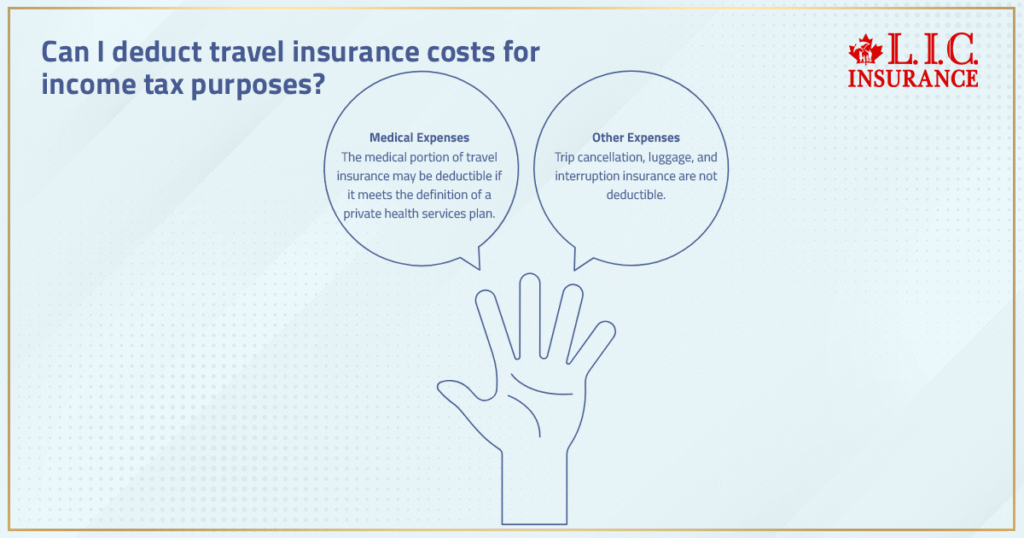
This is the question most people raise, and it needs an accurate response. It should be known that all costs associated with Travel Insurance are not deductible for income tax purposes. However, the medical portion of the insurance policy may be deducted, depending on whether it meets the definition of a private health services plan.
What does this mean in practice? If your Travel Insurance covers emergency medical expenses, you may include this cost in your deductible medical expenses. All other types of insurance, such as trip cancellation, luggage, and interruption, are not deductible.
The confusion usually arises when reading through the contract document provided by your insurer. In many cases, the different elements of Travel Insurance are combined, so it is crucial to consult with experts who can distinguish between what belongs to medical expenses and what does not. Otherwise, it will be hard to provide the necessary documentation if challenged by the CRA.
It is easy to understand: the full cost of Travel Insurance is not deductible. The only deductible amount is the insurance covering your medical expenses abroad.
What Travel Insurance Coverage Does NOT Qualify
The non-medical parts of Travel Insurance are explicitly exempted from being taxable as per CRA. Such parts of Travel Insurance provide financial protection against financial inconveniences, but not illness or injuries.
Coverage like trip cancellations ensures that you get compensated for not being able to travel due to reasons beyond your control. Trip interruptions cover situations where your trip gets disrupted prematurely. Your baggage is covered by baggage insurance in case of delays or loss. Although these aspects of the Travel Insurance Policy are important, they are not part of medical services, hence their ineligibility.
People are normally surprised at this decision since they think that all forms of insurance that cover any aspect of illnesses qualify.
Example Of Claiming Travel Medical Insurance
An example of how this process can be carried out will prove useful in understanding. For instance, if you get a Travel Insurance Plan at $400, the insurer shows you that out of the $400 you have paid, $280 is the cost of Travel Medical Insurance, while $120 is for trip cancellation and baggage insurance.
Should the total of your medical expenses be more than the CRA threshold for the fiscal year, then you could add the $280 to the list of those eligible for the benefit. The other $120, however, will never be claimed.
In a situation where the eligible total expenses you have incurred are less than the threshold, the $280 would still offer you no tax relief due to the fact that you won’t have not reached the minimum amount required.
How To Claim Travel Insurance On Your Tax Return
For filing the income tax return, it is crucial to be meticulous and precise. For this reason, it is vital to prepare and collect all the relevant documents, such as receipts, policies, and breakdowns indicating the percentage of the cost dedicated to the medical component of premiums.
In terms of eligible expenses, they are included in Line 33099 (self, spouse, and dependents) or Line 33199 (other dependents) on the form T1 of the income tax return. The cap is calculated at either 3% of one’s net income or an indexed amount by CRA ($2,759 for 2024). As CRA updates this amount each year, it is recommended to refer directly to CRA to receive the updated limits on medical expense credits for the 2025 and 2026 tax years.
It is possible that CRA will ask to provide some documents. To stay prepared for potential requests, it is essential to have all relevant documentation collected and stored in a convenient manner using a client portal or personal filing system.
The medical expense claim will be made when calculating total medical expenses.
Eligibility Rules And Tax Conditions
Certain requirements need to be fulfilled before qualifying Travel Medical Insurance expenses for a tax deduction. For one, it should be incurred during the tax year and should not have been reimbursed already. Additionally, the expenses have to be related to medical expenses that qualify under the rules set out by the CRA.
CRA further looks at the income tax scenario of the taxpayer and the net income, along with the total expenses that were incurred. In determining the impact, CRA does not consider individual premiums only. Rather, it takes into account the impact of the cumulative effect of all eligible medical expenses.
Only when these criteria are met do we get the real benefit from insurance premium expenses.
Common Mistakes To Avoid
Many individuals unintentionally reduce their chances of claiming a valid tax credit due to simple but critical errors.
- Claiming the full Travel Insurance premium instead of isolating the medical portion
- Failing to keep proper receipts and supporting documents for verification
- Including expenses that have already been reimbursed
- Assigning medical expenses to the wrong tax year on the income tax return
- Not understanding CRA eligibility rules before attempting to claim
Avoiding these mistakes often requires careful review or guidance from a qualified tax professional or accountant.
What We See In Practice At Canadian LIC
The most frequent misinterpretation occurs when it is assumed that the total cost of the Travel Insurance Policy is deductible. For example, an Ontario couple was travelling as snowbirds for six months and tried to claim the full cost of the policy; however, their accountant informed them that only the medical component was deductible.
One other common problem that many clients have is not obtaining an itemized statement from the insurance company. Since it is imperative that there be a distinction between medical coverage and other benefits, otherwise the CRA may disallow the deduction.
Why Travel Insurance Still Matters
Even when there is only the smallest chance of deducting premiums, Travel Insurance Canada proves its value by providing much more than any tax benefits might. The unexpected medical issues that travellers encounter can cause expenses much higher than the price of their insurance policies, especially for travellers who do not have provincial healthcare coverage during trips.
When considering Travel Insurance for elderly people, such concerns grow to a whole new level. Health issues that may arise due to age become more likely, making the inclusion of Health Coverage mandatory. In addition, many foreign visitors travelling to Canada need Travel Insurance for Canada in order to cover possible expenses from accessing healthcare services in this country.
Any insurance product exists to provide protection to its holders. Only additional tax advantages must be considered.
Super Visa Insurance And Medical Expense Tax Credit Eligibility
Super Visa programs see many Canadian LIC customers buy insurance for their parents. Insurance in such a case is highly focused on medical aspects, which makes it likely that medical parts can be included in the total amount of qualified medical expenses.
Nevertheless, the very same conditions by CRA apply here. Only medical insurance will be considered, provided that the payment has not been compensated and is higher than the required threshold. With high premiums involved in Super Visa programs, it becomes relevant for calculating medical tax credits.
How Canadian LIC Helps You Maximize Benefits
The Canadian LIC provides support to its customers to make sure that their Travel Insurance Plan is formulated effectively for the purpose of protection and paperwork. The customer is advised about the kind of plans that differentiate between the part of the policy which is concerned with medical needs and the rest.
Moreover, the Canadian LIC also assists in record keeping, determining eligibility, and getting good Travel Insurance rates in Canada. With such an approach, not only is the client protected, but the benefit of being able to take deductions is ensured as well.
Expert Advice Before Filing
The process of taxation is never simple, and many elements can contribute to the success or failure of an effort. Personal elements such as salary, dependents, and overall medical costs are just a few elements that might impact your claim.
Hiring a tax expert or accountant will make sure that you take the right steps according to the latest CRA tax regulations.
Final Answer: Is Travel Insurance Tax Deductible In Canada
Canadian Travel Insurance premiums are not entirely tax-deductible, although some parts of the premium might qualify for the Medical Expense Tax Credit. This would depend on the medical component of the Travel Insurance, not the entire amount paid. Provided that the component complies with the requirements set by the CRA and that your aggregate qualifying medical expenses surpass the limit relative to your income, then you can use it as a tax shield.
Nonetheless, one must temper his/her expectations. Most Travel Insurance Policies provide coverage that extends beyond medical benefits. For instance, most packages offer travel cancellations, baggage insurance, and delays. These components cannot be counted as deductible medical expenses.
You Can Claim If:
- The Travel Medical Insurance premium qualifies under CRA rules
- The expense relates to medical care and is not reimbursed
- Your total medical expenses exceed CRA thresholds
You Cannot Claim If:
- The cost relates to non-medical benefits
- The expense has been reimbursed
- The full policy is claimed without separating the medical portion
In short, eligibility is partial and depends entirely on structure and documentation.
Author: Harpreet Puri, Licensed Insurance Adviser | MDRT Qualifier
Experience: 14 Years In Life Insurance & Financial Planning
LinkedIn Profile:https://www.linkedin.com/in/harpreetpuricanadianlic/
Disclaimer:
This content is for general informational purposes only and is not intended as tax, legal, or financial advice. Tax treatment of Travel Insurance and medical expenses may vary based on individual circumstances and CRA rules. Always consult a qualified tax professional or accountant before claiming any insurance premiums on your income tax return.
FAQs
In case a journey includes both private and business aspects, only that which is specifically concerned with the health care aspect will qualify for deduction in this tax credit program; otherwise, other travel expenses will have to be considered independently in terms of their tax treatment.
Yes, if you have any expenses incurred in foreign currency, then you should convert them into Canadian dollars according to the acceptable exchange rates. According to the rules of the CRA, it is essential that you report your premium payment amount accurately.
There is no unlimited carry-forward for unused medical expenses, but you have some leeway in which months within a 12-month period can be chosen. This will allow you to maximize any potential tax credit based on higher Travel Medical Insurance premiums.
Even though you don’t always have to provide it initially, the CRA might ask for supporting evidence like travel dates, copies of insurance policies, and receipts. Having all the necessary documentation will help you ensure that you only claim eligible expenses.
Travel Insurance Plans Offered by Insurers like Manulife, Sun Life, and Canada Life contain Travel Medical Insurance Coverage. The important thing is not which company you use, but rather that your plan contains Travel Medical Insurance coverage that satisfies CRA’s requirements for deductibility.
It is possible to deduct part of your insurance premium as an expense while filling out your tax return, provided that it pertains to medically deductible expenditures. First, the CRA checks if the insurance payment qualifies as an eligible expenditure prior to any deduction of taxes.
Eligibility will apply only for plans that provide for medical Travel Insurance associated with emergency medical coverage. Travel Health Insurance Plans that concentrate only on financial protection, like cancellations, do not meet the eligibility criteria for deductible medical expenses.
It is possible to buy Travel Insurance in Canada from a certified advisor, broker, or insurer that offers compliant coverage. Consulting with an expert, such as Canadian LIC, makes it much easier to establish whether there is clear coverage for the medical portion of the policy.
The Canadian tax system does not provide for any deduction of Travel Insurance costs for foreign travel trips. However, only those expenditures that qualify under the medical expense tax credit can be included.
The self-employed are not entitled to deduct the total cost of their Travel Insurance as an expense. But there could be some part of the Travel Insurance premium that may be considered eligible as a personal medical expense.
Eligible expenses are reported on Line 33099 and Line 33199 of the T1 income tax return. These are part of Schedule 1 used to calculate the medical expense tax credit.
Yes, if the expenses qualify under CRA rules and relate to necessary medical care, snowbirds can include them as eligible medical expenses, including qualifying Travel Medical Insurance.
Super Visa insurance may qualify if the medical portion meets CRA requirements. Since these plans focus heavily on healthcare, they often provide a higher eligible expense component.
Sources and Further Reading
- Canada Revenue Agency – RC4065 Medical Expenses Guide
https://www.canada.ca/en/revenue-agency/services/forms-publications/publications/rc4065.html - Canada Revenue Agency – Eligible Medical Expenses (Lines 33099 & 33199)
https://www.canada.ca/en/revenue-agency/services/tax/individuals/topics/about-your-tax-return/tax-return/completing-a-tax-return/deductions-credits-expenses/lines-33099-33199-eligible-medical-expenses-you-claim-on-your-tax-return.html - Canada Revenue Agency – Medical Expense Tax Credit Details
https://www.canada.ca/en/revenue-agency/services/forms-publications/publications/rc4065/medical-expenses.html - Government of Canada – Income Tax Folio S1-F1-C1
https://www.canada.ca/en/revenue-agency/services/tax/technical-information/income-tax/income-tax-folios-index/series-1-individuals/folio-1-health-medical/income-tax-folio-s1-f1-c1-medical-expense-tax-credit.html - Income Tax Act Section 118.2
https://laws-lois.justice.gc.ca/eng/acts/I-3.3/section-118.2.html
Supporting Insights
- CRA confirms eligible medical expenses can include healthcare costs incurred inside or outside Canada (if not reimbursed):
https://www.canada.ca/en/revenue-agency/services/forms-publications/publications/rc4065/medical-expenses.html - CRA guidance on claiming expenses on your income tax return:
https://www.canada.ca/en/revenue-agency/services/tax.html
Key Takeaways
- Travel Insurance in Canada is not fully tax deductible; only the medical portion may qualify under the medical expense tax credit
- The Canada Revenue Agency allows claims only if expenses meet the eligible medical expenses criteria and are not reimbursed
- Non-medical benefits like trip cancellation, baggage insurance, and delays are not tax-deductible
- You must exceed the CRA threshold (based on net income) for any tax credit to apply
- Proper documents, receipts, and a clear breakdown of the premium paid are essential for claiming
- Expenses are reported on Line 33099 or 33199 of your income tax return
- Travel Medical Insurance premiums must qualify under a private health services plan to be considered
- Working with a tax professional or accountant helps avoid errors and maximize tax benefits
Your Feedback Is Very Important To Us
IN THIS ARTICLE
- Is Travel Insurance Tax Deductible In Canada?
- Canada Revenue Agency Guidelines On Travel Insurance
- Understanding Medical Expense Tax Credit In Canada
- What Qualifies As Eligible Medical Expenses
- Are Travel Insurance Premiums Tax Deductible
- What Travel Insurance Coverage Does NOT Qualify
- Example Of Claiming Travel Medical Insurance
- How To Claim Travel Insurance On Your Tax Return
- Eligibility Rules And Tax Conditions
- Common Mistakes To Avoid
- Why Travel Insurance Still Matters
- How Canadian LIC Helps You Maximize Benefits
- Expert Advice Before Filing
- Final Answer: Is Travel Insurance Tax Deductible In Canada
Sign-in to CanadianLIC
Verify OTP