What Is The Maximum RRSP Contribution For 2026?

Hey there! Ready to secure your financial future? Don’t forget to check out the RRSP (Registered Retirement Savings Plan) contribution limits for 2024. Understanding these limits is a vital piece of the puzzle in planning a successful retirement. With the new year around the corner, understanding these changes can help you plan better and maximize your savings. This guide is here to walk you through the 2024 RRSP contribution limits, offering insights and strategies to make the most of your retirement savings. Whether you’re a seasoned saver or just starting, this information is pivotal in shaping your financial future. So, let’s get started on understanding these updates and how they can benefit you!

What is the Maximum RRSP Contribution for 2026?

By Canadian LIC, January 22, 2026, 8 Minutes

What Is The Maximum RRSP Contribution

SUMMARY

Canadian LIC breaks down the 2026 registered retirement savings plan contribution limit of $33,810, who qualifies for it, and how to use it strategically. The content also explains RRSP interest rate 2025 trends, penalties for over-contribution, and how to coordinate RRSPs with TFSAs, spousal plans, or employer contributions to maximize tax savings and long-term retirement growth.

Introduction

Every year, we see Canadians miss out on thousands in tax savings and compound growth simply because they didn’t fully understand how much they could contribute to their Registered Retirement Savings Plan (RRSP). Some over-contribute and face penalties. Others under-contribute and miss the chance to reduce taxable income or grow their retirement savings effectively. At Canadian LIC, we’ve helped clients recover from both scenarios — and plan smarter with clear, personalized strategies built over 14+ years of working directly with Canadian families.

Why the RRSP Contribution Limit Is More Than Just a Number

At Canadian LIC, we often meet clients who assume the RRSP contribution limit is a number they can look up once and forget. But in our work, that number represents much more. It reflects how prepared you are to reduce taxes, how flexible you can be with your savings plan, and how successfully you can take control of your retirement.

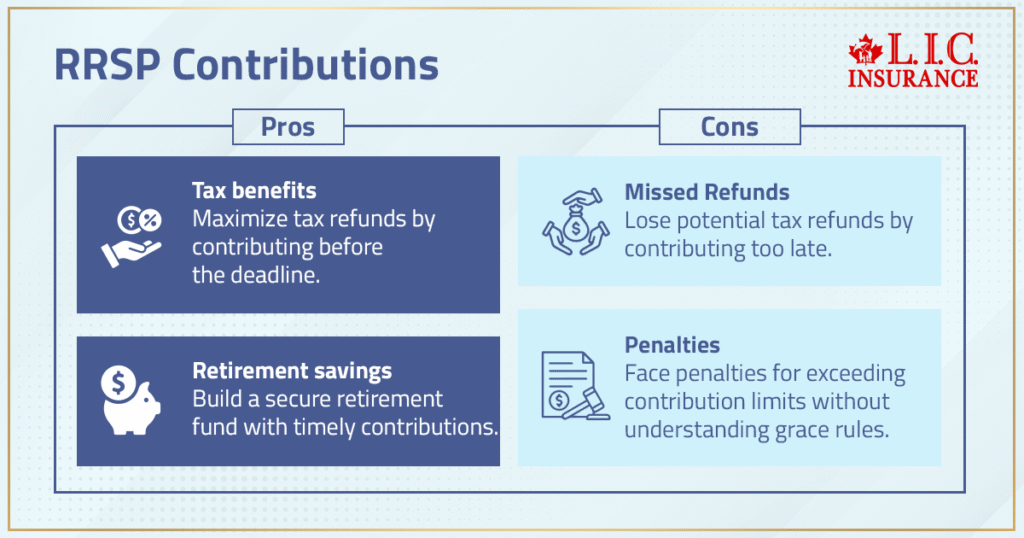
We’ve met families who left thousands in tax refunds on the table simply by contributing too late. We’ve also seen individuals pay painful CRA penalties for accidentally going over the limit because no one explained the $2,000 grace rule.
RRSP Contributions

Understanding the maximum RRSP contribution for 2026 isn’t just about knowing the ceiling. It’s about using the number the right way, at the right time, for the right result.

What Is the Maximum RRSP Contribution for 2026?

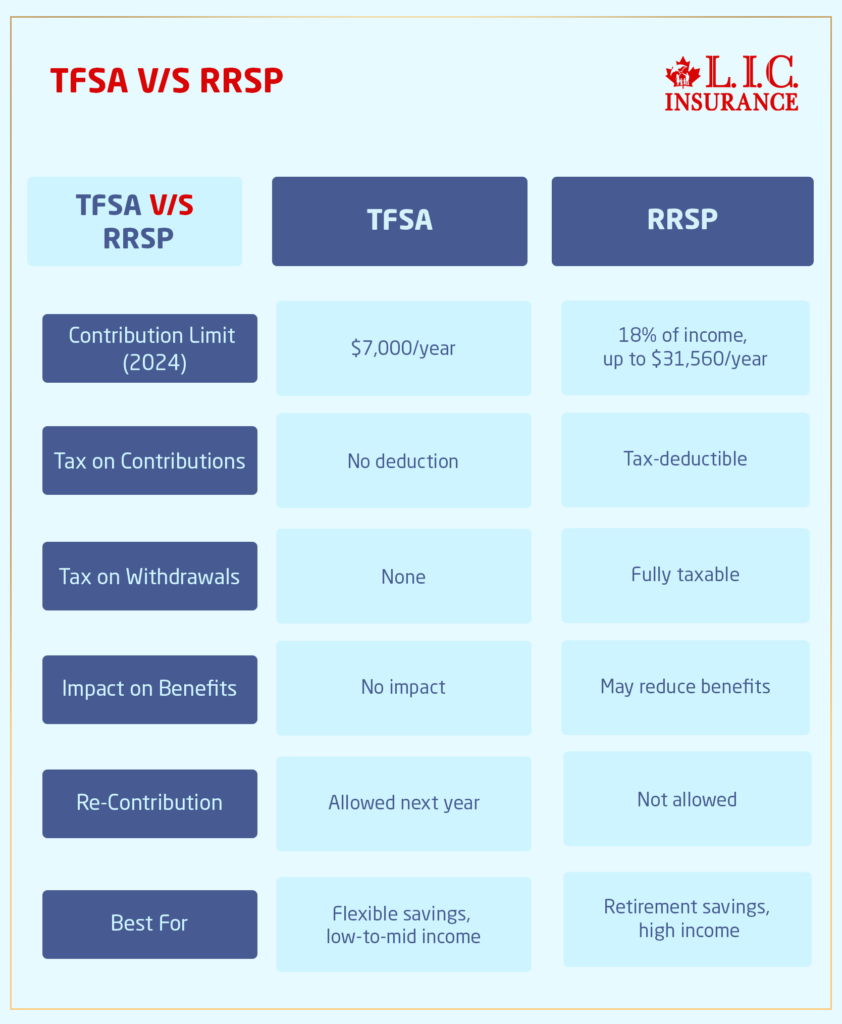
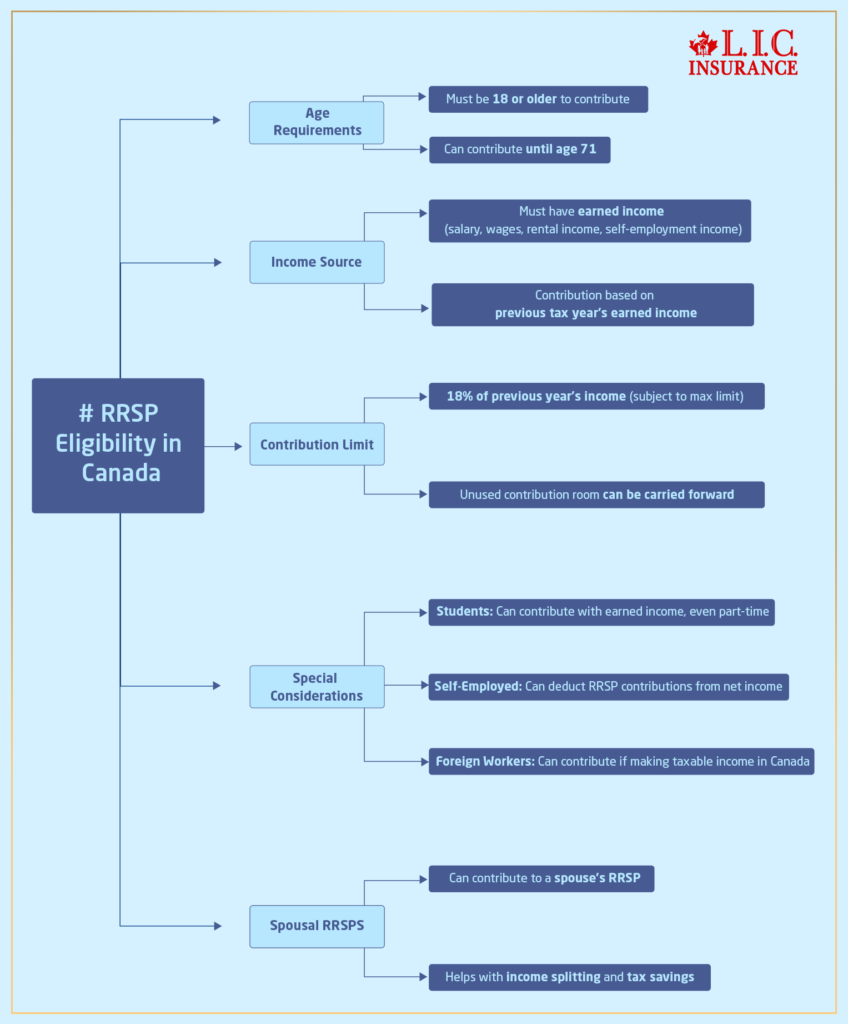
For the 2026 tax year, the maximum RRSP contribution limit is $33,810, which increased from the 2024 limit of $31,560. But don’t stop reading there — because most Canadians aren’t RRSP eligible to contribute the full amount unless they have earned income of approximately $180,500 or more in 2024, and their pension adjustment does not reduce their available contribution room.

The actual calculation is 18% of your earned income from the previous year (2024) up to the annual maximum.

Example:

If you earned $75,000 in 2025, your RRSP contribution room for 2026 would be $13,500.

Key facts:

  • Max contribution: $33,810
  • Based on 18% of earned income in 2024
  • Deadline to contribute for 2026 tax return: March 2, 2026

We always remind clients: even if you can’t contribute the full amount now, any unused room carries forward indefinitely. That unused room is your future opportunity.

What Counts as Earned Income for RRSP Purposes?

CRA calculates RRSP contribution room based on “earned income,” which includes specific employment and business income items and is adjusted for pension participation and other deductions.

This is where many people go wrong. RRSP room is based on earned income — not all income.

At Canadian LIC, we take the time to explain this clearly to every client. We often see people assume their investment gains or pension payouts will boost their RRSP limits. They don’t

What counts:

  • Salaries and wages
  • Self-employment or business income
  • Net rental income
  • Alimony received (if taxable)

What doesn’t count:

  • Investment income (dividends, capital gains)
  • CPP, OAS, EI, and pension income
  • Lottery winnings or inheritance

Knowing what counts means you can plan contributions properly — especially if your income mix includes freelance or rental earnings.

What Happens If You Over-Contribute to Your RRSP?

One of the biggest mistakes we help people fix at Canadian LIC is over-contributing to their RRSP without realizing it.

There’s a $2,000 lifetime overcontribution buffer allowed without penalty. But anything beyond that? You’re looking at a 1% penalty per month — that’s $10 for every $1,000, every single month until it’s fixed.

Real case:

A client contributed through work and personal channels. No one told him his group RRSP was being deducted automatically. By year’s end, he was $5,200 over. We helped him file a T3012A and withdraw the excess using CRA Form T746.

The solution is available — but the stress is avoidable with the right guidance.

What If You Don't Use All Your RRSP Room?

Contrary to what many people think, unused RRSP room never expires. We’ve had clients in their 50s with $100,000+ in unused space.

Rather than panic, we build a long-term contribution strategy. Sometimes, that means using RRSP loans strategically to catch up. Other times, we create monthly deposit plans aligned with bonuses, tax refunds, or seasonal income.

An unused room isn’t a problem — as long as it’s part of the plan.

RRSP Interest Rate 2026: What You Should Expect

RRSPs themselves don’t have a “rate” — they’re accounts. The growth depends on what you invest in inside the RRSP.


However, many clients choose RRSP GICs, especially during periods of market uncertainty.

RRSP GIC rates vary by term and financial institution and can change frequently throughout the year. Investors should review current posted rates and may consider strategies such as GIC laddering to balance return and liquidity.

Real Client Story: Retirement Confidence From a Strategic RRSP Plan

A couple in their mid-40s came to us thinking they were behind on their retirement savings. Their combined income was strong, but they were unsure about their unused RRSP room. We pulled CRA data, found over $45,000 in available space, and structured the following:

  • $10,000 lump sum RRSP deposit before the deadline for instant tax relief
  • Monthly contributions of $1,000 aligned with their pay schedule
  • GICs and ETFs are selected based on risk level

Within a year, their tax return included over $5,000 in refunds, which we reinvested. Now, they’re on track to retire comfortably — not because they saved more, but because they saved smarter.

The RRSP vs TFSA Question in 2026

This question comes up in nearly every client meeting we have: “Should I contribute to my RRSP or my TFSA first?”

The answer depends entirely on your current tax bracket and your expected retirement income.

We recommend RRSPs when:

  • You’re in a high-income bracket now
  • You want to reduce your taxable income immediately
  • You expect lower income in retirement

We recommend TFSAs when:

  • You’re in a lower income bracket today
  • You want flexible withdrawals with no tax impact
  • Have you already maxed out RRSPs or expect a higher retirement tax rate

At Canadian LIC, we often recommend using both accounts. We build dual strategies that combine tax-deferral today and tax-free growth for tomorrow.

How to Maximize RRSP Contributions Strategically

Here’s what we guide our clients to do in 2026:

The Real Power of RRSPs in 2026: More Than Just Tax Savings

We remind every client that an RRSP isn’t just a tax tool. It’s a retirement accelerator.

When used properly, your RRSP:

It can also open the door to other financial strategies — like the Home Buyers’ Plan or the Lifelong Learning Plan. At Canadian LIC, we integrate RRSPs into the broader financial landscape — mortgages, kids’ education, estate planning, and more.

Final Word

The maximum RRSP contribution for 2026 is $33,810 — but that number only matters if you use it well.

At Canadian LIC, we go beyond reminders and numbers. We build tax-efficient RRSP strategies that are customized to your income, family needs, and future goals.

RRSP success isn’t about guessing. It’s about guided planning backed by real expertise.

If you’re wondering whether you’ve contributed enough, contributed too much, or contributed at the wrong time, we’re here to help.

Let’s get your RRSP working as hard for your future as you do today.

Get The Best Insurance Quote From Canadian L.I.C

Call 1 844-542-4678 to speak to our advisors.

Best Insurance Plans Helpline From Canadian L.I.C

FAQs

Yes, you can still make your RRSP contributions before the March 2, 2026, deadline, even if you haven’t filed your 2025 tax return yet.

You can contribute to a spousal RRSP even if your partner files a separate return. We often help couples structure this smartly — where one spouse contributes and gets the tax break while the other builds their retirement cushion. It’s not about filing together — it’s about planning together. And our advisors walk you through every line to ensure both benefits are maximized.

Many clients with employer RRSP matching programs don’t realize those contributions count toward their personal limit. This is one of the top sources of over-contribution errors we see. At Canadian LIC, we help you account for both your payroll deductions and your direct contributions to make sure you don’t exceed your limit unknowingly.

Yes — but only under specific programs like the Home Buyers’ Plan (HBP) or Lifelong Learning Plan (LLP). We’ve helped first-time buyers and adult students use these options to their advantage. But we always explain the repayment terms clearly — because if you don’t repay on time, the withdrawal is added to your income and taxed. Our role is to help clients use RRSPs without triggering surprise tax bills.

This is one of the more overlooked questions. RRSP withdrawals in retirement can increase your taxable income — and that may reduce eligibility for benefits like GIS or age credits. That’s why we model long-term income scenarios for our clients. With the right planning, we balance RRSP usage with TFSAs and other assets to protect future benefit entitlements.

Only if you still have an RRSP room from when you were a resident and earned qualifying income. We’ve worked with Canadians living abroad who kept contributing — and faced unexpected CRA letters. Our team walks you through residency status, contribution eligibility, and tax treaty considerations to keep everything legal and penalty-free.

Waiting for a windfall often means never starting at all. Many of our most successful clients began with monthly automated contributions of $100 or $200. It’s the habit — not the amount — that compounds. And we often show clients how small monthly amounts lead to larger refunds than they expect by tax time.

We always point our clients to CRA’s “My Account” portal — but we don’t stop there. We walk them through reading their Notice of Assessment, explain what pension adjustments mean, and even verify group plan deductions. You don’t need to guess your room. With the right help, you can see it, use it, and plan around it confidently.

You must convert your RRSP to a RRIF (Registered Retirement Income Fund) or an annuity by December 31 of the year you turn 71. We prepare our clients for this year in advance — showing them how to reduce taxes with early withdrawals, income splitting, and TFSA re-contributions. It’s not the end of tax deferral — it’s the start of income strategy.

Our work doesn’t end at contribution season. We offer quarterly check-ins, annual reviews, and real-time investment insights so your RRSP evolves with your goals. Whether it’s reallocating funds during market changes or rebalancing to protect gains, we ensure your RRSP continues to grow efficiently — without losing sight of your long-term retirement vision.

The above information is only meant to be informative. It comes from Canadian LIC’s own opinions, which can change at any time. This material is not meant to be financial or legal advice, and it should not be interpreted as such. If someone decides to act on the information on this page, Canadian LIC is not responsible for what happens. Every attempt is made to provide accurate and up-to-date information on Canadian LIC. Some of the terms, conditions, limitations, exclusions, termination, and other parts of the policies mentioned above may not be included, which may be important to the policy choice. For full details, please refer to the actual policy documents. If there is any disagreement, the language in the actual policy documents will be used. All rights reserved.

Please let us know if there is anything that should be updated, removed, or corrected from this article. Send an email to Contact@canadianlic.com or Info@canadianlic.com
What Is An RRSP Deduction Limit And How Do Contributions Affect It?

What Is An RRSP Deduction Limit And How Do Contributions Affect It?

What Is An RRSP Deduction Limit And How Do Contributions Affect It
Canadian LIC

By Pushpinder Puri

CEO & Founder

SUMMARY

The content explains how the RRSP deduction limit and RRSP contribution limit determine tax savings and retirement growth within a Registered Retirement Savings Plan in Canada. It covers unused RRSP contributions, RRSP loans in Canada, and RRSP benefits such as tax advantages, financial protection, and long-term RRSP coverage strategies for individuals and business owners seeking stronger financial security and informed investment decisions.

Introduction

It’s on your tax slip, the spreadsheet from your accountant and even the Canada Revenue Agency letter in your mailbox — the RRSP deduction limit. Those might sound like technical words, but they are the key to one of the most powerful wealth-building tools available to Canadians.

We witness this every single tax season – people are leaving tens of thousands on the table as potential tax savings, simply because they don’t understand how RRSP contribution limits and deduction limits were designed to complement each other. So let’s dissect it as we do with our clients: in plain language, real strategy behind every number.

The Registered Retirement Savings Plan

A Canadian Registered Retirement Savings Plan is more than just an account. It’s a government-registered investment plan that encourages you to save for retirement early. What’s so great about it is the tax benefits — you contribute pre-tax dollars, lower your taxable income for the year, and your money grows tax-deferred until withdrawal.

Think of this as a bargain between you and the government — you promise to save responsibly for retirement, and they reward you by permitting your contributions to shrink your tax bill now. When you add up the impact of consistent savings, tax reductions and compound growth over time, it really becomes some retirement power.

But to get the best result, you need to understand your RRSP contribution limit and your RRSP deduction limit — two numbers that may sound alike but are not.

What Is the RRSP Deduction Limit?

Your RRSP deduction limit is the most you are able to deduct from your income for RRSP contributions in a year. It directly influences the amount you can claim on your tax return to decrease your income tax payable.

For the majority of Canadians, this is 18% of their income earned in the previous year, up to a maximum annual amount set by the government. If you earned $80,000 last year, you could claim a deduction of $14,400 — that’s if you don’t already have another pension plan, which reduces your available contribution room.

This limit is refreshed every year and is based on your income in the prior year, pension adjustment (if you have a company or group pension plan), and RRSP contribution room left over from previous years.

It’s important to note that this limit doesn’t just restrict how much you can contribute. It has an impact on how much you can deduct — and that’s ultimately what affects your tax refund or tax savings.

Understanding RRSP Deduction Limit

How the RRSP Deduction Limit Is Calculated

Let’s break it down in simple steps, because this is where many Canadians get lost.

  1. Start with your unused contribution room from the previous year.
  2. Add the lesser of 18% of your earned income or the annual limit set for the tax year.
  3. Subtract any pension adjustments (if you’re part of a registered pension plan through your employer).
  4. Add any reversals if you left a pension plan (pension adjustment reversal).

The math is that if you’re married, and filing your taxes jointly as a couple, you should take the absolute value of half of whatever number popped out when all those would-be deductions were added up, then subtract $313,8000 (or $622,050 in New York state), then multiply by.05(either 5 cents on every dollar over that original basis amount) for a final “limitation amount’’ once doing that arithmetic it turns out to be less than nothing. If not (because arithmetic insists), your limit is zero. That’s the maximum you can use as an RRSP deduction on your tax return for that year.

You will find that figure on your most recent Notice of Assessment from the Canada Revenue Agency. It is the official acknowledgement of what your contribution room actually is.

Why the RRSP Deduction Limit Matters

Your deduction cap is your ticket to immediate tax savings. Every dollar you put in up to that limit decreases your taxable income, so the less you owe this year.

Here’s the truth we explain to clients every day: your marginal tax rate determines how potent that deduction is. If you’re in a higher income bracket, every RRSP contribution saves you more on tax. For example, if he or she is in a marginal tax bracket of 40%, such an RRSP contribution would save the taxpayer about $4,000 in income tax.

It’s not black magic — it’s math plus government policy. The objective is simple: To reward savers, both the consistent and future retirees who plan ahead.

RRSP Contributions and How They Affect the Deduction Limit

Whenever you contribute to your RRSP, you’re using up part of your available contribution room. Your RRSP contribution limit and your deduction limit work together — contribute too little and you’ll carry forward room; contribute too much and you risk penalties.

Let’s look at the three possible outcomes:

  1. You contribute up to your limit. Perfect — you’ll get the full deduction, and your money starts growing tax-deferred.
  2. You contribute less than your limit. No problem — your unused RRSP contribution room carries forward indefinitely, giving you flexibility for future years.
  3. You contribute more than your limit. That’s a red flag. If you go beyond your allowed contribution room by more than $2,000, you’ll owe a 1% per month tax penalty on the excess amount until it’s withdrawn or the limit catches up.

We always advise clients to track their RRSP contribution room carefully. Over-contributing is one of the easiest ways to waste money unnecessarily.

The Relationship Between Contribution Limit and Deduction Limit

Many people use the terms interchangeably, but they’re not the same.

  • The contribution limit is how much you’re allowed to deposit into your RRSP during the year.
  • The deduction limit is how much you can deduct from your taxable income on your tax return.

You can contribute more than you deduct in a given year — and choose to carry forward part of the deduction to a future year when your income (and tax rate) might be higher. This gives you tax flexibility, especially if you’re self-employed, a business owner, or expect fluctuating income.

Understanding Unused Contribution Room

Not everyone can afford to max out the RRSP every year — and that’s fine. The RRSP scheme is a forgiving structure.

Let’s start by acknowledging that your contribution room doesn’t vanish at year-end if you haven’t used it. Instead, it carries forward indefinitely. So, if you didn’t save much in your 20s or 30s, you have the opportunity to contribute more later when you are earning more money and your financial situation has improved.

For instance, if you worked for $60,000 a year over five years and failed to contribute a year either of those years, your RRSP deduction limit potentially could have become upwards of $50,000 in just a few short years. That’s a huge opening that could be put to strategic use.

The Power of Carry-Forward Contributions

Upon speaking with one of our clients, we learned that a lot of them do plan ahead and strategically carry forward their unused RRSP deductions to subsequent years. Why? That is because waiting until your marginal tax rate is higher can make more sense.

For example, if you find yourself in a lower tax bracket today but anticipate getting a promotion, growing your business or receiving an influx of money next year that will lead to higher income levels, contributing now and taking the deduction in 2019 could potentially result in greater savings.

This type of planning distinguishes reactive savers from strategic investors. That’s the difference between simply having an RRSP and being in control of where and how it fits into your long-term plan.

RRSP Deadlines, Withdrawals, and Retirement Conversion

Every RRSP has a contribution deadline — typically 60 days after the close of the calendar year. The tax is based on contributions up to that date for the purpose of deductibility in the prior tax year.

Withdrawals, however, have tax implications. When you make a withdrawal from an RRSP, the money is taxed as income in that year. The idea is to contribute when you’re in a higher tax bracket, and then withdraw later, when your income is lower — saving on taxes both coming and going.

At age 71, you can no longer contribute to your RRSP. Your RRSP must be converted to a Registered Retirement Income Fund (RRIF) or an annuity by the end of that year. “So then the goal becomes preserving capital to drawing income tactically.

Avoiding Over-Contribution and Tax Penalties

Canada Revenue Agency offers a little wriggle room — $2,000 worth of escape hatch — on RRSP over contributions. That excess amount results in a 1% charge per month until it is reduced to the tolerable levels.

But many over-contributions are inadvertent, occurring when people forget about payroll-deducted RRSPs or automatic investment plans. Always compare your most recent Notice of Assessment with your current contributions to ensure accuracy.

If you do accidentally over-contribute, don’t freak out. You can adjust with CRA or withdraw the overcontribution. But it is easier to prevent than to file paperwork.

RRSP Loans: Boosting Your Contribution Power

One common question we hear: “What if I don’t have enough cash to maximize my RRSP this year?” That’s where an RRSP loan in Canada can make sense.

There are short-term RRSP loans available from banks and other financial institutions aimed at helping you make last-minute contributions. The appeal is straightforward: you receive the tax deduction in full today, and often enough, it results in a big refund that can cover the loan.

It’s not for everyone — you need to be disciplined and confident about repayment — but for many Canadians, it is a powerful method of maximizing tax-deferred growth without losing any year contribution room.

RRSP and Taxable Income: The Bigger Picture

The point of the RRSP deduction limit is all about shrinking your taxable income while growing your personal wealth. The higher your income, the more potent your deduction will be.

For example, if you make $120,000 and contribute $20,000 to your RRSP, your taxable income goes down to $100,000. And depending on your province, that can save you between $6,000 and $9,000 in income tax right away.

Those savings aren’t merely numbers on a tax form — they’re cash flow available for reinvestment, insurance or debt paydown. Sure enough, that’s the main reason why RRSPs are one of the coolest vehicles we have to balance financial growth and tax.

Integrating RRSPs with Insurance and Long-Term Financial Security

Here’s where most advisors get it wrong — your RRSP doesn’t function in isolation. For our part, we often bundle RRSP planning with CI or Critical Illness Insurance Coverage, parallel to disability insurance and some other protective policies.

Why? Because life has curveballs. Should a major illness or disability prevent you from earning, your RRSP contributions could halt — or, even worse, necessitate premature withdrawals that result in taxes and less retirement money.

Critical Illness Insurance Policies have the advantage of allowing you to withdraw from your retirement account if you experience one of the covered illnesses. The same can hold true for disability insurance — it keeps your income protected, so your long-term financial goals remain on track in times of hardship.

A combination of financial protection and tax-efficient investment planning is the essence of real financial security.

Business Owners and the RRSP Deduction Advantage

For entrepreneurs and incorporated professionals, RRSPs are one of the most basic strategies to lower taxable income earned from salary or dividends. Together with tactics such as corporate-owned life insurance or tax-deferred investment accounts, they form a stacked framework for a company’s financial security and business continuity.

For instance, a business owner can take a salary from the corporation and make an RRSP contribution with that earned income and continue to have the corporate investment options. And it’s that combination of personal and business growth that makes RRSPs so valuable in tax planning.

Strategic Takeaways for Smart Contributors

  1. Know your numbers. Always check your deduction limit on your Notice of Assessment before contributing.
  2. Use carry-forward wisely. Plan deductions for high-income years to maximize savings.
  3. Avoid penalties. Track all contributions — especially from automatic transfers or employer programs.
  4. Consider spousal RRSPs. They balance income between partners, creating smoother tax brackets at retirement.
  5. Pair RRSPs with insurance coverage. Protect contribution consistency through Critical Illness Insurance and Disability Insurance to avoid derailing your long-term plan.
  6. Think long game. RRSPs are not a quick win. Their real value appears when you combine consistent investing, tax savings, and compounding growth over decades.

The Emotional Side of Saving

Let’s face it: Saving for retirement is not always the sexiest pastime. The majority of Canadians have mortgages, childcare and soaring costs of living to worry about before considering their 70-year-old selves.

But here we sit every year, meeting with people who tell us the same thing — “I wish I started earlier.” The RRSP deduction limit is more than a tax math problem; it’s a friendly push from the system reminding you that your future merits today’s consideration.

Your RRSP isn’t some clever way to try to beat the taxman, in other words: It’s an investment in your future freedom — the right to decide when you stop working, where you live and how comfortably you spend your later years.

Final Thoughts

How the RRSP deduction limit, contribution limit and unused RRSP contributions all inter-relate is not only important to know, but it’s essential for any Canadian who wants to retire with dignity. Every contribution lowers your taxable income more, makes your investment grow faster and establishes a safety net for the rest of your life.

We’ve had the privilege to help thousands of Canadians – be it young professionals or established business owners, including doctors — plan their path with RRSPs. We believe that wealth isn’t created by accident; it’s built through structure, discipline and educated action.

So as you consider your next RRSP contribution, remember: the more time your investments have to grow for you, the better. The cleverer you are about the amount of your deduction, the more money you can keep in your pocket instead of padding Uncle Sam’s chequebook.

Let’s sit down, take a look at your existing Registered Retirement Savings Plan (RRSP), evaluate the levels of RRSP coverage you have in place, and help make sure you’re getting as much benefit from both your tax advantages and long-term financial protection. Because your retirement deserves more than hope — it deserves a plan.

Get The Best Insurance Quote From Canadian L.I.C
Call +1 416-543-9000 to speak to our advisors.
Get Quote Now

FAQs

Use the Registered Retirement Savings Plan in Canada for immediate tax savings and the TFSA for flexible withdrawals.

Direct bonuses or windfalls to the TFSA; funnel career-year income to RRSP contributions for stronger tax advantages.

In volatile markets, keep emergency cash in a TFSA so RRSP benefits compound uninterrupted.

This balance reduces pressure to withdraw money early from your RRSP coverage.

Consider an RRSP loan in Canada when your refund can quickly retire the loan, keeping interest costs contained.

It helps front-load investing so growth starts sooner while preserving cash flow for personal expenses.

Best used by disciplined savers aiming to hit the RRSP contribution limit before the contribution deadline.

Pair the strategy with a payoff plan so debt doesn’t crowd future contributions.

A spousal approach smooths retirement income and can lower future income tax on withdrawals.

Contribute to your partner’s plan when they’ll be in a lower future bracket, and you need additional tax deduction room.

It complements unused RRSP contributions by shifting future taxable income across the household.

Keep records clean if both partners also use a Group RRSP or a Registered Pension Plan.

Short answer: consistency wins. Keep RRSP contributions steady while adjusting the mix, not the habit.

Use cash buffers or the TFSA for shocks so the retirement savings plan, RRSP, keeps compounding.

Rebalance instead of timing; let the carry-forward room work if cash is tight for a quarter.

Staying invested typically beats reactive, stop-start contributions.

Critical Illness Insurance Coverage provides a lump sum payout so you don’t raid your RRSP during recovery.

Disability Insurance replaces income, so contributions continue through a waiting period.

That guardrail preserves investment income momentum and long-term financial security.

It’s practical synergy: protect cash flow first, then maximize RRSP benefits.

Yes—draw salary to create earned income and build contribution room while keeping corporate flexibility.

Layer in key person protection (life or critical illness insurance) to defend operations and business continuity.

Use unused contribution room to time larger RRSP moves in high-profit years.

Document pension adjustment details if you also sponsor a company pension plan.

They’re tools, not shortcuts—treat withdrawals as temporary bridges with a defined repayment cadence.

Keep unused RRSP contributions available so regular saving doesn’t stall during payback years.

If life throws a curveball, insurance can help cover expenses so repayments stay on track.

Use HBP/LLP sparingly to avoid shrinking future tax savings.

Use a top-up, a short RRSP loan in Canada, or split contributions between now and early next year.

Claim part now and carry forward a portion of the deduction for a higher marginal tax rate year.

Automate monthly deposits so the next tax year isn’t a scramble.

Ask for an RRSP quote online to map cash flow and the maximum amount you can sustain.

Stack them during strong income years, but avoid excess contributions above the small buffer.

Coordinate with group RRSP payroll deductions so totals match your RRSP contribution limit.

Defer a slice of the deduction if you expect a bigger raise next calendar year.

Monitor your Notice of Assessment—your contribution limits change with each previous year update.

RRSPs target retirement income; permanent insurance can add a typically tax-free death benefit.

For complex estates or business partners, insurance can fund buy-sell needs while RRSPs handle retirement cash flow.

Some plans offer return of premium benefit options on specific riders; different purpose, different math.

Blend tools thoughtfully—Registered Retirement Savings Plan tax benefits Canada plus strategic insurance equals resilience.

Yes—pair contributions with critical illness insurance policies and disability insurance.

A lump sum payment after a covered illness stabilizes monthly expenses and avoids RRSP withdrawals.

That cushion limits financial stress and keeps the plan compounding during recovery.

Think of it as durable scaffolding around your retirement savings.

Start small to open a contribution room, then scale as income stabilizes.

Use diversified, low-cost options via reputable financial institutions to grow tax-deferred.

Balance TFSA liquidity with RRSP tax advantages for the long run.

When ready, request an RRSP quote online to formalize targets and automate momentum.

Totally—contribute now and claim the offsetting deduction later if next year’s bracket will be higher.

This lets carry forward mechanics do their quiet magic on your tax bill.

It’s a clean way to turn unused contributions into bigger future tax savings.

Just track timing and keep receipts tidy for your tax return.

Tie deposits to real milestones: child care costs easing, a mortgage renewal, or career jumps.

Use small auto-contributions plus a bigger lump sum when bonuses hit.

Review RRSP benefits annually like a health check—then upgrade coverage options where needed.

Stay consistent; let your future self send the thank-you note.

Key Takeaways

  • The RRSP deduction limit determines how much you can deduct from your taxable income each year, directly affecting your annual tax savings.
  • Your RRSP contribution limit equals 18% of your previous year’s earned income, up to the government’s annual maximum, minus any pension adjustments.
  • Unused RRSP contributions carry forward indefinitely, allowing flexibility to claim larger deductions in high-income years.
  • Exceeding your deduction limit by more than $2,000 triggers a 1% monthly tax penalty on excess contributions.
  • Using an RRSP loan in Canada can help maximize contributions and boost tax-deferred investment growth when planned strategically.
  • Combining RRSP planning with critical illness insurance and disability insurance safeguards your contributions during health or income disruptions.
  • The Registered Retirement Savings Plan in Canada remains one of the most effective tax-advantaged tools for building long-term financial stability and RRSP coverage for retirement.
  • Strategic use of spousal RRSPs, carry-forward deductions, and consistent contributions can optimize RRSP benefits and reduce lifetime income tax burdens.

Sources and Further Reading

  1. Government of Canada – Canada Revenue Agency (CRA)
    Registered Retirement Savings Plan (RRSP) Contribution and Deduction Limits
    www.canada.ca/en/revenue-agency/services/tax/individuals/topics/rrsps-related-plans.html 
  2. Financial Consumer Agency of Canada (FCAC)
    Understanding Registered Retirement Savings Plans (RRSPs)
    www.canada.ca/en/financial-consumer-agency/services/savings-investments/rrsp.html 
  3. Statistics Canada (StatCan)
    Canadians’ Contributions to RRSPs and TFSAs: Annual Trends
    www150.statcan.gc.ca 
  4. Sun Life Canada
    RRSP Contribution Limits and Tax Benefits Explained
    www.sunlife.ca 
  5. Wealthsimple Canada
    RRSP Contribution Limit and Carry Forward Rules
    www.wealthsimple.com/en-ca 
  6. BMO Financial Group
    RRSP Strategies to Maximize Tax Savings and Retirement Income
    www.bmo.com 
  7. RBC Royal Bank
    RRSP Contribution Deadlines and Deduction Limits in Canada
    www.rbcroyalbank.com 
  8. TD Canada Trust
    Understanding RRSP Deduction Limits and Contribution Room
    www.td.com 
  9. National Bank of Canada
    RRSP: Know Your Contribution and Deduction Limits
    www.nbc.ca
  10. Manulife Canada
    Planning for Retirement: How RRSP Contributions Affect Your Taxes
    www.manulife.ca 

Feedback Questionnaire:

We’d love your feedback!
Your responses help us understand what Canadians find most confusing about RRSP deduction limits, contributions, and tax savings — so we can create more content that truly helps.


    Thank you for sharing your thoughts!
    Our team will review your responses and, if you requested it, reach out with a personalized breakdown of your Registered Retirement Savings Plan in Canada, including your RRSP contribution limit, RRSP coverage, and RRSP benefits tailored to your income and goals.

    RRSPs For Your Spouse In Canada: How You and Your Spouse Can Benefit

    RRSPs For Your Spouse In Canada: How You and Your Spouse Can Benefit

    RRSPs For Your Spouse In Canada - How You and Your Spouse Can Benefit
    Canadian LIC

    By Harpreet Puri

    CEO & Founder

    SUMMARY

    Spousal RRSPs in Canada offer a smart retirement planning strategy for couples. By allowing one partner to contribute to the other’s account, couples can lower taxable income, split retirement income, and maximize tax savings. The blog explains contribution rules, withdrawal timing, attribution rules, and estate planning benefits, while helping readers compare RRSP spousal contribution limits and get RRSP quotes online.

    Introduction

    It doesn’t matter whether you and your partner have been together for 3 years or 30—when it comes to retirement planning, the earlier you coordinate your income strategy, the better the outcome.

    Let’s say one of you earns more. A lot more. And you’re starting to think about the long-term implications. Taxes. Withdrawals. Government benefits. You realize quickly that keeping everything in one name might not be the most efficient path forward.

    Here’s where a Spousal RRSP comes into play—and believe me, it’s one of the most underused tools couples in Canada have at their disposal. We see this all the time: one spouse is carrying most of the income, while the other has little to no RRSP savings. The tax burden? Heavier than it needs to be.

    But there’s a better way to plan.

    A Simple Definition That Goes A Long Way

    A Spousal RRSP isn’t all that different from a personal one, except for one major detail: the contributor and the owner aren’t the same person.

    If you’re the higher-income earner, you put money into a Registered Retirement Savings Plan that’s in your spouse or common-law partner’s name. They own the account. They control the investment decisions. But you get the tax deduction when you contribute.

    It’s a form of income splitting before retirement even starts. The ultimate goal? Make sure both spouses retire with similar levels of retirement income, so that neither ends up paying more than necessary in income tax.

    Spousal RRSP in Canada Explained

    Let’s Talk Strategy — Not Just Saving, But Planning

    Here’s what most people don’t realize: you don’t need to be close to retirement to open a spousal RRSP. You just need to have earned income and contribution room. That’s it.

    You can contribute:

    • While you’re working full-time.
    • While your spouse is home raising children.
    • While they’re between careers or in part-time work.
    • Even after you turn 71, as long as your spouse is under 71 and you still have RRSP contribution room left.

    We often see couples where one partner earns six figures and the other earns significantly less. Without careful planning, the higher income-earning spouse ends up withdrawing huge chunks in retirement—often pushing them into a higher tax bracket, losing money unnecessarily.

    With a spousal RRSP in place, the lower-income-earning spouse can withdraw from their own RRSP in retirement, at a lower tax bracket.

    That’s real-life tax savings. Not just theory.

    Contribution Rules You Can’t Afford To Ignore

    Let’s keep it clear.

    • The contribution counts toward your RRSP limit, not your spouse’s.
    • The maximum in 2025 is 18% of your income, up to $32,490.
    • Any unused room from previous years? Still available.
    • Don’t forget to check your CRA Notice of Assessment for your exact RRSP contribution room.

    Now here’s where things get tricky—if you contribute too much, you’re looking at penalties. So if you’re putting money into your own RRSP, a spousal plan, or even a Group RRSP at work, you need to add everything up. You don’t get separate limits.

    That’s something we guide our clients through step-by-step.

    The Attribution Rule: Don’t Let It Surprise You

    This one trips up more people than it should.

    If you contribute to a spousal RRSP and your spouse withdraws funds within three calendar years of your last contribution, the Canada Revenue Agency can turn around and say: “Nice try, but the tax is on you, not them.”

    It’s called the three-year attribution rule.

    So what do we tell clients? Simple. If your goal is tax savings, make sure no withdrawals happen until at least three full calendar years have passed after your last contribution.

    Otherwise, you’ll pay tax on the contributor’s taxable income instead of benefiting from your spouse’s lower taxable income.

    Real Numbers, Real Results

    Here’s a classic scenario.

    • Spouse A earns $110,000/year.
    • Spouse B earns $35,000/year.
    • They want to withdraw $70,000/year during retirement.

    Now—without a spousal RRSP?

    • Spouse A takes the full $70,000.
    • They get bumped into a higher tax bracket.
    • They pay more than necessary.

    With a spousal RRSP in place?

    • Spouse A and B each withdraw $35,000.
    • Both stay in lower-income brackets.
    • Each benefits from the basic personal amount (which is $15,705 in 2024).
    • The result? They keep more of their money.

    Just that one adjustment alone can amount to thousands saved every year. Add that up over 25 years of retirement? That’s real wealth preservation.

    What If You Both Already Have RRSPs?

    You can still benefit from spousal contributions. Many clients we serve already have individual RRSPs, but the contribution levels aren’t equal.

    For instance:

    • You have $25,000 of unused contribution room.
    • You use $15,000 for your own RRSP.
    • You contribute $10,000 to your spouse’s RRSP.

    Totally legal. Totally strategic.

    We’ve also helped clients merge personal and spousal RRSPs. But remember: once merged, the entire account is treated as a Spousal Registered Retirement Savings Plan. So attribution rules would apply going forward.

    Plan accordingly.

    And What About Common-Law Couples?

    Good news. If you’ve been living with your partner for 12 months or more in a conjugal relationship, CRA considers you common law.

    Meaning:

    • What are all the spousal RRSP rules Canada offers?
    • You qualify for them.

    You don’t need to be legally married to benefit from income splitting and tax savings through this method.

    Separation And Spousal RRSPs: What Happens?

    This is where things get more complex, but let’s break it down.

    • In a divorce, RRSP accounts are considered family assets.
    • That includes spousal RRSPs.
    • In most provinces, the value of RRSPs accumulated during the relationship is split equally.
    • A written agreement or court order can authorize a tax-free transfer of RRSPs from one spouse to the other.

    That’s right—tax-deferred transfers during separation are possible. But only if done properly.

    We always recommend speaking to a legal representative or tax advisor before moving RRSP assets during a breakup.

    TFSA vs RRSP: Can I Do This With My Spouse’s TFSA?

    Not exactly.

    You can’t contribute directly to your spouse’s TFSA the way you do with a spousal RRSP. But there’s a loophole—and it’s legal.

    You can gift your spouse money. They can then contribute it to their own TFSA. And here’s the twist: no attribution rule applies.

    That means the growth is theirs—and it stays tax-free.

    Another way to shift income and maximize joint retirement savings without triggering extra income tax.

    Spousal RRSPs vs Pension Income Splitting

    We get this a lot: “Why bother with a spousal RRSP if we can do pension income splitting when we retire?”

    Here’s the difference:

    • Pension income splitting kicks in at age 65.
    • Spousal RRSPs? They work at any age.
    • That makes them perfect for early retirement or for couples with inconsistent income levels.

    You’re not choosing one over the other. You can use both for maximum tax efficiency.

    Spousal RRSPs let you contribute now and split income later—long before the government allows formal pension splitting.

    Why Couples Choose Canadian LIC

    We don’t just “set up accounts.” We run the math. We analyze your income, your RRSP accounts, your unused contribution room, your age difference, and your goals.

    We tell you when to withdraw money, how to avoid being retroactively taxed, and how to combine RRSPs with other strategies like registered retirement income funds, corporate insurance, and estate planning benefits.

    We’ve helped couples recover overpaid taxes, protect pension income, and retire with confidence—all because of a well-structured spousal plan.

    Final Thought

    If you’re earning more than your spouse and planning to retire together, don’t ignore the Spousal RRSP. The earlier you start, the more flexibility you’ll have later.

    The tax rules aren’t always intuitive. But with the right help, they can absolutely work in your favour.

    Let’s Get You Started

    • Call Canadian LIC to speak with an RRSP advisor
    • Request RRSP quotes online today
    • Ask us to map your contribution limit, income splitting options, and attribution window
    • We’ll build a tax-smart retirement planning for couples strategy that’s built to last

    Want to retire smarter together?

    It’s not about who earns more. It’s about how you both keep more.

    Get The Best Insurance Quote From Canadian L.I.C
    Call +1 416-543-9000 to speak to our advisors.
    Get Quote Now

    FAQs

    They work, not waiting until 65. That’s the key. It allows you to carve out tax savings years before the formally allowed pension income splitting comes into effect, providing couples a longer time frame in which to withdraw retirement income on an equal footing basis and before CRA limitations come into play.

    If you make too much income in retirement, that OAS benefit begins to decline. But by shifting some of that retirement savings into the name of a partner early on, you can do much to keep it under wraps and shield what you have earned.

    It’s about control and continuity. If something should happen to the contributing spouse, those spousal RRSP assets can roll over into their partner’s registered retirement income fund without creating a tax event. That’s an estate strategy—not just savings.

    Yes—and this one’s sneaky smart. Let’s say you have unused contribution room available. Rather than stuffing your own RRSP, channel some of that into a spousal plan, and you’re keeping your future retirement-income picture more balanced. It’s long-game planning.

    Totally. We have heard this a lot — one partner diverged to raise kids or switched careers later in life. The higher-earning spouse can incorporate contributions, and that supports the couple in accumulating a more equal pool of retirement savings over time.

    If all of the savings are in one person’s name, one partner bears the tax burden. That’s not efficient. And a spousal RRSP lets you spread things out — so that both spouses report income more smoothly and get less socked with high rates, later on.

    They can, yes. Take the money out too fast, and you could see your GIS or other support pared down. With spousal RRSPs, you are playing the long game—managing taxable income into it gradually, across both of your names, to keep doors open for benefits.

    Depends on what you’re aiming for. Prefer the tax deduction now, but smoother income splitting later? The second spouse teaches you that you can have both of those things. The sweet spot, perhaps, is somewhere in between — and that’s what we help couples sort out.”

    Then CRA might shift the tax back to your lap. That’s the danger if you don’t time it properly. We steer clients away from setting off the three-year attribution rule — because tapping the funds early can undo all the good you hoped to accomplish.

    Yes, and they should be. When dealing with incorporated clients, it is common for us to mix in spousal RRSPs along with holding company assets, corporate-owned life insurance and surplus strategies. It’s all a piece of the pie for retirement planning as a couple. Travelling in retirement isn’t about flying by the seat of your pants. It’s about preparation for adventure and the fight.

    Key Takeaways

    • Spousal RRSPs help couples split future retirement income by allowing the higher income-earning spouse to contribute to the lower income spouse’s account—leading to long-term tax savings and smarter retirement planning for couples.

    • RRSP spousal contribution limits follow the contributor’s personal RRSP limit, not the recipient’s. You can contribute up to 18% of your earned income annually (to a max of $32,490 for 2024), including any unused RRSP contribution room from past years.

    • The three-year attribution rule is critical: if the spouse withdraws funds within three calendar years of a contribution, the contributor may be taxed on it, so timing withdrawals is essential for keeping income tax low.

    • Spousal RRSPs can reduce taxable income now and enable income splitting later, even before age 65—offering flexibility beyond traditional pension income splitting rules in Canada.

    • These accounts also offer estate planning benefits, as they allow for tax-deferred transfers of retirement savings to the surviving spouse’s registered retirement income fund upon death.

    • Spousal RRSPs complement personal RRSPs and corporate strategies, especially for self-employed professionals and incorporated individuals planning for retirement with uneven spousal income levels.

    Sources and Further Reading

    Official Government Resources

    Financial Institution Guides

    Trusted Financial Education Platforms

    Feedback Questionnaire:

    We’d love to hear your thoughts! Your answers will help us better understand how Canadians like you are planning their retirement together — and where you’re feeling stuck.


      RRSP Loans In Canada: Should You Borrow To Invest In Your Retirement?

      RRSP Loans In Canada: Should You Borrow To Invest In Your Retirement?

      RRSP Loans In Canada and Should You Borrow To Invest In Your Retirement
      Canadian LIC

      By Harpreet Puri

      CEO & Founder

      SUMMARY

      The blog explains how an RRSP loan in Canada works, when borrowing from RRSP contributions makes sense, and how interest rates, cash flow, and RRSP Withdrawal Rules affect results. It also reviews the RRSP Contribution Limit, the impact on retirement savings, and how tools like an RRSP Quote Online can guide Canadians in deciding whether borrowing money helps or harms their long-term Registered Retirement Savings Plan.

      Introduction

      Retirement feels far away… until it doesn’t. Bills, mortgages, groceries, kids’ hockey fees — all of it keeps chewing up income while the idea of saving for the future keeps getting pushed to the “someday” list. But then tax season rolls around, and you remember the Registered Retirement Savings Plan (RRSP). You realize you’ve got unused contribution room just sitting there, and the clock is ticking on the deadline. That’s when someone whispers about an RRSP loan in Canada — a way to borrow money just to stuff it into your RRSP. Sounds clever. But is it? Let’s talk about it like real people, not just a bank pamphlet.

      What Is An RRSP Loan?

      An RRSP loan is exactly what it sounds like: the bank lends you money, but instead of spending it on a car or a trip, you throw it into your RRSP account. It’s not charity. You have to repay it, and you’ll pay interest too. But here’s why it’s tempting: making a bigger RRSP contribution before the deadline can shrink your taxable income and maybe score you a nice refund from the CRA.

      Imagine this: you’ve got $4,000 saved up to put into your RRSP. But the deadline looms, and you realize your RRSP Contribution Limit is way higher. If you toss in another $3,000 using borrowed money, suddenly you’ve contributed $7,000 total. That pushes your refund higher. In some cases, the refund is almost the same size as the loan. You pay it back quickly, with minimal cost, and your retirement savings get a nice boost. On paper, it makes sense.

      Boosting Retirement Savings with RRSP Loan

      How Does An RRSP Loan Work In Real Life?

      Let’s keep it human. You’re 35, decent job, juggling expenses. Tax bracket? Maybe around 40%. You can afford $4,500 cash into your RRSP. Then you borrow $3,000 from your bank. That’s $7,500 total. Multiply that by your marginal tax rate, and you’re looking at a tax refund of $3,000, which just happens to equal the loan you took. You turn around, pay off the loan, and boom: your debt is cleared, and your RRSP balance is higher.

      This is the magic people talk about when they explain how an RRSP loan works. You use the refund to wipe out the debt. The cost? A little bit of interest, maybe a few weeks’ worth, depending on when you repay. But your retirement account is fatter, and time is on your side. Compound growth loves those extra dollars.

      Interest Rates: The Deal Breaker Or Maker

      Here’s the part banks don’t sugar-coat, but you still need to hear clearly: interest rates matter. Right now, prime rates aren’t exactly low. Let’s say your bank offers an RRSP line of credit or loan at prime + 1%. That’s what, 6.95% give or take? If your RRSP investments earn more than that over the long run — maybe 7%, 8%, or more — you’re fine. But if your portfolio is conservative and earns 4% or 5%, suddenly the cost of borrowing outweighs the gains.

      It’s like running on a treadmill that’s going faster than your legs. You’re putting money in, but the interest keeps eating at the advantage. And no — unlike some types of investment loans — the interest you pay on an RRSP loan is not tax deductible. That kills the appeal for some folks.

      Flexible Limits And Repayment Terms

      Most banks, whether it’s RBC Royal Bank, TD, or others, offer flexible terms on these loans. Some let you borrow up to a certain cap based on your credit approval, your income, and how much contribution room you have left. Repayment can be stretched over 1 year, 5 years, or even 10 years. Some give you a deferred repayment period of 90 days — handy if you’re waiting on your tax refund to come in.

      Here’s the kicker: you can often pay the loan faster if you want, without penalties. Extra payments? Allowed. Want to wipe it clean the moment your refund hits your chequing account? Go ahead. That’s why some Canadians treat it like a bridge loan — short-term debt, long-term gain.

      The Impact On Cash Flow

      This is the part that too many gloss over. Even with the best planning, debt is still debt. Adding another monthly payment to your budget affects your cash flow. If you’re already tight — mortgage, car, groceries, daycare — then squeezing in RRSP loan repayments might push you over the edge. Sure, you might have more money growing inside your RRSP, but if you’re stressing over day-to-day bills, was it worth it?

      One of the things we tell clients: don’t chase the RRSP deadline at the expense of your sanity. You can also build your retirement savings slowly with regular RRSP contributions taken right off your paycheque. No borrowing, no interest rates, no stress. Just slow and steady growth.

      When Borrowing Money For RRSPs Might Make Sense

      Borrowing isn’t always bad. It can make sense if:

      • You’re young enough that those dollars will invest and compound for decades.
      • You’re in a higher tax bracket now and expect to be in a lower tax bracket when you retire, meaning the tax refund is sweeter today.
      • You know you’ll get a big refund that can immediately pay off the loan.

      In those cases, using an RRSP loan Canada strategy can really maximize your RRSP. Think of it as front-loading your retirement. You’re pulling future savings into the present so they can grow longer.

      When It’s A Bad Idea

      It’s a red flag if:

      • You’re already juggling debt like credit cards or lines of credit with high interest rates. Adding more borrowing is risky.
      • You can’t realistically repay the loan quickly. The longer you drag it out, the more you pay interest.
      • You’re in a lower tax bracket, so the refund isn’t big enough to justify the move.
      • Your income is unpredictable. Missing payments damages your credit and adds stress.

      In these cases, it’s better to contribute at your own pace with smaller, consistent amounts.

      What About Borrowing From Your RRSP?

      Some Canadians confuse borrowing from RRSPs with taking an RRSP loan. Different thing. Borrowing directly from your RRSP is usually tied to the Home Buyers’ Plan or the Lifelong Learning Plan. Yes, you can withdraw funds without immediate tax penalties — but you must repay them over time, or they will be added to your taxable income. Different rules, different risks.

      An RRSP loan, on the other hand, is outside money you borrow to contribute more. It’s not dipping into your savings — it’s adding to them. Big difference.

      RBC Royal Bank And Other Financial Institutions

      Big names like RBC Royal Bank and other financial institutions heavily market these loans in the weeks before the RRSP deadline. Ads everywhere. They highlight the benefits: bigger refund, bigger retirement balance. But remember, they make money off the interest rates you pay. Don’t take glossy brochures as financial gospel. Always crunch your own numbers, or better yet, sit with a financial planner who can lay out scenarios.

      The Psychology Of Borrowing For Retirement

      This part doesn’t get talked about enough. When you take a loan for a car or a house, you see and feel what you bought. When you borrow for an RRSP, it’s invisible. Your funds are tied up for decades. That lack of immediate payoff makes it harder for some people to stay motivated about repaying the debt. You’ve got to be disciplined — treating it like a real financial strategy, not a whim.

      Should You Take The Leap?

      At the end of the day, whether an RRSP loan makes sense comes down to three things:

      1. Your contribution room and how much you want to fill it.
      2. Your ability to repay quickly, ideally with a tax refund.
      3. Whether the expected growth of your investments will beat the interest rates on the loan.

      If those align, then borrowing to invest in a Registered Retirement Savings Plan might be a smart move. If not, stick to regular contributions and avoid adding another line of credit to your life.

      Final Thoughts

      Saving for retirement isn’t easy in today’s world. Inflation, housing, kids — everything feels like it competes for your dollars. An RRSP loan work strategy can help you play catch-up and give your future a boost, but only if you approach it with eyes wide open. For some, it’s the right tool. For others, it’s a distraction.

      We see both sides every tax season. Some families thrive using short-term borrowing to maximize their RRSPs. Others find peace of mind just making steady contributions, knowing their savings will grow at their own pace. Both paths lead to retirement — the real trick is choosing the one that fits your life, not your neighbour’s.

      Get The Best Insurance Quote From Canadian L.I.C
      Call +1 416-543-9000 to speak to our advisors.
      Get Quote Now

      FAQs

      Yes, but banks push them hardest around the RRSP deadline. You can apply anytime if you meet credit approval, but the big draw is using it to fill unused RRSP contribution room before tax season ends.

      Most RRSP loans are tied to prime, so rising interest rates can make repayment more expensive. If you can repay faster, you’ll save on interest and keep your retirement savings strategy intact.

      Absolutely. An RRSP loan shows up like any other debt. Making payments on time helps your credit, but missed payments can drag it down, even if the funds went straight into a Registered Retirement Savings Plan.

      Not quite. RBC Royal Bank and other big players market RRSP line and loan products with different flexible limits, repayment schedules, and prime rate add-ons. Comparing options matters before signing.

      Stretching repayment out is possible, but you’ll pay more interest over future years. If cash flow gets tight, talk to your bank about adjusting terms rather than risking missed payments on the loan.

      Some do. RBC Royal Bank and other lenders may set flexible terms where the loan looks like a personal line of credit. The difference is that the funds must go directly into your RRSP account.

      Yes, because you don’t have decades of compounding left. Borrowing late in life means the interest cost could outweigh the RRSP benefits, especially if you need to start repaying fast.

      It can, but only if you manage cash flow carefully. A big early contribution grows longer, but if payments stretch your budget, you may not keep up with regular RRSP contributions in later years.

      The faster, the better. If you clear it right after the tax refund comes in, you reduce interest charges. Letting debt drag on eats away at the retirement savings advantage you wanted in the first place.

      Most financial institutions advertise flexible limits. You can usually repay extra without fees. That’s one of the hidden benefits — finish it off early and keep more money compounding.

      Not always. The refund is smaller, which means less immediate cash to help repay. Some Canadians in a lower tax bracket prefer to contribute at their own pace instead of borrowing.

      Key Takeaways

      • RRSP loans in Canada can help boost contributions before the deadline, potentially creating a larger tax refund and more long-term retirement savings.

      • Borrowing works best for those with steady cash flow, manageable debt, and an ability to repay quickly—especially when interest rates are low.

      • Not all borrowers benefit equally. If carrying high-interest debt or lacking repayment stability, focusing on regular contributions may be wiser.

      • Using an RRSP Quote Online and understanding RRSP Contribution Rules helps Canadians see if the numbers make sense before borrowing.

      • While short-term borrowing can accelerate growth in a Registered Retirement Savings Plan, long-term success still depends on consistency and overall financial discipline.

      Sources and Further Reading

      Government & Regulatory Guidance

      • Overview of RRSPs (Canada Revenue Agency)
        Detailed official information on how RRSPs work, contribution rules, tax treatment, and withdrawals—straight from the CRA. Government of Canada

      • CRA Guide on RRSPs and Related Retirement Plans
        A thorough guide covering technical definitions, contribution limits, and related registered plans like RRIFs and RPPs. Government of Canada

      Financial Institution Insights

      • TD’s RSP Loan Options and Features
        Real-world details from TD Bank on RRSP loan products, including loan types (e.g., CarryForward, On-the-Spot), repayment terms, and interest rate options. TD Bank

      • RBC’s RRSP Loan Illustration
        Example showing potential tax savings after accounting for interest and flex terms like deferred repayment. RBC Royal Bank

      • National Bank of Canada: RRSP Loans vs Lines of Credit
        Breakdown of borrowing options, their ideal use cases, and typical loan structures—very practical comparison advice. National Bank

      Independent Financial Commentary

      • NerdWallet’s Analysis of RRSP Loans
        Benefits and drawbacks in clear terms, with examples of when a loan can work—and when it might backfire. NerdWallet

      • Sun Life Canada on Borrowing to Contribute
        Explains how borrowing for an RRSP can boost contributions and tax efficiency—while flagging risk. sunlife.ca

      Expert Perspectives & Reader Questions

      • “Should I Borrow to Invest?” (Boomer & Echo)
        A personal finance blog that unpacks the psychology and practicalities of borrowing to invest, offering a cautionary viewpoint. Boomer & Echo

      • RBC Wealth Management PDF on RRSP Borrowing
        Insight into how loan interest relates to after-tax investment returns, and why short repayment timelines matter. RBC Wealth Management

      Together, these resources offer a well-rounded and trustworthy set of insights—from official guidelines to strategic analysis—that complement the guidance in your RRSP loan blog.

      Let me know if you’d like help summarizing any of these into quick reference bullets for your readers!

      Feedback Questionnaire:

        Personal Information


        Understanding & Experience


        Struggles & Concerns


        Practical Needs


        Final Thoughts

        Pension Vs. Group Rrsp In Canada: Which One Will Maximize Your Retirement Income?

        Pension Vs. Group Rrsp In Canada: Which One Will Maximize Your Retirement Income?

        Pension vs. Group RRSP in Canada
        Canadian LIC

        By Pushpinder Puri

        CEO & Founder

        SUMMARY

        The comparison between Pension Plans and Group Registered Retirement Savings Plans highlights how each impacts retirement income, tax savings, and flexibility. It examines RRSP Withdrawal Rules, contribution limits, and other benefits while considering super visa insurance eligibility and RRSP quote online options. Readers gain insights into maximizing long-term retirement savings and selecting the most affordable Registered Retirement Savings Plans in Canada for their needs.

        Introduction

        There does not have to be much digging to identify the problem — around 46% of working Canadians are said not to be saving enough capital for living in retirement. That’s not a scary headline. That is what is revealed by many of the retirement income surveys that have run recently. This is more than just a factor of how much people save, but where that saving goes after the fact. Canadians are eligible for pensions for some. Some of us have RSP group plans with our employers. And more than a few are juggling both, but remain terrified of outliving their $80,000 in retirement savings — not just the immediate bills or deep into some day-after-tomorrow scenario that involves travel and hobbies and an extra pillow of money for family.

        It is a delicate, yet constant, war of attrition on your finances. It is discussed less often around dinner tables, but the questions are very similar: “If my company offers a pension, should I put money into the group RRSP at all?” or “Will RRSP withdrawals get me harder on my T1 than I think?” These aren’t abstract issues — they turn up in paycheques, annual contribution-room statements, and even arguments over whether it’s OK to splurge on a vacation instead of stuffing extra money into your nest egg.

        The Real Difference Isn’t Always About Rates or Fees

        That is, other than return, you may be thinking that the major difference between a Pension Plan and a Group Registered Retirement Savings Plan is. In reality, though, the form work and tax treatment are important than performance numbers. Basically, a group RRSP is a bunch of individual RRSPs in Canada that are pooled at work via your employer and managed by you. You make a tax-deductible contribution out of each paycheck (or in some cases an equivalent match from your employer), which reduces the amount of taxable income you report that year. While it is easy to get an RRSP quote online and compare fees, where the entire thing really begins to work its magic is in how it relates back to your RRSP contribution room and long-term retirement income strategy.

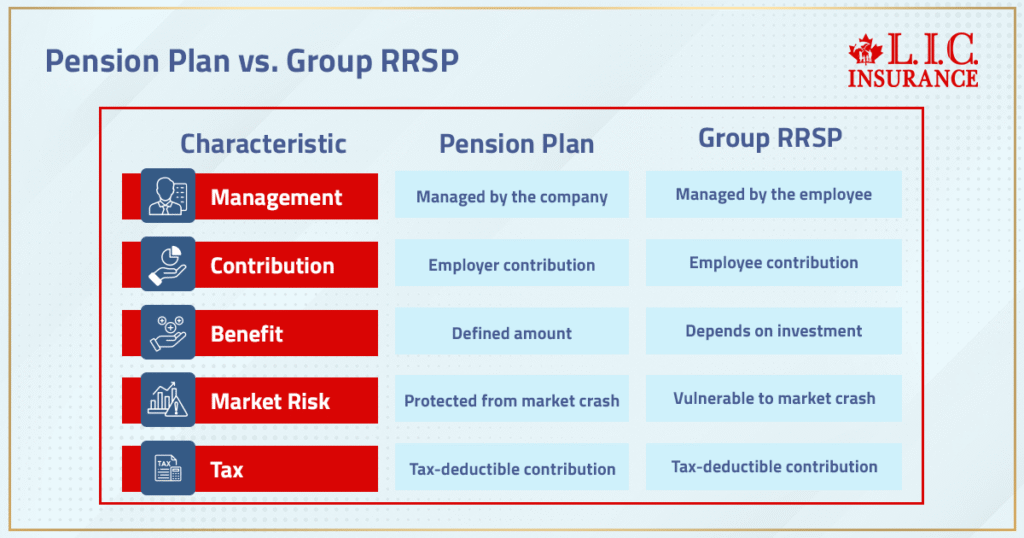
        By contrast, there are two primary types of pensions — defined benefit and defined contribution. Your retirement earnings are set as a dollar amount in the defined benefit plan based on salary and years of service. You need not worry about the market crashing just before you are ready to retire. On the other hand, it operates similarly to an RRSP in that your future income will depend on how well those investments perform rather than a defined benefit plan.

        Pension Plan Vs. Group RRSP

        How Taxes and Withdrawals Affect Your Choice

        This is where it separates the boys from the men — when RRSP Withdrawal Rules in Canada come into play. If and when you withdraw from your group RRSP, those withdrawals are, in fact, taxed as income for the tax year. That is, the most important question may be what your marginal tax bracket will look like when you retire — after all, if you opt for a lower income and therefore a lower tax rate, that bite could be nearly nothing. However, suppose you are also supplementing with rental property income, non-registered investment or a business for which you still receive investment income. In that case, you may push yourself into a higher tax bracket and end up paying more than expected.

        More often than not, pension income is also taxable. Here is the catch: some types of pension income can be split with your spouse in order to create income splitting that reduces your household tax bill once you turn 65. Unlike RRSPs, your pension payments are regular monthly amounts, and you do not have to decide how much, if anything, to withdraw each year. While this predictability can be a blessing for some, it takes away the flexibility that others would otherwise prefer to control better when they would take these withdrawals (and hopefully have them taxed more advantageously).

        Why The Order of Decision-Making Matters

        In fact, there are even a few people who try to equate pensions with group RRSPs as if they were trying to compare two menus of investment options available on a website. But it’s not quite apples-to-apples. For most companies, you never really made a choice — your employment automatically meant enrolling in a company Pension Plan or group RRSP. Usually, the decision involves whether to contribute something to the plan, more than that to a TFSA outside the plan, or save it in your RRSP, where contribution room may be unused from previous years.

        And this is how financial advisors can struggle to justify their existence. A good financial advisor will not only say which plan seems to be better — they will calculate it in your income tax return, with your RRSP contribution, and how much more money you actually have after tax. They will take into account the effect on your combined retirement income of Canada Pension Plan benefits, entitlement to a guaranteed income supplement, and old age security clawbacks down the road.

        The Emotional Side Nobody Puts in a Chart

        Money decisions aren’t just spreadsheets. I have observed clients — one in a de facto relationship, another single parent — each with comparable earned income but very different risk preferences. The first was content spinning the fact that they had a DB pension, comfortable in their expectation of full OAS and a reliable income for life. The second option felt restrictive due to the lack of flexibility, leading him to opt for a group RRSP over the permanent savings plan. Additionally, he invested some funds in a tax-free savings account for quick access to cash in emergencies.

        This is why retirement planning isn’t just about “which pays better”. The peace of a fixed income stream might matter more for the select few than chasing capital gains or creating their own portfolio of mutual funds. For others, control outweighs predictability.

        Shuffling the Comparisons — Thinking Beyond the Usual Order

        Rather than just start with pensions, let’s go right to what a group RRSP offers, and in cases where flexibility is top priority. Suppose you want to retire early and push off collecting Old Age Security pension or Canada Pension Plan benefits until later for a larger payout. A group RRSP allows you to take out any amount of money each year to help minimize your income tax and avoid getting booted from other benefits, i.e., guaranteed income supplement.

        For the pensionist, on the other hand, it is as plain as a nested bean soy as someone can forget something. Your pension adjustment appears on your T4, so this amount gets subtracted from your overall RRSP contribution room, although you do not have to worry about investing or deciding when markets are oversold. And if your employer includes indexing in a defined benefit plan, you have automatic inflation protection, which an RRSP does not.

        Contribution Limits and Overlap

        Both options are subject to a contribution limit. Your group RRSP and personal RRSP both have a limit called the RRSP contribution limit, so if one of these accounts is already maxed out, it leaves less room for the other. This is not so with pensions (work-related) — your contribution and any employer contributions are assessed via a pension adjustment that decreases your RRSP room. Some workers with strong Registered Pension Plans often find that their RRSP contribution room is very limited.

        And remember — if you do contribute more to your RRSP than that buffer of $2,000, you might end up having to pay a tax on the excess.

        How Age Security and Tax-Free Accounts Fit In

        Regardless of which main course you select, adding a TFSA can be a sauce. It would not be considered taxable income upon your withdrawal, thereby removing any age security implication that you are earning enough money to cause an old age security clawback. And as such, it’s also a great way to store cash for rainy-day or income smoothing needs in years when your pensions and RRSP withdrawals would otherwise push you into a higher tax bracket.

        Pension Plan vs. Group Registered Retirement Savings Plan

        FeaturePension PlanGroup RRSP
        DefinitionAn employer-sponsored plan that promises a set retirement income, often through a defined benefit or defined contribution model.An employer-sponsored registered retirement savings plan where contributions are invested and grow tax-deferred until withdrawn.
        Contribution LimitDetermined by pension rules and the pension adjustment reported on your income tax return.Follows the RRSP contribution limit set by the Canada Revenue Agency, reduced by any pension adjustment.
        Investment ChoicesLimited; managed by the pension fund administrator with less personal control.A wide range of investment options, like mutual funds and ETFs, offers more flexibility.
        Funding SourceFunded by employee contributions and employer contributions, the employer often covers a significant portion.Funded by employee contributions, often with employer matching up to a certain percentage.
        Retirement IncomeProvides guaranteed income (for defined benefit plans) or income based on contributions and investment performance (for defined contribution plans).Retirement income depends entirely on contributions and investment growth; no guarantee of lifetime payments.
        Tax TreatmentContributions reduce taxable income; pension income is considered taxable income when received in retirement.Contributions reduce taxable income; withdrawals follow RRSP withdrawal rules and are taxed as income.
        FlexibilityLow flexibility — payouts often structured as monthly payments for life.High flexibility — funds can be withdrawn anytime (subject to taxes), and can be converted to a registered retirement income fund at retirement.
        RiskFor defined benefit plans, the employer bears the investment and longevity risk.Individual bears all investment risk; returns vary based on market performance.
        PortabilityLess portable; may need to be transferred to a locked-in retirement account if you leave your job.Highly portable; can transfer to a personal RRSP without tax penalty.
        Other BenefitsMay include survivor benefits, inflation protection, and eligibility for a guaranteed income supplement.Allows greater control, more potential tax savings, and the ability to align with your own portfolio strategy.

        Where Canadian LIC Often Sees Clients Trip Up

        When it comes to the math and helping clients compare Group RRSPs vs. Pensions, we have seen many mistakes as well — but that’s not where the vast majority are: they’re in the impacts of how withdrawals from an RRSP will affect projections for filing an income tax return or how much more (or less) purchasing power someone can expect over a 30-year life expectancy with indexing (or lack thereof) on their company pension. Though, as many retirees also forget, a pension terminates when you die (unless you are paying for survivor benefits), while RRSPs live on for the heirs and likely create capital gains or non-registered account problems.

        Get The Best Insurance Quote From Canadian L.I.C
        Call +1 416-543-9000 to speak to our advisors.
        Get Quote Now

        FAQs

        Yes — some employers provide a registered Pension Plan while also allowing voluntary contributions to a group registered retirement savings plan. The catch is that your pension creates a pension adjustment that lowers your available RRSP contribution room, so the two need to be coordinated carefully.

        Withdrawals from a group RRSP can raise your taxable income, which may reduce your Old Age Security or guaranteed income supplement eligibility. Strategic withdrawal timing can help you keep more of these other benefits, especially when balancing with Canada Pension Plan income.

        A group RRSP typically lets you select from a range of mutual funds and other investment options, so you can tailor your portfolio based on risk tolerance. In contrast, most company Pension Plans pool contributions into a standard fund, limiting your investment choices but simplifying management.

        If you leave a job with a group RRSP, you can transfer the balance to your own registered retirement savings plan without triggering tax. With a Pension Plan, your options may include a lump-sum transfer to a locked-in account or leaving it in the company pension until retirement age.

        Withdrawals from a group registered retirement savings plan follow the same RRSP Withdrawal Rules in Canada as individual plans. The amount withdrawn is considered taxable income in the year you take it out, and your marginal tax rate determines how much you’ll owe.

        Yes — a tax-free savings account can complement your group RRSP by offering flexibility for short-term needs without affecting your income tax return. This pairing helps balance long-term retirement income goals with accessible tax-free savings.

        Not always. While group RRSPs provide tax deductions and employer contributions, non-registered investments offer no withdrawal restrictions. The choice depends on your tax bracket, investment income strategy, and desired retirement savings timeline.

        The RRSP contribution limit for a group RRSP is combined with your personal RRSP room. You can check your available contribution room each year on your tax return or through the Canada Revenue Agency’s online account.

        A financial advisor can assess your retirement savings plans, company pension benefits, and RRSP contribution strategy. They help align your retirement planning with tax efficiency, income security, and lifestyle goals in retirement.

        Key Takeaways

        • Both Pension Plans and Group Registered Retirement Savings Plans can grow your retirement savings, but each offers different tax and withdrawal flexibility.

        • Affordable Registered Retirement Savings Plans in Canada provide portability if you change jobs, while pensions offer predictable income but less control.

        • Understanding RRSP Withdrawal Rules helps you avoid unnecessary taxes and keep more of your money in retirement.

        • Comparing options with a qualified advisor ensures you choose the structure that supports long-term retirement income stability.

        Sources and Further Reading

        Feedback Questionnaire:

        Help us understand your challenges so we can provide better guidance.


          Who Is Eligible For RRSP In Canada?

          Who Is Eligible For RRSP In Canada?

          Who Is Eligible For RRSP In Canada
          Canadian LIC

          By Pushpinder Puri

          CEO & Founder

          SUMMARY

          This blog explains who is eligible for an RRSP in Canada, detailing age requirements, income sources, contribution limits, and special cases like spousal RRSPs. It also highlights strategies for maximizing RRSP contributions and the tax benefits of using an RRSP for retirement savings. Additionally, the blog discusses how RRSPs work alongside Term Life Insurance and provides practical tips on getting the best Term Life Insurance quotes online to complement your financial planning.

          Introduction

          Are you hoping to make your future more financially secure? RRSPs are a registered retirement savings tool in Canada used by millions of people for retirement while getting tax benefits. However, one of the most frequently asked questions Canadians ask is: Who can contribute to RRSP?

          When you first hear about RRSPs, it just sounds like some complex financial product, like trying to understand a Term Life Insurance policy. Both have valuable long-term benefits, but determining how they play into the overall picture of your finances can be confusing. In this blog, we’ll cover who is eligible for RRSP contributions, some budgeting tips, and how you can take advantage of this tool to have a more secure financial future.

          At the end of this post, you will learn not only who is eligible for an RRSP but also how to effectively use your RRSP to maximize the amount of retirement income you have and the amount of money you save on taxes!

          What is an RRSP, and Why Should You Consider It?

          Before we get into RRSP eligibility criteria, let’s start with what exactly an RRSP is and what it does for you.

          An RRSP is a retirement savings account for Canadians. RRSP contributions are tax-deductible — you can offset your taxable income in the same year you contribute. This allows you to save tax immediately. The cash in your RRSP compounds tax-free until you take it out, normally in retirement when your income may be in a lower tax bracket.

          The tax-deferred growth of an RRSP can be a powerful tool for anyone saving for retirement. But in order to take full advantage of an RRSP to save for the future, you need to know the eligibility rules so that you can contribute.

          Who is Eligible for RRSP in Canada?

          RRSP Eligibility in Canada

          Understanding who can contribute to an Registered Retirement Savings Plan is crucial to making the most of this savings tool. The eligibility requirements are relatively straightforward but include some important exceptions and conditions.

          1. Age Requirements:

          • Age: You must be 18 or older to open and contribute to an RRSP. This is the full withdrawal age, allowing you to benefit from RRSP contributions.
          • Under 71: You can make contributions to an RRSP until you turn 71. After that, contributions have to cease, but the money sitting in your RRSP can sit there and compound tax-deferred.

          2. Income Source:

          • Anyone with earned income can make RRSP contributions. This includes salary, wages, rental income and all other taxable income from employment or contracting. You can contribute to an RRSP if you have earned income.
          • But in order to add to an RRSP, you need to have earned income in the previous tax year. Your maximum contribution to an RRSP is tied to your earned income from the previous year.

          3. Contribution Limit:

          • The contribution room for an RRSP is usually 18% of your income from the previous tax year, subject to a government-declared maximum amount. For example, for the 2025 tax year, the maximum contribution is $32,490.
          • If you don’t max out the allowable contribution in a particular year, you may carry over the unused contribution room to future years. This offers you additional flexibility in future years where you may want to contribute more.

          4. Special Considerations for Certain Groups:

          • Students: You may also deduct contributions to an RRSP even if you’re a student and have limited income, as long as you earned income. This is an excellent way to begin to build your retirement savings early, even if only doing part-time jobs. While most students wouldn’t consider Term Life Insurance in their early years, it is possible to add up baby steps such as monthly RRSP contributions with Term Life Insurance quotes to preserve financial security well into the future.
          • Self-Employed: Self-employed Canadian residents can deduct RRSP contributions from net income from self-employment. It works the same as with employees, but you’ll declare your self-employment income when you file your taxes and that will determine your RRSP contribution room.
          • About RRSPs and foreign workers in Canada: A non-resident can also contribute to an RRSP but must also meet the same requirements as a Canadian resident. To qualify, you’ll have to make taxable income in Canada.

          5. Spousal RRSPs:

          • You can also put money into your spouse’s RRSP if you are married or in a common-law relationship. This is called a spousal RRSP and can be beneficial to making income splitting between you and your spouse work so that you can pay less overall tax if one of you is in a higher tax bracket than the other. This is a great way for couples to maximize their retirement savings and lower their overall tax burdens.

          Special Cases and Eligibility for RRSPs

          While the general eligibility for an RRSP is clear, there are some unique situations that might affect your ability to contribute or the amount you can contribute.

          1. Students and Early Career Professionals:

          If you’re a student or in the early stages of your career, you might not have a lot of earned income. However, you can still take advantage of RRSP contributions by saving small amounts. The tax-deferral benefits of an RRSP are especially useful when starting early in your career.

          2. Retirees:

          If you’re over 71 but still working or receiving earned income, you can continue contributing to your RRSP. However, once you turn 71, you must either convert your RRSP to a Registered Retirement Income Fund (RRIF) or use other retirement savings options.

          How to Maximize Your RRSP Contributions

          To truly benefit from an RRSP, it’s not just about contributing; it’s about maximizing your contributions. Here are a few strategies you can use to get the most out of your RRSP:

          1. Contribute Early and Regularly:

          The earlier you start contributing to your RRSP, the more you benefit from tax-deferred growth. Contributing regularly—whether monthly or annually—ensures that you’re consistently building wealth for retirement.

          2. Catch Up with Unused Contribution Room:

          If you haven’t contributed the full limit in past years, you can carry over unused contribution room to future years. This allows you to contribute more in years when you can afford to.

          3. Use Spousal RRSPs to Split Income:

          If one spouse is in a higher tax bracket, using a spousal RRSP can help reduce the overall tax burden. The lower-income spouse contributes to the spousal RRSP, and the funds will be taxed at their lower rate when withdrawn.

          4. Avoid Over-Contribution:

          While RRSPs offer a lot of flexibility, it’s important to avoid over-contributing. The Canada Revenue Agency (CRA) allows a small buffer (up to $2,000) over your limit without penalty, but any contributions above that can lead to a penalty tax of 1% per month on the excess amount.

          RRSP Withdrawals and Tax Implications

          Although the basic eligibility for an RRSP is straightforward, there are some special circumstances that can limit your ability to contribute or the amount of contribution you can make.

          • Students & Early Career Professionals: If you’re still a student or are just starting your career, you may not have much in terms of earned income. Still, you don’t need to invest large sums to benefit from RRSP contributions and extend your savings. The RRSP tax-deferral advantages are particularly advantageous when begun early in your career.
          • Retirees: If you turned 71 last December or earlier but are still working or continuing to earn income, you can still contribute to your RRSP. Once you reach age 71, however, you have to either convert your RRSP to a Registered Retirement Income Fund (RRIF) or to other retirement savings options.
          • Maximize your RRSP contributions: It’s not just about making contributions; it’s about maximizing them. There are several things you can do to maximize your RRSP:
          • Participate in the early stages and on an ongoing basis: If you wait until you are older to contribute to your RRSP, you lose out on tax-deferred growth; the longer you contribute early on, the better. By contributing regularly, whether monthly or annually, you make sure that you are consistently building wealth for retirement.
          • Make Up Unused Contribution Room: An unused contribution room can carry forward to future years if you did not contribute the full limit in prior years. It enables you to pay more when you can afford to do so.
          • Split Income Using Spousal RRSPs: Another efficient use is to utilize spousal RRSPs to ensure that you are making use of both spouse’s tax exemptions if there is a disparity between the tax bracket of a husband and a wife. The lower-earning partner invests the spousal RRSP and pays tax at a lower bracket rate when the money comes out.

          Avoid Over-Contribution: While RRSPs are fairly flexible, it’s important to know how to avoid over-contributing. The Canada Revenue Agency (CRA) does allow you some manoeuvrability (up to $2,000 over your limit). However, any dollars contributed above this limit are punished with a penalty tax of 1% each month on the excess dollars contributed over your limit.

          Combining RRSPs with Life Insurance

          While RRSPs are an excellent way to save for your retirement, many Canadians are unaware that it is imperative to include life insurance as a part of the overall financial plan. For instance, Term Life Insurance can cover specific financial needs at critical times in your life, like when you are building your career or raising children.

          For further information on RRSP contributions and Term Life Insurance, please visit our website. Lastly, speaking with a Term Life Insurance agent can help you understand how life insurance can work with your RRSP strategy.

          Final Thoughts

          When it comes to RRSPs, identifying who can participate is key to establishing a successful plan for retirement. Contributing early, maximizing unused RRSP contribution room, and using tactics such as spousal RRSPs can greatly increase your retirement savings. Putting these initiatives together with a Term Life Insurance policy enables you not only to save for retirement but also to shield your loved ones over the long term.

          If you’re ready to get started, review your contribution room and consider working with a financial advisor to discuss how to structure your RRSP contributions best to meet your goals.

          Next Steps:

          • Check your RRSP contribution room.
          • Consult a financial advisor for tailored retirement planning.
          • Start contributing today to benefit from tax-deferred growth.
          Get The Best Insurance Quote From Canadian L.I.C
          Call +1 844-542-4678 to speak to our advisors.
          Get Quote Now

          Frequently Asked Questions (FAQs) about RRSP Eligibility in Canada

          Anyone age 18 or older with earned income, either from employment or self-employment, can contribute to an RRSP. Your contribution limit depends on your income, up to a maximum amount set by the Canadian government. You can also make contributions to an RRSP if you have income from an eligible source, as long as you’re not 71 or older.

          Case in point: We see many clients approach us on whether they can contribute to an RRSP while self-employed. The answer is yes! RRSP contributions lower your taxable income, so as long as you have income, this can be of benefit to you.

          Putting money into an RRSP reduces your taxable income, which means you’ll pay less tax during the year in which you contribute. The money you put into your RRSP grows tax-free until you withdraw it — at a time typically in retirement when your tax bracket is lower.

          True story: One of our clients, Alex, did well at work last year. By making a contribution to an RRSP, Alex was able to drop his taxable income a lot and save hundreds in taxes. This tax saving allowed Alex to save more for the future.

          No, to contribute to an RRSP, you need to have taxable income from employment or self-employment. If you don’t have income, you won’t have contribution room for the current year, but you may be able to use carry-forward contribution room from previous years if applicable.

          Each year, you can contribute a maximum of 18% of the earned income from the previous year or whatever amount is capped by the Canadian government. The limit for 2025 is $32,490. Unused contribution rooms from previous years can be carried forward, too.

          Tip: One of the most common questions clients ask us is: “How much can I put in my RRSP?” The simplest way to find out is to look at your Notice of Assessment from the Canada Revenue Agency (CRA), which details your contribution room.

          If you’re marrying or living in a common-law partnership, you can contribute to a spousal RRSP. If one partner is in a higher tax bracket than the other, it is an excellent mechanism to copay income and decrease the tax burden.

          For example, last year, a couple approached us for information on spousal RRSPs. They also saved on taxes by contributing to a spousal RRSP, ensuring that both members of the couple were contributing to savings for retirement.

          Yes, on excess contributions over your limit of more than $2,000, you’ll pay a penalty of 1% per month on the excess amount. Tracking your contributions will save you from this penalty.

          For example, one of our clients accidentally over-contributed to their RRSP last year and was hit with a penalty. We assisted them in rectifying the error and avoided incurring additional penalties — a timely reminder of the necessity of adhering to contribution limits.

          Yes, but withdrawing money from your RRSP before retirement means you will be taxed on whatever you withdraw. The money can be withdrawn from the plan for specific reasons without tax implications, such as for the Home Buyers’ Plan (HBP) or Lifelong Learning Plan (LLP), which also allows you to take tax-free money if you have to pay either to purchase your first home or education.

          For example, we recently helped a client withdraw some money from their RRSP under the Home Buyer’s Plan, which they used for their first home down payment. At the same time, this particular program made them tax-free on their withdrawal and guaranteed them a better future than other investments.

          An RRSP gives you tax-deferred growth, while a Tax-Free Savings Account (TFSA) allows tax-free growth. RRSP contributions are tax-deductible, but withdrawals are taxed. In contrast, TFSA contributions aren’t tax-deductible, but withdrawals aren’t taxed.

          Tip: Many of our clients ask us whether to choose an RRSP or a TFSA. It depends on your goals—if you’re looking for immediate tax savings, an RRSP may be the better option. If you want more flexible withdrawals without paying taxes later, a TFSA could be more suitable.

          Yes, you can contribute to both. Each account has its own set of contribution limits. This strategy allows you to save for retirement in an RRSP while keeping some savings in a TFSA for more flexible access.

          In your financial plan, an RRSP and Term Life Insurance can work complementarily. As your RRSP helps you accumulate savings for retirement, Term Life Insurance protects you for specific periods — while you’re raising a family or paying off a mortgage, for example.

          For example, Mark is a client who had a strong RRSP, but he also needed insurance coverage for his family. We found him a low-cost Term Life Insurance policy to complement his RRSP and ensure his family was covered in the event something happened to him.

          RRSPs are for retirement savings, but you can spend your RRSP fund on life insurance premiums if you want to. By definition, life insurance itself is not an asset held inside the RRSP; it is merely a separate policy.

          Note: Many of our clients ask us about getting term life insurance quotes online combined with their RRSP. Though they are distinct, ensuring they are developed at the same time makes your overall financial well-being more robust.

          Example: One of our clients, Lisa, was seeking Term Life Insurance but was uncertain what plan to go for. It was a good example of this. We were able to get her several quotes for Term Life Insurance online at an affordable price that fit her needs.

          Contributing to an RRSP should begin as soon as you earn income. The earlier you start, the more you can benefit from tax-deferred growth and compound interest.

          Clients who begin contributing to their RRSP in their early twenties typically have significant savings by the time they retire. Early preparation makes a world of difference, and all this, combined with Term Life Insurance, guarantees a solid financial future.

          To get a Registered Retirement Savings Plan Quote Online, you can visit the websites of various financial institutions and Registered Retirement Savings Plan Providers in Canada. Many of these providers offer easy-to-use tools that allow you to calculate your potential contributions, tax savings, and retirement growth. This is a quick way to compare different plans and find the best options for your retirement goals.

          There are several reputable Registered Retirement Savings Plan Providers in Canada. Some of the top names include major banks, credit unions, and independent financial institutions. It’s important to compare Registered Retirement Savings Plan Quotes Online from these providers to understand their fees, contribution limits, and investment options. Popular providers include RBC, TD Canada Trust, Scotiabank, and Manulife, among others.

          We hope that these FAQs have clarified who can have an RRSP in Canada and how it relates to other financial tools like Term Life Insurance. And if you have further questions or want personalized advice, reach out. And we’re here to help craft an effective financial plan today and for the future.

          Sources and Further Reading

          1. Canada Revenue Agency (CRA) – RRSPs and Taxes
            The official CRA page offers a wealth of information on RRSP eligibility, contribution limits, and tax rules. It’s essential for anyone looking to contribute to an RRSP.

          2. Financial Consumer Agency of Canada (FCAC) – RRSP Overview
            The FCAC provides a clear, straightforward guide on RRSPs, including eligibility and benefits.

          3. Investopedia – Understanding RRSPs
            This article on Investopedia provides an in-depth breakdown of RRSPs, including how they work, the tax benefits, and strategies for using them effectively.

          4. Sun Life – RRSP Contribution Limits and Eligibility
            A well-known Canadian insurance provider, Sun Life, explains the RRSP contribution limits, carry-forward rules, and how to maximize your contributions.

          5. The Globe and Mail – RRSP Strategies for Retirement
            This article provides useful strategies for Canadians looking to maximize their RRSP contributions and retirement savings.

          Website: The Globe and Mail – RRSP Strategies

          Key Takeaways

          • RRSP Eligibility: To contribute to an RRSP, you must be at least 18 years old and have earned income. Contributions are limited to 18% of your income up to a specified maximum each year.

          • Tax Benefits: RRSPs offer significant tax deferral benefits. Contributions reduce your taxable income, while the funds grow tax-free until you withdraw them, typically in retirement.

          • Contribution Limits: The annual contribution limit is 18% of your earned income from the previous year, up to a maximum limit ($30,780 for 2023). Unused contribution room can be carried forward to future years.

          • Spousal RRSPs: You can contribute to your spouse’s RRSP, which can help split income and reduce overall taxes if one spouse is in a higher tax bracket.

          • RRSP vs. TFSA: While both are valuable savings tools, RRSPs are ideal for tax deferral on retirement savings, whereas TFSAs offer tax-free growth with more flexible withdrawals.

          • Withdrawing from RRSPs: Withdrawals from RRSPs are taxed, but specific programs like the Home Buyers’ Plan (HBP) and Lifelong Learning Plan (LLP) allow tax-free withdrawals for specific purposes.

          • Integration with Term Life Insurance: An RRSP and Term Life Insurance can complement each other in a financial plan. While RRSPs help build retirement savings, Term Life Insurance provides coverage for specific life events.

          • Start Early for Maximum Growth: The earlier you begin contributing to your RRSP, the more you benefit from tax-deferred growth and compounded returns. Even small, regular contributions can add up significantly over time.

          • Avoid Over-Contribution: Be mindful of your contribution limit to avoid penalties for over-contributing. The CRA allows a $2,000 buffer, but excess contributions beyond that are taxed.

          Plan for the Future: Incorporate both RRSP and Term Life Insurance strategies to ensure long-term financial security. Speak with a financial advisor to align these tools with your retirement and family planning goals.

          Your Feedback Is Very Important To Us

          We would love to hear about your experience and any struggles you’ve faced in understanding RRSP eligibility in Canada. Your feedback helps us improve our content and better address your needs.


            Please provide your full name:


            Please provide your email address so we can follow up with any additional resources or answers to your questions:


            Thank you for taking the time to fill out this questionnaire!
            Your feedback is invaluable in helping us improve our content and assist you better in understanding RRSPs.

            Can I Transfer Money To RRSP Online?

            Can I Transfer Money To RRSP Online?

            Can I Transfer Money To RRSP Online
            Canadian LIC

            By Pushpinder Puri

            CEO & Founder

            SUMMARY

            This blog guides you through transferring money to your RRSP online, highlighting key steps, security tips, and common mistakes to avoid. It discusses different RRSP providers in Canada, including banks, credit unions, and online brokers, and explains how to choose the right one. The blog also covers how to get a Registered Retirement Savings Plan Quote Online, offers tips on avoiding contribution penalties, and compares online transfers with in-person banking.

            Introduction:

            Sarah, a 35-year-old from Toronto, sat down one evening with a cup of coffee and a firm goal to invest in her future. She knew that opening and contributing to a Registered Retirement Savings Plan (RRSP) was a good way to prepare for her retirement, but the thought of transferring money online to an RRSP just made her nervous. Would she hit the wrong button and make an error? Could somebody get her information? And there were so many banks and financial companies out there offering RRSPs; how could she possibly find the right one? Sarah is not alone in feeling this way. For many of our clients at Canadian LIC, these kinds of questions have echoed over the years as they navigated their way through RRSP contributions online. In fact, many of them have gone so far as to search for a “Registered Retirement Savings Plan Quote Online,” similar to purchasing a simple insurance product, and were even more confused than ever about all the options available.

            The real-life questions, even the fear of being wrong, the anxiety about online safety, and confusion over how to select among Registered Retirement Savings Plan Providers in Canada are super common. The good news is that, with some guidance and education, those fears can transform into confidence. This blog will take you through Sarah’s (and possibly your) journey from the anxious start to a comfortable, step-by-step understanding of how to transfer money to an RRSP online. In the process, we’ll discuss the benefits of transferring money online, the things to look out for, and how to make the transaction as seamless and safe as possible.

            Are you ready to take this journey with Sarah? Let’s tackle one of her initial big questions: Where do I start?

            Getting a Registered Retirement Savings Plan Quote Online

            When Sarah initially made up her mind to invest in an RRSP, she did what we all tend to do – she went to Google. She entered “Registered Retirement Savings Plan Quote Online” in a hurry to get the best RRSP quote. It’s a term we commonly hear from clients who are approaching an RRSP as they would a car insurance policy or a term life plan, looking for a quick quote. The truth is a little more complicated. An RRSP is not a one-product, fixed-price item; it’s an account that can contain different investments (such as savings deposits, mutual funds, stocks, or GICs). So, though you won’t get a quote for an RRSP, there isn’t a one-size-fits-all solution; online searching is still an excellent way to compare your choices.

            Rather than an easy quote, what you find on the net are calculators and tools that will assist with determining how much you may be required to set aside or how much you may receive back in tax refund from donating so much. Take Sarah, who discovered an RRSP contribution calculator that indicated what she could expect in tax savings if she put in $5,000 for this year. More significantly, she discovered comparison pages with various RRSP accounts and their attributes – sort of like getting a quote by comparing fees and interest rates. If you encounter the phrase “RRSP quote,” it generally refers to comparing these attributes or obtaining an investment quote (such as the prevailing interest rate on an RRSP savings account or the management fee of an RRSP mutual fund).

            The takeaway? Don’t stress if you can’t discover a single “price” for an RRSP. Take advantage of the online browsing experience to learn. Search for RRSP interest rates, investments, and customer feedback. Numerous financial institutions in Canada offer details online where you may input your information and view estimates for your retirement savings – this is effectively the essence of requesting a quote for your RRSP savings. Sarah understood that rather than looking for a single quote, she should compare multiple quotations to determine what best fit her. That leads us to the next step of her process: selecting the appropriate provider.

            Comparing Registered Retirement Savings Plan Providers in Canada

            With the long queue of banks, credit unions, insurance firms, and online investing services to navigate through, Sarah got confused. The Canadian ground offers a thick culture of RRSP providers, and one seems to assure something better. Actually, it is possible to establish a Registered Retirement Savings Plan with practically every kind of financial institution – trust companies, credit unions, insurance companies, and banks all make a profit in selling RRSP accounts​

            . With so many choices, the question becomes: how do you choose the right RRSP provider for your needs?

            Let’s break it down. Big banks are a popular option. Providers such as RBC, TD, CIBC, BMO, and Scotiabank all have RRSP accounts and make online money transfers simple through their banking sites.

            If you already bank at a large bank with a chequing or savings account, the convenience of having all your accounts in one location can be a significant advantage. Sarah, for example, was inclined towards her current bank (TD) merely because she was comfortable with their online banking.

            Aside from banks, there are credit unions and online banks with better interest rates on RRSP savings. EQ Bank or Oaken Financial may be mentioned – these online banks can have excellent rates and are equally secure (EQ Bank, for instance, is CDIC-membered and has competitive RRSP savings rates)​

            The drawback is that they don’t have physical branches, so you need to be okay with doing everything online or through an app. Sarah took this into account when she noticed a good rate at an online bank; the prospect of getting a little more interest was appealing.

            Online venues such as Wealthsimple or Questrade enable you to start an RRSP investment account yourself online and often charge lower rates for buying into ETFs or stocks. If you’re not opposed to trying it on your own or liking the app-only experience, those are solid. Wealthsimple also has deals (like they match part of your transfer) that encourage you to transfer over your RRSP

            But moving an existing RRSP from one organization to another can be a waiting game (occasionally weeks) and costs money (in some cases $50–$150, which some companies will absorb to gain your account)​

            Insurance firms provide RRSPs, typically mutual fund or segregated fund policies. Sun Life and Canada Life sell RRSP investing, which is often packaged with a financial adviser’s advice. If you wish to have a guiding hand along with perhaps the inclusion of something like investment guarantees (in segregated funds), you might find them interesting. Canadian LIC, being a brokerage for insurance and investments, can frequently assist clients in making sense of these alternatives. For instance, one of our clients elected to have a segregated fund RRSP with an insurer because he preferred the death benefit guarantee option over his retirement funds – something usual bank RRSPs do not provide.

            So how did Sarah choose? She put her priorities into a list. She desired ease of use, robust security, fair fees, and the ability to speak to someone if she needed support. She knew that whichever federally regulated provider she used would be secure – banks and credit unions belong to the Canada Deposit Insurance Corporation (CDIC), which ensures deposits and investment accounts are insured by the Canadian Investor Protection Fund (CIPF) against broker failure​. With security taken care of, it was a matter of convenience. Ultimately, Sarah decided to remain with her bank for the time being, aware that she could switch later. The comfort of the online banking site prevailed, and she created an RRSP investment account there (it took her approximately 10 minutes to complete the application online).

            With her RRSP account in hand, the real challenge was then transferring her money into it. Now came the moment of truth – moving money online, for the first time, into her own RRSP.

            Registered Retirement Savings Plan Providers in Canada-Comparison

            Registered Retirement Savings Plan Providers in Canada-Comparison

            Step-by-Step: How to Transfer Money to an RRSP Online

            Log into your online banking or investment account: Go to the web or app for the financial institution that holds your RRSP and log in. For Sarah, she logged into her bank’s online portal and saw all her accounts (chequing, savings, now an RRSP) were listed on the dashboard. Enter this information (but only) over a secure internet connection (avoid public Wi-Fi at this step) to protect your information.​

            Go to your RRSP account: From the dashboard, go to your account list and click on your RRSP. Many NJ online banking login platforms have a separate section for investment or retirement accounts. In RBC’s online banking,​ for example,​ you would go to the Accounts Summary page, click on your RRSP account, and select the Contribute​ option.

            Sarah had taken the same steps but had clicked her new RRSP account from her TD online banking homepage, and it opened options to manage that specific account.

            Select method of payment: Specify which account the money will come from. Usually, you’ll transfer from a chequing or savings account directly into the RRSP. Sarah picked her chequing account as the source because that’s where her paycheque is deposited. If your RRSP is at a different institution than your bank, you might need to add the RRSP provider as a payee (same as paying a bill) or set up an electronic funds transfer. Most deposits into investment RRSP providers (like Questrade) can be funded by linking your bank account or even via Interac e-Transfer.

            Enter contribution amount: This is where Sarah stepped back to compare her figures. She recalled that there are yearly dollar limits to RRSP contributions. She confirmed her current RRSP contribution room for the year based on her Notice of Assessment from her last tax return. (Also, she hadn’t maxed out previous years, so she had lots of room to move. You need to check your limit — exceeding your limit by more than $2,000 will result in a penalty of 1% per month on the contribution in excess of your limit.​

            Tip: If you’re uncertain, you can find your contribution limit in the Canada Revenue Agency’s My Account portal or in the paper notice mailed after you file taxes.

            Double-check the details: After Sarah entered, say, $5,000 as a contribution and checked “Next,” she reviewed the summary. The screen displayed all the information: the from account (her chequing) and the to account (her RRSP), the amount and the date (she did it right away). She checked that everything looked good — no stray zeros in the amount by accident! We always advise clients at this point: take time to reflect. It’s a lot easier to fix a typo now than after you press submit.

            Finalize the Transfer: Sarah clicked on the “Confirm” or “Submit” button, sending the transfer off with a deep breath. And a caption later, the transfer was complete! In one second, she looked to see the balance in her RRSP account reflect the new contribution. Most electronic transfers to an RRSP occur immediately if you are dealing with the same bank. When moving funds into an RRSP at another institution, it can take 1-2 business days for the money to show up (or longer if you are doing a formal transfer from an existing RRSP between institutions, a process that involves filling out some paperwork). Sarah’s transfer was made through her own bank, so the update was instant.

            Save the confirmation receipt: After completing the transaction, she downloaded the confirmation page as a PDF file and wrote the transaction ID down. The other fact that she had in her mind was that her bank was going to produce an official RRSP contribution receipt (for tax purposes) around the year-end or early March for any contributions made within the first 60 days of the year. Record-keeping is important, especially because if you give in January or February for the previous tax year — those are your tax receipts.

            Invest the contribution (optional next step): Putting cash into an RRSP is only half the equation. What should we do with that money afterwards? In Sarah’s case, she had made contributions to a self-directed RRSP investment account. That meant her $5,000 sat as cash in the RRSP. Her strategy was to put it into a balanced mutual fund in the RRSP. So the last step was for her to order — she could also do it on the internet — purchasing units of the mutual fund with that cash. If your RRSP is just a savings deposit, you can probably skip this step — your funds may be already accruing interest. But if it’s an investment account, keep in mind that contributing is only Step 1, after which you need to invest the money according to your plan so it can grow.

            Following these steps, one at a time, Sarah made her first online RRSP contribution without a hitch. She even signed up for a pre-authorized contribution for after – a service whereby the bank will direct deposit a predetermined portion from her chequing to her RRSP monthly. This “pay yourself first” method meant she wouldn’t need to repeat the manual steps every single time, and it’s a tactic that’s particularly helpful for many to ensure they remain on-target with their retirement savings (banks stress that on-time, regular automatic contributions to your investment portfolio are a positive thing​).

            Having done it, Sarah was relieved and even proud. The once-daunting experience was empowering. But she also picked up a few tips on the ups and downs of doing it the way she did. Let’s examine the upsides she uncovered and the downsides she overcame by transferring money to her RRSP online.

            Advantages of Transferring Money to an RRSP Online

            After submitting her online transfer, Sarah was soon able to see why so many Canadians are choosing to handle their own RRSPs online. Based on Sarah’s experience and other Canadian LIC clients, here are some key benefits to doing an online transfer of funds to your RRSP:

            Convenience Convenience and Access: Number one, We think. You can make your RRSP contribution anytime, anywhere. You do not have to go to a bank branch or mail a cheque. As long as you have internet access, you can plan for retirement at your fingertips. Online banking offers up to “convenience and accessibility,” enabling you to manage accounts and perform transactions from the comfort of your home or on the go. For people strapped for time or people who live far from the nearest brick-and-mortar bank, it will be a lifesaver.

            Speed and Timeliness: One of the primary advantages of online transfers is their speed. Suppose you suddenly discover the RRSP contribution deadline (the 60-day deadline for contributions to count in last year’s taxes) is tomorrow. In that case, an online transfer can be done in seconds — mailing a cheque or setting an appointment may simply take too long. One thing Sarah loved was that her contribution had an instant impact. And you also receive instant confirmation, which is helpful when time is of the essence.

            Fewer Error (with Immediate Feedback): To Sarah’s surprise, putting it online actually made her less afraid of making a mistake. Why? The interfaces typically catch common errors (such as leaving an amount field empty) and will always confirm a transaction. It’s more difficult to, for example, write an additional zero like you can on a paper form without it appearing on screen. And if you do screw up, you’ll usually catch it immediately during confirmation. Some even warn you if a transaction would exceed a limit, but you shouldn’t count on that.

            The takeaway: The concise directions and summaries available online can help you steer clear of missteps.

            Security: It may sound counterintuitive, but online transfers can be highly secure. Banks and finance institutions deploy encryption and multi-factor authentication to secure transactions. When you move money in a secure online session, that transaction is encrypted from end to end​. No physical papers to lose or steal or be lost or stolen. And any trusted, regulated institution would do so with safety nets like deposit insurance. Funds in a regular bank RRSP savings account, for example, are typically CDIC-insured (up to $100,000) as is any other bank deposit — which is an additional peace of mind. Even most banks will guarantee your protection: if someone makes an unauthorized transaction, you just report it, and they’ll investigate and compensate you, assuming you took reasonable care (keeping your password secure, etc.).

            To Sum It Up: As long as you practice good online hygiene, online RRSP transfers are very safe.

            Easily Found and Managed: Online access lets you check your RRSP balance, confirm your contribution history, and even reallocate investments in real-time. Most platforms will allow you to establish alerts (for example, receive an email or text every time a contribution goes through or when your account balance reaches a specific level). This transparency can provide peace of mind and a sense of control. For example, whenever Sarah’s automatic monthly contribution was deposited into her RRSP she set an alert to notify her, so she could always rest assured knowing it was taken care of. Watching your nest egg grow with each transfer is satisfying, and having that information at your fingertips can encourage you to persevere.

            Potential for better rates or promotions: Certain providers may offer incentives for those who use online services. For example, a high-interest online RRSP savings account can return you a much better return than a traditional account at a physical bank. Also, there are specific investment platforms that offer bonus incentives (Wealthsimple’s transfer match or banks offering points for a contribution, for example, as noted above). Though bonuses shouldn’t be the be-all and end-all of your decision-making processes, it is a nice little bonus, literally, to hopefully end up with a little extra cash or reward for completing your RRSP online. In other words, as a consumer, you can benefit from the competition in the online space.

            So, in a nutshell, the online route wins for speed, comfort, and control. Sarah went from dreading the whole thing to realizing just how simple it was. Like everything, there are two sides to the coin. We also covered some potential barriers and caveats to watch out for.

            Take Action Today for Peace of Mind

            While navigating the Term Life Insurance approval process may feel overwhelming, it’s an essential step to securing financial peace of mind for your loved ones. Knowing what to expect and how long it might take can help alleviate the stress and also keep you in the loop through the process. If you are looking for an economical Term Life Insurance Plan in Brampton, Canada or want to get instant Term Life Insurance Policy Quotes Online, then take the help of an expert to make informed decisions with confidence.

            If you’re ready to move forward, here are a few things you can do today to get started:

            Assess Your Insurance Requirements:

            Consider your family’s needs and what that translates to, how much coverage. If you are a bit lost, consulting with a seasoned insurance broker will clarify. You can explore Term Life Insurance Policy Quotes Online as well. This will give you an idea of alternatives and the cost of coverage. Take the time to make sure you won’t overpay for unnecessary coverage or under-protect your family.

            Organize Your Medical Records:

            Being prepared by having your medical history readily available can fast-track the approval process. Gather the required documents before applying. The required documents, which may include your recent medical history, prescriptions, and test results, should be gathered before applying. If you can be proactive in this area, then you can significantly reduce any delays.

            Have an Insurance Broker’s Expertise On Your Side:

            An experienced insurance broker like Canadian LIC can simplify the process. We can help you navigate through the complicated application process by making sure all required documents are in order and also ensure that you are getting the cost of Term Life Insurance Plan in Canada that fits into your budget. Brokers may also advise you on which insurers are most likely to offer you the best terms, considering your individual situation.

            Compare Different Policies:

            Do not take the quote that suits you the best. Devote time to search for different term life insurance policy quotes online. Premiums can vary widely, and it’s worth doing a bit of shopping around to make sure you’re getting the best deal that meets your needs. Shopping for policies also affords you the opportunity to hear about specific details about what is and isn’t covered.

            Ensure your Application Remains Current:

            After submitting your application, follow up regularly. Insurance companies may ask for further details or explanations. If you are on this early and participate in the process, it will go much faster.

            Challenges and How to Overcome Them

            Making an RRSP contribution online is nothing without its trials. The first step is being aware of them; the second is knowing how to counter them. Here are some of the most common problems people fear or face, along with advice for getting through each:

            Security Breaches: The thought of one’s hard-earned cash whizzing through cyberspace can feel disconcerting. And although banks use robust security systems and encryption, it pays to be vigilant. Always confirm you’re on the official website (check for https:// and the padlock icon in your browser). Do not open links in unsolicited emails that claim to be your bank — those may be phishing scams. Instead, go directly to your bank’s site yourself or their official app. Also, use strong passwords (and two-factor authentication — a one-time code sent to your phone, for example — which most banks give you the option of having). This makes it very difficult for anyone else to access your active accounts. Raj, one of our clients, confessed he used to only bank in person out of security concerns. We had him turn on biometric login for his bank’s mobile app, and we showed him all the security guarantees that the bank makes. The fact that any reputable institution is federally regulated and typically insured (meaning that, in the worst-case scenario, his money was safe) made the switch to online transfers reassuring​

            Mistaking the Transfer: “What if I screw up?” That was one  of the things Sarah worried about. The common mistakes could be sending money to the wrong account or contributing the wrong amount. Fortunately, most online banking interfaces are relatively intuitive. Takes it slow the first time so as not to make mistakes. Make sure you transferred to your RRSP (not, say, your TFSA or another account). Double-check the total — verbalizing it may help (like reading “five thousand dollars” as you look at $5,000 can prevent your eyes from hopping over an additional zero). And as mentioned in the steps, always check the summary prior to confirmation. If you happen to overcontribute, don’t sweat it. Tiny amount-over-contributions (within $2,000 naught the limits) aren’t note punished, but anything overhead that accrues 1% kind every month until removed CANADA.CA​. If that happens, you can typically remedy the situation by withdrawing the excess amount or reaching out to that institution for assistance. One of our clients created two competing automatic contributions (whoops!) and then went over the $500 limit (whoops again), but noticed it a month later. With our help, he completed a T1-OVP notice for the excess contribution and withdrew the excess contribution. It was some paperwork, but all was well. The takeaway: check your contributions every once in a while (which is relatively easy to do online), and you’ll catch any problem before it escalates.

            Investments Made Without Guidance: When you transfer online, and particularly if you transfer to a self-directed RRSP, you might sense that you’re all alone in deciding how to invest that money. In an in-person appointment, an advisor may recommend where you should direct your contribution (e.g., into a particular mutual fund or GIC). Online, you have plenty of options — which can be intimidating if you are uncertain about what to choose. The way to terminate this is to use the available resources. Most online platforms come with built-in tools or tutorials to help you select investments based on your goals and risk tolerance. Some banks have an “investment selector” or even allow you to chat with an advisor virtually. You can also take baby steps: there’s nothing wrong with, at least to begin with, making a contribution to an RRSP high-interest savings or a conservative fund until you know more. You can always change investments down the road. In fact, after transferring the money, Sarah called her bank’s investment helpline to discuss which fund to invest in. After 20 minutes, she decided on an RRSP moderate balanced fund. If you require that human touch, however, it’s there to find – even when you carry out the transfer online. Also, Canadian LIC is available to help, and many of our clients transfer funds online but are still consulted with us regarding overall RRSP planning and investment strategy.

            Technical Glitches or Access Issues: Let’s be honest, no tech is 100% glitch-proof. The website is down just as you want to make a last-minute contribution, or your Internet sputters out at the most inopportune moment. These things can happen. Planning ahead is the best way to avoid panic. If you can, by all means, do not leave your contribution to the final day! But if you have to and nothing’s working, know that most institutions can process phone transactions as a backup (the wait times might be lengthy during RRSP season, but at least it’s an option). Also, there are a lot of banking apps and websites that allow future-dated contributions — so you could schedule your contribution ahead of time, a few days in advance of the deadline date, and then you don’t even have to log in on the day at all. In Sarah’s case, her initial transfer went through without any issues. But if the site had frozen, her plan B was to attempt the bank’s mobile app, and plan C was to call the customer service line to make sure her contribution got recorded anyway. Her backup plans provided her with some comfort around “What if the computer/internet fails me.”

            Not Sure if Everything Went Through: Some people submit a transfer, then aren’t 100% sure it went. Did I do it right? If your RRSP lives at the same bank as your source account, you should see the new balance immediately (and probably receive an email notification). If it’s a transfer to another institution, you may see just money out of your bank account at first, which can be nerve-wracking until you see you’ve arrived in the RRSP. To avoid this problem, always verify the deposit to the RRSP account. External transfers can take a day or so, so don’t worry if it’s not instantaneous. Do save any confirmation numbers or screenshots. And in the extremely unlikely event that there’s something wrong, you’ve got the proof, and the institutions will track it down. In our experience, missing or misdirected contributions are extremely rare so long as you have entered all information correctly. And if you’re the nervy type, make your transfer a little early. So that you can check everything and rest easily.

            In other words, online RRSP transfers are all about security, accuracy, and sometimes  support. As long as you are vigilant (for security), attentive (for accuracy), and holistically proactive in seeking advice when appropriate, you can ultimately conquer these hurdles. By the end of the process, Sarah’s initial fears had gone away for the most part. She learned her best friends are knowledge and preparation. So, to close out with the big question she asked in the beginning: is transferring money into an RRSP online the right decision for you?

            Conclusion: Is Transferring Money to an RRSP Online the Right Choice?

            As Sarah’s story shows, in most cases, a transfer to an RRSP online in Canada is THE way to go. Weighing the pros and cons, here’s my take:

            For most users, the benefits outweigh the drawbacks by far.

            The ability to contribute when you want, knowing that you’ll get instant confirmation and that you’ll have full discretion over what you’re transferring. With busy lives, it’s invaluable to be able to “embrace digital banking with confidence” and do what you need to financially on your own schedule​

            And, with reputable institutions using high-level security protocols and insurance, the online process can be as safe as going into a branch (and often more convenient). For Sarah, once she grasped the process and saw it play out, she wondered why she hadn’t started doing it years ago. That said, whether it’s the right decision also has to do with your comfort level. If you’re tech-savvy or even just moderately comfortable online, you’ll probably consider this method empowering. If you’re still uncomfortable, that’s fine, too. You might begin with a small transfer or make an automatic contribution of a small amount just for practice. Use your bank’s online resources, or talk to an adviser (by phone or video chat) to guide you through the first time. And as you gradually learn how to manage the interface and begin to see successful outcomes, your confidence will build. A number of our Canadian LIC clients who were reluctant to make online contributions have now become regular users of online contributions after taking the plunge with some hand-holding.

            So, is it a good choice? In a word, yes — with a few caveats. Yes, if what you’re looking for is flexibility and control over your finances. Yes, if you like the immediacy and clarity that digital tools offer. And oh, yes, if you care to get up to speed on the process and the safeguards (as Sarah did). The types of drawbacks – security concerns or making mistakes – can be mitigated by practicing good habits and taking advantage of the support available. On the one hand, however, if you have been around long enough to know that no matter how many conference calls you set and no matter how often you insist on going through this or that idea during regular progress check-ins, unless someone tells you you need to do something then you most likely aren’t going to contribute, then go with whatever method best supports you. What matters is that you routinely fund your RRSP.

            Ultimately, there are all sorts of reasons why transferring money to your RRSP online is going to be the modern and convenient approach to taking control of your financial future. As Canadian LIC has found with its clients, once initial fears are calmed, nearly all embrace the online approach — and never look back. If you’re still not sure, maybe give it a shot at a small donation. You may well be one of the many Canadians who, after answering these questions, feel empowered and relieved to know that their retirement savings are a few clicks away — safe, sound and steadily growing for the future.

            Remember: Whatever way you transfer money into an RRSP, online or in person, the key is you’re saving for retirement. The fact that you do it is more important than how you do it. But if online transfers do make that task more manageable and more accessible (as it did for Sarah), then it could be the right option for you, too.

            Get The Best Insurance Quote From Canadian L.I.C
            Call +1 844-542-4678 to speak to our advisors.
            Get Quote Now

            FAQ: Transferring Money to an RRSP Online in Canada

            Open your online banking or investment account, hover over your RRSP, and click “Contribute” or “Transfer.” Enter the amount and confirm. You’ll receive a receipt confirming your records.

            Avoid over-contributing by checking your RRSP limit, ensuring you select the correct RRSP account, and double-checking the amount. Also, don’t forget to invest the funds once deposited.

            Yes, online transfers are secure with encryption. Use strong passwords, enable two-factor authentication, and avoid public Wi-Fi to protect your personal information.

            Yes, providers vary in fees, investment options, and customer service. Choose one based on convenience, fees, and the type of investment you want, whether it’s savings, stocks, or mutual funds.

            Yes, many providers offer online tools to estimate your RRSP savings, tax refunds, and investment returns. It’s a good starting point to understand how much you could contribute or save.

            Know your RRSP contribution limit, track your contributions, and stay under your limit. Contribute early, not last minute, to avoid missing the deadline or over-contributing.

            Online transfers are faster, more convenient, and available 24/7. In-person transactions offer more immediate personal support but are limited to bank hours.

            Use secure Wi-Fi, strong passwords, and two-factor authentication. Be cautious of phishing emails, and always verify you’re on the official website of your RRSP provider.

            Big banks offer convenience and in-person service, while online brokers give you more control over investments at lower fees. Credit unions often offer competitive interest rates.

            Consider fees, customer service, and the types of investments available. If you’re hands-off, go for a robo-advisor; if you prefer control, a self-directed RRSP is ideal.

            About the Author – [Harpreet Puri]

            Harpreet Puri  is a seasoned financial expert and insurance advisor at Canadian LIC, specializing in retirement planning, investment strategies, and wealth protection solutions. With over a decade of experience in the Canadian financial sector, Harpreet Puri  has helped thousands of individuals and families navigate the complexities of RRSPs, life insurance, and investment options tailored to their financial goals.

            As a part of Canadian LIC—one of Canada’s leading insurance and investment brokerages, Harpreet Puri  is dedicated to empowering Canadians with financial knowledge to make informed decisions about their future. Whether it’s understanding RRSP contributions, maximizing tax benefits, or selecting the right financial products, Harpreet Puri  provides personalized guidance backed by industry expertise.

            Harpreet Puri  is committed to delivering client-centric financial solutions, ensuring that each individual receives the best investment and insurance advice aligned with their needs. This blog is a testament to [his/her/their] expertise, breaking down complex financial concepts into simple, actionable insights for Canadians.

            Connect with [Harpreet Puri]:

            Sources and Further Reading

            Key Takeaways

            • Transferring Money to an RRSP Online is Easy and Secure:
              Online RRSP transfers are convenient, fast, and secure when you use trusted providers. Always ensure you use strong passwords and secure Wi-Fi to protect your personal data.
            • Avoid Common Mistakes:
              Double-check your RRSP contribution limit before transferring money to avoid over-contributing. Be sure to select the correct RRSP account and verify the transfer details before confirming.
            • Choosing the Right RRSP Provider:
              Different providers offer varying fees, investment options, and services. Compare options like banks, online brokers, and robo-advisors to find the best fit for your needs.
            • Security Is Key:
              Ensure you use two-factor authentication, avoid public Wi-Fi, and verify you’re on the official website of your provider to protect your financial information.
            • RRSP Contributions and Deadlines:
              Contribute early to avoid last-minute issues and over-contribution penalties. Contributions made in the first 60 days of the year can count toward the previous year’s tax deduction.
            • Online Transfers Are Convenient:
              Online RRSP transfers are available 24/7, allowing you to contribute whenever it fits into your schedule, without the need to visit a bank branch.
            • Keep Records:
              Save your confirmation receipt and contribution details for tax purposes. Make sure you understand how your RRSP contributions affect your taxes and retirement planning.

            Your Feedback Is Very Important To Us

            We’d love to hear about your experience with transferring money to your RRSP online. Your feedback helps us understand any struggles or challenges you might face and how we can better assist you. Please take a few minutes to fill out the questionnaire below.

              Please provide your details:

              1. Name:


              Thank you for your time and valuable feedback. We will use your responses to improve the experience for future users and assist you better in the future!

              Smart Financial Moves for Women in Their 50s

              When a woman is in her 50s, her life often changes completely. Imagine that Maria had just turned 50. All of a sudden, she had to balance her work and take care of her parents, who were getting old. Susan, who has been married for a lifetime, is forced to confront the intimidating financial world when her spouse leaves her. These stories are not just made up; they are the truths that many women face as they get close to what should be the peak of their financial power. This decade, pivotal for shaping retirement, brings unique financial challenges and opportunities. For Maria and Susan, and maybe for you, being able to appreciate what is happening now and where these changes come into play is important. In this blog, we will examine common financial dilemmas for women in their 50s, including investing and insurance, as well as provide you with our proven approach to turning these challenges into opportunities to create financial freedom. Are you ready to get your finances in order? Let’s start to understand this better.

              Smart Financial Moves for Women in Their 50s

              By Harpreet Puri, June 11 2024, 7 Minutes

              Smart Financial Moves for Women in Their 50s

              When a woman is in her 50s, her life often changes completely. Imagine that Maria had just turned 50. All of a sudden, she had to balance her work and take care of her parents, who were getting old. Susan, who has been married for a lifetime, is forced to confront the intimidating financial world when her spouse leaves her. These stories are not just made up; they are the truths that many women face as they get close to what should be the peak of their financial power. This decade, pivotal for shaping retirement, brings unique financial challenges and opportunities. For Maria and Susan, and maybe for you, being able to appreciate what is happening now and where these changes come into play is important. In this blog, we will examine common financial dilemmas for women in their 50s, including investing and insurance, as well as provide you with our proven approach to turning these challenges into opportunities to create financial freedom. Are you ready to get your finances in order? Let’s start to understand this better.

              Understanding the Unique Financial Needs of Women in Their 50s

              Understanding the Unique Financial Needs of Women in Their 50s

              The Retirement Readiness Gap

              Let’s take Laura’s story as an example. When she hit 55, she figured she was on her way to retirement. However, a recent financial assessment showed she was lagging behind in her savings goals. Unfortunately, like Laura, there are many women who only find out that they have a retirement readiness gap when it is too late. What causes this gap? For example, the need to take career breaks to care for children – or other loved ones – can ultimately mean less money saved and less of a pension accrued.

              How can you bridge this gap? Take a look at what you have now and set some simple, attainable goals for the short-, mid-, and long-term (like 10, 15, and 20 years from now). You might want to engage with a financial advisor to custom-create a plan that will meet your specific needs as well as to consider potential career breaks or periods where you are receiving a lower income.

              Health Care Costs and Insurance

              Anita had just had a pretty serious health scare and found herself with large medical bills. As we get older, health expenses can add up quickly. Health Insurance in Your 50s is essential, especially for women in their 50s.

              What steps can you take? There are even health insurance plans to cover up for the scenarios that your age brings with it and a host of other related benefits. It might be time to look into supplemental health insurance or Critical Illness Coverage to ensure you’re aware of medical expenses.

              Estate Planning and Protection

              Rachel lost her life suddenly, and then her family was left burdened in dealing with a myriad of legal matters afterward. One of the overlooked areas is estate planning. Understanding how to preserve your assets is gainfully important for women in their 50s as it determines who gets your inheritance.

              How do you start? Prepare a will, trust where changes are required and keep all documents in order. It is also a good idea to talk to your family regarding your plans to guarantee there is no confusion or conflict when the time comes.

              Investing Smartly in Your 50s

              Balancing Risk and Return

              Sophie, then 52, discovered that all of her investments were in high-risk stocks when the market sank, so she was forced to select low-risk investments. Rebalancing your investment portfolio to match your risk tolerance and retirement timeline is key.

              What’s the best approach? Spread your investments to stocks, bonds, and more. Reassess your risk tolerance as you age, and shift towards more conservative investments if necessary. Get personalized advice from financial advisors based on your financial situation and goals.

              Real Estate and Downsizing

              Linda opted to downsize her home to release some of the equity in her home to help fund her retirement. Real estate can be a valuable asset for women in their 50s. From downsizing to re-renting property or purchasing a second home, every move must be planned with great detail when it comes to real estate.

              Using Real Estate to Make Money

              Assess your current and future housing needs and explore how selling your home could provide an avenue to better your financial welfare. For personalized, detailed information that reflects the real estate market in your area, you can also speak with a real estate professional.

              Preparing for Life's Uncertainties

              Long-Term Care Planning

              Judy never thought she would need long-term care until her husband needed specialized care after a stroke. Long-term care planning is a vital but often overlooked part of financial planning for women in their 50s.

              What should you consider? Research long-term care insurance and other ways to ensure that you and your loved ones get the care they need without spending all of the money you saved. This is a very broad area, so it is advisable to talk to the experts on insurance.

              Creating a Comprehensive Financial Plan

              Think of Ellen, who found peace of mind after creating a comprehensive financial plan. This plan addressed her income, investments, insurance, estate planning, and more. Having a comprehensive financial plan is like having a roadmap through the financial landscape of your 50s and beyond.

              Where to begin? Organize your financial data, and think about consulting a financial planner. They can help you develop a strategy that aligns with your financial situation and future goals.

              Conclusion: Why Waiting Is Not an Option

              The stories of Maria, Susan, Laura, Anita, and others are not just cautionary tales. They are the typical experiences that re-emphasize the importance of proactive financial planning because the moves you make in your 50s can greatly impact your financial well-being.

              Canadian LIC, with its experienced service and personal interest, will help you deal with these challenges. Do not let the unknown determine your destiny. Contact Canadian LIC today to start planning for your future! And in finance, you guessed it right, the best time to do something is always now.

              Get The Best Insurance Quote From Canadian L.I.C

              Call 1 844-542-4678 to speak to our advisors.

              Best Insurance Plans Helpline From Canadian L.I.C

              More FAQs: Empowering Women in Their 50s with Financial Knowledge

              Do you ever feel like you’re not sure how to handle your retirement savings? You’re not alone. Put yourself in the shoes of Clara, who questioned at 55 whether there is enough money in her retirement fund. Calculate how much you expect to spend in retirement, should you decide to live life exactly as you do now. Next, look at your savings plus what you might reasonably expect in income during your retired years. A financial advisor can explain this to you and help you establish the savings objectives. Remember, you can always begin to save more later!

              Take Beth, who was exhausted by her many options when trying to figure out what health insurance plan to choose. Enter the coverage of universal health care, which includes preventive services, chronic disease management, and significant illness coverage, and that is where you should be at this age. Assess your current health requirements and assess whether there is a family health history that may catch up in the future. Using an insurance broker can assist you in finding the appropriate cover to fit your needs.

              Imagine you’re like Sandra, who thought estate planning was only for the wealthy. Notwithstanding, there is always some type of estate plan that applies to every individual to ensure that their hard-earned property is passed to others according to their will. Write a will, establish healthcare directives, and consider trusts at a baseline. This is also a prudent move to convey your plans to your family members in order to avoid confusion in the future and avoid any disputes.

              Lucy suddenly discovered that high-risk stock because it started to crash, which, at this point, too much money was in. Balancing your investments means to have your portfolio diversified across different asset classes, for example, stocks, bonds, and real estate. Adjust your investment strategy to lean more toward lower-risk assets as you get closer to retirement. A financial advisor can provide personalized advice based on your risk tolerance, financial goals, and other factors.

              Diane decided to downsize early and found it financially liberating. How much can downsizing free up equity and save on living expenses? Understand what you are looking to get out of where you live today and what you are working towards in your retirement. The earlier you can downsize to improve your financial health, the better.

              Tanisha was in a situation after his surprise stroke where the long-term care expenses were out of reach. Long-term care insurance can help pay for care services that your regular health insurance likely won’t cover, such as in-home care or nursing home stays for you and your spouse. Shop around, and buy one when you’re in your fifties; as premiums go up the older and unhealthier you are when you start.

              Collect all your financial data—assets, liabilities, income, and expenditure. Work with a financial planner that can tie all of your retirement planning, investing, insurance needs, and estate planning needs together into a single plan. This approach ensures all parts of your financial life are working together towards your goals.

              Canadian LIC offers personalized service tailored to the unique needs of women in their 50s. They specialize in financial planning as well as insurance products and are happy to guide you through the challenges of retirement planning, selecting a suitable health policy, etc. Just like Maria, who found peace, belief, and clarity in her financial decisions with their help, so can you. Canadian LIC (Licensed Insurance Brokers) will be available to bring along a partner who can guide you along your financial journey.

              Angela, 58, came to realize that the investment strategy she had followed for years was too risky as she neared retirement. As with Angela, you may have to move out of high-flying growth stocks and into safer, dividend-paying investments. Have your portfolio reviewed with a financial advisor to make sure it is positioned appropriately for your decreasing risk tolerance, along with the soon-to-arrive need for that capital for retirement. Rebalancing your investments can protect your assets from market volatility and prepare you for a stable income in retirement.

              Think about the story of Sareena, who, after her husband passed away unexpectedly, felt they could have had better life insurance. If you are in your 50s, purchase a Life Insurance Policy to have financial protection for your dependents and to cover any liabilities present or that may come in the future. Search for plans that provide you with the necessary coverage while still fitting within your budget. You can meet with an insurance professional who can guide you to the right type and size policy that is best suited to you and your family.

              Jamie was in debt for the first time after paying his way to get his children through college. For those of you who are like Jamie, look to pay off any high-interest debts (like credit card debts) first and consider consolidating loans for a lower interest rate. Creating a realistic budget that monitors how much you spend can also help you avoid going into further debt. Other times, a trip to a debt counsellor can offer extra ways to manage better and reduce your debt.

              Lisa learned about tax implications the hard way when she withdrew from her retirement savings without understanding the consequences. As you plan for retirement, be aware that withdrawals from certain retirement accounts, like RRSPs in Canada, can be taxable income. Plan your withdrawals strategically to minimize tax liabilities, and consider consulting a tax advisor to optimize your retirement income and tax benefits.

              Consider the example of Georgia, who had no experience with the large medical bills that could cripple his entire retirement fund. To prevent this type of scenario from affecting you or your Health Insurance Policy, be sure to supplement your health insurance plan with the provision of extended medical treatment coverage and long-term health care. On the other hand, keeping your savings under the mattress and placing a buffer aside as an emergency fund for health can give you peace of mind without unbalancing the budget.

              Emily realized the importance of updating her will when she remarried and welcomed a new member into her family. The reality is that your will needs to be updated to represent where your life circumstances are now and where your life circumstances may be at some point, from your children to other legal matters. Having another set of eyes look at your will every couple of years or after a life event ensures that you are getting what you want where you would like your stuff to go, and it can also make sure your stuff does not just go down the line where there will be heated debates amongst families or litigations.

              At 55 Boby finally started thinking about retirement savings when he knew it was too late. If you are in a similar spot, consider upping the amount you put into retirement accounts like RRSPs or TFSAs. Look for additional income sources, like part-time work or freelancing, to boost your savings. You definitely want to consider pushing back retirement—if possible—by a few years to give your investments a few extra years to grow.

              Diversity in income streams. As mentioned earlier, Julia experienced financial freedom by creating different income streams, e.g., rental income, returns on investment, and dividends. Diversify your investments and look for passive income streams that will pay you regularly, even after you retire, to make sure of your financial independence. Finally, continue to build up that strong safety net of an emergency fund to protect against those unscheduled expenses without having to rely on others.

              Imagine you are like Janet, who was unsure about her transition from a bustling career to retirement. Begin by envisioning your desired retirement lifestyle and calculating the associated costs. Gradually reduce your working hours, if possible, to ease into retirement. Financially, adjust your budget to fit a fixed income and consult a financial planner to ensure your savings and investments support your retirement goals.

              Take Laura, Laura, who neglected her retirement savings during her peak earning years. People frequently make the mistake of under-contributing retirement accounts and/or withdrawing from them too soon. Not updating estate plans or insurance policies is also an error. Avoid these by regularly reviewing your financial plans and seeking advice from financial experts to keep everything current and optimized for your situation.

              Take Anne, for instance, who found herself financially strained after her divorce. Everything that belongs to you and anything that should be paid back is identified. Seek advice from a divorce attorney and a financial advisor to divide them fairly. Get good insurance coverage and update beneficiaries for retirement accounts and insurance policies.

              Consider Robert, who cut his monthly costs by refinancing his home loan at a lower rate of interest. Refinancing is worthwhile if it lowers interest rates, payments, or adjusts your mortgage term to something more affordable. Still, factor in closing costs and how long you plan to remain in your home to make sure it’s a cost-efficient move.

              Emily took this advice to heart and sought to make her investments align with her values, preferring to invest in companies with sound environmental and social governance. Get to know funds and companies with a focus on sustainability and integrity so you can responsibly invest your money. Alternatively, socially responsible investment financial advisors help you choose investments that align with your goals without losing financial returns.

              In the same way, Susan attended workshops to become more knowledgeable in financial terms and continue learning about these areas. Keep yourself updated with the financial news, subscribe to newsletters, attend seminars, and interact with financial communities online. If you stay up to date, you will make smarter financial decisions and notice any trends that might affect your financial planning.

              Helen tried to create a legacy but didn’t know how to go about it? First, speak with a financial adviser to discuss how much money can be gifted to whom while minimizing tax. This is a great way to make sure your assets go where you want them to. It would help if you did the same for your insurance policies and your retirement account.

              Helping her adult children financially impacted her retirement savings, and hence, Mary faced a dilemma. It’s important to set boundaries on financial support for adult children to ensure it doesn’t compromise your retirement plans. Be transparent with your children about your financial situation, and encourage their independence. Prioritizing your financial security is not selfish—it’s necessary.
              you secure your future and reach the prosperity you want.

              The goal of these questions and answers is to help you feel more in control and, therefore, more confident in the important financial choices of your 50s. Whether you are revising your retirement plan, updating insurance, or finalizing your estate plan, knowing these areas can help you secure your future and reach the prosperity you want.

              Sources and Further Reading

              To delve deeper into the topics discussed in this blog and to further your understanding of financial planning for women in their 50s, consider exploring the following resources:

              Books:

              “Smart Women Finish Rich” by David Bach: This book offers actionable advice for women who want to take control of their finances and secure their future.

              “The Charles Schwab Guide to Finances After Fifty” by Carrie Schwab-Pomerantz: Tailored specifically for those approaching or in retirement, this guide covers everything from investment strategies to estate planning.

              Websites:

              Investopedia: A comprehensive resource for personal finance, investing, and market trends.

              National Institute on Aging: Offers insights and tips on health, aging, and retirement planning.

              The Balance: Provides a wide range of articles on personal finance, including retirement planning and insurance.

              Podcasts:

              “HerMoney with Jean Chatzky”: This podcast focuses on financial advice for women, covering topics like savings, investment, and financial security.

              “Retirement Answer Man” by Roger Whitney: Discusses various aspects of retirement planning, providing practical tips and strategies.

              Government and Non-profit Organizations:

              Financial Consumer Agency of Canada (FCAC): Provides tools and information to help Canadians improve their financial health.

              Women’s Institute for Financial Education (WIFE.org): Dedicated to providing financial education to women and supporting their financial independence.

              Articles and Research:

              Articles by credible financial news sources like Bloomberg and The Wall Street Journal often discuss market trends and financial advice relevant to the pre-retirement demographic.

              Professional Financial Advisors:

              Consulting with a certified financial planner or a retirement planning specialist can provide personalized advice and strategies tailored to your specific financial situation.

              Each of these resources can provide further insight and detailed strategies to help you manage your finances effectively in your 50s and beyond. Whether through reading, listening, or direct consultation, continuing your financial education is crucial to navigating the complexities of financial planning at this stage in life.

              Key Takeaways

              Your Feedback Is Very Important To Us

              We value your insights and experiences. This questionnaire aims to better understand the unique financial challenges you face as a woman in your 50s. Your responses will help us tailor our content and services to better meet your needs.

                1. Personal Details

                Full Name:


                2. Feedback Questions


                The above information is only meant to be informative. It comes from Canadian LIC’s own opinions, which can change at any time. This material is not meant to be financial or legal advice, and it should not be interpreted as such. If someone decides to act on the information on this page, Canadian LIC is not responsible for what happens. Every attempt is made to provide accurate and up-to-date information on Canadian LIC. Some of the terms, conditions, limitations, exclusions, termination, and other parts of the policies mentioned above may not be included, which may be important to the policy choice. For full details, please refer to the actual policy documents. If there is any disagreement, the language in the actual policy documents will be used. All rights reserved.

                Please let us know if there is anything that should be updated, removed, or corrected from this article. Send an email to Contact@canadianlic.com or Info@canadianlic.com

                Is RRSP Taxable?

                Registered Retirement Savings Plans (RRSPs) are something that many Canadians care about (and have money set aside for). There is a lot of information that could be confusing about this subject, but there are also a lot of great savings possibilities.

                Is RRSP Taxable?​

                By Canadian LIC, March 18, 2024, 8 Minutes

                Is RRSP Taxable

                Registered Retirement Savings Plans (RRSPs) are something that many Canadians care about (and have money set aside for). There is a lot of information that could be confusing about this subject, but there are also a lot of great savings possibilities.

                Let’s start with a story you might find all too familiar. Sarah is a mid-career professional who is proud of how smart she is with money. Even though she tried very hard, she still couldn’t understand RRSPs that well. She was not clear with the question, “Are RRSPs taxable?” “And how does the whole RRSP Canada interest rate factor into my planning?” This kind of question kept going through her mind.

                Sarah’s search to understand RRSPs began with a simple realization: she wasn’t the only one on this path. A lot of people across the country are asking the same questions. They all want to make sure they have enough money for the future without getting lost in the jargon and rules that seem to govern retirement savings.

                As we talk about RRSP taxes and interest rates, we’ll also tell stories about people like Alex, who found “RRSP quotes” useful when he was looking for the best ways to save for retirement. An important part of financial planning that is often ignored was brought to light by Alex’s experience: it’s important to shop around and talk to experts before making decisions that will affect your financial future for years to come.

                Then there’s Jamie. When he first started putting money into his RRSP, he did so out of excitement more than any real plan. For example, Jamie learned the hard way that knowing the details of taxes, like how RRSP payments are taxed as income, could have saved him a lot of money in the long run.

                Through these stories, we’ll look at everything you need to know about RRSPs in Canada, from how your payments and withdrawals affect your taxes to how interest rates affect your long-term savings. What’s our goal? Our goal is to take the mystery out of RRSPs and make them available to everyone, no matter where they are in their financial journey.

                There’s something for everyone in the world of RRSPs, whether you’re an experienced investor like Sarah, a hard-working researcher like Alex, or an eager beginner like Jamie. Join with us as we clarify everything one by one that will help you turn your uncertainty into insight and your plans into action.

                Get on board because this is going to be a fascinating experience.

                What's An RRSP Anyway?

                Let’s explore more, focusing on an important question: What is an RRSP? Think that you have a special treasure box, not just any box for saving money, but one that helps your money grow for the future. This isn’t a tiny box hidden away; it’s a strong, safe treasure box supported by the government, made to help you prepare for when you retire.

                A Registered Retirement Savings Plan (RRSP), which stands for Registered Retirement Savings Plan, is exactly this kind of box. It’s a special account for people in Canada to save money for their older years. Inside this box, you can put many different types of money-saving tools—like stocks that can grow fast, bonds that are very stable, mutual funds that invest in different things, and more.

                Let’s think about Sarah’s experience for a moment. At first, Sarah thought saving for retirement was mostly about luck. But then, she learned that RRSPs are more like a garden. She found out she could choose different ways to save money in her Registered Retirement Savings Plan (RRSP), like planting different seeds and watching them grow over time.

                But a Registered Retirement Savings (RRSP) isn’t just any garden. It has special benefits—like tax breaks—that can make your savings grow even faster. Just like a greenhouse protects plants from bad weather, an RRSP protects your savings from taxes, letting them grow without being touched until you need them in retirement. This unique feature makes the RRSP very powerful. Unlike regular savings, where you pay taxes on the interest you earn right away, the RRSP lets your money grow without paying taxes until you retire.

                Alex, who we talked about before because of his smart shopping for quotes, saw his RRSP as a training ground for his savings. This training ground helped his money get stronger by protecting it from taxes. This means every dollar in a Registered Retirement Savings (RRSP) can grow bigger over time, more than it could in a regular savings account.

                And Jamie, who was just starting out? Finding out about the RRSP’s tax benefits was like finding a secret way through a maze. It wasn’t just about putting money away; it was about planning and growing his savings strategically, planting seeds now that would turn into a beautiful garden by the time he retired.

                So, when we talk about RRSPs, we’re talking about much more than a simple savings account. We’re talking about a powerful, flexible financial tool that helps Canadians get ready for retirement, powered by the growth of their investments and tax benefits.

                As we continue going through RRSPs’ details and benefits, remember Sarah’s garden, Alex’s training ground, and Jamie’s secret path. These stories show us the active, smart way we need to use RRSPs to make the most of our retirement savings. The Registered Retirement Savings (RRSP) is like your financial ship, ready to be filled with smart investments, protected by a strong shield of tax benefits, as you head towards a safe and happy future.

                The Golden Question: Are RRSPs Taxable?

                Now, let’s come to the main question: Are RRSPs taxable? This part of our journey brings a twist that’s both interesting and important to understand.

                When Sarah decided to put money into her Registered Retirement Savings Plan (RRSP), it was like she was asking for a favour from the taxman. She was saying, “I’m saving this for when I retire. Can you not tax me on this right now?” To her delight, the taxman agreed. By putting money into her RRSP, Sarah could deduct that amount from her income when she did her taxes, meaning she paid less that year.

                However, there’s a twist in the story. When Sarah retires and starts taking money out of her RRSP, the situation changes. Now, the taxman comes back for his share. So, is the money in RRSPs taxable? The answer is yes, but the taxes are delayed. Instead of paying taxes now, you pay them when you retire, hopefully at a lower tax rate because you might be earning less than when you were working.

                Let’s get Alex and his money-saving skills back. When Alex put money into his RRSP, he felt like he was going one level up, and each contribution was a move towards a more secure future. He knew that the money he put in was not taxed right away, giving his savings a chance to grow stronger over the years. But Alex also understood that when he eventually would withdraw this money in his retirement years, he’d need to pay taxes on it. He saw it as paying dues after enjoying years of tax-free growth, a fair exchange in his eyes.

                Jamie, our enthusiastic beginner, initially thought of his RRSP as a secret treasure chest that would never be taxed. Learning that withdrawals would eventually be taxed was like discovering that the chest had a lock on it. However, Jamie also realized that the tax on his RRSP withdrawals would be based on his income in retirement, which could be lower than his working years. This made him see the situation in a new light—it was a delay, not an escape, but still a beneficial delay that allowed his investments to grow more.

                So, while RRSPs do come with a tax obligation, it’s not immediate but postponed until retirement. This system allows your savings to benefit from years of growth without the immediate tax reduction. It’s a strategic way to plan for retirement, ensuring that while you do pay taxes later, you potentially pay less overall, thanks to being in a lower tax bracket.

                Through Sarah’s planning, Alex’s disciplined approach, and Jamie’s newfound understanding, we see that the taxation of RRSPs isn’t a drawback but a feature designed to benefit Canadians as they save for their retirement. The key is to use this feature wisely, understanding both its benefits and its eventual obligations.

                Understanding RRSP Canada Interest Rate

                As we continue, let’s get to the topic of the ‘RRSP Canada interest rate’. It’s a subject that gets a lot of attention because it plays a big role in how your savings can expand over the years. It’s important to note that RRSPs don’t come with the same interest rate for everyone, as they can house a variety of investments. Understanding how these investments grow within your Registered Retirement Savings (RRSP) is key to maximizing your retirement savings.

                Sarah, who we’ve gotten to know for her journey into the world of RRSPs, quickly realized that the term ‘RRSP Canada interest rate’ doesn’t refer to a single, static number. Instead, it encompasses the growth potential of all the different investments she could hold in her RRSP. Stocks, bonds, mutual funds—each offers its unique growth trajectory, influenced by market conditions, economic factors, and more. Sarah learned that the beauty of her RRSP was in its ability to let these investments grow tax-free until she needed to withdraw them, essentially letting her savings snowball over the years without being chipped away by taxes.

                On the other hand, Alex thought about the “RRSP Canada interest rate” like a financial planner. He understood that the real power of his Registered Retirement Savings Plan (RRSP) lay in the compound growth of his investments. By carefully selecting a mix of investments and monitoring their performance, Alex aimed to maximize the growth potential of his retirement savings. The concept of tax-free growth within his RRSP was like a secret technique to bolster his financial strength, allowing his savings to grow more significantly over time than if they were subject to annual taxes.

                Jamie’s exploration into the world of RRSPs brought him face-to-face with the realization that the growth of his savings was something he could influence through intelligent investment choices. The ‘RRSP Canada interest rate’ was not a static figure but a dynamic opportunity. Jamie began to see his RRSP as a garden where he could sow a variety of seeds—each type of investment representing a different seed, with its growth potential nurtured by the tax-free environment of the RRSP. This understanding transformed his approach to saving for retirement from passive saving to active investing.

                Gathering RRSP Quotes: Knowledge is Power

                When planning your Registered Retirement Savings Plan (RRSP) contributions, it’s wise to gather “RRSP quotes.” No, we’re not talking about inspirational sayings to motivate your savings efforts. We’re referring to consulting with financial institutions or advisors to get the best advice and options for your RRSP investments. These quotes can provide you with insights into potential fees, returns, and strategies to maximize your retirement savings.

                The Taxing Story of Withdrawals

                Now, about those withdrawals. Since RRSPs are tax-deferred, withdrawals are taxed as income at your current tax rate. There’s a silver lining, though. Many people find themselves in a lower tax bracket in retirement, meaning the tax hit isn’t as heavy as it would have been during their peak earning years.

                Borrowing from Your RRSP: A Tax-Free Treat

                Did you know you can borrow from your Registered Retirement Savings Plan (RRSP) to buy your first home or pay for education without immediate tax penalties? Programs like the Home Buyers’ Plan (HBP) and the Lifelong Learning Plan (LLP) allow these tax-free withdrawals, provided you repay the amount within a specified timeframe. It’s like getting an interest-free loan from your future self!

                The Road to Retirement: Making Your RRSP Work for You

                Saving for retirement through an RRSP is a long journey that requires patience, smart planning, and consistent effort. Here are some key steps to ensure your Registered Retirement Savings Plan (RRSP) is working efficiently for you, explained in simple terms:

                By following these steps, you can make the most of your Registered Retirement Savings Plan (RRSP) and ensure a smoother and more prosperous journey to retirement.

                Get The Best Insurance Quote From Canadian L.I.C

                Call 1 844-542-4678 to speak to our advisors.

                Best Insurance Plans Helpline From Canadian L.I.C

                Final Thoughts

                Wrapping it all up, remember that while RRSPs do become taxable upon withdrawal, they offer a powerful way to save for retirement while reducing your tax bill today. Engaging with “RRSP quotes” and staying informed about the ‘RRSP Canada interest rate’ can empower you to make smarter decisions for your financial future.

                As we part ways, remember that understanding the minutest details of RRSPs can significantly affect your retirement planning. Start early, stay informed, and let your RRSP be the bridge to a comfortable and secure retirement.

                Find Out: The maximum RRSP contribution for 2024

                Find Out: What are unused RRSP contributions?

                FAQ's on Registered Retirement Savings Plan

                As we near the end of our journey, let’s address some frequently asked questions (FAQs) that might have surfaced in your mind, illustrated through the ongoing stories of Sarah, Alex, and Jamie.

                Sarah once found herself in a situation where she needed funds for an unexpected expense. She wondered if her RRSP could be a source. The short answer is yes, you can withdraw from your RRSP before retirement, but it’s essential to remember that such withdrawals are subject to taxes at your current income rate. However, there are exceptions like the Home Buyers’ Plan and the Lifelong Learning Plan, which allow you to borrow from your RRSP under specific conditions without immediate tax penalties, provided you repay the amount within a set timeframe.

                Alex, always keen on optimizing his investments, frequently checks his contribution room. The contribution limit for an RRSP is generally 18% of your earned income from the previous year, up to a maximum limit set by the government, which is subject to change each year. It’s also possible to carry forward unused contribution room to future years. Alex uses this feature to plan larger contributions in years when he expects his income to be higher.

                As Jamie nears retirement, this question becomes more relevant to him. Upon retirement, you don’t just “cash out” your RRSP. Instead, you convert it into a retirement income option like a Registered Retirement Income Fund (RRIF) or an annuity. This way, the savings you’ve accumulated continue to work for you, providing a steady income during retirement. The conversion must happen by the end of the year you turn 71, at the latest.

                Sarah, Alex, and Jamie each have both RRSPs and TFSAs, recognizing that these accounts serve different purposes and offer different benefits. An RRSP is ideal for long-term retirement savings, especially if you expect to be in a lower tax bracket in retirement. It’s beneficial for reducing your taxable income now and deferring taxes until retirement. A TFSA, on the other hand, offers more flexibility for withdrawals and is tax-free, making it suitable for short- to medium-term saving goals. The best choice depends on your personal financial situation and goals.

                This was the first question Jamie asked when he decided to take control of his financial future. Starting an RRSP is relatively straightforward: you can open an account through banks, credit unions, brokerage firms, or online investment platforms. The key is to choose a provider that compliments your investment style, whether you prefer a hands-off approach with robo-advisors or a more hands-on strategy with a brokerage account. Once your account is open, you can start contributing and selecting investments that fit your risk tolerance and retirement goals.

                Remember, the path to financial security in retirement is about consistent effort over time and passing the baton to your future self, equipped with the knowledge and resources to live comfortably in retirement.

                The above information is only meant to be informative. It comes from Canadian LIC’s own opinions, which can change at any time. This material is not meant to be financial or legal advice, and it should not be interpreted as such. If someone decides to act on the information on this page, Canadian LIC is not responsible for what happens. Every attempt is made to provide accurate and up-to-date information on Canadian LIC. Some of the terms, conditions, limitations, exclusions, termination, and other parts of the policies mentioned above may not be included, which may be important to the policy choice. For full details, please refer to the actual policy documents. If there is any disagreement, the language in the actual policy documents will be used. All rights reserved.

                Please let us know if there is anything that should be updated, removed, or corrected from this article. Send an email to Contact@canadianlic.com or Info@canadianlic.com

                Can You Withdraw Funds from Group RRSP?

                Finding your way around the complex world of retirement savings can be hard, especially when it comes to Group Registered Retirement Savings Plan (RRSP). Here, you will find ways that will make the process of withdrawing funds from a group RRSP easier.

                Can You Withdraw Funds from Group RRSP?

                By Pushpinder Puri,  February 26, 2024, 8 Minutes

                Can You Withdraw Funds from Group RRSP

                Finding your way around the complex world of retirement savings can be hard, especially when it comes to Group Registered Retirement Savings Plan (RRSP). Here, you will find ways that will make the process of withdrawing funds from a group RRSP easier.

                Understanding Group Registered Retirement Savings Plan

                The Group Registered Retirement Savings Plan (RRSP) is important for Canadians who are planning their financial future. A Group RRSP is a type of Registered Retirement Savings Plan Canada offers, typically provided by employers as part of their employee benefits package. It’s a collective investment scheme where employees can give out a pert of their income towards their retirement savings. The main attraction of a Group RRSP is its collaborative nature, often involving contributions from the employer as well, which can significantly enhance the growth of the retirement fund.

                What sets the Group RRSP apart from other savings plans is its tax-advantaged status. Contributions made to a Group Registered Retirement Savings Plan are tax-deductible. This means that the amount you contribute to the RRSP will be deducted from your taxable income, potentially lowering your tax burden for the year. It’s a feature that makes the Group RRSP an appealing option for many Canadian employees, as it provides immediate tax relief while promoting long-term savings.

                Furthermore, the investments within the Group RRSP grow tax-free. As long as the funds remain in the plan, any interest, dividends, or capital gains earned from these investments will not be taxed. This tax-free growth potential is a significant advantage, allowing your retirement savings to compound over time, which can end up in a much larger retirement fund.

                Another key aspect of the Group Registered Retirement Savings Plan is its flexibility. While primarily intended for retirement savings, certain circumstances allow for early withdrawal of funds, such as purchasing your first home or funding your education, without facing immediate tax penalties. However, it’s important to understand the specific rules and implications of such withdrawals to avoid unforeseen tax consequences.

                In summary, a Group RRSP is more than just a savings account; it’s a strategic financial tool many Canadian employers provide. Many Canadian workers use it as a main part of their retirement planning because it gives them tax benefits, employer contributions, and the chance for their investments to grow. Understanding the full scope and benefits of a Group Registered Retirement Savings Plan is essential for anyone looking to secure their financial future and make the right decisions about their retirement savings strategy.

                The Essence of Registered Retirement Savings Plans in Canada

                The core purpose of any RRSP, including group RRSPs, is to facilitate Canadians in saving for their retirement. You can deduct the money you put into these plans from your taxes, and the earnings on investments in an RRSP grow tax-free until you take them out.

                Find Out: What should you know about RRSP?

                Find Out: What is RRSP and reasons to make RRSP investments?

                Find Out: What are unused RRSP contributions?

                Can You Withdraw Funds from Your Group RRSP?

                Yes, you can withdraw funds from your Group RRSP, but there are several factors and implications to consider:

                Tax Implications

                When you withdraw money from your Group RRSP, that amount is considered taxable income in the year of withdrawal. This means you will have to pay tax on the amount you take out.

                Withdrawing for Specific Goals

                Interestingly, the Canadian government recognizes that financial needs can extend beyond retirement. Under certain conditions, you can withdraw from your Group RRSP without immediate tax penalties:

                Home Buyers’ Plan (HBP): This plan makes it possible for first-time homebuyers to withdraw up to $35,000 from their RRSP to buy or build a home.

                Lifelong Learning Plan (LLP): This plan permits you to withdraw up to $10,000 per year (up to a total of $20,000) for education or training expenses.

                Retirement Withdrawals

                Upon retirement, you have several options for your Group RRSP funds:

                Lump-Sum Withdrawal: Withdraw all the money at once, subject to tax.

                Converting to a Registered Retirement Income Fund (RRIF): A RRIF provides regular payments post-retirement.

                Purchasing an Annuity: Converts your savings into a steady income stream for a defined period or for life.

                Leaving Your Employer

                If you leave your job, you can transfer your Group RRSP to a personal RRSP, an RRIF, or use it to purchase an annuity.

                Making the Decision to Withdraw

                Withdrawing from your Group RRSP should be a well-thought-out decision. Think about your current financial needs, tax implications, and future retirement plans. Consulting with a financial advisor can offer personalized guidance based on your situation.

                Encouraging Action

                You can make the right decisions if you know about your Group RRSP and your possibilities. Whatever you’re planning to do with your money—buying your first home, going to school, saving for retirement, or changing jobs—your Group RRSP can help.

                Next Steps

                Review Your Financial Goals: Align your Group RRSP withdrawals with your short-term and long-term objectives.

                Consult a Financial Advisor: Professional advice can be invaluable in going through tax implications and investment choices.

                Stay Informed: Regularly review the rules and limits set by the Canada Revenue Agency (CRA) as they can change.

                Find Out: At what age should you stop contributing to RRSP?

                Find Out: The maximum RRSP contribution for 2024

                Get The Best Insurance Quote From Canadian L.I.C

                Call 1 844-542-4678 to speak to our advisors.

                Best Insurance Plans Helpline From Canadian L.I.C

                Concluding Words

                Your Group Registered Retirement Savings Plan is more than just a retirement fund. It’s a creative way to save money that can be used at different times and for different reasons. Knowing the specifics of taking money out of your Group RRSP can greatly affect your current and future finances.

                Find Out: Who should not use an RRSP?

                Sources and Further Reading

                For more detailed information and the latest updates, consider visiting the following resources:

                Canada Revenue Agency (CRA) Website: Offers comprehensive and up-to-date information on Group RRSPs.

                Financial Consumer Agency of Canada: Provides educational material on various financial products, including RRSPs.

                Canadian financial news websites: Frequently publish articles and guides on RRSPs and other retirement savings options.

                Remember, the journey to financial literacy is ongoing. Stay informed, plan wisely, and make the most of your Group Registered Retirement Savings Plan in Canada.

                Get The Best Insurance Quote From Canadian L.I.C

                Call 1 844-542-4678 to speak to our advisors.

                Faq's

                No, withdrawing from a Registered Retirement Savings Plan does not affect your credit score. Credit scores are influenced by factors related to debt and credit management, such as payment history, amounts owed, and credit history length. RRSP withdrawals are considered financial transactions and do not involve borrowing or repaying debt, so they have no impact on your credit score.

                You can withdraw from your RRSP at any time, but there are tax implications to consider. Withdrawals are added to your taxable income for the year and taxed accordingly. There are special programs like the Home Buyers’ Plan (HBP) and Lifelong Learning Plan (LLP) that allow for tax-free withdrawals under specific conditions, but these amounts must be repaid over time to avoid tax penalties.

                Yes, contributions to a Group RRSP are tax deductible. The amount you contribute to your Group RRSP can be deducted from your income when you file your tax return, reducing your overall taxable income and potentially lowering your tax bill for the year.

                Yes, you can claim your Group RRSP contributions on your tax return. When you contribute to a Group RRSP, you (or your employer on your behalf) will receive a tax slip indicating the total contributions made during the year. This amount can be claimed as a deduction on your income tax return.

                A Group RRSP is a retirement savings plan set up by an employer for their employees. Employees contribute a portion of their pre-tax salary to the plan, which may be matched in part or full by the employer. The contributions are tax-deductible, and the investment grows tax-deferred until withdrawal. Employees choose from a range of investment options offered within the plan based on their risk tolerance and retirement goals.

                When you leave your job, you have several options for your Group RRSP. You can transfer the funds to a personal RRSP or a Registered Retirement Income Fund (RRIF) or use them to purchase an annuity. Alternatively, you can withdraw the funds as cash, but this would be subject to income tax. The specific choices and processes depend on the terms of your Group RRSP and the policies of the new financial institution.

                A Group RRSP is a way for employees to save for retirement that their employers give as a perk of their job. It lets workers put some of their pay into retirement savings, and the company will often match that amount. It also gives workers tax advantages.

                While both offer tax advantages and are intended for retirement savings, a Group RRSP is set up by an employer for their employees. It often includes additional benefits like employer contributions and lower management fees, compared to individual RRSPs, which individuals for themselves set up.

                Yes, you can withdraw funds from your Group RRSP before retirement, but there are tax implications. Withdrawals are added to your taxable income for the year. However, for specific purposes like buying a first home or funding education, you might be able to withdraw without immediate tax penalties under the Home Buyers’ Plan or Lifelong Learning Plan.

                Withdrawals from a Group RRSP are considered taxable income. You’ll need to pay income tax on the amount withdrawn, and there may also be withholding taxes at the time of withdrawal.

                At retirement, you can withdraw the funds as a lump sum (subject to tax), convert the RRSP to an RRIF for regular income, or purchase an annuity. Each option has different tax implications and should be considered based on your retirement plans.

                While there are no specific penalties, early withdrawal leads to taxation of the withdrawn amount as income. Additionally, you lose the contribution room and potential future growth of the withdrawn funds.

                Employers may match employee contributions to a Group RRSP up to a certain percentage. This matching is a direct addition to your retirement savings, making it a valuable plan component.

                Participation in a Group RRSP is typically voluntary, but it’s advisable to take advantage of it if available, especially if employer-matching contributions exist.

                The plan provider usually determines investment options within a Group RRSP. Employees can choose from different investments based on how much risk they are willing to take and their retirement plans. For the best handling of these investments, it is advised that you talk to a financial advisor on a regular basis.

                Non-residents can contribute to a Group RRSP if they have earned income subject to Canadian tax. However, their residency status and income earned outside of Canada may affect their contribution limit.

                Contributions to a Group RRSP reduce your taxable income, potentially reducing your tax bill in the contribution year. This tax deferral is a key benefit of RRSPs, allowing your investments to grow tax-free until withdrawal.

                Yes, Group RRSPs can hold a variety of investment types, including mutual funds, stocks, bonds, and GICs. The specific choices that are available will depend on the plan set up by your employer and the plan provider.

                Over-contributing to a Group RRSP beyond your contribution limit can result in penalties. The CRA allows a $2,000 grace amount over the limit, but amounts above this are subject to a penalty tax.

                Direct borrowing from a Group RRSP is not allowed. However, under specific plans like the Home Buyers’ Plan or Lifelong Learning Plan, you can withdraw funds with the intention to repay them over time.

                The HBP is a program that makes it possible for you to withdraw up to $35,000 from your RRSPs, including Group RRSPs, to buy or build a first home. This withdrawal is not taxed if repaid within a 15-year period.

                The LLP allows you to withdraw up to $10,000 per year (up to a total of $20,000) from your Group RRSP to finance full-time training or education for you or your spouse/common-law partner. These withdrawals are interest-free and must be repaid over a 10-year period.

                You can contribute to your Group RRSP until December 31 of the year you turn 71. After this, you must withdraw the funds, convert them to a RRIF, or purchase an annuity.

                Consider factors like your current tax bracket, potential future income, the impact on your retirement savings, and any immediate financial needs. Talking to a financial advisor can guide you in taking a decision that is similar to your overall financial plan.

                The above information is only meant to be informative. It comes from Canadian LIC’s own opinions, which can change at any time. This material is not meant to be financial or legal advice, and it should not be interpreted as such. If someone decides to act on the information on this page, Canadian LIC is not responsible for what happens. Every attempt is made to provide accurate and up-to-date information on Canadian LIC. Some of the terms, conditions, limitations, exclusions, termination, and other parts of the policies mentioned above may not be included, which may be important to the policy choice. For full details, please refer to the actual policy documents. If there is any disagreement, the language in the actual policy documents will be used. All rights reserved.

                Please let us know if there is anything that should be updated, removed, or corrected from this article. Send an email to Contact@canadianlic.com or Info@canadianlic.com
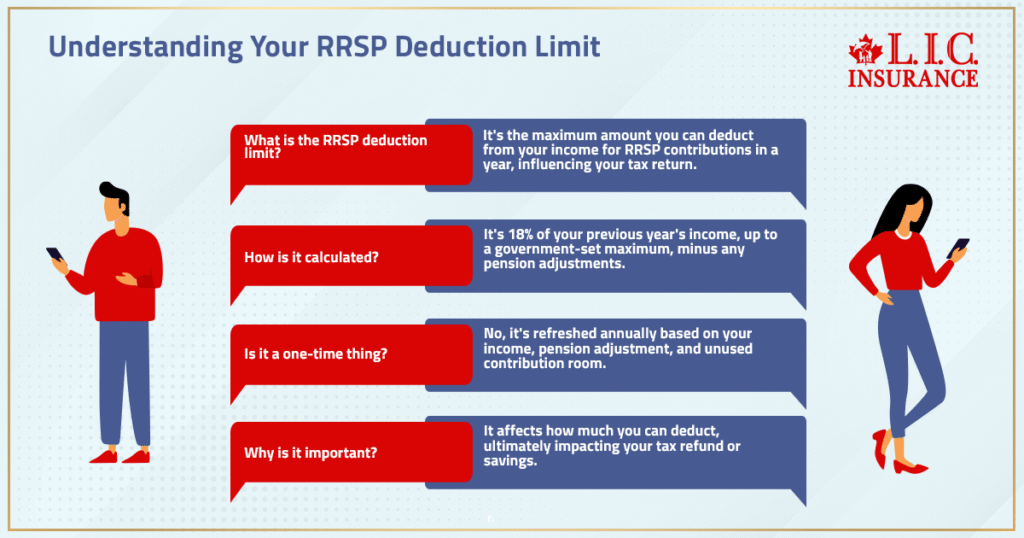
                How Do I Use My RRSP for Retirement?

                Retirement may seem like a distant event, but planning for it should be completed on time. In Canada, one of the most effective ways to prepare for retirement is through a Registered Retirement Savings Plan (RRSP). Understanding RRSPs and their benefits can be essential in ensuring a comfortable retirement. This blog will help you easily grasp how to utilize your RRSP for retirement.

                How Do I Use My RRSP for Retirement?

                By Canadian LIC, February 20, 2024, 7 Minutes

                How do I use my RRSP for retirement

                Retirement may feel like an event far, far away — but planning for it has to begin in earnest on schedule. In Canada, Registered Retirement Savings Plan (RRSP) is the most effective way to get ready for retirement. This article gives you a short overview of what RRSps are and what they can do for you and your retirement. This retirement blog will make understanding how to use your RRSP for retirement easy.

                But contributing to your RRSP is only half the battle—what to do with RRSP when you’re retired is equally as significant. Most Canadians save money in a systematic manner yet they don’t have a plan for withdrawals, taxation and timing of income. The way you distribute the money from your accounts can affect your quality of life, the taxes you pay and your long-term financial health. Whether you’re close to retirement or just starting to think about it, it’s key to know how to manage your RRSP to meet your goals. In these next few pages you’ll discover the most efficient ways to use your RRSP-during your working years as well as in retirement.

                Let’s first understand RRSPs

                An RRSP is a special type of retirement savings plan registered with the Canadian government. It is a way to save money for retirement and part of the appeal is that you can get some tax breaks.

                An RRSP is designed primarily to postpone the payment of tax. The cash you give your RRSP is tax deductible, which decreases the amount of income tax you pay now. However, you will pay taxes on this money when you withdraw it in retirement, presumably at a lower tax rate.

                More: What should you know about RRSP?

                RRSPs Benefits: A Dual Advantage

                Registered Retirement Savings Plan Benefits
                • The RRSP: Two key benefits The RRSP is attractive to save for retirement in Canada for one main reason: The registered retirement savings plan (RRSP) has a two-fold advantage. To begin reducing your current taxable income is one of the key advantages of an RRSP. Every dollar you invest in your RRSP lowers your taxable income for that year and may put you in a lower tax bracket, which equals instant tax savings. And that’s especially advantageous for high-income earners.
                • Tax-Deferred Growth: Your RRSP assets — such as stocks, bonds, and mutual funds — grow without tax erosion while they’re held within the plan. That means you pay no tax on the interest, dividends or capital gains your investments earn in the RRSP. The power of tax-deferred growth has a compounding effect, which over time, can really increase the value of your investment, and be a powerful weapon in your retirement saving arsenal.
                • Variety of Investments: RSPPs have a large variety of investment alternatives. Depending on your risk tolerance and investment goals, you can select from a range of assets, including stocks, bonds, mutual funds and exchange-traded funds (ETFS). The flexibility allows you to customize your portfolio to match your particular retirement saving requirements.
                • Lower Tax Bracket in Retirement: In retirement when you take out this money from the RRSP, you will most likely be at a lower tax bracket than when you were working. What this means in plain language is that, because all you’re withdrawing is your own contributions from the account, you will probably pay less tax on these withdrawals than you did on your income during your peak earning years.
                • Spousal RRSP Contributions for Income Splitting: Making contributions to a Spousal RRSP can help to split income, something that is a tremendous benefit if there is a large divergence between a couple’s incomes. This tactic can lower the family’s overall tax bill during retirement.
                • Home Buyers’ Plan (HBP) and Lifelong Learning Plan (LLP) Accessibility: RRSPS provide the ability to borrow HBP funds to buy your first home without immediate income tax, receive similar treatment to finance education (Repayment of these amounts to your RRSP must occur within a specified period after your home purchase or the cessation of the enrolled educational program).
                • Estate Planning: RRSPS can be used for estate planning purposes. Upon death, the value of your RRSP can be rolled over to a surviving spouse, financially dependent child or grandchild with no immediate taxes owing.
                  • Aids in Developing a Saving Habit: Normal contributions to an RRSP foster the habit of saving, which is important for accumulating enough money to fund your retirement. As well, the nature of RRSPs, with contribution maximums and deadlines, can push people to commit to long term savings goals.

                When you know these we can help you to make greater informed choices about your retirement planning. With the benefits of immediate tax savings and tax deferral, RRSPs have become a key investment vehicle for retirement savings in Canada.

                Choosing the Right Investments

                You can have a mix of investments in your RRSP- stocks, bonds, mutual funds and GICS (Guaranteed Investment Certificates) are all fair game. The trick is to invest in a way that matches your retirement goals and appetite for risk. A common one is that younger investors should have more stocks for growth, while those approaching retirement might shift toward more stable, income-producing investments, like bonds.

                Saving for Retirement: A Consistent Approach

                The single most important factor to ensuring your financial future, particularly in retirement, is to build a steady habit of saving.

                If you consistently contribute to your Registered Retirement Savings Plan (RRSP), the magic of compound interest can turn small contributions into large amounts of money over years. How the benefits of regular RRSP contributions for retirement can work for you This section examines how saving for retirement through an RRSP, from the time a taxpayer first starts working, can benefit you and is provided as a listicle for easy reading.

                • Benefit From Compound Interest By Starting Early: The earlier that you start contributing to your RRSP, the more time that your money has to benefit from compounding. Compound interest is the force that causes interest earned on the savings also to earn interest, it is the interest that interest earns, and that, over time, adds up to much more than a simple interest return on savings. For example, if you begin contributing in your 20s or 30s, you will have a much larger retirement fund than if you begin contributing in your 40s or 50s contributing the same amount.
                • Take regular contributions goals: Regularly contributing to your RRSP can have a big impact on the size of your retirement nest-egg. Decide on a feasible figure that you can contribute on a monthly or annual basis. This could be a fixed amount, or a percentage of your income. And then of course, over time, regular contributions, because they compound, even if they are small, they compound and become significant over time.
                • Know the Benefits of RRSP: One of the main advantages of an RRSP is that it offers instant tax relief. You can get a tax deduction on your contributions to your RRSP, which as a result will lower your tax rate and decrease the tax you have to pay now. Furthermore, the money you use to buy an RRSP gets shielded from taxes — you don’t have to pay taxes on investment growth until you withdraw the funds at a later date.
                • Automate Your Savings: If you set it up, automatic contributions to your RRSP can make saving for your retirement a piece of cake. With automatic transfers from your bank account to your RRSPs, you guarantee contributions without relying on remembering to make contributions. It’s a ‘set and forget’ method of saving that works consistently.
                • Gradually Increase Your Contributions: If you see your income growing, you may wish to increase your RRSP contributions. Incremental changes add up, and even the smallest can make a big difference in the long run. This becomes even more important as you near retirement since higher contributions can ultimately balloon your retirement savings.
                • Reinvest in tax refunds: Reinvesting your tax refunds from RRSP contributions can supercharge your retirement portfolio for the future. That serves as a positive feedback loop in which your savings and tax benefits both help one another build your retirement account.
                • Keep your RRSP investments diversified: In your RRSP, it’s important to diversify your investments to achieve a mix of risk and growth. Diversification with a mix of stocks, bonds, and mutual funds can spread risks while seeking moderate growth. Diversification is key, to help shield your savings from market gyrations.
                • Keep tabs on your investments: Monitor your RRSP investments from time to time and make adjustments if necessary. When you get closer to retirement, you may prefer to invest more conservatively to protect your savings.
                • Know Your Contribution Limits: Know what the annual contribution limits are and if there is any contribution room left from years past. Contributing too much might lead to penalties, so it’s important to stay on top of this.
                • Speak with a FA: If you are unsure how to maximize your RRSP contributions consider speaking with a financial advisor. They can work with you to develop a plan that aligns with your financial goals and retirement expectations.

                By adopting a steady, step-by-step way to save for retirement through an RRSP, you’ll discover the advantages of compound interest, tax breaks and a brighter financial future for yourself. And don’t forget: It’s not only what you save, it’s also how consistently and intelligently you save.

                Understanding Contribution Limits

                There also is a limit on how much you can contribute to your RRSP per year. For 2024, this ceiling is 18 percent of your earned income for the preceding year but no more than $31,560. If you don’t use all of your contribution room in a year, it can be carried forward to future years. Keeping in mind your personal contribution limit is essential to avoid over-contributing, as you may face penalties for going over it.

                More: What is the maximum RRSP contribution for 2024?

                More: At what age should you stop contributing to an RRSP?

                Get The Best Insurance Quote From Canadian L.I.C

                Call 1 844-542-4678 to speak to our advisors.

                Best Insurance Plans Helpline From Canadian L.I.C

                Making RRSP Withdrawals: What You Should Know

                De-registering a registered retirement savings plan (RRSP) is an important step for using the funds it contains for your retirement plan. Mastering the basics of RRSP withdrawals is critical if you want to maximize the impact your savings will have on your life in retirement. The following points are vital to understand as you consider how best to make RRSP withdrawals.

                • RRSP Conversion To Do: You generally have until the end of the year you turn 71 to convert your RRSP to a RRIF or an annuity. This is a necessary conversion because it transitions what is happening to your savings from accumulation to distribution.
                • Know the tax implications: Money you take from your RRSP is treated as income in the year that you take it out. Which means not only the return OF your investment, but the return ON your investment will simply added to your income and taxed. Strategizing your withdrawals to reduce tax comes with the territory when getting the most out of your RRSPs.
                • Think About When to Tap RRSPs: If you retire young, be careful not to withdraw all of your RRSPs at once, opting instead to withdraw funds from your RRSP when you require the income or land in a lower tax bracket. This approach can aid in your retirement saving by enabling your investments to compound tax-deferred for more time.
                • Be strategic with the Home Buyers’ Plan (HBP): The HBP is a program whereby you can pull out up to $35,000 from your RRSP to put toward your first home purchase. This drawdown is non-taxable if you repay it over 15 years. For aspiring home buyers it’s a big break.
                • Utilize the Lifelong Learning Plan (LLP): Under the LLP, you can withdraw money from your RRSP to pay tuition for yourself or your spouse. You may withdraw a maximum of $10,000 a year, for a total of $20,000. Those withdrawals are tax free, so long as they are paid back over 10 years.
                • Interface Minimum RRIF Withdrawals: After you convert your RRSP to a RRIF, the government stipulates minimum withdraws based on how old you have turned. Those minimums are rising with age.
                • Consider Withholding Taxes: Keep in mind that the financial institution, when you make the withdrawal from a RRSP, will take a chunk of it (up to a certain amount) for tax purposes, depending on where you live and how much you withdraw. It’s important to know about these withholding taxes so it doesn’t come as a shock during tax time.
                • Where to avoid tapping into, if at all possible: Withdrawing money from your RRSP in advance can have a big tax implication. It also diminishes your retirement savings, which can affect your financial stability in your retirement.
                • Review your retirement income sources: When you plan your RRSP withdrawals, think about any other sources of income, such as pensions, government benefits, and income from other investments. The interplay of these sources can help maximize your retirement income and tax picture.
                • Consult A Specialist: RRSP Withdrawals are complicated. A financial advisor can offer you custom advice for your personalized financial situation that will allow you to take full advantage of your RRSP.

                Knowing these vital information about RRSP withdrawals will allow you to make the most informed decisions so you can maximize the benefits from your retirement savings. Remember, the point of an RRSP is not just to save for retirement, but also to help ensure you have income and options in your golden years.

                Strategic RRSP Timing: A Missed Opportunity Most Canadians Overlook

                One of the most overlooked aspects of retirement planning is how and when to withdraw from your RRSP—not just from a tax perspective but from a life design angle. Most articles focus on converting your RRSP to a RRIF at age 71, but very few talk about how your goals for retirement lifestyle, healthcare needs, and legacy planning should determine withdrawal timing.

                So, what to do with RRSP when you retire?

                Think beyond the default RRIF route. For example, if you retire early and your other income sources are minimal, it might make sense to begin modest RRSP withdrawals before age 71 to take advantage of lower tax brackets. Doing so could reduce future Old Age Security (OAS) clawbacks and ensure a more tax-efficient drawdown strategy later.

                Also consider “income layering.” This strategy staggers withdrawals from your RRSP, TFSA, pension, and non-registered accounts to balance your yearly taxable income. It’s not about draining your RRSP first or last—it’s about coordinating with your unique timeline and needs.

                By carefully mapping out what to do with RRSP when you retire, you’re not just minimizing taxes—you’re maximizing lifestyle flexibility and long-term financial security. Most Canadians don’t do this—and it can cost them thousands.

                Planning for the Unexpected

                Preparing for the unexpected is a critical element in saving for retirement. Even if RRSPS provide many advantages for retirement, also remaining relevant in the case of unplanned life events should be considered.

                • Set Up an Emergency Fund: One of the initial steps for preparing for those unexpected events is setting up an emergency fund. They should be readily available and apart from your RRSP. You should have a long-term savings to handle 3-6 months’ worth of living expenses in your possession. This way, you won’t have to pull from your RRSP in an emergency and potentially incur taxes and lose contribution room.
                • Know the Effects of RRSP Early Withdrawals: If you take out money from your RRSP before your retirement, there are financial consequences. Not only is it taxed, but it also reduces your investments in retirement in the future. Being aware of this can help you avoid decisions that aren’t well-informed when you use your RRSP funds.
                • Think About Disability and Critical Illness Insurance: I am a big believer in Insurance as a part of your financial plan. Having a Disability or Critical Illness policy in place can help you if you need to take a health-related leave of absence from work, which means you won’t be raiding your retirement savings for such events.
                • Review and Update Your Financial Plan Periodically: Major life changes such as marriage, birth of a child or a job change can impact your financial circumstances. It’s always a good idea to review your financial plan — including how you are contributing to your RRSPs and where the money is invested — to make sure it continues to reflect your situation.
                • Diversify Your Investment Portfolio: Besides an individual RRSP, diversifying your portfolio investment can help mitigate risk. Owning a variety of assets, such as stocks, bonds and real estate, can add further security — and further income streams.
                • Draft a Will and Estate Plan: When you have a will and an estate plan, you can control where your assets go when you die. The planning for your RRSP and other investments is all part of that, which for some people will be essential when it comes to supporting dependents.
                • Keep Up To Date With RRSP Withdrawal Options: Knowing when you’re allowed to withdraw money from your RRSPs without facing onerous penalties (the Home Buyers’ Plan, Lifelong Learning Plan), in the event of financial hardship.
                • Keep an Open Mind: Having a flexible mindset and remaining open to modifying your retirement plans is essential. This option can assist in getting through momentary cash flow issues without greatly derailing your long-term retirement plans.
                • “Professional Advice: Receiving professional advice for your finances is helpful, especially when dealing with financial strains you didn’t anticipate,” Hamrick says. They can provide ideas about how to handle your finances without decimating your retirement savings.
                • Don’t Neglect Your Savings: Despite the fact that life throws curveballs, keep investing in your RRSP and other savings accounts. Regular saving is the key to saving a lot for retirement.

                Conclusion: Taking Action for a Secure Retirement

                Make the most of your RRSP Taking full advantage of your RRSP is the best single guarantee of a secure retirement. The advantages of RRSPs for retirement savings are evident: the tax benefits, the growth of your investments and a range of options for your future. It’s time to act now. Begin by assessing your position and see how it can be used to make the most of your RRSP contributions. Keep in mind the sooner you begin, the more you can benefit from compound interest and tax savings.

                Discuss your options with a professional and tailor a plan that meets your financial needs to ensure you are on a path to a safe and secure future. Retirement may be a long way off, but with some careful RRSP planning, you can plan for your retirement with the knowledge, certainty and peace of mind.

                Get The Best Insurance Quote From Canadian L.I.C

                Call 1 844-542-4678 to speak to our advisors.

                FAQ's

                Your RRSP money is intended to provide you with an income in retirement. You can take it out in cash, but most people roll their RRSP into a Registered Retirement Income Fund (RRIF) or buy an annuity. They also offer a bit more of a reliable, structured form of income. You also have the ability to use RRSP proceeds for other things – you can invest in lifelong learning and pull money without penalty, and, you can use it to fund a down payment on a house.

                Here are a few more details: You can access the money in your RRSP anytime you want, but it will be taxed if you withdraw it. Withdrawals are treated as income for the year they are taken and taxed at that time. RRSP monies are best withdrawn in retirement when your income is probably lower, which could mean that you may be in a lower tax bracket. Note also that this is the last year and the final year the year you turn 71 that you can contribute to an RRSP before converting it into an RRIF or an annuity.

                Withdrawals of funds from an RRSP do not reduce your contribution room. So if you take out money, you don’t get that contribution room back. If you withdraw any amount, you cannot contribute that amount without using your remaining or future contribution room. This is unlike the TFSA (Tax-free Savings Account) where what you withdraw is added back to your contribution room in the year following your withdrawal.

                Any Canadian resident with earned income and a social insurance number who files a tax return can open an RRSP. The ability to contribute to an RRSP continues until December 31st of the year, which is when you turn 71 years old.

                Your RRSP contribution limit is 18% of your earned income from the previous year, up to a maximum limit set by the government for the current year. This limit is also affected by your pension adjustments and any unused contribution room from previous years.

                The benefits include tax-deductible contributions, tax-deferred growth, potential tax savings in your highest earning years, and the flexibility to withdraw funds for specific programs like the Home Buyers’ Plan or Lifelong Learning Plan.

                Yes, but withdrawals are subject to taxation. There are exceptions like the Home Buyers’ Plan and Lifelong Learning Plan, which allow for tax-free withdrawals under specific conditions and require repayment within a designated period.

                Upon retirement, you typically convert your RRSP into a Registered Retirement Income Fund (RRIF) or use it to purchase an annuity. These options provide you with regular income during retirement. Withdrawals from these funds are taxed as income at your current tax rate.

                Investment choices should be based on your risk tolerance, investment goals, and the time horizon until retirement. Common investment options include stocks, bonds, mutual funds, and GICs. Diversifying your investments is recommended to balance risk and growth.

                Over-contributing beyond your limit by more than $2,000 can result in a penalty tax. It’s important to keep track of your contributions to avoid penalties.

                RRSPs cannot be jointly held, but you can contribute to a spousal RRSP, which helps in income splitting and can be beneficial for tax purposes in retirement.

                Contributions to your RRSP reduce your taxable income in the year they are made, potentially lowering your immediate tax liability. However, withdrawals from an RRSP during retirement are added to your income and taxed at your marginal tax rate.

                There are basically two programs in which you can make tax-free withdrawals from an RRSP:

                • Home Buyers’ Plan (HBP): First-time home buyers can withdraw up to $35,000, tax-free to buy or build a home. The amount received is tax-free, but you have 15 years to repay the RRSP.
                • There are basically two programs in which you can make tax-free withdrawals from an RRSP:
                • Lifelong Learning Plan (LLP): You can take out up to $20,000 for educational expenses. These withdrawals are tax-free but must be repaid over a 10-year period.

                The above information is only meant to be informative. It comes from Canadian LIC’s own opinions, which can change at any time. This material is not meant to be financial or legal advice, and it should not be interpreted as such. If someone decides to act on the information on this page, Canadian LIC is not responsible for what happens. Every attempt is made to provide accurate and up-to-date information on Canadian LIC. Some of the terms, conditions, limitations, exclusions, termination, and other parts of the policies mentioned above may not be included, which may be important to the policy choice. For full details, please refer to the actual policy documents. If there is any disagreement, the language in the actual policy documents will be used. All rights reserved.

                Please let us know if there is anything that should be updated, removed, or corrected from this article. Send an email to Contact@canadianlic.com or Info@canadianlic.com
                What Are Unused RRSP Contributions?

                People in Canada can use the Registered Retirement Savings Plan (RRSP) to save money for their future in a smart way. It offers the potential for a comfortable and secure retirement by allowing you to set aside a portion of your income within a tax-advantaged account. But here’s the key: the more you contribute, the brighter your retirement prospects become.

                What Are Unused RRSP Contributions?

                By Canadian LIC, January 30, 2024, 8 Minutes

                What Are Unused RRSP Contributions

                Canadians have a smart way to save for their financial future: the Registered Retirement Savings Plan (RRSP). It provides some opportunity to have a comfortable and secure retirement by deferring a portion of your income to a tax-benefited account. But here’s the thing: The more you contribute, the rosier your retirement future looks.

                But there’s more to the picture of how much to spend on RRSP contributions compared to just contributing; there are some limits in play. The contribution limit was 18% of your pre-tax income, to a maximum of $30,780, in 2023. It should be noted that the number is subject to change, and you should check with the Canada Revenue Agency (CRA) website for up-to-date details. Also, if you’re a member of a pension or deferred profit-sharing plan, your contribution room could vary.

                The good news is, if you can’t afford to or if you opt not to contribute in a given year, your contribution room doesn’t disappear. It rolls over so you can catch up when your finances allow.

                In the case of your retirement security, there is no time better than the present to begin.

                In this blog, we learn about Unused RRSP Contributions, which can really siphon off into your financial future. We’re going to get you up to speed on this concept, the RRSP contribution limit, and we’ll also walk you through how to make the most of your RRSP.

                What Are Unused RRSP Contributions?

                What Are Unused RRSP Contributions

                Unused RRSP (Registered Retirement Savings Plan) contributions’ mean you have contributed to your or your spouse or common-law partner’s RRSP, PRPP (Pooled Registered Pension Plan), or SPP (Specified Pension Plan) and haven’t claimed a deduction for those contributions. You made these contributions after 1990 and did not deduct them on your past income tax and benefit returns or ask us to apply them to Home Buyers’ Plan (HBP) or Lifelong Learning Plan (LLP) repayments.

                Understanding the RRSP Contribution Limit

                If you want to manage your RRSP well, you need to know your RRSP contribution limit. This limit is the most that you can contribute to your RRSP for that tax year. It’s based on your earned income and can be located on your most recent notice of assessment or notice of reassessment — this will be the form with the RRSP Deduction Limit Statement that you’ve received from the Canada Revenue Agency if you’ve contributed to an RRSP. Form T1028, “Your RRSP Information for YEAR” is another document to look for this information.

                The Hidden Impact of Unclaimed RRSP Contributions on Your Long-Term Planning

                While most people focus on their annual RRSP deposits, very few consider the deeper implications of what is unused RRSP contributions in their portfolio. If you’re wondering why do I have unused RRSP contributions, you’re not alone—many Canadians unintentionally leave valuable deduction room on the table due to career changes, parental leave, or periods of lower income. These unclaimed RRSP contributions may seem minor at first, but over time, they can represent a significant pool of tax-sheltered investment opportunity.

                What makes this even more strategic is the flexibility built into the system. How long can you carry forward unused RRSP contributions? The good news is—indefinitely. As long as you remain eligible for RRSP participation, that unused room doesn’t expire. This opens up unique opportunities for higher-income years ahead, when maximizing deductions can lead to substantial tax savings.

                So, what are unused RRSP contributions really worth to you? Think beyond the immediate tax season. With careful planning, they can be your secret weapon for smoothing out taxable income spikes and optimizing your retirement funds. Ignoring them may mean leaving long-term financial benefits unrealized. Integrating these figures into your annual review can help you make smarter, data-driven decisions and eliminate the guessing game around contribution strategies.

                How do you find out if you have unused RRSP contributions?

                How do you find out if you have unused RRSP contributions

                Understanding the Significance of RRSP Contributions

                So, before learning how to recognize unused RRSP contributions, let’s first determine why they are relevant. RRSP contributions are the foundation of your retirement savings plan. They provide tax advantages and the opportunity for investment growth, and they are a key tool for planning your financial future.

                Begin With Your Notice of Assessment:

                Determine if You Have Unused RRSP Contributions It is quite an easy task to figure out if you have RRSP contribution room or not. Start by looking at your last Notice of Assessment from the Canada Revenue Agency (CRA). This form, which arrives after you’ve filed your tax return, includes a bundle of information. It will disclose your RRSP contributions for the prior year and the contribution room you have left.

                How to log in to your CRA account online:

                And, for those who favour online convenience, the CRA offers a website that will allow you to receive your financial information online. If this is your first visit, you’ll need to click the link and register. You can log in through a CRA username and password or use your bank as a sign-in partner, if you prefer.

                Go to Section “RRSP and TFSA”

                Once you have logged in to your CRA account, you’ll find the section under “RRSP and TFSA.” This is the area that gets you all the information that you need for your RRSP needs.

                Click on the “RRSP” Link:

                In the “RRSP and TFSA” area, find the “RRSP” link and click on it. This action will bring you to the page with your RRSP information (and contribution specifics).

                Find “Unused RRSP Contributions”:

                While you’re going through all that RRSP information, look for the line where it says: “Unused RRSP contributions available to deduct for is $XXX.” XX.” This is the line that gives you the magic number of your remaining RRSP money that can be used to lower your tax bill.

                Maximize Your RRSP:

                Find out whether you have RRSP contribution room that you can contribute to is a crucial part of maximizing your retirement savings plan. With these contributions, you can maximize your RRSP’s earning power and enjoy peace of mind knowing your financial future is in good hands.

                Contact our team now for personalized RRSP quotes and professional advice tailored to your specific financial aspirations and needs. We are here to support you through this, and your financial health is our highest priority.

                After all, when it comes to dreams about retirement, it all starts with having a clear picture of what you may achieve through your RRSP contributions. So let’s take this financial journey together and secure the future you deserve.

                Know when to stop contributing to RRSP here

                Dealing with Unused Contributions

                If you determine you don’t want to deduct all your RRSP, PRPP or SPP contributions you made in the year, you have a few choices:

                Complete Schedule 7: If you’re not claiming all of the contributions, you can complete Schedule 7 “RRSP, PRPP and SPP contributions and transfers and HBP and LLP activities.” This list includes contributions made to your RRSP, PRPP, SPP, or your spouse’s or common-law partner’s RRSP or SPP. Fill it in for gifts dated March 2, 2023-February 29, 2024. If you are filing a paper return, attach a completed Schedule 7 to your income tax return. If you’re filing online, retain Schedule 7 in case the CRA (Canada Revenue Agency) asks to see it.

                If You Have Already Filed Your Return: If you have already filed your income tax and benefit return, you can still act on unused contributions. Complete Schedule 7 and Form T1-ADJ (T1 Adjustment Request) and mail them to your tax center. Please ensure that you send us copies of receipts to support your contributions, showing your name and social insurance number.

                Two Choices for Unused Contributions: Your unused contributions can be left in the plan or taken out. Remember, you could potentially owe tax if you contribute beyond your RRSP deduction limit. This tax hits whether or not you took the withdrawal under the Home Buyers’ Plan (HBP) or Lifelong Learning Plan (LLP).

                Withdrawing Unused Contributions: If you do not plan to use all of your contributions, you need to withdraw them and include them in your income on your income tax and benefit return. But it’s potentially possible to deduct an amount equal to the contributions you withdrew. See the section on requesting the return of unused contributions in this publication for details.

                Concluding Words

                Unused RRSP contributions mean a lot to your future finances. It is important to know one’s own RRSP contribution limit and how to deal with the “leftover” contribution room in your RRSP account, as it plays a major role in planning for your retirement. Hopefully, this blog has given you some clarity on what Unused RRSP Contributions are in Canada, and you’re a little bit more confident navigating your financial journey.

                At Canadian LIC, it’s part of our jobs to offer Insurance professionals advice resources so they can make smart and educated choices towards a safe and financially satisfying future. Need RRSP quotes and advice that is tailored to you? Give our specialized insurance experts a call. Our first concern is your financial health.

                Get to know who should not use RRSPS

                Get The Best Insurance Quote From Canadian L.I.C

                Call 1 844-542-4678 to speak to our advisors.

                Best Insurance Plans Helpline From Canadian L.I.C

                FAQ's

                RRSP contributions are funds that individuals contribute to their Registered Retirement Savings Plan. They are essential for building a financial cushion for retirement, as they offer tax benefits and the potential for long-term growth through investments.

                Unused RRSP contributions are the amounts you’ve contributed to your RRSP, PRPP, or SPP or on behalf of your spouse or common-law partner, but have not claimed as deductions on your previous tax returns. These contributions were made after 1990 and were not designated for HBP or LLP repayments.

                You can find your RRSP contribution limit on your latest notice of assessment or notice of reassessment, which includes the RRSP Deduction Limit Statement. Form T1028, “Your RRSP Information for YEAR,” also provides this information.

                If you haven’t deducted all your RRSP, PRPP, or SPP contributions made in a tax year, you can fill out Schedule 7, which is used for reporting unused contributions. This is important for managing your unused contributions effectively.

                Yes, you can. If you’ve already filed your income tax and benefit return and wish to address unused contributions, complete Schedule 7 and submit it along with a Form T1-ADJ (T1 Adjustment Request) to your tax center. Include copies of your contribution receipts with your name and social insurance number.

                If you exceed your RRSP deduction limit, you may be required to pay tax on the excess contributions. This tax liability applies even if you withdrew the contribution under the Home Buyers’ Plan (HBP) or Lifelong Learning Plan (LLP).

                You must include unused contributions as income on your income tax and benefit return to withdraw them. However, you may have the option to deduct an amount equal to the withdrawn contributions. The official CRA website provides Detailed guidelines for withdrawing unused contributions.

                Absolutely! At Canadian LIC, our dedicated team of insurance professionals is here to provide expert guidance on RRSP contributions and all your insurance needs. We’re committed to helping you make smart choices for a secure and prosperous future.

                The deadline for making RRSP contributions for a specific tax year is usually March 1 of the following year. However, if March 1 falls on a weekend or holiday, the deadline is extended to the next business day.

                Yes, you can carry forward unused RRSP contributions to future years. The contribution room accumulates over time, allowing you to catch up on contributions in years when your financial situation allows for it.

                Yes, contributing beyond your RRSP contribution limit can result in penalties. You may have to pay a 1% per month tax on the excess contributions that exceed $2,000. It’s important to monitor your RRSP contributions to avoid penalties.

                Deducting RRSP contributions on your tax return reduces your taxable income for the year in which the deduction is claimed. This can result in a lower tax bill and potentially lead to a tax refund.

                While RRSP contributions are primarily intended for retirement savings, you can use them for specific financial goals, such as buying your first home through the Home Buyers’ Plan (HBP) or funding your education through the Lifelong Learning Plan (LLP).

                Determining the ideal RRSP contribution amount depends on various factors, including your income, financial goals, and retirement plans. It’s advised to consult a financial advisor or use online tools to assess your specific needs and contribution limits.

                Yes, you can contribute to your RRSP even if you have a workplace pension plan. However, your pension contributions may affect your RRSP contribution room, so it’s essential to consider both when planning your retirement savings strategy.

                There are no specific limits on withdrawing unused contributions from your RRSP. However, it’s crucial to be aware of the potential tax implications and consult with a tax professional to understand the best approach for your financial situation.

                Yes, you can transfer unused RRSP contributions to your spouse’s or common-law partner’s RRSP, provided they have contribution room available. This may be of assistance to you as you plan your household’s retirement savings strategy.

                Keep in mind that RRSP regulations can shift from year to year so, it is important that you stay up to date and informed and consult financial professionals for individual advice regarding your RRSP contributions and your future financial security.

                The above information is only meant to be informative. It comes from Canadian LIC’s own opinions, which can change at any time. This material is not meant to be financial or legal advice, and it should not be interpreted as such. If someone decides to act on the information on this page, Canadian LIC is not responsible for what happens. Every attempt is made to provide accurate and up-to-date information on Canadian LIC. Some of the terms, conditions, limitations, exclusions, termination, and other parts of the policies mentioned above may not be included, which may be important to the policy choice. For full details, please refer to the actual policy documents. If there is any disagreement, the language in the actual policy documents will be used. All rights reserved.

                Please let us know if there is anything that should be updated, removed, or corrected from this article. Send an email to Contact@canadianlic.com or Info@canadianlic.com

                Can You Transfer an RESP to an RRSP?

                A Registered Education Savings Plan (RESP) is an intelligent way to make sure your kids have the money they need for higher education after high school. However, what many might not know is that there are ways to transfer funds from an RESP to a RRSP. So here we will go into the details of whether you can transfer an RESP to an RRSP and the essential rules and considerations involved. But before we discuss that, let’s first understand what RESP is and what is its importance.

                Can You Transfer an RESP to an RRSP?

                By Harpreet Puri, January 16, 2024, 10 Mins

                Can You Transfer an RESP to an RRSP

                A Registered Education Savings Plan (RESP) offers parents a smart way to make sure their children have money to use for their post-secondary education, such as undergraduate studies or a certified trade or technical school program. But what people may not realize is there are some strategies available to transfer money from an RESP to an RRSP. So let’s dive into whether you can transfer an RESP to an RRSP and the necessary steps and factors to consider. But before we delve into that, we should begin by understanding what is RESP and why it is important.

                Let’s Understand Registered Education Savings Plan

                Registered Education Savings Plan Tips for Parents and Students

                An RESP is a government-approved savings plan designed to help families save up for their kids’ post-secondary education. After you open an RESP, parents, grandparents, or the remaining family members can contribute money to an account that can be used for tuition, books, and additional education-related expenses at a college, university, or trade school.

                RESP Guidelines

                If you’re a beginner at contributing to your child’s RESP, here’s what you need to know:

                Courtesy of RESP ProvidersThese are just the basics, but knowledge is power when it comes to getting the most from your RESP and ensuring your child’s educational aspirations are fully funded when the time comes to take the next steps.

                Go here to get more clarity on -‘Why to choose an RESP?

                Understanding the Why

                So there you have a general RESP overview which can take us to the next topic, how to transfer money from an RESP to an RRSP. So why would a person transfer funds that were supposed to be used for their child’s education instead into their retirement plan? The fact is that not all children decide to go to college. In some instances, even after your child has completed their post secondary education by 1 or 2 years, you will still have some proceeds left in their RESP. Moving this money to your RRSP can be a money-making strategy that will defer taxes on the withdrawal, and arguably one of the best RESP withdrawals for non-education purposes.

                Rules for RESP to RRSP Transfers

                Before moving money from your Registered Education Savings Plan (RESP) to your Registered Retirement Savings Plan (RRSP), you should make sure you know the exact rules and conditions that apply to this financial move. For ease of understanding, consider the following points:

                Age and Education Status:

                • Each child beneficiary must be at least 21 years old.
                • They should not be currently enrolled in post-secondary education.

                Tip for Parents: Plan ahead and consider your child’s education for the future when thinking about the RESP to RRSP transfer. Ensure they’ve reached the specified age and are not actively pursuing higher education.

                RESP Duration:

                The RESP account must have been open for a minimum of 10 years.

                Tip for Parents: Start your child’s RESP early to meet the 10-year requirement. The longer the account is open, the more options and flexibility you have for managing the funds.

                RRSP Contribution Space:

                You need to have enough RRSP contribution space available.

                Tip for Parents: Keep track of your RRSP contribution room. Ensure it aligns with the amount you intend to transfer from the RESP. Consult with insurance experts if needed to optimize your contribution space.

                Timing and Exceptions:

                • The transfer is also possible in the 35th year after entering the RESP plan.
                • Alternatively, it’s allowed if all beneficiaries under the plan have passed away.

                Tip for Parents: Be aware of these time-sensitive conditions. If the RESP has been diligently maintained, it can serve as a valuable financial resource well into the future.

                RESP Flexibility: 

                An RESP can remain open for 35 years, providing flexibility even if your child is not actively pursuing education.

                Tip for Parents: Understand the extended lifespan of the RESP. This flexibility makes it possible for you to adapt to changing circumstances and logically decide when and how to utilize the funds.

                Hence, understanding these rules and registered education savings plan tips for parents and students is extremely vital before initiating an RESP to RRSP transfer. By having all the required knowledge and planning strategically, you can confidently deal with this financial process, ensuring the optimal benefits possible for both you and your child’s future.

                Rules for RESP Withdrawals

                It’s very important to understand the rules around withdrawals when it comes to managing your RESP. Those guidelines should serve as a course of action for navigating the financial landscape whether you’re contemplating a withdrawal for non-educational purposes or mulling transferring money from an RESP to an RRSP. Here are two plain points that will provide clarity for parents and students:

                Tax-Free Distributions on Contributions:

                When it comes to your contributions to your RESP, you are like super lucky: you can pull them out faster than you can say “oh my god I can buy skis with this,” and the best part is that no tax man cometh. That means your contributions come back to you with no tax penalty. This is a breath of fresh air for parents trying to get to the money they have worked hard to save.

                Returning CESG or CLB Funds:

                One thing to remember is that any grants (i.e. CESG or CLB) can be a slippery slope. If the EAPs are not pulled out, then really these EAPs would have to be paid back to the government. It’s a refund policy, only there’s a bit more paperwork involved.” This rule creates certainty that prevents everything from going to hell.

                Normal Taxable Income For Non-Educational Withdrawals:

                And now, brace yourself for the tax talk. It is not, however, without its disadvantages to use funds for purposes other than education: This income is taxed at your ordinary income tax rate plus an additional 20 percent. Although students typically benefit from a low tax rate during their student lifetime, the situation is different when the money is spent for other purposes.

                How to get RESP to RRSP Transfers:

                “That is where some intentional planning can really come in. To reduce the tax hit from drawing income, have withdrawals sent directly to your registered retirement savings plan (RRSP). What’s beautiful about this is the fact that the investment EARNINGS from the RESP, after it’s been transferred, will continue to grow tax-free inside that tax-deferred RRSP.

                Get The Best Insurance Quote From Canadian L.I.C

                Call 1 844-542-4678 to speak to our advisors.

                Best Insurance Plans Helpline From Canadian L.I.C

                Dealing with Limited RRSP Contribution Room

                While the maximum transfer amount from RESP to RRSP is $50,000, ensuring you have enough RRSP contribution space is very important. Options for those with limited space include:

                Real-World Scenarios Where RESP to RRSP Transfers Make Strategic Sense

                While the RESP to RRSP transfer process may seem technical, its practical impact becomes clearer when viewed through real-life financial planning lenses. For instance, families with more than one child may open a family RESP, pooling funds under a single plan. If one child decides not to pursue post-secondary education, the leftover grant-earning contributions and accumulated income in the RESP can still be used effectively. In such cases, a RESP transfer to RRSP offers a smart pivot, especially when the RESP subscriber (usually a parent) has ample RRSP contribution room.

                Another often-overlooked use case involves self-employed individuals. Many small business owners delay RRSP contributions during the early stages of their business due to inconsistent income. Later, if their child doesn’t use all the RESP funds, they can transfer RESP to RRSP CRA-compliantly and simultaneously boost their retirement savings, while keeping the income growth sheltered from tax.

                These nuanced financial strategies are not widely discussed, yet they show how RESP transfer rules can be applied to maximize tax efficiency and retirement preparedness. Always ensure compliance by cross-verifying RESP to RRSP eligibility criteria and contribution caps. For those who plan early and think long-term, a transfer RESP to RRSP is more than a tax move—it’s a strategic upgrade.

                Practical Scenarios for RESP to RRSP Transfer

                Step-by-Step Guide for Transferring RESP Funds to an RRSP

                Suppose you find yourself in a situation where you are certain that your child won’t be pursuing further education, and you are considering the strategic move of transferring RESP savings to your RRSP. In that case, following a systematic approach is essential to ensure a smooth process. Here are the steps that are needed to make this move.

                1. Confirm that you meet the transfer conditions:

                Really it is important that you make sure you are qualified to transfer an RESP to RRSP before you start the transfer. Make certain that each child RESP recipient is at least 21 years old and not enrolled in post-secondary education. You’ll also want to confirm that your RESP has been open for at least 10 years and that you have enough room for RRSP contributions.

                This is very crucial as it is a prelude to a successful move. If you satisfy those requirements you’re halfway toward enjoying the tax-deferred benefits of funds being transferred from RESP to RRSP.

                1. Check your RRSP contribution room:

                The next step is to figure how much RRSP contribution room you have for the transfer. The money you can put in your RRSP is called the contribution room. You can obtain this information by looking at your latest notice of assessment from the Canada Revenue Agency (CRA).

                If space is limited, there are options like adding a spouse to the RESP or waiting until you’ve built up enough space. Knowing your contribution room is key to a smooth transfer.

                1. Gather the necessary documents, including your account number:

                In order to begin the transfer, you need to collect certain documents. This can be a copy of your RESP account statements, pieces of your identification, and also your RRSP account number. You can speed up the process when you contact your own RESP promoter if you have these papers ready ahead of time.

                They need your account number, which is very important for a good and secure transfer. This information should also be verified to avoid the delays and problems that can result from incorrect information.

                1. Contact your RESP promoter for the required forms and facilitate the transfer:

                With your paperwork at the ready, contact your RESP promoter and ask for the forms to make the transfer. All banks have call center agents who can walk you through the process and even have the necessary papers delivered to you.

                Complete the forms carefully, and make certain all information is fully completed and accurate. Send your forms to your RESP promoter, and they will arrange this income transfer and the return of any federal and provincial grants to the government.

                1. Considerations and Potential Fees:

                Just a note that there might be some fees associated with such a transfer. Your RESP promoter may charge a transfer fee, plus a closing fee for the account. Also note that some financial institutions may require you to sell your investments in order to transfer them as cash.

                Also, remember it depends on how long the transfer process takes as well. Transfers can take a few weeks to a few months but some may complete in a week or so. It’s important to be patient and maintain open communication with your RESP promoter at this point.

                Wrapping It Up

                In short, snaking underutilized RESP funds to your RRSPs can be a very savvy tax play, which will ultimately reduce your tax bill. Although there are some administrative and possibly monetary burdens to the process, the rewards of expatriation are certainly worth the headaches. Investigate and accomplish the transfer the right way just in case your child doesn’t go to college so you can make the most of the savings you have. If you’re thinking about embarking on such a transfer, there’s no harm in having a discussion with your RESP provider to get some individual advice tailored to your circumstances.

                Get The Best Insurance Quote From Canadian L.I.C

                Call 1 844-542-4678 to speak to our advisors.

                Faq's

                RESP stands for Registered Education Savings Plan. It’s a Canadian government-approved savings plan that helps families save for their children’s post-secondary education. Contributions grow tax-deferred until withdrawal.

                RESP operates by providing a tax-advantaged way to save for education. Family members contribute, the government offers grants (CESG), and the money grows tax-free. Withdrawals fund qualified educational expenses.

                RESP withdrawals are taxable. Contributions are not taxed, but income and government grants are taxed at the beneficiary’s regular rate plus an extra 20%. Transferring to an RRSP can minimize the tax burden.

                If your child decides not to pursue higher education or there are remaining funds in their RESP after studies, transferring to your RRSP can defer taxes on the withdrawn amount, offering a strategic move for non-educational purposes.

                In order to complete the transfer, each child beneficiary must be at least 21 years old, not currently enrolled in post-secondary education, and the RESP must have been open for a minimum of 10 years. Additionally, sufficient RRSP contribution space is required.

                Yes, an RESP can remain open for up to 35 years, providing flexibility even if your child is not actively pursuing education. During this time, grants and earnings remain tax-sheltered within the RESP.

                Yes, the maximum transfer amount is $50,000. However, you need to ensure you have enough RRSP contribution space available to complete the transfer.

                Any Canada Education Savings Grant (CESG) or Canada Learning Bond (CLB) funds that are not taken out as an Education Assistance Payment (EAP) must be given back to the government. However, payments can be taken out tax-free.. Income withdrawn for non-educational purposes is taxable at your regular tax rate plus 20%.

                A6: To minimize the tax burden, consider transferring funds from your RESP to your RRSP. The income growth from the RESP, once transferred, is not taxed within the tax-deferred RRSP account.

                The maximum amount that you can transfer is $50,000, and having enough RRSP contribution space is crucial. Options include adding a spouse to the RESP, waiting to build an additional room, or adjusting your salary (for small business owners) to create more contribution space.

                A8: If you’re certain your child won’t pursue further education, confirm meeting transfer conditions, check the RRSP contribution room, gather necessary documents, and contact your RESP promoter for the required forms. The transfer involves administrative steps, and it may take some time to complete.

                Yes, some fees may apply, including a transfer fee and possibly an account closure fee. Additionally, depending on the financial institution, you may need to sell investments, and the transfer duration can vary.

                The transfer from RESP to RRSP is considered an indirect transfer. While the transfer amount is reported as income, you also claim an equal amount as an RRSP contribution. This doesn’t lower your taxable income like a traditional RRSP contribution, but offsets the added income.

                The above information is only meant to be informative. It comes from Canadian LIC’s own opinions, which can change at any time. This material is not meant to be financial or legal advice, and it should not be interpreted as such. If someone decides to act on the information on this page, Canadian LIC is not responsible for what happens. Every attempt is made to provide accurate and up-to-date information on Canadian LIC. Some of the terms, conditions, limitations, exclusions, termination, and other parts of the policies mentioned above may not be included, which may be important to the policy choice. For full details, please refer to the actual policy documents. If there is any disagreement, the language in the actual policy documents will be used. All rights reserved.

                Please let us know if there is anything that should be updated, removed, or corrected from this article. Send an email to Contact@canadianlic.com or Info@canadianlic.com

                Who Should Not Use RRSP?

                There is one word that stands out in Canada’s financial planning world, and that word is an RRSP, which stands for “Registered Retirement Savings Plan.” People often praise the Registered Retirement Savings Plan (RRSP) as a financial powerhouse because it gives Canadians a strong way to save for retirement while also getting big tax advantages. Having said that, just like not all the tools in a kit are good for every job, an RRSP is not the best way to save money for everyone. Today, we’re going to answer a big question: Who should not use RRSP?

                Who Should Not Use RRSP?

                By Harpreet Puri, January 12, 2024, 10 Mins

                Who Should Not Use RRSP

                There is one word that stands out in Canada’s financial planning world, and that word is an RRSP, which stands for “Registered Retirement Savings Plan.” People often praise the Registered Retirement Savings Plan (RRSP) as a financial powerhouse because it gives Canadians a strong way to save for retirement while also getting big tax advantages. Having said that, just like not all the tools in a kit are good for every job, an RRSP is not the best way to save money for everyone. Today, we’re going to answer a big question: Who should not use RRSP?

                Registered Retirement Savings Plan (RRSP) is almost like a special kind of savings account that lets you put money away for retirement. What sets it apart from other options is that it’s really good at saving you money on taxes. Making contributions to an RRSP will get you a special gift on taxes, which would be a reduction based on your top marginal tax rate. You can understand it in a better way with the example of getting a cheap coupon that makes your financial life a little easier.

                However, here’s a thing to keep in mind at the same time: This heroic tool may not be the best fit for everyone. An RRSP might not always be the best idea, even when it seems like it would be safe to use one. The main point is not about having a problem with RRSPs but finding the best way to handle your money.

                Imagine it like choosing the perfect outfit. Just like you wouldn’t wear a tracksuit to a fancy dinner, not everyone should put on the RRSP outfit. It’s about finding the right match for your unique financial needs.

                Just think that if you have a small amount of money coming in every month. What if your income isn’t very high? The RRSP might not be the best choice for you. It’s like having a powerful instrument that isn’t quite right for the job.

                We’ll look more closely at a number of situations in which RRSPs might not be the best way to manage your money. Whether you’re thinking about getting an RRSP loan or just want to know the best road for your financial future, buckle up as we go over the many things you need to think about when it comes to RRSPs. Remember that financial planning is a personal journey.

                Read here to know the right age to stop RRSP contributions

                Understanding RRSP Basics

                Understanding RRSP Basics

                The Registered Retirement Savings Plan (RRSP) offers financial superpowers, offering a dynamic blend of retirement savings and tax benefits in Canadian finance. It operates as a strategic tool to secure a comfortable future while providing a deduction based on your marginal tax rate. Let’s go deep to understand the little details of RRSPs, exploring scenarios where they may not be the perfect solution for everyone.

                Tax Benefits:

                When you put money into an RRSP, it’s like boosting your financial future. Here’s how it works: you get a discount on your income taxes, thanks to something called a deduction based on your tax rate. So, it’s a totally advantageous situation – you save for the future and get a tax break right now.

                Low-Income Earners:

                Assume your income is on the lower side, close to the entry-level limit. In this case, RRSPs might not be the best way to save money. The reason is simple: the tax reduction you get is based on how much money you make. If you have a small tax bill, the Registered Retirement Savings Plan (RRSP) gain is not as big. You can think of it like having a ticket for a product you don’t really need. You’ll save money, but it might not be worth it in the long run.

                High Retirement Income Anticipation:

                Now, let’s imagine that you are a financial genius working hard to make the best retirement plan ever. If you think that your retirement income will be higher than what you make now, RRSPs might not be the best thing for you. It doesn’t happen often, but if you leave and find yourself in a higher tax bracket, the tax advantages you used to enjoy might go away. It’s like planting seeds today and then realizing that the crop might not be as big as you thought it would be.

                Already RRSP Wealthy:

                Some people are very lucky and get great returns on their Registered Retirement Savings Plan (RRSP) investments. Take George as an example. He was very good at dealing with the tech stock world. His RRSP fund has grown beyond his wildest dreams, showing how successful he really is. Putting more money into an RRSP that is already doing well might not be the best idea, especially since increased wealth comes with higher taxes. When a garden is already in full bloom, adding more seeds might not make a big difference in the growth.

                Anticipating a Jump in Tax Bracket Soon:

                When it comes to money, timing is very important. If you’re about to move up on the salary ladder, it might be smart to put off making RRSP contributions for a while. Take Betty, who is looking forward to getting a raise next year. She could save more on taxes if she waits until her income goes up. This would make the most of her RRSP contributions.

                The Bottom Line

                RRSPs Situation and Consideration

                There is no specific advice that works for everyone when it comes to personal finances. An RRSP may not be the best option for everyone despite being an effective means in the Canadian financial world. If you find yourself in any of the above situations, you might want to rethink your RRSP plan.

                Keep in mind that financial planning should fit you perfectly, much like a custom outfit. Understand your situation and your objectives, and make choices that will help you reach your specific financial goals.

                Here is everything you should know about RRSPs

                Get The Best Insurance Quote From Canadian L.I.C

                Call 1 844-542-4678 to speak to our advisors.

                Best Insurance Plans Helpline From Canadian L.I.C

                Faq's

                A Registered Retirement Savings Plan (RRSP) is a special savings account for Canadians to help them save for retirement. It offers tax benefits, allowing individuals to deduct contributions from their taxable income.

                When you contribute to an RRSP, you receive a tax deduction based on your marginal tax rate. This reduces your taxable income for the year, providing immediate tax savings.

                RRSPs are beneficial for individuals who want to save for retirement while enjoying tax advantages. Those in higher tax brackets can particularly benefit from the significant tax savings on contributions.

                No, RRSPs are not a one-size-fits-all solution. Individuals with low incomes, those expecting higher retirement incomes, those already with substantial RRSP wealth, and those anticipating a jump in tax brackets soon may find RRSPs less suitable.

                Yes, RRSPs can be worth it for many Canadians. They offer a tax-advantaged way to save for retirement, providing immediate tax deductions on contributions. The potential for tax-deferred growth can result in a more financially safe retirement.

                An RRSP works by allowing Canadians to contribute a portion of their income to a registered account. Contributions are tax-deductible, reducing taxable income. The investments within the RRSP grow tax-free until withdrawal during retirement when they are taxed as income.

                Upon death, the value of your RRSP is included in your income for the year of death, potentially leading to taxes. However, if you name a beneficiary, the RRSP can transfer directly to them without going through probate, minimizing taxes.

                The RRSP deduction limit is the maximum amount you can contribute to your RRSP and deduct from your income for tax purposes. It is calculated based on your earned income and any carried-forward contribution room from previous years.

                The specific RRSP investments depend on your risk tolerance, financial goals, and time horizon. Common options include mutual funds, stocks, bonds, and GICs. Consulting with a financial advisor can help tailor your investment strategy.

                RRSPs are generally protected from creditors in the event of bankruptcy or financial difficulties, with some exceptions. However, contributions made within a certain time frame before declaring bankruptcy may be subject to seizure.

                Yes, RRSPs can include liquid assets, such as cash, stocks, or mutual funds, that can be easily converted into cash. This liquidity allows flexibility in managing your investments.

                The RRSP limit is calculated based on 18% of your earned income up to a specified annual maximum. Unused contribution rooms are carried forward, and additional rooms are added each year.

                RRSP deductions work by reducing your taxable income for the year in which you make contributions. The deducted amount is based on your marginal tax rate, providing immediate tax savings.

                RRSP withdrawals are taxed as income in the year they are withdrawn. The tax rate depends on your total income for that year, potentially resulting in lower taxes if you withdraw in a lower tax bracket during retirement.

                After retirement, you can start withdrawing from your RRSP. The withdrawals are taxed as income, but the tax rate may be lower if your overall income is reduced during retirement.

                RRSP contributions reduce your taxable income for the year in which they are made. This can result in immediate tax savings, and the contributions grow tax-free until withdrawal during retirement.

                RRSPs may not be the best fit for low-income earners, as the tax benefits are directly linked to the individual’s income. In some cases, it might not result in significant tax savings.

                Yes, contributing to RRSPs when in a low tax bracket and withdrawing in a higher tax bracket can lead to a loss due to poor tax planning. It’s crucial to consider the timing of contributions and withdrawals.

                Ideally, contribute to an RRSP when in a high marginal tax rate and withdraw when in a lower tax bracket. This strategic approach can maximize tax savings.

                An RRSP loan is an option to boost contributions, especially if you’re anticipating a higher income in the near future. However, it’s essential to weigh the benefits against the interest costs of the loan.

                The above information is only meant to be informative. It comes from Canadian LIC’s own opinions, which can change at any time. This material is not meant to be financial or legal advice, and it should not be interpreted as such. If someone decides to act on the information on this page, Canadian LIC is not responsible for what happens. Every attempt is made to provide accurate and up-to-date information on Canadian LIC. Some of the terms, conditions, limitations, exclusions, termination, and other parts of the policies mentioned above may not be included, which may be important to the policy choice. For full details, please refer to the actual policy documents. If there is any disagreement, the language in the actual policy documents will be used. All rights reserved.

                Please let us know if there is anything that should be updated, removed, or corrected from this article. Send an email to Contact@canadianlic.com or Info@canadianlic.com
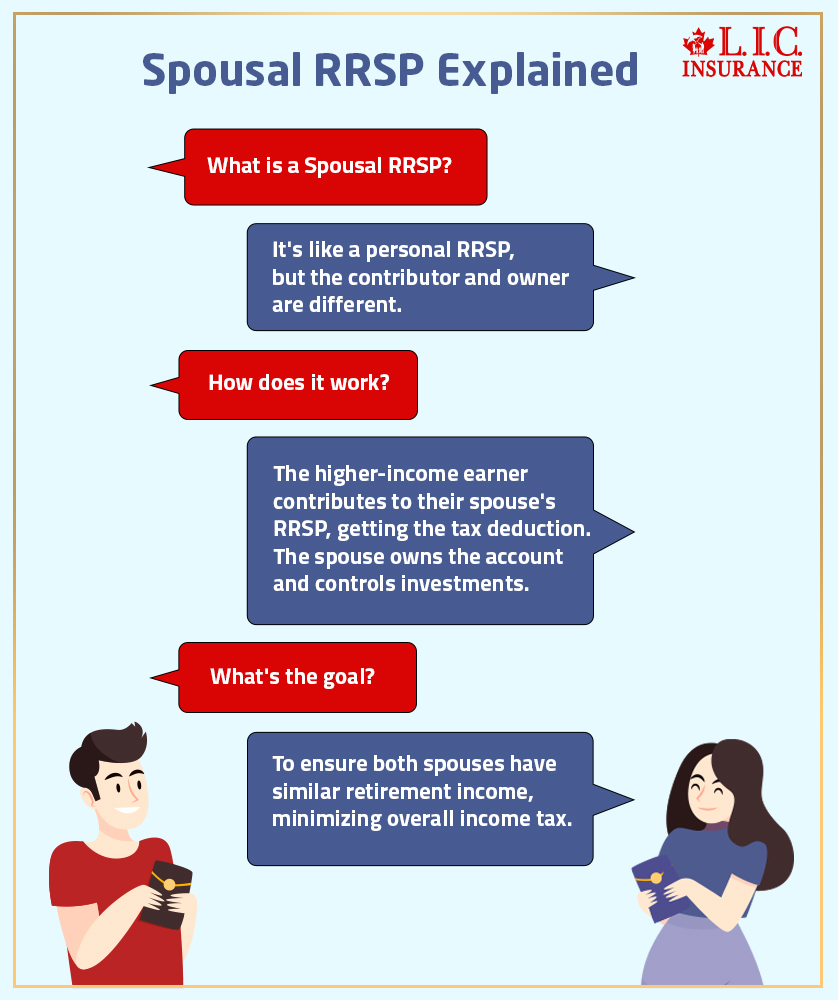
                At What Age Should You Stop Contributing to RRSP?

                Getting insurance on your own can be very risky and challenging compared to buying a car or a home. There are so many things to consider, and that’s why you should consider hiring a professional insurance broker. They can help you choose the right policy and coverage for that policy. However, the question here would be, how can you

                At What Age Should You Stop Contributing to RRSP?

                By Pushpinder Puri, December 14, 2023, 7 Minutes

                At What Age Should You Stop Contributing to RRSP?

                The RRSP (Registered Retirement Savings Plan) isn’t just an account—it’s your secret weapon for securing a brighter financial future. It’s like planting little money seeds that grow into a comfy bundle of cash for when you stop working. But here’s the thing: figuring out when to press pause on these contributions? That’s the puzzle we’re here to solve.

                Imagine your RRSP as a treasure chest where every contribution is a gold coin. Each coin adds up over time, turning into a chest full of opportunities for a comfortable retirement. But at some point, you might wonder, “Should I stop tossing coins into this treasure chest?”

                That’s where the roadmap to your financial future begins. It’s like planning a journey—deciding when to take that scenic pause and when to keep moving forward. And this journey isn’t just about RRSPs; it’s about having security for tomorrow. It’s about ensuring that your RRSP (Registered Retirement Savings Plan) isn’t just about retirement—it’s about weaving together a financial web of safety, kind of like a life insurance policy for your savings.

                So, think like this: you’re crafting a blueprint for life after 2024, and your RRSP is a key piece of that puzzle. It’s about making smart choices now that will let you relax and enjoy life later. Let’s jump into this puzzle to uncover the perfect timing to hit pause on those RRSP contributions.

                Understanding RRSP Contributions

                Understanding RRSP Contributions

                Remember, these age ranges are general considerations. The decision of when to stop contributing to your RRSP depends on various personal factors like financial goals, retirement plans, and income stability. Consulting a financial advisor can provide tailored advice for your specific situation.

                RRSP and its benefits

                Think of an RRSP as a supercharged piggy bank for your retirement. It’s a savings account that’s got a special perk—when you put money in, it’s like planting a money tree. This tree grows tax-free until you’re ready to pluck its fruits in retirement. The best part? It’s not just about saving money; it’s about making it grow.

                Life after work might seem far away, but an RRSP is like a cozy blanket for your future. It’s not just about tucking money away; it’s about letting it grow big and strong. And here’s the secret: your contributions aren’t just sitting idle; they’re out there, working hard, earning interest, and building a nest that’ll keep you comfy after 2024.

                How Registered Retirement Savings Plan contributions affect taxes and retirement savings

                Alright, here’s the cool part—RRSP contributions aren’t just about saving money for a rainy day; they’re about keeping more money in your pocket right now. When you put your hard-earned cash into an RRSP, it’s like doing a magic trick with taxes. You get to shrink the amount of income that gets taxed today, which means you pay less to the tax folks. It’s like giving yourself a little bonus!

                But wait, there’s more! Remember that money tree we talked about? Well, it’s not just growing tax-free; it’s growing faster because you’re not paying taxes on the gains. That’s more money in your pocket when you’re ready to kick back and relax.

                Importance of consistent contributions over time

                Okay, here’s the secret ingredient to making your RRSP (Registered Retirement Savings Plan) magic work: consistency. It’s not about tossing a big bag of money in and calling it a day; it’s about planting those seeds regularly. Every time you contribute, it’s like giving your money a little boost, and those boosts add up big time.

                Consistency is key, my friend. Even if it’s just a small contribution, it’s like adding fuel to the fire, making your retirement fund grow bigger and brighter. It’s like setting the stage for a comfy life after 2024—making sure your RRSP is there, shining like a lamp of financial security.

                Remember, an RRSP isn’t just a savings account; it’s a lifeline for your future. It’s about making smart choices now so you can relax and enjoy life later. It’s about securing your savings, almost like having a life insurance policy for your retirement plans. So, keep those contributions coming, and watch your future blossom!

                Find out more on RRSP and reasons to make RRSP investments

                Factors Influencing the Decision

                Age-related considerations:

                Early vs. later contributions: Impact on growth

                Alright, let’s talk about timing! Contributing to your RRSP early is like planting seeds in fertile soil. The sooner you start, the more time your money has to grow. It’s like giving your retirement savings a head start, and trust us, time is your best friend here. Even small contributions early on can sprout into substantial life savings, thanks to the magic of compound interest.

                But hey, if you’re late and still need to jump on the RRSP train, don’t sweat it. You can still start now. Sure, you might miss out on some of that early growth, but every little bit counts. The key is to start as soon as you can and let time work its magic.

                Contribution limits and room for growth

                Now, here’s a little something to keep in mind—there’s a limit to how much you can put into your RRSP (Registered Retirement Savings Plan) each year. It’s like a savings sandbox with boundaries. The government sets these limits and can change, so keeping tabs on them is essential.

                But don’t worry; even with these limits, there’s room for your money to stretch its legs. You can explore other investment avenues if you’ve maxed out your contributions. Think of it as diversifying your savings garden—planting different seeds in different pots to ensure your retirement garden grows lush and green.

                Contribution limits and room for growth

                Life’s a rollercoaster, especially when it comes to finances. Your income might shoot up like a skyrocket one year and take a dip the next. That’s where financial circumstances come into play. You’ve got to consider these twists and turns when deciding how much to put into your RRSP.

                If your income fluctuates, it might affect how much you can comfortably put aside in your RRSP. It’s about finding that sweet spot—contributing enough without straining your finances. And here is the place where that life insurance piece fits in. It’s like a safety cushion for your savings. If unexpected bumps come along, having a safety cushion can make sure your retirement plans stay on track.

                Saving for retirement after 2024 isn’t just about crunching numbers; it’s about adapting to life’s changes. It’s about being flexible with your contributions and ensuring your savings stay secure, almost like having a guardian angel for your retirement dreams. So, consider your age, keep an eye on those contribution limits, and adapt to life’s financial rollercoaster—your future self will thank you!

                Evaluating Retirement Goals

                Retirement lifestyle expectations:

                Assessing the desired lifestyle post-retirement:

                Think this out: lounging on a beach, pursuing hobbies, or travelling the world—that’s your retirement dream, right? Well, assessing your desired lifestyle after 2024 is crucial. Do you aim for a simple, relaxed life or a more extravagant one? Knowing this helps gauge how much you’ll need in your RRSP to fund that dream.

                Estimating retirement expenses:

                Let’s talk numbers! Retirement isn’t just about fun and games; it’s about expenses, too. Consider housing, food, travel, and entertainment. Don’t forget those sneaky expenses like healthcare, which can add up. Estimating these expenses helps set a savings target for your RRSP.

                Health and longevity considerations

                Factoring in potential healthcare costs:

                Healthcare can be a big-ticket expense post-retirement. It’s vital to factor in potential healthcare costs from routine check-ups to unexpected medical emergencies. Your RRSP isn’t just for sipping cocktails on a beach; but RRSP is a lifeline for potential healthcare expenses, too.

                Longevity risk and financial planning:

                Life is full of surprises, and longevity is one of them. Longevity risk means living longer than expected, which is great, but it can strain your finances. Imagine your RRSP as a financial safety guard, ensuring you’re financially equipped for those extra golden years.

                Planning for retirement in 2024 isn’t just about dreamy beach days; it’s about the essentials, too. It’s about painting a realistic picture of your future lifestyle and being prepared for whatever life throws at you. Your RRSP isn’t just a savings plan; but RRSP is your partner in crafting a secure and fulfilling post-retirement life. It’s like having a financial toolkit ready for any situation that may arise—making sure your retirement dreams become a reality. So, envision your dream retirement, calculate those expenses, consider your health needs, and plan for a longer, fulfilling life after 2024. Your RRSP isn’t just a savings account; it’s your passport to the retirement you’ve always imagined.

                Strategies for Optimizing RRSP Contributions

                Contribution strategies for different life stages

                Early career vs. mid-career vs. pre-retirement:

                Let’s talk about timing! Early career, mid-career, or nearing retirement—each stage has its own RRSP game plan. In the early career phase, you’ve got time on your side. Even putting in just a little money can grow into a big bunch for your retirement. Mid-career? Try boosting those contributions as your income grows. Pre-retirement? Keep an eye on maximizing savings and consider catch-up contributions to shore up your RRSP.

                Maximizing tax benefits while contributing:

                Tax time can be friendlier with RRSP contributions. It’s like a double win—saving for the future and paying less tax now. Aim to contribute enough to snag those tax benefits, but be mindful of contribution limits to make the most of those tax perks.

                Diversification and alternative retirement savings

                Exploring other retirement savings vehicles:

                Your RRSP isn’t the only player in the retirement game. There are other avenues like Tax-Free Savings Accounts (TFSAs) or workplace pension plans. Each has its perks, so exploring these options can diversify your savings. It’s like having a retirement buffet—choose what suits your appetite!

                Balancing RRSP contributions with other investments:

                See this: a financial juggling act. It’s not just about dumping everything into your RRSP. Consider spreading your savings across different investment baskets. Balancing RRSP contributions with other investments ensures a diversified portfolio.

                Planning for retirement in 2024 isn’t just about putting money away; it’s about playing the long game smartly. It’s about knowing when to put your foot down on contributions and when to diversify your financial garden. Your RRSP isn’t just a savings account; it’s your partner in crafting a secure and fulfilling post-retirement life. It’s like having a financial toolkit ready for any situation that may arise—making sure your retirement dreams become a reality. So, embrace those different life stages, maximize tax perks, explore diverse savings options, and create a balanced investment plan. Your RRSP isn’t just a savings account; it’s your passport to the retirement you’ve always imagined.

                Deciding the Ideal Age to Stop RRSP Contributions

                Analyzing retirement readiness

                Assessing retirement savings and income sources:

                Let’s take stock of your retirement toolbox. Calculate how much you’ve put aside in your RRSP and other savings pots. Consider any potential income sources post-retirement, like pensions or government benefits. It’s like ensuring you have enough ingredients for the recipe for a comfy retirement after 2024.

                Considering potential sources of income in retirement:

                Your RRSP isn’t the lone star in your retirement galaxy. Think about other income sources—maybe rental properties, part-time gigs, or even a side hustle. These can supplement your RRSP and contribute to a more financially robust retirement plan.

                Impact of continuing vs. halting RRSP contributions

                Pros and cons of extending contributions:

                Alright, it’s decision time! Continuing those RRSP contributions?

                It can make your retirement savings bigger, making sure you have more money saved up for when you stop working. But there’s a flip side, too—contributing might mean less cash flow for present needs. It’s a balancing act between present comfort and future security.

                Benefits of redirecting savings to other investments:

                Halting RRSP contributions doesn’t mean the end of the road. Redirecting those savings into other investments can diversify your portfolio. Think about it like planting different crops; each has its season to grow and flourish. You’re spreading the risk and potential rewards by exploring other investment avenues.

                Deciding when to put the brakes on your RRSP contributions is a challenging choice. It’s about weighing your retirement readiness, considering your income sources, and balancing the pros and cons. Your RRSP isn’t just a savings account; it’s your partner in crafting a secure and fulfilling post-retirement life. So, assess your retirement toolbox, explore various income sources, weigh the pros and cons of continuing contributions, and consider redirecting savings.

                Get The Best Insurance Quote From Canadian L.I.C

                Call 1 844-542-4678 to speak to our advisors.

                Best Insurance Plans Helpline From Canadian L.I.C

                Conclusion

                Figuring out when to stop putting money into your RRSP is different for everyone. It’s a personal journey influenced by various factors. Consultation with insurance experts can provide tailored advice to align your retirement goals with your financial strategy, ensuring a secure and comfortable future.

                Ultimately, planning for retirement involves understanding the nuances of RRSP contributions, balancing current financial circumstances with future aspirations, and making informed decisions along the way.

                Get The Best Insurance Quote From Canadian L.I.C

                Call 1 844-542-4678 to speak to our advisors.

                Faq's

                There’s no one-size-fits-all answer. It depends on various factors like your retirement goals, financial situation, and other income sources. Assessing these factors helps determine the right time for you.

                You can contribute to your RRSP until the year you turn 71. However, it’s essential to consider if contributing after retirement aligns with your financial goals and tax situation.

                You can over-contribute up to a certain limit without facing penalties. However, exceeding the limit significantly may result in tax penalties, so monitoring your contributions is crucial.

                Not necessarily. Your RRSP can still play a vital role in your retirement plan, even if you have other savings. Assess the tax advantages and growth potential before making a decision.

                Yes, it is possible to withdraw money. You can withdraw funds from your RRSP after retirement. However, these withdrawals are considered taxable income and may impact your taxes in the year of withdrawal.

                Life insurance can complement your retirement plan by providing financial security for your loved ones. It’s important to understand how life insurance fits into your overall retirement strategy.

                Generally, you can’t directly use RRSP funds to buy life insurance. However, you can name a beneficiary, such as a spouse or child, who can receive the RRSP funds tax-free upon your passing.

                It is all dependent on your financial goals and risk tolerance. Diversifying your investments, including RRSPs and other options, is often recommended for a balanced retirement portfolio.

                The above information is only meant to be informative. It comes from Canadian LIC’s own opinions, which can change at any time. This material is not meant to be financial or legal advice, and it should not be interpreted as such. If someone decides to act on the information on this page, Canadian LIC is not responsible for what happens. Every attempt is made to provide accurate and up-to-date information on Canadian LIC. Some of the terms, conditions, limitations, exclusions, termination, and other parts of the policies mentioned above may not be included, which may be important to the policy choice. For full details, please refer to the actual policy documents. If there is any disagreement, the language in the actual policy documents will be used. All rights reserved.

                Please let us know if there is anything that should be updated, removed, or corrected from this article. Send an email to Contact@canadianlic.com or Info@canadianlic.com

                How Much Do I Need to Retire in Canada?

                Retirement is a significant milestone in one’s life, representing the culmination of years of hard work and financial planning. For those planning to retire in Canada, determining how much money is needed for a comfortable retirement is a crucial question. The answer varies depending on various factors, including your lifestyle, location, retirement age, and financial goals. In this comprehensive guide, we will delve into the key considerations and calculations to help you estimate how much you need to retire in Canada.

                How Much Do I Need to Retire in Canada?

                By Pushpinder Puri, October 25, 2023, 8 Minutes

                How Much Do I Need to Retire in Canada

                Retirement is a significant milestone in one’s life, representing the culmination of years of hard work and financial planning. For those planning to retire in Canada, determining how much money is needed for a comfortable retirement is a crucial question. The answer varies depending on various factors, including your lifestyle, location, retirement age, and financial goals. In this comprehensive guide, we will delve into the key considerations and calculations to help you estimate how much you need to retire in Canada.

                The Basics of Retirement Planning in Canada

                Retirement planning in Canada is a multifaceted endeavour that involves setting financial goals, assessing your current financial situation, and creating a roadmap to achieve those goals. Here are some fundamental steps to get started:

                Determining Your Retirement Age

                One critical decision in retirement planning is determining your retirement age. The age at which you choose to retire has a significant impact on how much you need to save. In Canada, the standard retirement age for receiving full Old Age Security (OAS) and Canada Pension Plan (CPP) benefits is currently 65. However, you can choose to retire earlier or later based on your preferences and financial circumstances.

                Estimating Your Retirement Expenses

                To determine how much you need to retire comfortably, you must estimate your retirement expenses. These expenses can be categorized into essential and discretionary:

                To estimate your expenses accurately, consider factors like inflation, potential healthcare costs, and any existing debts that need to be paid off before retirement.

                Sources of Retirement Income

                Sources of Retirement Income

                In Canada, retirees typically rely on a combination of income sources to fund their retirement lifestyle. Understanding these sources is crucial when calculating how much you need to retire comfortably:

                Government Benefits:

                The Canadian government provides several retirement benefits, including the Old Age Security (OAS) and the Canada Pension Plan (CPP). The amount you receive depends on factors like your years of contribution and retirement age.

                Employer Pensions:

                If you have a workplace pension plan, it will provide a reliable source of retirement income. The amount you receive depends on your salary, years of service, and the plan’s terms.

                Personal Savings:

                Personal savings, including Registered Retirement Savings Plans (RRSPs) and Tax-Free Savings Accounts (TFSAs), play a significant role in retirement planning. These accounts allow you to save and invest money tax-efficiently.

                Investments:

                Investments such as stocks, bonds, and mutual funds can generate income through dividends, interest, and capital gains. Proper investment planning is essential to ensure a steady income stream.

                Other Income Sources:

                Consider any other sources of income you may have in retirement, such as rental income, part-time work, or business income.

                Life insurance is another source of retirement income to take into account. Although a lot of individuals primarily consider pensions as a way to support their families when they pass away, they can also be used to supplement retirement income.

                If you want to use life insurance for retirement, your options include whole life or universal life. Both are types of permanent life insurance, which means the protection is lifelong in nature. They also develop cash value, which can be accessed whenever you like and increases tax-deferred.

                Cash value only becomes taxable upon withdrawal because it grows tax-deferred. If you use it after retirement, your tax burden will likely be lower because your taxable income will be smaller than it is now.

                By surrendering your policy, you might get cash value all at once or in monthly installments. Only people under the age of 45 should consider using life insurance as a vehicle for retirement planning because cash value growth doesn’t accelerate until after 10 to 15 years.

                Cash value from whole life insurance accrues interest at a certain rate set by the insurer. In contrast, with universal life insurance, the pace of cash value growth is not fixed. The performance of the metrics of the sub-accounts that are linked to it can also affect the cash value growth rate.

                Calculating Your Retirement Savings Goal

                To estimate how much you need to retire in Canada, you can follow these steps:

                For example, if your income gap is $20,000 per year and your chosen withdrawal rate is 4%, your savings goal would be $500,000.

                Get The Best Insurance Quote From Canadian L.I.C

                Call 1 844-542-4678 to speak to our advisors.

                Best Insurance Plans Helpline From Canadian L.I.C

                Investment Strategies for Retirement

                As you approach retirement, your investment strategy may shift from wealth accumulation to income generation and capital preservation. Here are some investment strategies to consider:

                Tax Considerations in Retirement

                Understanding the tax implications of your retirement income is essential for effective retirement planning. Key tax considerations include:

                Adjusting Your Retirement Plan Over Time

                Your retirement plan is not static; it should evolve as your circumstances change. Here are some considerations for adjusting your retirement plan:

                Get The Best Insurance Quote From Canadian L.I.C

                Call 1 844-542-4678 to speak to our advisors.

                Retirement Saving Rules

                Let’s explore how these retirement saving rules can be applied in the context of Canada:

                The 50/30/20 Rule:

                The 50/30/20 rule is a budgeting guideline that can be adapted for retirement savings in Canada. Here’s how you can apply it:

                50% for Needs: Dedicate 50% of your income to cover essential expenses, including housing, utilities, groceries, healthcare, and transportation. This ensures you can maintain a comfortable lifestyle during retirement.

                30% for Wants: Allocate 30% of your income to discretionary spending, which includes non-essential expenses like dining out, entertainment, and travel. Reducing these expenses during retirement can free up funds for savings.

                20% for Savings: Reserve at least 20% of your income for retirement savings. This includes contributions to retirement accounts like RRSPs (Registered Retirement Savings Plans) and TFSAs (Tax-Free Savings Accounts).

                Adhering to this rule can help you balance your current lifestyle with your retirement savings goals.

                Savings by Age (As a Multiplier of Income) Rule:

                The “Savings by Age” rule provides a rough guideline for how much you should aim to have saved for retirement at various stages of your life. In Canada, the rule can be adapted as follows:

                By Age 30: Target savings equivalent to about 1 times your annual income. For example, if your annual income is $50,000, aim to have saved around $50,000 for retirement.

                By Age 40: Strive to have savings of about 3 times your annual income. With an income of $60,000, this would mean having around $180,000 saved.

                By Age 50: Aim for savings of about 6 times your annual income. With an income of $70,000, this would translate to approximately $420,000 in retirement savings.

                By Age 60: Target savings of approximately 8 times your annual income. If your income is $80,000, aim for savings of around $640,000.

                These multipliers can serve as benchmarks, but remember that individual circumstances, such as lifestyle, retirement goals, and investment returns, can significantly impact your actual savings needs.

                Years Multiplied by Annual Expenses Rule:

                The “Years Multiplied by Annual Expenses” rule is a useful way to estimate your retirement savings requirements in Canada:

                Keep in mind that these rules offer simplified guidance and should be adapted to your specific circumstances. Consulting with a financial advisor and using retirement planning tools can provide a more personalized and accurate retirement savings strategy tailored to the Canadian context. Additionally, consider the impact of government programs like the Canada Pension Plan (CPP) and Old Age Security (OAS) in your retirement planning.

                Wrapping It Up

                Planning for retirement in Canada requires careful consideration of your lifestyle, financial goals, and income sources. You can work towards a comfortable and financially secure retirement by estimating your retirement expenses, calculating your savings goal, and crafting an investment strategy. Keep in mind that retirement planning is an ongoing process that should adapt to your changing circumstances and financial landscape. With prudent financial management and a clear retirement plan, you can look forward to enjoying your retirement years with peace of mind.

                Faq's

                Ideally, you should start planning for retirement as early as possible. Many financial experts recommend beginning in your 20s or 30s. The earlier you start saving and investing, the more time your money has to grow, potentially resulting in a more substantial retirement fund.

                Life expectancy can vary among individuals. You can use general statistics for Canadians, but it’s often more accurate to consider your family’s health history and your own lifestyle choices. A financial advisor can help you make a reasonable estimate.

                While government pension benefits can be a significant part of your retirement income, they are typically not sufficient to maintain your desired lifestyle in retirement. It’s advisable to supplement these benefits with personal savings, investments, and possibly employer pensions.

                The amount you should contribute to your RRSP depends on your income, tax situation, and retirement goals. The Canada Revenue Agency (CRA) sets annual RRSP contribution limits based on your income. A financial advisor can help you determine an appropriate contribution strategy.

                RRSPs allow you to contribute pre-tax income and defer taxes until withdrawal, making them tax-advantageous if you expect to be in a lower tax bracket in retirement. TFSAs, on the other hand, use after-tax contributions but offer tax-free growth and withdrawals, making them flexible for various financial goals, including retirement.

                Yes, it’s possible to retire early in Canada (as early as age 55), but it may result in reduced government pension benefits, such as OAS and CPP. Consider how early retirement may affect your overall retirement income and plan accordingly.

                To account for inflation, you can use a rule of thumb that assumes an average annual inflation rate of around 2-3%. Adjust your projected expenses for each year of your retirement accordingly to maintain your purchasing power.

                Investment strategies for retirement should balance growth and preservation of capital. This often involves a diversified portfolio that includes stocks, bonds, and other asset classes. Your asset allocation should reflect your risk tolerance and time horizon.

                Yes, Canada offers programs like the Canada Pension Plan (CPP), Old Age Security (OAS), and the Guaranteed Income Supplement (GIS) to provide financial support in retirement. Additionally, there are incentives like RRSPs and TFSAs that offer tax benefits for retirement savings.

                Creating a retirement budget involves estimating your expenses and matching them to your retirement income. Tracking your spending, having a buffer for unexpected expenses, and periodically reviewing and adjusting your budget can help you stay on track in retirement.

                The above information is only meant to be informative. It comes from Canadian LIC’s own opinions, which can change at any time. This material is not meant to be financial or legal advice, and it should not be interpreted as such. If someone decides to act on the information on this page, Canadian LIC is not responsible for what happens. Every attempt is made to provide accurate and up-to-date information on Canadian LIC. Some of the terms, conditions, limitations, exclusions, termination, and other parts of the policies mentioned above may not be included, which may be important to the policy choice. For full details, please refer to the actual policy documents. If there is any disagreement, the language in the actual policy documents will be used. All rights reserved.

                Please let us know if there is anything that should be updated, removed, or corrected from this article. Send an email to Contact@canadianlic.com or Info@canadianlic.com

                What Is RRSP & Reasons to Make RRSP Investments?

                When it comes to planning for a secure and comfortable retirement, Canadians have a valuable tool at their disposal: the Registered Retirement Savings Plan, or RRSP. RRSPs are a cornerstone of the Canadian retirement savings landscape, offering numerous benefits and incentives for individuals to save and invest for their golden years. So, let us understand what an RRSP is and the compelling reasons why investing in RRSPs should be an essential part of your financial plan.

                What Is RRSP & Reasons to Make RRSP Investments?

                By Harpreet Puri,October 19, 2023, 8 Minutes

                What Is RRSP & Reasons to Make RRSP Investments?

                When it comes to planning for a secure and comfortable retirement, Canadians have a valuable tool at their disposal: the Registered Retirement Savings Plan, or RRSP. RRSPs are a cornerstone of the Canadian retirement savings landscape, offering numerous benefits and incentives for individuals to save and invest for their golden years. So, let us understand what an RRSP is and the compelling reasons why investing in RRSPs should be an essential part of your financial plan.

                Understanding RRSPs

                A Registered Retirement Savings Plan (RRSP) is a government-approved tax-advantaged account designed to help Canadians save for their retirement. It allows individuals to contribute a portion of their income to the plan, reducing their taxable income for the year of contribution. The funds within the RRSP can then be invested in a wide range of financial instruments, such as stocks, bonds, mutual funds, Guaranteed Investment Certificates (GICs), and more. These investments grow tax-deferred until they are withdrawn during retirement.

                Read More – Information on RRSP’s

                How to set up an RRSP?

                Setting up a Registered Retirement Savings Plan (RRSP) in Canada involves several simple steps. Here’s a guide to help you get started:

                Check Your Eligibility:

                Ensure that you meet the eligibility criteria for an RRSP, including being a Canadian resident for tax purposes, having earned income, and being within the contribution age limits.

                Choose an RRSP Provider:

                Decide where you want to open your RRSP. You can choose from banks, credit unions, investment firms, mutual fund companies, insurance companies, or online brokerages. Research and compare fees, investment options, and customer service to find the provider that suits your needs.

                Gather Required Documents:

                You will need your Social Insurance Number (SIN) and other personal identification documents to set up your RRSP.

                Open Your RRSP Account:

                Contact your chosen RRSP provider and request to open an RRSP account. You can typically do this online, over the phone, or in person at a branch or office.

                Choose Your Investments:

                Once your RRSP account is open, you’ll need to decide how to invest your contributions. RRSPs offer a wide range of investment options, including stocks, bonds, mutual funds, Guaranteed Investment Certificates (GICs), and more. Your choice should align with your risk tolerance and long-term financial goals.

                Set Up Contributions:

                Determine how much you want to contribute to your RRSP and how frequently. You can make one-time lump-sum contributions or set up automatic contributions. Be mindful of your annual RRSP contribution limit, which is determined by your previous year’s earned income and reported on your Notice of Assessment from the Canada Revenue Agency (CRA).

                Monitor and Adjust:

                Regularly review your RRSP investments to ensure they align with your financial goals and risk tolerance. Adjust your portfolio as needed over time.

                Maximize Tax Benefits:

                Keep track of your RRSP contributions to maximize tax deductions. Ensure that you contribute to your RRSP before the annual deadline, typically March 1st of the following year (often referred to as the “RRSP deadline”), to claim deductions on your tax return for the current year.

                Plan for Retirement Withdrawals:

                As you approach retirement, consider your withdrawal strategy. You can choose to convert your RRSP into a Registered Retirement Income Fund (RRIF) or purchase an annuity to receive regular income during retirement. Be aware that mandatory RRIF withdrawals begin at age 72.

                Stay Informed:

                Keep yourself informed about changes in RRSP rules and contribution limits, as these may evolve over time. Consult with a financial advisor like Canadain LIC for personalized guidance on your RRSP and retirement planning.

                Remember that RRSPs are designed for long-term retirement savings, and early withdrawals may result in tax consequences and the loss of contribution room. Consult with Canadian LIC today to ensure that your RRSP strategy aligns with your financial goals and overall retirement plan.

                When can I withdraw my RRSP?

                In Canada, you can withdraw funds from your Registered Retirement Savings Plan (RRSP) under certain circumstances. However, some specific rules and considerations govern when and how you can make withdrawals:

                Age 71: The latest age at which you can hold an RRSP is 71. By the end of the year in which you turn 71, you must convert your RRSP into an income-producing vehicle. You have several options:

                Registered Retirement Income Fund (RRIF): You can transfer your RRSP funds into an RRIF, which provides you with regular, taxable income. There are mandatory annual minimum withdrawals from an RRIF, and these minimums are determined based on your age.

                Life Annuity: You can use your RRSP to purchase a life annuity from a financial institution. The annuity will provide you with regular payments for life, regardless of how long you live. Note that annuity payments are generally taxable.

                Lump-Sum Withdrawal: You can choose to withdraw all the funds in your RRSP as a lump sum. However, this option will result in significant tax consequences, as the full withdrawal will be treated as taxable income in the year it is taken.

                Home Buyers’ Plan (HBP): You can withdraw up to $35,000 from your RRSP to use as a down payment on your first home through the Home Buyers’ Plan (HBP). This withdrawal must be repaid to your RRSP over a 15-year period to avoid tax penalties.

                Lifelong Learning Plan (LLP): Under the Lifelong Learning Plan (LLP), you can withdraw up to $20,000 from your RRSP to finance eligible educational expenses for yourself or your spouse or common-law partner. Like the HBP, the amount must be repaid over time.

                Financial Hardship: In cases of severe financial hardship, you may be able to make early withdrawals from your RRSP through the Home Buyers’ Plan (HBP) or Lifelong Learning Plan (LLP), even if you don’t meet the usual criteria. Consult the CRA for specific guidelines.

                It’s important to note that withdrawals from your RRSP are generally considered taxable income in the year you make the withdrawal. This means that you’ll need to include the withdrawal amount on your income tax return and pay any applicable taxes. However, some exceptions apply, such as withdrawals made under the HBP or LLP, which are not subject to withholding tax.

                Before making any RRSP withdrawals, it’s advisable to consult with Canadian LIC to understand the tax implications, withdrawal limits, and repayment requirements associated with your specific situation. Proper planning can help you make informed decisions about when and how to access your RRSP savings while optimizing your retirement income and minimizing tax liabilities.

                Do you have to live in Canada to contribute to RRSP?

                No, you do not have to live in Canada to contribute to an RRSP (Registered Retirement Savings Plan). The primary eligibility requirement for contributing to an RRSP is that you must have eligible earned income in Canada. Earned income includes various types of income derived from employment, self-employment, rental income, and specific other sources.

                Here are some key points to consider regarding RRSP contributions for non-residents:

                Eligible Earned Income: To contribute to an RRSP, you must have eligible earned income in Canada. Passive income, such as investment earnings or rental income from outside Canada, does not count as earned income for RRSP contribution purposes.

                Unused Contribution Room: If you were a Canadian resident in previous years and accumulated an RRSP contribution room but are now a non-resident, you can still use your unused contribution room to make contributions when you return to Canada as a resident.

                Tax Deductibility: Contributions made while you are a non-resident may not be tax-deductible in Canada since you may not have Canadian taxable income against which to claim the deduction. However, if you return to Canada and become a resident, you can carry forward your contributions and claim the deduction in future years when you have taxable income.

                Overcontributions: Be cautious not to overcontribute your RRSP, as this can result in penalties. The Canada Revenue Agency (CRA) allows a lifetime overcontribution limit of $2,000 without penalties, but any excess contributions may be subject to a 1% per month penalty tax.

                Tax Treaty Considerations: Depending on your country of residence, you should also consider any tax treaties between Canada and your country, as they may impact the taxation of your RRSP contributions and withdrawals.

                Consult with a Tax Professional: Given the complexity of tax laws and the potential implications of RRSP contributions for non-residents, it’s advisable to consult with a professional or advisor like Canadian LIC to ensure that you meet all legal requirements and make informed decisions regarding your RRSP.

                Non-residents who have eligible earned income in Canada can contribute to an RRSP, but there may be tax implications and limitations to consider. Consulting with a tax professional is recommended to navigate the complexities of RRSP contributions as a non-resident and to ensure compliance with Canadian tax laws.

                What happens to an RRSP if you leave Canada?

                If you leave Canada permanently or become a non-resident for tax purposes, your Registered Retirement Savings Plan (RRSP) does not need to be closed, but it will undergo specific tax and reporting changes. Here’s what happens to your RRSP when you leave Canada:

                Tax Implications:

                As a non-resident of Canada, you will be subject to a 25% withholding tax on most RRSP withdrawals, including both lump-sum withdrawals and periodic payments. This withholding tax is applied to ensure that non-residents pay their Canadian tax liability upfront when they access their RRSP funds.

                No New Contributions:

                Once you are no longer a Canadian resident, you generally cannot contribute to your existing RRSP. Contributions made by non-residents may not be tax-deductible in Canada.

                Reporting to the CRA:

                When you become a non-resident, you are required to notify the Canada Revenue Agency (CRA) of your change in residency status by filing a departure tax return. This return helps determine your final tax obligations, including any taxes owed on the deemed disposition of certain assets, such as real estate and some investments.

                Options for RRSP Funds:

                             You have several options for your RRSP funds when you leave Canada: 

                Leave the RRSP Intact: You can leave your RRSP intact and continue to manage your investments from abroad. You will be subject to withholding tax on withdrawals. 

                Convert to a Registered Retirement Income Fund (RRIF): If you are over the age of 71, you can convert your RRSP into an RRIF and receive regular, taxable withdrawals. Withholding tax applies. 

                De-register and Withdraw: You can choose to de-register your RRSP and withdraw the funds. Withholding tax will apply, and you may have tax obligations in your new country of residence.

                Reporting to Foreign Tax Authorities: Depending on your new country of residence, you may need to report your RRSP and its income to tax authorities in that country. Tax treaties between Canada and your new country of residence can affect the taxation of RRSP withdrawals.

                Consult with a Tax Advisor: It’s highly advisable to consult with a tax advisor who is knowledgeable about cross-border tax issues when leaving Canada. They can help you navigate the tax implications, consider the tax treaties in place, and make informed decisions regarding your RRSP and other financial assets.

                Remember that the rules and tax treatment of RRSPs for non-residents may change over time, so it’s essential to stay updated on the latest regulations and consult with a tax professional to ensure compliance with tax laws in Canada and your new country of residence.

                Get The Best Insurance Quote From Canadian L.I.C

                Call 1 844-542-4678 to speak to our advisors.

                Best Insurance Plans Helpline From Canadian L.I.C

                Can you withdraw from RRSP from outside Canada?

                Yes, you can withdraw funds from your Registered Retirement Savings Plan (RRSP) from outside Canada. However, there are specific rules and tax considerations to keep in mind when making RRSP withdrawals while residing outside of Canada:

                You can withdraw funds from your RRSP from outside Canada, but there are withholding tax obligations and tax considerations to address. Consult with a tax professional to understand the specific tax treatment, reporting requirements, and potential tax implications associated with your RRSP withdrawals based on your unique situation.

                How to claim your RRSP deduction

                Claiming your RRSP (Registered Retirement Savings Plan) deduction in Canada involves several steps, and it’s essential to ensure accurate reporting to maximize your tax benefits. Here’s how to claim your RRSP deduction:

                Determine Your RRSP Contribution Room:

                Review your most recent Notice of Assessment from the Canada Revenue Agency (CRA) to determine your available RRSP contribution room for the tax year. Your contribution room is based on your earned income and unused contribution room from previous years.

                Contribute to Your RRSP:

                Make eligible contributions to your RRSP account before the annual RRSP contribution deadline, which is typically March 1st of the following year (e.g., contributions for the 2022 tax year must be made by March 1, 2023). You can contribute to your RRSP at any time during the year, but contributions made within the first 60 days of the new year can be claimed as a deduction for the previous tax year.

                Keep Records:

                Maintain detailed records of your RRSP contributions, including contribution amounts, dates, and the financial institution where you made the contributions.

                File Your Tax Return:

                Complete your income tax return for the tax year in which you made RRSP contributions. You can file your return online or on paper.

                Report RRSP Contributions:

                On your tax return, report your RRSP contributions in the appropriate section. In the case of paper returns, use Schedule 7, “RRSP and PRPP Unused Contributions, Transfers, and HBP or LLP Activities,” to calculate your allowable RRSP deduction.

                Calculate Your Deduction Limit:

                Calculate the amount of your RRSP deduction limit for the year. This limit is generally 18% of your previous year’s earned income, up to a maximum limit set by the CRA. You can find this limit on your Notice of Assessment or by using the CRA’s My Account online service.

                Claim the Deduction:

                On your tax return, enter the amount you want to claim as an RRSP deduction up to your RRSP deduction limit for the year. The deduction reduces your taxable income for the tax year, potentially resulting in a lower tax liability or a tax refund.

                Verify the Claim:

                Carefully review your tax return to ensure that you’ve correctly claimed your RRSP deduction. Double-check your calculations and make sure you haven’t exceeded your deduction limit.

                Submit Your Tax Return:

                If you’re filing your return electronically, follow the submission process for your chosen tax preparation software or service. If you’re filing a paper return, mail it to the appropriate CRA tax center.

                Receive Your Notice of Assessment:

                After the CRA processes your tax return, you will receive a Notice of Assessment, which confirms the amount of your RRSP deduction and any changes made to your return. Keep this document for your records.

                Don’t forget that claiming an RRSP deduction reduces your taxable income for the year, potentially resulting in a tax refund. It’s crucial to stay within your RRSP contribution limit to avoid penalties and to ensure that you’re making the most of your retirement savings. If you have complex financial situations or questions about your RRSP deductions, consider seeking advice from Canadian LIC today!

                RRSP Contribution Limits

                Your RRSP contribution limit is determined by a combination of factors, including your earned income, previous contributions, and the annual contribution limits set by the Canada Revenue Agency (CRA). Here are the key points to know about RRSP contribution limits:

                Get The Best Insurance Quote From Canadian L.I.C

                Call 1 844-542-4678 to speak to our advisors.

                Reasons to Make RRSP Investments

                Now, finally, after finding out so much about RRSPs, let’s delve into the compelling reasons why making RRSP investments should be a priority in your financial planning:

                Tax Advantages

                One of the most significant benefits of RRSP investments is the potential for immediate tax savings. When you contribute to your RRSP, the amount is deducted from your taxable income for that year. This can lead to a lower tax bill or even result in a tax refund, depending on your overall financial situation. By strategically maximizing your RRSP contributions, you can optimize your tax savings.

                Tax-Deferred Growth

                Inside your RRSP, your investments grow tax-deferred. This means that you won’t pay taxes on the capital gains, interest income, dividends, or other earnings generated by your investments until you withdraw the funds. This tax-deferral strategy can lead to significant long-term savings and allows your investments to compound more efficiently over time.

                Supplementing Pension Income

                RRSPs play a crucial role in supplementing pension income during retirement. For individuals who have employer-sponsored pension plans or government pensions like the Canada Pension Plan (CPP) and Old Age Security (OAS), RRSPs provide an additional source of retirement income. This supplementary income can help you maintain your desired lifestyle and cover expenses in retirement.

                Retirement Planning Flexibility

                RRSPs offer flexibility in retirement planning. You can choose when and how you want to receive income from your RRSP. Whether you convert it into a Registered Retirement Income Fund (RRIF), purchase an annuity, or take periodic withdrawals, you have options to structure your retirement income in a way that suits your financial goals and circumstances.

                Income Splitting

                Spousal RRSPs allow for income splitting in retirement. By contributing to a Spousal RRSP, you can provide your spouse or common-law partner with retirement income. This strategy can help equalize your retirement income and potentially reduce your overall tax liability in retirement.

                Homeownership

                The Home Buyers’ Plan (HBP) enables first-time homebuyers to withdraw up to $35,000 (or $70,000 for a couple) from their RRSP to use as a down payment on a home. This provision provides a tax-efficient way to fund your first home purchase while maintaining the long-term savings aspect of your RRSP.

                Lifelong Contributions

                Unlike other savings accounts, there is no age limit for contributing to an RRSP. As long as you have earned income, you can continue to contribute to your RRSP, even after the age of 71. This feature allows you to extend your retirement savings and optimize your financial security in your later years.

                Asset Diversification

                RRSPs offer a wide range of investment options, allowing you to diversify your portfolio to align with your risk tolerance and investment goals. You can hold various asset classes within your RRSP, including stocks, bonds, mutual funds, GICs, and more, creating a well-balanced investment strategy.

                Catching Up on Retirement Savings

                If you haven’t prioritized retirement savings earlier in your career, RRSPs offer a valuable opportunity to catch up. The contribution room accumulates over the years, allowing you to make larger contributions as your financial situation improves.

                Professional Guidance

                Navigating the complexities of RRSP investments can be challenging, especially when considering factors like asset allocation, investment selection, and retirement income planning. Seeking professional advice from a financial advisor or planner can help you make informed decisions, create a personalized retirement strategy, and maximize the benefits of your RRSP.

                Summary

                Registered Retirement Savings Plans (RRSPs) are a powerful tool for Canadians to save and invest for retirement while enjoying significant tax advantages and financial flexibility. By making RRSP investments a central part of your financial plan, you can benefit from immediate tax savings, tax-deferred growth, and a reliable source of retirement income. Whether you’re looking to reduce your current tax liability, supplement pension income, or achieve long-term financial security, RRSPs offer a comprehensive solution for your retirement needs. To make the most of your RRSP investments, schedule a meeting with Canadian LIC today, as they can provide personalized guidance and help you navigate the intricacies of retirement planning in Canada.

                The above information is only meant to be informative. It comes from Canadian LIC’s own opinions, which can change at any time. This material is not meant to be financial or legal advice, and it should not be interpreted as such. If someone decides to act on the information on this page, Canadian LIC is not responsible for what happens. Every attempt is made to provide accurate and up-to-date information on Canadian LIC. Some of the terms, conditions, limitations, exclusions, termination, and other parts of the policies mentioned above may not be included, which may be important to the policy choice. For full details, please refer to the actual policy documents. If there is any disagreement, the language in the actual policy documents will be used. All rights reserved.

                Please let us know if there is anything that should be updated, removed, or corrected from this article. Send an email to Contact@canadianlic.com or Info@canadianlic.com
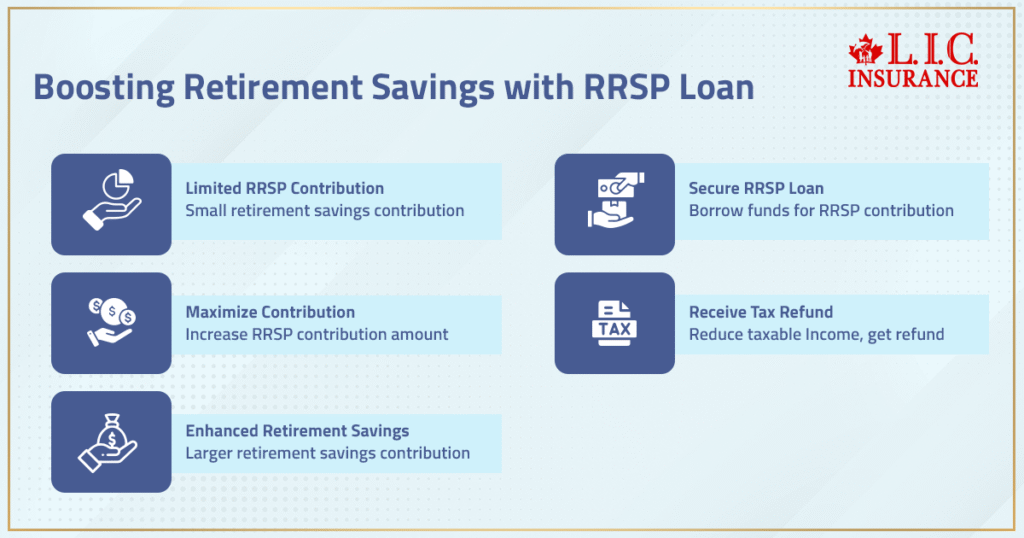
                Get a Comfortable Retirement Through a Registered Retirement Savings Plan

                Reaching your retirement age and worrying about how to make the best life after your retirement? A lot might be going on in your mind. But what if we tell you that there is a perfect solution that will instantly make everything easy for you, and that is a Registered Retirement Savings Plan with the help of which you can keep your pre-taxed income aside and invest in a lot of ways? Whatever growth you will achieve in your investments will not get taxed until you take it out when you retire or transfer it to RRIF (Registered Retirement Income Fund).

                So an RRSP is an easy and quick saving solution that is great for building long-term wealth. A Canadian RRSP is a very smart option for smooth retirement planning. In this article, we will learn about the Canadian Registered Retirement Savings Plan, its working process, why one should have it who is eligible for it, etc.

                Get a Comfortable Retirement Through a Registered Retirement Savings Plan (RRSP)

                By Canadian LIC, September 23, 2023, 8 Minutes

                Get a Comfortable Retirement Through a Registered Retirement Savings Plan (RRSP)

                Reaching your retirement age and worrying about how to make the best life after your retirement? A lot might be going on in your mind. But what if we tell you that there is a perfect solution that will instantly make everything easy for you, and that is a Registered Retirement Savings Plan with the help of which you can keep your pre-taxed income aside and invest in a lot of ways? Whatever growth you will achieve in your investments will not get taxed until you take it out when you retire or transfer it to RRIF (Registered Retirement Income Fund).

                So an RRSP is an easy and quick saving solution that is great for building long-term wealth. A Canadian RRSP is a very smart option for smooth retirement planning. In this article, we will learn about the Canadian Registered Retirement Savings Plan, its working process, why one should have it who is eligible for it, etc.

                What is an RRSP?

                A Registered Retirement Savings Plan is mainly a plan for your retirement. This savings and investment plan will be an income source when you retire and will no longer work. This plan drops your taxable income by allowing you to keep your pre-tax income aside. You can invest the money in your RRSP in mutual funds, stocks, bonds, and GICs.

                Till the time you are not withdrawing your money, the growth of your RRSP is protected from taxation. The best thing about RRSPs is they help you conveniently create long-term wealth compared to traditional savings accounts.

                Types of RRSPs

                Types of RRSPs in Canada

                You will find quite a number of Canadian Retirement Savings Plans in the market as per your decision of investment and risk tolerance levels; they can provide huge returns for your retirement savings. Mainly there are three types of RRSP’s. The most commonly known is an individual RRSP, but you might find spousal or group RRSPs interesting too. Let’s find out more about them.

                Individual RRSP: An individual RRSP account is registered in your name, providing you with all the tax benefits. This is the most flexible and common type of plan, and its tax benefits are totally yours. It is up to you whether you want to build your RRSP by yourself or want to take the help of an advisor. 

                Spousal RRSP: This type of RRSP is registered in your spouse’s name. Even though they own the investment, the contribution has to be yours. In the case of any contributions you make, you get tax deductions on it. Your own RRSP limit of deduction also gets reduced for about a year for any contributions you make. But the amount your spouse can contribute doesn’t get affected.

                You and your spouse can evenly divide your income at the time of retirement with the help of a spousal RRSP. With a combined RRSP, you will have to pay less income tax which would have been higher in the case if you had a separate RRSP for yourself. Going for a combined Registered Retirement Income Fund is beneficial in the case of having a higher income than your spouse, as the amount of income tax to be paid by you individually will be reduced greatly.

                The eligibility criteria for a spousal RRSP are as follows:

                In case your partner takes out the money you have contributed:

                You will have to pay the tax on the amount withdrawn within three years of the contribution date. Your spouse will have to pay tax when the amount is withdrawn three years after the contribution date.

                In the case, your relationship gets over:

                Spousal RRSPs are best to equalize income at the time of retirement and reduce the amount of tax to be paid. If you think your spouse’s income will be almost equal at retirement, then there is no point in going for a spousal RRSP.

                Group RRSP: Group RRSPS are offered by some employers to make it easy for employees to save for their retirement. In the case of a group Canadian Retirement Savings Plan, you will have to open an individual RRSP, which you have to contribute to through your employer. In group RRSP all the employees’ RRSPs are in the same financial institution. 

                Let’s find out how a Group RRSP works:

                It is very important to understand RRSP well. To learn more about it, you can read – What Should You Know About RRSP?

                RRSP Working Process

                Eligibility Requirements for RRSP in Canada

                If you want to open your RRSP in Canada, then:

                The CRA (Canada Revenue Agency) sets the amount of contribution you can make to an RRSP each year as per your previous year’s income. You can learn more about the amount you can contribute and the deduction limits on the CRA website.

                One thing to keep in mind is that there is an age limit to contribute to an RRSP. The year when you will turn 71 years of age, you can contribute only till December 31st of that year. The rules will be different if you plan to leave Canada permanently.

                Reasons to get an RRSP

                A Registered Retirement Income Fund is not only a great way to save for retirement, but it offers many other benefits. Let’s get to know them one by one:

                Hence having an RRSP is not only beneficial for tax savings but reduces your taxable income and also helps in estate planning by transferring money directly to your heirs.

                The Right Way to Setup an RRSP

                Contact any of the below-mentioned institutions to set up your Registered Retirement Savings Plan:

                Each institution has its own portfolio to offer, with an investment gain of a different interest rate.

                The Right Time to Withdraw an RRSP

                One of the best ways to have access to money when you retire is withdrawing from an RRSP only thing is you have to take care of certain restrictions like:

                Get The Best Insurance Quote From Canadian L.I.C

                Call 1 844-542-4678 to speak to our advisors.

                Best Insurance Plans Helpline From Canadian L.I.C

                Coming to the End

                So after reading all this, you might now have a better idea about how to go about it, and you will definitely be able to make a wiser decision on whether to start your RRSP contributions or not.

                It would be an even smarter decision if you also take the advice of an investment professional as they will guide you in detail as per your requirements and financial conditions, and thus you will end up having the maximum tax benefits.

                You can contact us today, and our experts will do their best to guide you through everything you need to know.

                Faq's

                The rates of return offered by different financial institutions differ from each other. Some financial institutions offer up to 5% of interest rate, but on average, the return on a Canadian Registered Retirement Savings Plan is between 3-4%. So the important thing is to find an interest rate that suits you as per your requirements, fulfilling your objectives.

                A lot of factors need to be considered before you make a decision to invest in an RRSP(Registered Retirement Savings Plan).

                These factors are your:

                • Your present income
                • The goal for your retirement and
                • Financial Obligations

                Generally, it is best advised to contribute between 10-20% of your income. But it is important not to forget your current financial situation and the amount of previous investments made, if any. The right way to go about making the best decision for yourself is to seek the help of an experienced financial advisor to secure your future with the best you can.

                The best time to start your contributions is as early as you can for the best results. The sooner you start, the more your tax-free investments will have time to grow. It is best to start in your early twenties as you will have sufficient time to save until you retire. But don’t get disheartened if you haven’t started yet, as it is never too late to begin anything. Whatever age you start, even if you are in your fifties, you will still enjoy great benefits from an RRSP. The main thing to focus on is making regular contributions and increasing your savings by utilizing the full benefits of tax breaks and compound interest.

                The above information is only meant to be informative. It comes from Canadian LIC’s own opinions, which can change at any time. This material is not meant to be financial or legal advice, and it should not be interpreted as such. If someone decides to act on the information on this page, Canadian LIC is not responsible for what happens. Every attempt is made to provide accurate and up-to-date information on Canadian LIC. Some of the terms, conditions, limitations, exclusions, termination, and other parts of the policies mentioned above may not be included, which may be important to the policy choice. For full details, please refer to the actual policy documents. If there is any disagreement, the language in the actual policy documents will be used. All rights reserved.

                Please let us know if there is anything that should be updated, removed, or corrected from this article. Send an email to Contact@canadianlic.com or Info@canadianlic.com
                What Should You Know About RRSP?

                Retirement planning is a crucial aspect of financial stability, and in Canada, the Registered Retirement Savings Plan (RRSP) is a cornerstone of retirement savings. An RRSP is a government-approved account designed to help Canadians save for retirement while enjoying tax benefits along the way. If you want to find out everything about RRSPs in Canada, including what they are, how they work, their benefits, contribution limits, investment options, and tips for maximizing your retirement savings.

                What Should You Know About RRSP?

                By Canadian LIC, October 18, 2023, 10  Minutes

                What Should You Know About RRSP

                Retirement planning is a crucial aspect of financial stability, and in Canada, the Registered Retirement Savings Plan (RRSP) is a cornerstone of retirement savings. An RRSP is a government-approved account designed to help Canadians save for retirement while enjoying tax benefits along the way. If you want to find out everything about RRSPs in Canada, including what they are, how they work, their benefits, contribution limits, investment options, and tips for maximizing your retirement savings.

                How Do RRSPs Work?

                Here’s a step-by-step overview of how RRSPs work:

                Read More – RRSP here

                Types of RRSPs

                Spousal RRSP & Common Law RRSP

                You can think about creating a spousal or common-law partner RRSP, depending on your marital status, to assist in splitting retirement income more fairly amongst spouses. When a higher-income person makes contributions to an RRSP for their lower-income partner, this type of plan is especially favourable in such a situation. While the other spouse, who is anticipated to be in a lower tax band during retirement, can collect the income and report it on their income tax and benefits return, the primary contributor can take advantage of a tax deduction for their contributions.

                Self-directed RRSP

                Consider a self-directed RRSP if you want more control over creating and managing your investment portfolio. Depending on your interests, you can buy and sell several kinds of investments using this kind of RRSP. It would be best if you spoke with your financial institution before moving on with this form of RRSP

                How does an RRSP work?

                A Registered Retirement Savings Plan (RRSP) in Canada is a tax-advantaged investment account designed to help individuals save for retirement. Its fundamental workings are quite straightforward. Canadians can contribute a portion of their annual earned income into their RRSP account, with the contributions being tax-deductible. These contributions, up to a specified limit, reduce the individual’s taxable income for that year. The money deposited into the RRSP can then be invested in a variety of financial instruments, including stocks, bonds, mutual funds, GICs, and more, allowing it to grow tax-free until retirement.

                The unique tax benefits of an RRSP become apparent when funds are withdrawn during retirement. At that time, when retirees may be in a lower tax bracket, withdrawals from the RRSP are considered taxable income. This tax-deferral strategy can result in significant long-term savings and is especially beneficial when retirees have a lower annual income in retirement than during their working years.

                Overall, an RRSP serves as a powerful tool for Canadians to systematically save for retirement, reduce their annual tax liability, and enjoy the benefits of compound growth on their investments over the long term.

                Read More – RRSPs and other registered plans for retirement by the Government of Canada

                RRSP vs TFSA

                Registered Retirement Savings Plans (RRSPs) and Tax-Free Savings Accounts (TFSAs) are both popular tax-advantaged savings vehicles in Canada, but they serve different purposes and have distinct features. Here’s a comparison of RRSPs and TFSAs to help you understand the key differences:

                RRSP (Registered Retirement Savings Plan):

                Purpose:

                Contribution Limits:

                Tax Benefits:

                Withdrawals:

                Age Restrictions:

                TFSA (Tax-Free Savings Account):

                Purpose:

                Contribution Limits:

                Tax Benefits:

                Withdrawals:

                Age Restrictions:

                Choosing Between RRSP and TFSA:

                The choice between RRSP and TFSA depends on your individual financial goals, income level, and tax situation. Here are some general guidelines:

                RRSP

                TFSA

                Many Canadians choose to leverage both RRSPs and TFSAs to achieve a balanced approach to saving and investing. Consulting with a financial advisor can help you develop a personalized strategy that aligns with your unique financial circumstances and goals.

                RRSP Benefits

                RRSPs offer several benefits that make them an attractive retirement savings vehicle:

                Get The Best Insurance Quote From Canadian L.I.C

                Call 1 844-542-4678 to speak to our advisors.

                Best Insurance Plans Helpline From Canadian L.I.C

                How Much Can You Contribute to an RRSP?

                The amount you can contribute to a Registered Retirement Savings Plan (RRSP) in Canada is determined by a combination of factors, including your earned income, contribution room, and the annual contribution limits set by the Canada Revenue Agency (CRA).

                How to Improve Your RRSP Savings?

                To make the most of your RRSP and ensure a comfortable retirement, consider implementing the following strategies:

                The power of compound interest is most effective when you start saving early. Even small, consistent contributions over many years can lead to substantial savings.

                Set up automatic contributions to your RRSP to ensure you’re consistently saving for retirement. Many employers offer payroll deduction programs that make it easy to contribute regularly.

                Contribute the maximum allowable amount to your RRSP to maximize your tax deductions. Use your Notice of Assessment to determine your contribution limit, and try to contribute the maximum amount each year.

                Diversification can help spread risk and potentially increase your returns. Consider a mix of asset classes, including stocks, bonds, and cash equivalents, to create a well-balanced portfolio.

                When you receive a tax refund resulting from your RRSP contributions, consider reinvesting it back into your RRSP. This can boost your savings and take full advantage of the tax benefits.

                Regularly review your RRSP investments and contributions to ensure they align with your financial goals. Adjust your portfolio and strategy as needed based on changing circumstances.

                Consult with the best financial advisors, like Canadian LIC best insurance brokers in Canada, specializing in retirement planning. They can help you create a comprehensive retirement strategy, maximize your RRSP, and address any tax or investment concerns.

                Common RRSP Myths

                It’s crucial to bust common retirement savings myths in order to make informed choices about your RRSP:

                Myth 1: You Need to Contribute the Maximum Every Year

                While contributing the maximum amount to your RRSP is ideal, it’s not always feasible for everyone. Contributions should align with your financial situation and goals. Prioritize regular, consistent savings over chasing contribution limits.

                Myth 2: RRSPs Are Only for Retirement

                While the primary purpose of an RRSP is retirement savings, you can use it for other financial goals. For example, the Home Buyers’ Plan (HBP) allows you to withdraw funds from your RRSP for a down payment on your first home.

                Myth 3: RRSPs Are Only for High Earners

                RRSPs are designed to benefit individuals of all income levels. Even if you have a modest income, contributing to an RRSP can result in tax savings and help you build a more secure retirement.

                Myth 4: You Can Only Contribute Cash

                RRSPs allow you to hold various types of investments, not just cash. You can invest in stocks, bonds, mutual funds, GICs, and other assets within your RRSP to potentially increase your returns.

                Get The Best Insurance Quote From Canadian L.I.C

                Call 1 844-542-4678 to speak to our advisors.

                To Sum Up

                In Canada, the Registered Retirement Savings Plan (RRSP) is a valuable tool for retirement savings and financial security.

                Start early, contribute regularly, and consider professional advice to make the most of your RRSP. Remember that RRSPs are not just for retirement—they can also support other financial goals, such as homeownership. By taking a proactive approach to your RRSP, you can pave the way for a financially secure and comfortable retirement.

                Faq's

                Here we bring to you some frequently asked questions (FAQs) related to Registered Retirement Savings Plans (RRSPs) in Canada, along with answers to help you understand this retirement savings tool much better:

                An RRSP (Registered Retirement Savings Plan) is a tax-advantaged account in Canada designed to help individuals save for retirement. It allows you to contribute money that grows tax-deferred until retirement, at which point you can withdraw funds and potentially pay lower taxes. Contributions to RRSPs are tax-deductible, reducing your taxable income for the year.

                Canadian residents with earned income (such as employment income, business income, or rental income) are eligible to open and contribute to an RRSP. There is no age limit for contributing to an RRSP, but there is an age limit for making contributions (age 71) and an age at which you must convert the RRSP into an income stream (also age 71).

                Your RRSP contribution limit is based on your earned income and calculated as 18% of your previous year’s earned income, up to a specified maximum limit set by the Canada Revenue Agency (CRA). You can find your contribution limit on your Notice of Assessment from the CRA.

                Overcontributions to your RRSP are subject to penalties. The CRA allows a lifetime overcontribution limit of $2,000 without penalties, but any excess contributions are subject to a 1% monthly penalty tax. It’s important to stay within your contribution limit to avoid penalties.

                You can withdraw money from your RRSP at any time; however, withdrawals are subject to taxation. It’s generally more tax-efficient to make withdrawals during retirement when your income may be lower, as you will pay income tax on the withdrawn amount.

                If you need to make an early withdrawal, you will typically face withholding tax. The withholding tax rate depends on the amount withdrawn and varies by province. Additionally, the withdrawn amount is added to your taxable income for the year, potentially resulting in higher taxes.

                Yes, through the Home Buyers’ Plan (HBP), you can withdraw up to $35,000 (or $70,000 for a couple) from your RRSP to use as a down payment on your first home. The withdrawn amount is repayable to your RRSP over a 15-year period.

                By the end of the year, you turn 71, you must convert your RRSP into an income stream. You can choose to convert it into a Registered Retirement Income Fund (RRIF), purchase an annuity, or take the entire amount as a taxable lump-sum withdrawal.

                In addition to the Home Buyers’ Plan, there is also the Lifelong Learning Plan (LLP), which allows you to withdraw funds from your RRSP to finance full-time training or education for you or your spouse. The LLP has specific rules and repayment requirements.

                Yes, RRSPs offer a wide range of investment options, including stocks, bonds, mutual funds, Exchange-Traded Funds (ETFs), Guaranteed Investment Certificates (GICs), and more. You can create a diversified portfolio within your RRSP to suit your risk tolerance and investment goals.

                Yes, you can have multiple RRSP accounts with different financial institutions or providers. However, your total contributions across all accounts must not exceed your annual RRSP contribution limit.

                Contributions to your RRSP are tax-deductible, meaning they reduce your taxable income for the year you make the contributions. This can result in immediate tax savings. Additionally, investments within your RRSP grow tax-deferred, allowing your savings to compound without annual taxes.

                Contributing to an RRSP can still be beneficial if you have a workplace pension plan. It can provide additional retirement savings and tax benefits. Your contribution room is based on your earned income, so having a pension plan may reduce your RRSP contribution room, but it doesn’t eliminate the potential benefits of contributing.

                Yes, you can contribute to a Spousal RRSP for your spouse or common-law partner. Contributions to a Spousal RRSP are deducted from your taxable income, but the eventual withdrawals are included in your spouse’s or partner’s taxable income. This can help in income splitting during retirement.

                These FAQs provide a fundamental understanding of RRSPs in Canada. However, since tax rules and financial situations vary among individuals, it’s advisable to seek personalized advice from a financial advisor or tax professional when managing your RRSP. You can go with Canadian LIC, as they will be one of your best choices if you are looking for expert insurance brokers in Canada. They can help you optimize your contributions, withdrawals, and overall retirement planning strategy.

                The above information is only meant to be informative. It comes from Canadian LIC’s own opinions, which can change at any time. This material is not meant to be financial or legal advice, and it should not be interpreted as such. If someone decides to act on the information on this page, Canadian LIC is not responsible for what happens. Every attempt is made to provide accurate and up-to-date information on Canadian LIC. Some of the terms, conditions, limitations, exclusions, termination, and other parts of the policies mentioned above may not be included, which may be important to the policy choice. For full details, please refer to the actual policy documents. If there is any disagreement, the language in the actual policy documents will be used. All rights reserved.

                Please let us know if there is anything that should be updated, removed, or corrected from this article. Send an email to Contact@canadianlic.com or Info@canadianlic.com
                Life Insurance Policy Form


                  sekumpul faktaradar puncakinfo traffic idTAKAPEDIAKIOSGAMERLapakgamingBangjeffSinar NusaRatujackNusantarajackscarlotharlot1buycelebrexonlinebebimichaville bloghaberedhaveseatwill travelinspa kyotorippin kittentheblackmore groupthornville churchgarage doors and partsglobal health wiremclub worldshahid onlinestfrancis lucknowsustainability pioneersjohnhawk insunratedleegay lordamerican partysckhaleej timesjobsmidwest garagebuildersrobert draws5bloggerassistive technology partnerschamberlains of londonclubdelisameet muscatinenetprotozovisit marktwainlakebroomcorn johnnyscolor adoactioneobdtoolgrb projectimmovestingelvallegritalight housedenvermonika pandeypersonal cloudsscreemothe berkshiremallhorror yearbooksimpplertxcovidtestpafi kabupaten riauabcd eldescansogardamediaradio senda1680rumah jualindependent reportsultana royaldiyes internationalpasmarquekudakyividn play365nyatanyata faktatechby androidwxhbfmabgxmoron cafepitch warsgang flowkduntop tensthingsplay sourceinfolestanze cafearcadiadailyresilienceapacdiesel specialistsngocstipcasal delravalfast creasiteupstart crowthecomedyelmsleepjoshshearmedia970panas mediacapital personalcherry gamespilates pilacharleston marketreportdigiturk bulgariaorlando mayor2023daiphatthanh vietnamentertain oramakent academymiangotwilight moviepipemediaa7frmuurahaisetaffordablespace flightvilanobandheathledger centralkpopstarz smashingsalonliterario libroamericasolidly statedportugal protocoloorah saddiqimusshalfordvetworkthefree lancedeskapogee mgink bloommikay lacampinosgotham medicine34lowseoulyaboogiewoogie cafelewisoftmccuskercopuertoricohead linenewscentrum digitalasiasindonewsbolanewsdapurumamiindozonejakarta kerasjurnal mistispodhubgila promoseputar otomotifoxligaidnggidnppidnppidnggarenaidnppIBS Hospitaliaspappropertiautopark serviceweb designvrimsshipflorida islandcanadianlickatsu shironrj radiofloating dragon wild horsesformula awal spin jepe 48 jutafrancophone roulette goldgame poker backjack oceaniahadir untuk para pemain dadukasino indonesian berhasilkisah di balik jepe awampenataan simbol besar untuksweet bonanza candy hangatteknik bermain red doorakun baru bikin pemain awamampuh mengambil keputusananalisis alur permainan kartumemaksimalkan keuntungan dominomenjaga stabilitas doublereihan sukses bawa pulang tempospin mengikuti tempo agarstrategi pola kemenangan maksimalteknik menang casino digitaltutor menguasai pola room gacor