- Connect with our licensed Canadian insurance advisors
- Schedule a Call

BASICS
- Is Infinite Banking A Smart Financial Strategy?
- Understanding the Infinite Banking Concept
- Why Infinite Banking Appeals to Canadians Seeking Financial Freedom
- How Infinite Banking Strategy Helps Build Financial Independence
- Challenges and Misconceptions About Infinite Banking
- Who Should Consider Infinite Banking for Financial Freedom?
- How to Start Your Infinite Banking Journey
- Key Advantages of the Infinite Banking Strategy
- A Day-to-Day Struggle: Why More Canadians Are Exploring Infinite Banking
- Potential Drawbacks You Should Know
- The Future of Infinite Banking in Canada
- Is Infinite Banking a Smart Financial Strategy?
COMMON INQUIRIES
- Can I Have Both Short-Term and Long-Term Disability Insurance?
- Should Both Husband and Wife Get Term Life Insurance?
- Can I Change Beneficiaries on My Canadian Term Life Policy?
- What Does Term Life Insurance Cover and Not Cover?
- Does Term Insurance Cover Death?
- What are the advantages of Short-Term Life Insurance?
- Which Is Better, Whole Life Or Term Life Insurance?
- Do Term Life Insurance Rates Go Up?
- Is Term Insurance Better Than a Money Back Policy?
- What’s the Longest Term Life Insurance You Can Get?
- Which is better, Short-Term or Long-Term Insurance? Making the Right Choice
IN THIS ARTICLE
- What is the minimum income for Term Insurance?
- How Does Income Affect Your Term Life Insurance Policy?
- Can You Buy Term Life Insurance Online with a Low Income?
- How Can You Lower Your Term Life Insurance Cost?
- How Much Term Life Insurance Do You Need?
- Can Your Term Life Insurance Policy Be Adjusted Over Time?
- Why Term Life Insurance Is Ideal for Lower-Income Canadians
- Final Thoughts
- More on Term Life Insurance
Is Disability Covered In Term Life Insurance Plans?
By Harpreet Puri
CEO & Founder
- 10 min read
- July 23, 2026
SUMMARY
Term Life Insurance Coverage focuses on a death benefit, not disability. Does Term Life Insurance cover disability is addressed alongside Disability Insurance vs Term Life Insurance in Canada. It explains Life Insurance disability benefits, accidental disability cover Term Insurance, and the best Term Insurance with disability rider options, helping build financial protection with the right mix of coverage.
Introduction
Many people living in Canada find it prudent to purchase Term Life Insurance for themselves. They rest easy knowing that should something happen to them, the financial problems will not burden their loved ones alone. Mortgages, day-to-day expenses, and other financial obligations could all be covered with the help of an adequate Life Insurance Plan.
It may be surprising that there is one area where Canadians tend to lack awareness until they face serious trouble. The subject in question is disability.
As stated in the information provided by the Canadian Life and Health Insurance Association, the majority of Canadian workers will experience some kind of disability prior to retiring from their jobs. This disability might take several months or even years, during which people cannot provide for themselves financially. Still, most people only think about Term Life Insurance.
The confusion may be easy to comprehend. Many people have the expectation that because they have been paying premiums for their Life Insurance, it should be able to help out when they face financial difficulties. The truth is that Term Life Insurance payouts have a distinct purpose, and this purpose only includes the provision of a death benefit.
Understanding this distinction is not just technical. It is foundational to building real financial security. Without clarity on how Disability Insurance vs Term Life Insurance works, even well-intentioned financial planning can fall short.
Understanding Life Insurance And Disability Insurance
In order to comprehensively identify both limitations and benefits of these products, it is crucial to consider their features independently.
The Term Life Insurance in Canada is considered the most common type of Life Insurance since it is cheap and simple to use. It offers insurance during a specified period – usually 10, 20 or 30 years. The insured receives a death benefit if he/she dies during that period. The money can be used to cover lost financial means, pay debts, and keep the family at a decent level.
Some other types of insurance, such as Whole Life Insurance or Permanent Life Insurance, are not bound to specific terms. As a matter of fact, these plans usually have a cash value that allows people to collect some additional financial assets within the insurance policy. Such a feature helps save money, but neither of the insurance plans can replace lost income due to illness or accident.
That is where Disability Insurance plays a distinct role.
While Life Insurance aims at protecting one’s life after death, Disability Insurance takes care of one’s needs when one cannot perform any task. Disability Insurance pays out money regularly every month, and in turn, the essential bills keep getting paid.
The main Life Insurance providers, like Sun Life Financial, Canada Life, and Manulife, do distinguish between the two as they protect from different kinds of risks.
Does Term Life Insurance Cover Disability?
This question is asked more frequently than any other and perhaps understood least of all about insurance planning.
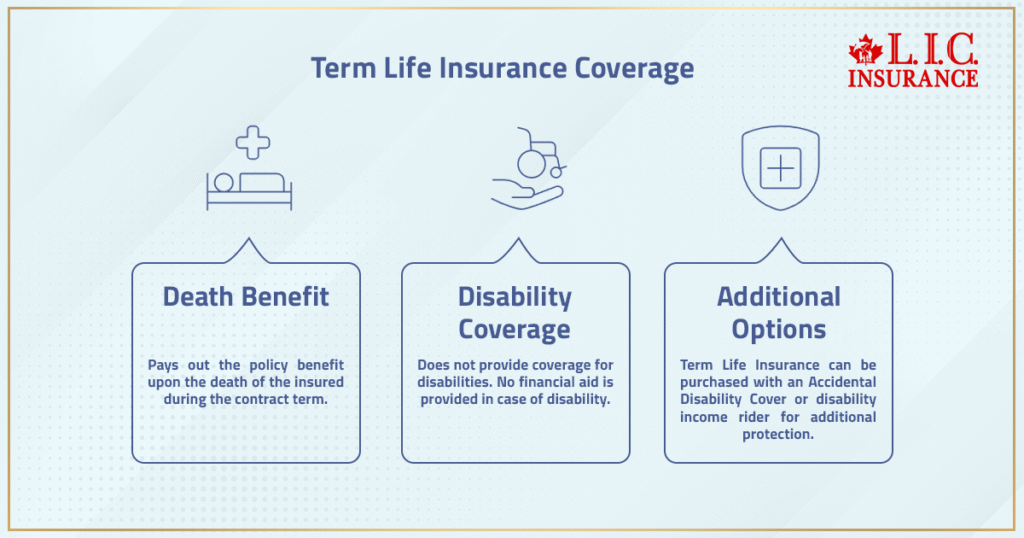
The answer is straightforward: Term Life Insurance does not provide coverage for disabilities.
According to a typical contract, Term Insurance will pay out the benefit of the policy in case of the death of the insured during the term of the contract. In case the insured becomes disabled and unable to work, no financial aid will be provided. This means there will be no compensation for the loss of salary, no assistance in handling expenses, and no provision for lengthy recovery.
Such an outcome usually catches many individuals off guard. It is natural that people expect broader coverage from their Life Insurance, but unfortunately, such expectations are unrealistic.
It is worth noting, however, that some additional options are available. Individuals may consider purchasing a Term Life Insurance with an Accidental Disability Cover Term Insurance rider, or disability income rider. They may provide additional protection, but at the same time impose certain limitations. For instance, the accident may exclude illnesses, the coverage may be limited by the dollar value of the benefit, or the benefit period may also be shorter.
What Is Disability Insurance Coverage, And How Does It Work?
The structure of Disability Insurance Coverage is meant to help keep your earning ability protected. In essence, this will ensure that if you fall ill and cannot earn money, your financial life will not be ruined along with your physical one.
Sun Life Financial and Canada Life Insurance companies normally plan their Disability Insurance Coverage to give clients around 60% to 70% of their earnings every month. This is usually a tax-free amount, dependent on the payment methods of the premiums.
There are four basic elements to every Disability Insurance Coverage contract. These include the waiting period when benefits will commence, depending on how long you have been out of work, from 30 days to several months. Then there is the benefit period, which refers to the length of the payments that you will receive, which might last several years up to your retirement date.
Long-Term Disability Insurance is especially useful for its capability of covering the extended income losses. Without such insurance coverage, people are left to rely on savings and credit.
Unlike Life Insurance, which offers one-time compensation, Disability Insurance helps maintain your budget while you are having trouble.
Term Life Insurance Vs Disability Insurance: Key Differences
Understanding the contrast between these two forms of insurance is essential for making informed decisions.
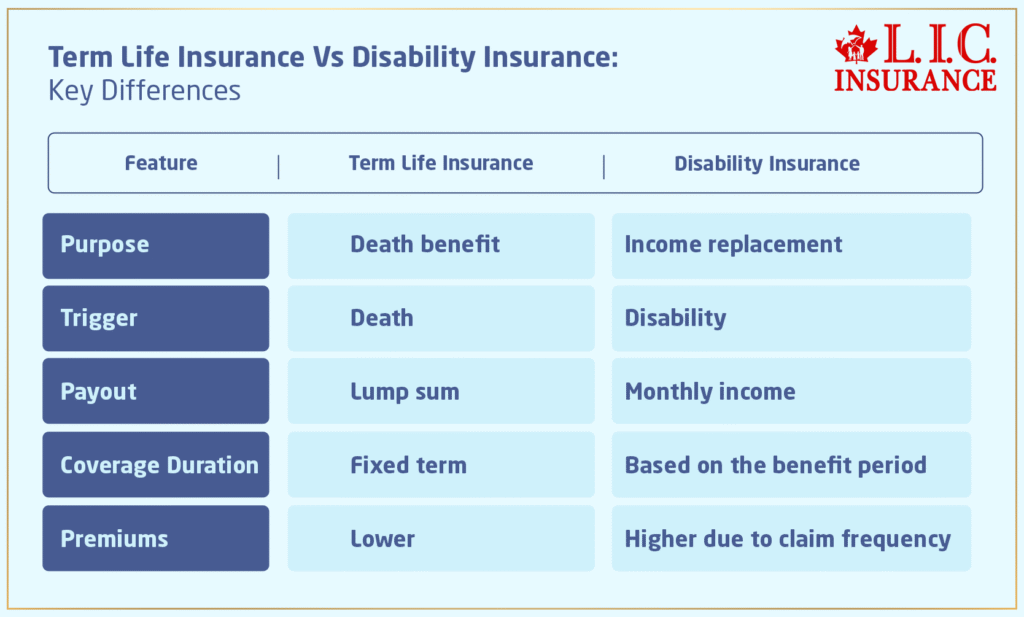
This comparison highlights a simple truth: Term Life Insurance protects your family, while Disability Insurance protects your income. Both are important, but they serve different roles within a comprehensive financial plan.
Can You Add Disability Coverage To Term Life Insurance?
Canadians will often try to see if they can make things simpler by combining Disability Insurance Coverage with an already existing Life Insurance Coverage.
There are options such as the waiver of premium and the disability income rider provided by insurance companies. Waiver of premium means that in case one gets disabled, the insurance company will pay for the premiums, thus keeping the Life Insurance Policy active. However, this is not enough because the individual does not receive an income.
The disability income rider could also be of help, although its payouts are usually less than those in a stand-alone Disability Insurance Coverage Plan. The coverage amounts may be too small to meet an individual’s financial needs if one gets disabled.
These two insurance options increase the costs through premiums paid. However, they may prove helpful to most individuals.
Life Insurance Costs Vs Disability Insurance Costs In Canada
Cost plays a major role in how people structure their coverage.
| Age | Coverage | Term Life Insurance | Disability Insurance |
|---|---|---|---|
| 30 | $500,000 | $25–$40 | $80–$150 |
| 40 | $500,000 | $45–$75 | $120–$250 |
| 50 | $500,000 | $95–$160 | $200–$400 |
At first glance, the premiums for Life Insurance seem significantly cheaper than those for Disability Insurance. But this is due to the type of risk being considered. Disability Insurance has a higher frequency of claims, and they are generally longer. This makes Disability Insurance more costly.
Risk considerations include your health record, occupation, medical examination, and other factors. Certain diseases can also make you eligible for high premiums. Yet, even if it is costly, it covers the most valuable investment you own—your earning capacity.
Income Disruption Without Disability Coverage
The individual in question is an Ontarian in their mid-30s and works on a salary. In order to ensure that there would be enough financial support in case of death, he/she got himself/herself a Term Life Insurance of $500,000.
Two years into his/her Life Insurance, this person suffered from a bad back injury, which did not relate to his/her work at all and made him/her incapable of continuing to work for some time.
In spite of having Life Insurance active, no payment from it occurred since Life Insurance does not deal with payments related to any disabilities. This particular individual still enjoyed his/her Life Insurance Policy, however, and did not require extra money to pay for anything.
Since he/she did not have any Disability Insurance and had to rely on his/her savings, the latter were quite quickly exhausted.
Structured Protection With Disability Insurance
A self-employed consultant in his/her early 40s met a Life Insurance agent to create an additional layer of protection. Besides the Term Life Insurance Coverage, the client decided to invest in a Long-Term Disability Insurance to help them cover a portion of their monthly paycheck.
In just a few years from then, they started developing health problems requiring treatment, which greatly affected their ability to work.
As soon as the Disability Insurance Policy became effective, the client started receiving a regular stream of income. About 65% of their previous monthly paycheck was covered by this new coverage.
The Term Life Insurance continued to operate as usual, providing necessary protection for the family. The Disability Insurance covered their current expenses, helping them maintain financial stability during the period of recovery.
Who Needs Disability Coverage Alongside Term Life Insurance?
Though everyone can stand to gain from such insurance, there are people who stand at a greater risk than others. Those self-employed or working for themselves stand a high chance of loss in case their ability to work is compromised. Also, families that depend on the income earners will suffer if their source of income is taken away.
Disabled persons or those who have prior illnesses or health problems can also find a suitable cover, but the costs will be a little bit higher.
What Happens If You Only Have Term Life Insurance?
The use of solely Term Life Insurance leaves a huge protection hole.
Income replacement is not there, financial planning is nonexistent, and most importantly, security in case of disability is absent. Although there might be some help from government schemes, those benefits do not cover all the costs needed to sustain the family’s level of living standards.
All of these holes become even more evident when recovery takes longer than expected.
Role Of Health History And Medical Records In Approval
Life Insurance and Disability Insurance both use underwriting for evaluating risks. The insurers consider the health background, health records, and answers to health questions. Issues like blood pressure, lifestyle, and profession play roles in this assessment process.
In certain instances, people have to deal with policy denial and more expensive premiums. Honesty in filling out the application form plays an important role in ensuring payment on claims.
Choosing The Right Coverage For Your Financial Plan
A good financial strategy should not depend on a single product. It incorporates various kinds of coverage that will handle diverse threats.
Term Life Insurance gives safety to the relatives in case of death. Meanwhile, Disability Insurance guarantees income even during sicknesses and injuries.
As a result, this will make an overall strategy regarding finance, which matches your financial targets.
Final Expense Insurance And Other Backup Options
Coverage is lower in final expense insurance plans to cater to funeral and post-death expenses. Although helpful, it fails to cater for income replacement or future financial requirements.
The options of permanent insurance plans may come with a cash value element. Nonetheless, this should not be confused with income replacement.
Essential Insights To Remember
It is essential to know how Term Life Insurance differs from Disability Insurance. The first is meant to protect your family when you are dead, while the latter will help protect your income when you are still alive. Relying on just one will leave you exposed to potential problems.
Written By: Harpreet Puri
Licensed Insurance Adviser | MDRT Qualifier
With over 14 years of experience in Life Insurance, wealth planning, and tax-efficient strategies for Canadians.
LinkedIn Profile: https://www.linkedin.com/in/harpreetpuricanadianlic/
Disclaimer: This content is for informational purposes only and does not constitute financial, legal, or tax advice. Life Insurance and Disability Insurance Coverage vary by insurance company, policy terms, and individual health history. Premiums, benefits, and coverage are subject to underwriting and may differ based on your situation.
Always consult a licensed Life Insurance agent or financial professional before making any decisions regarding your financial plan or insurance coverage.
FAQs
Yes, both can coexist without any problem. In the case of Disability Insurance, the insured receives income each month, whereas in the case of Term Life Insurance, the insured continues to be alive until the end of the policy period.
Yes, occupation is an important aspect of underwriting. Occupations that pose high risks may cause premium rates to increase or the amount insured to change under Disability Insurance Coverage. The insurance company assesses the job responsibilities together with the medical files.
This would depend on how the premiums are paid. When individuals pay the premiums themselves, the benefit payments are usually tax-exempt. When employers pay for the premiums, then the benefit payments become taxable income.
Yes, you can customize the policy depending on your income level and monthly expenses. The modification will include changing the duration of the benefit period, the waiting period, and the policy’s coverage itself.
When a denial of coverage happens during the claims process, one may opt for a review, or they may offer extra information about their medical background. It would be beneficial to cooperate with an insurance agent when making an appeal.
Starting early can help secure lower premiums and better coverage terms. Younger individuals in good health often qualify with fewer restrictions, making early planning a practical long-term decision.
Yes, insurers cap benefits based on a percentage of your earnings. This ensures income replacement remains balanced and prevents over-insurance while still supporting essential expenses during disability.
Yes, since it eliminates the requirement to withdraw funds from your savings account because of any income losses. By keeping your income steady, you will not be forced to touch any of your savings.
Many large Life Insurance providers, such as Sun Life Financial, Canada Life, and Manulife, provide riders as an additional coverage option. A disability income rider or a premium waiver rider, for example, can be provided based on the underwriting process.
The possibility of adding coverage for disabilities will depend on the conditions stipulated in the insurance policy. There are some insurance companies that provide the option of adding riders upon an examination of medical history and a new underwriting process.
As an add-on to Life Insurance, Disability Insurance offers minimal benefits, such as free premiums or a percentage of the benefit amount. This insurance can operate in tandem with Term Life Insurance, but does not serve as a substitute for Disability Insurance.
Claims can only be made when there is a rider for the disability. The absence of the rider means that there will be no cover for any claim related to disabilities. In addition, even with the rider, one must satisfy certain conditions.
No, Disability Insurance Coverage does not fall under regular Term Life Insurance Policies. Disability coverage is covered separately because Term Life Insurance only provides coverage for death benefits, not disability benefits.
Sources and Further Reading
- Canadian Life and Health Insurance Association – Industry insights on life and Disability Insurance trends in Canada
- Government of Canada – Disability Benefits – Official disability benefits and financial support programs
- Life Insurance – Canada Life – Overview of term and permanent Life Insurance options
- Disability Insurance – Canada Life – Income replacement and disability coverage details
- Disability Insurance – Sun Life – Protection during illness or injury
- Life Insurance – Manulife – Coverage options and product details
- Life Insurance Riders – Canada Life – Understanding riders, including disability-related options
- Manulife Synergy Insurance – Combined life and Disability Insurance solutions
Key Takeaways
- Term Life Insurance Coverage is designed to provide a death benefit, not income support during disability.
- The question does Term Life Insurance covers disability has a clear answer—standard policies do not include disability coverage.
- Disability Insurance plays a critical role by replacing a portion of your monthly income if you cannot work.
- Riders like a disability income rider or waiver of premium offer limited support but do not replace full Disability Insurance Coverage.
- Combining Term Life Insurance Canada plans with Long-Term Disability Insurance creates stronger overall financial protection.
- Individuals without disability coverage risk depleting savings and facing financial strain during extended recovery periods.
- Premiums for Disability Insurance may be higher, but they reflect the higher likelihood of claims compared to Life Insurance.
- Factors such as health history, occupation, and medical records influence eligibility, pricing, and coverage terms.
- A balanced financial plan should address both income protection and family security to ensure long-term stability.
Your Feedback Is Very Important To Us
IN THIS ARTICLE
- Is Disability Covered In Term Life Insurance Plans?
- Understanding Life Insurance And Disability Insurance
- Does Term Life Insurance Cover Disability?
- What Is Disability Insurance Coverage, And How Does It Work?
- Term Life Insurance Vs Disability Insurance: Key Differences
- Can You Add Disability Coverage To Term Life Insurance?
- Life Insurance Costs Vs Disability Insurance Costs In Canada
- Income Disruption Without Disability Coverage
- Structured Protection With Disability Insurance
- Who Needs Disability Coverage Alongside Term Life Insurance?
- What Happens If You Only Have Term Life Insurance?
- Role Of Health History And Medical Records In Approval
- Choosing The Right Coverage For Your Financial Plan
- Final Expense Insurance And Other Backup Options
- Essential Insights To Remember
Sign-in to CanadianLIC
Verify OTP