- Connect with our licensed Canadian insurance advisors
- Schedule a Call

BASICS
- Is Infinite Banking A Smart Financial Strategy?
- Understanding the Infinite Banking Concept
- Why Infinite Banking Appeals to Canadians Seeking Financial Freedom
- How Infinite Banking Strategy Helps Build Financial Independence
- Challenges and Misconceptions About Infinite Banking
- Who Should Consider Infinite Banking for Financial Freedom?
- How to Start Your Infinite Banking Journey
- Key Advantages of the Infinite Banking Strategy
- A Day-to-Day Struggle: Why More Canadians Are Exploring Infinite Banking
- Potential Drawbacks You Should Know
- The Future of Infinite Banking in Canada
- Is Infinite Banking a Smart Financial Strategy?
COMMON INQUIRIES
- Can I Have Both Short-Term and Long-Term Disability Insurance?
- Should Both Husband and Wife Get Term Life Insurance?
- Can I Change Beneficiaries on My Canadian Term Life Policy?
- What Does Term Life Insurance Cover and Not Cover?
- Does Term Insurance Cover Death?
- What are the advantages of Short-Term Life Insurance?
- Which Is Better, Whole Life Or Term Life Insurance?
- Do Term Life Insurance Rates Go Up?
- Is Term Insurance Better Than a Money Back Policy?
- What’s the Longest Term Life Insurance You Can Get?
- Which is better, Short-Term or Long-Term Insurance? Making the Right Choice
IN THIS ARTICLE
- What is the minimum income for Term Insurance?
- How Does Income Affect Your Term Life Insurance Policy?
- Can You Buy Term Life Insurance Online with a Low Income?
- How Can You Lower Your Term Life Insurance Cost?
- How Much Term Life Insurance Do You Need?
- Can Your Term Life Insurance Policy Be Adjusted Over Time?
- Why Term Life Insurance Is Ideal for Lower-Income Canadians
- Final Thoughts
- More on Term Life Insurance
How To Protect Your Business Loan With Disability Cover?

By Pushpinder Puri
CEO & Founder
- 12 min read
- Sep 18, 2026
SUMMARY
Business Loan Protection Insurance helps secure monthly loan payments if disability stops income. Covers Loan Protection Insurance Canada options, Disability Insurance for business loans, tax treatment, costs, and insurer comparisons to protect financial security during illness or injury for business owners and self-employed professionals.
Introduction
A Single Health Event Can Collapse Years Of Business Growth
There are many misconceptions regarding what it means to run a business in Canada. Many business owners look for opportunities to expand, develop, and maximize profits. However, very few consider the consequences that might arise from a scenario where the ability to perform the work becomes impossible. According to CLHIA, one in three Canadians will experience a disability of over 90 days before retiring. Such data completely redefines the way the risk is considered—not as something far-fetched, but rather as a potential financial event that may significantly impact survival.
In such a case, the issue under consideration would no longer be whether the company is strong enough to grow. Instead, the question would be whether it was solid enough to survive the situation where an unexpected health issue could disrupt its financial activities while it continues to operate. The loan for a business does not stop when the entrepreneur stops working, and the repayment schedule must be fulfilled accordingly.
That is why Business Loan Protection Insurance is so important. Loan Protection Insurance is more than just another form of insurance. It is a carefully planned-out financial plan that guarantees the borrower will not have a permanent setback due to being temporarily unable to do their job. This is how Loan Protection Insurance with disability can be used effectively.
What Is Business Loan Protection Disability Insurance
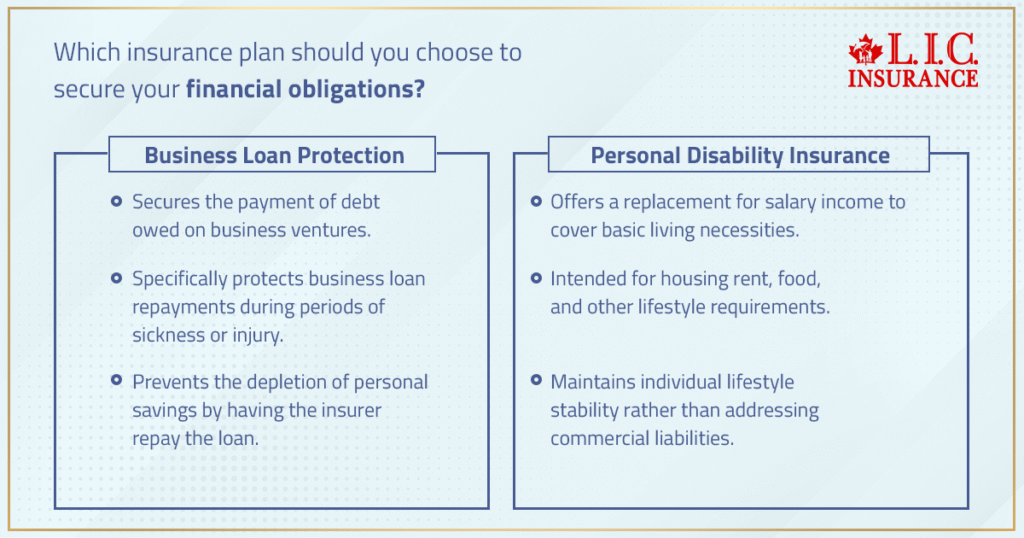
Business Loan Protection Insurance is an insurance plan created to secure the payment of debt owed on business ventures. In contrast to personal Disability Insurance plans that offer a replacement for salary income, the aim of this insurance plan is to protect the repayments for a business loan despite loss of income due to sickness or injury.
This point is very significant since most business people believe personal Disability Insurance will be enough to safeguard their business loan debts. Personal Disability Insurance is intended for use to pay for basic living necessities such as housing rent, food, and other lifestyle requirements, but not business loans.
Take an example where a consultant obtains a business loan worth $300,000. The earnings of the business depend on whether or not the individual can work. In case the person falls ill and cannot work for some time, then there will be no income at all. Without protection, the loan will still have to be repaid using savings and other sources of funds. But with Disability Insurance for business loans, the insurance company will step in to repay the loan for you.
This is the critical distinction between personal and business protection.
Why Every Business Owner And Self-Employed Professional Needs Disability Insurance
Financial stability in small businesses will not be structured to handle sudden income losses. In most cases, revenues for such organizations are closely associated with the performance of the entrepreneur. Once he or she pulls out, everything collapses.
It is not only corporations that face challenges in handling income loss when a person falls sick. Self-employed professionals find themselves more exposed than employees. Their incomes are determined by what they can produce at that particular time, leaving them with no salaries or benefits from the corporation.
There are three types of forces that act on such individuals upon falling sick. Firstly, their incomes come to an end; secondly, their expenses are ongoing, and thirdly, their loans keep on accumulating. In essence, there comes a point where the person faces increasing pressure from all fronts.
Through Loan Protection Insurance Canada plans, it becomes possible to solve such issues in a bid to stabilize the income situation of such individuals. This makes sure that monthly installments do not miss deadlines. Such insurance policies do not remove risks but turn them predictable.
What Happens To My Business Loan If I Become Disabled
Lenders do not have any cushion whatsoever in their dealings without protection on the business loan. No matter the disability faced by the borrower, the terms of payment set in the contract should be honored. Payments should be continued without fail whether the borrower is healthy or sick.
If the borrower fails to pay, the lender begins to impose penalties and interest. In addition, if the borrower continues to default on payment, it is reported to the credit agencies. In some instances, when the matter becomes serious, the lender may resort to recovery procedures.
For business loans with personal guarantees, the situation may extend beyond the business and affect the personal assets of the borrower. The reason why it is important to know what happens when a disability strikes while still servicing a business loan is that it is essential for business survival.
With no protection, the situation will be a threat to one’s financial well-being. With protection, the situation becomes an obstacle.
What Business Loan Protection Insurance Covers
Many policies covering Loan Protection Insurance with disability coverages tend to be designed to mirror the nature of the loan itself in order to maintain payment continuity without adding extra pressure to the business.
Take, for instance, companies like Canada Life that design benefit systems to fit the loan requirements perfectly. Monthly installments are made depending on the amount insured, which can be about a certain percentage of the total coverage, within specific maximums. Many times, there is a waiting period before benefits are paid, say 60 days, and may continue to be paid for up to 24 months per each disability, with unlimited lifetime limitations thereafter.
As a result, businesses are assured that even during the period when they cannot do much work, the loans are paid consistently.
What matters most, however, is predictability. There is no need to wonder about what will happen regarding the payments.
What Qualifies As Disability Under Coverage
The definition of disability is an important part of the policy. In most instances, it can be described as a health issue that renders the insured incapable of carrying out his or her primary responsibilities at work.
There are several criteria that back up the definition. These involve the insured being under constant medical supervision, following medication as prescribed, and proving that he or she cannot perform his or her job duties. The insurance company may ask for regular updates regarding the status of the insured.
At the same time, there are certain exclusions included in the policies. These include situations where the person causes the injury themselves or takes part in high-risk behaviours.
Knowledge about these restrictions is vital while choosing an appropriate policy.
Who Can Be Covered Under Business Loan Protection
It’s important to note that insurance coverage extends beyond the principal of the enterprise only. Many insurance policies enable covering more than one person under the same terms. Coverage usually includes partnerships, shareholding owners, and key personnel without whom the operation would not be possible for the enterprise.
In addition, persons who guarantee the loan may also be considered for inclusion. Insurance helps ensure business continuity when something untoward happens to an individual crucial to its proper operation. If a key worker goes missing or becomes incapacitated due to illness or disability, it’s important to plan ahead for contingencies.
Insurable interest is not restricted to one person alone.
Businesses And Loans Eligible For Coverage
Most business loan insurance plans are usually designed to cover businesses of all types. Both corporations, partnerships, and sole proprietorships can be considered for insurance coverage, as long as their activities are regulated.
Loans that may be covered under this kind of insurance include loans for commercial activities, loans for working capital, and loans for expanding one’s business.
On the other hand, personal loans that have no relation to business operations would not fall into this insurance plan.
This is to ensure that the insurance only covers financial obligations related to the business.
Federal Laws And Regulatory Oversight In Canada
The insurance market in Canada is one which requires adherence to regulatory controls. This means that bodies like the Financial Services Regulatory Authority of Ontario will regulate the operations of these businesses and their insurance advisors, while the Canada Revenue Agency will be responsible for ensuring any relevant tax requirements are adhered to.
In terms of compliance, what this implies is that insurance should be structured in a way that complies with the existing laws and regulations. This can be achieved through various aspects, including how the benefits and premiums of the insurance are taxed.
It is through professional help that this is achieved.
Tax Treatment Of Business Loan Protection Insurance In Canada
Knowing how your insurance is treated from a tax standpoint prior to purchasing a policy is very important to ensure that you make the right decision when choosing insurance. Taxation of the premium payments and taxability of the benefits depend greatly on the structure and ownership of the plan.
In the view of the Canada Revenue Agency (CRA), premium payments for Business Loan Protection Insurance that is meant to provide non-taxable benefits are not considered tax deductible. Generally, such a rule fits into the Canadian tax system principle, where if a person makes payments for premiums using after-tax money, they are exempt from taxes once the benefit is claimed.
Therefore, claiming benefits on your insurance policy will be easy once your application is approved, since you will be able to get the benefit free of any income tax charges. This means that you will have enough money to pay your loan installment without any deductions.
On the other hand, a business trying to claim premiums on its income statements would make all the benefits taxable, thus making the insurance less beneficial to use.
Things get even more complicated for owners of incorporated small businesses. The ownership of the insurance policy, whether in personal or corporate hands, can have an effect on both deductibility and taxation of benefits received.
Of course, regulatory oversight from the Canada Revenue Agency and similar organizations will guarantee consistency, but interpretation will depend entirely on the specific facts of the case at hand. There is no one-size-fits-all solution here, hence the need for custom-made planning.
It is very simple to understand what the main point here is. Loan Protection Insurance Canada is only as effective as its ability to provide full and untaxed benefits when needed.
Cost Of Loan Protection Insurance And Real Insurer Estimates
| Insurer | Coverage Amount | Monthly Cost | Waiting Period |
|---|---|---|---|
| Manulife | $250,000 | $65–$95 | 60 Days |
| Sun Life Financial | $300,000 | $80–$120 | 60–90 Days |
| Canada Life | $500,000 | $120–$180 | 60 Days |
These figures illustrate how premiums scale with coverage. While there is a cost associated with protection, it is often small compared to the potential financial impact of an uncovered disability.
Optional Riders And Comprehensive Coverage Options
Various plans also have riders that provide additional coverage. These riders ensure that the coverage is not limited to disability but includes other important situations.
For instance, including the rider for critical illness guarantees that there is money available if any major illness takes place. Other riders for life insurance could be included if death happens.
With these riders, the coverage becomes more inclusive and deals with all the different risks under one roof. This type of approach benefits entrepreneurs and makes their planning process much easier.
How Disability Insurance Protected A Growing Business
The self-employed professional had received a large loan for their business. Things were going smoothly, and future expectations were positive. However, an accident occurred, which turned everything upside down.
For a few months, the person could not work. Income fell almost to zero. Fixed costs did not stop, but the burden of paying off the debt was immediate.
But since Business Loan Protection Insurance had been arranged, everything went in a different direction. The monthly payments were made by the insurance company. Credit history stayed clean. There was no threat of closing the business due to bankruptcy.
After recovery, business processes resumed normally, and there were no further problems with the loan repayment or the business itself.
The only difference is that in the first case, there was no protection mechanism.
Is Business Loan Protection Insurance Worth It
Value is a subjective matter, depending on how it is looked at. Looking at the premium alone, there is no apparent value, but looking at the implications of being uninsured for any disabilities, the value starts to become clear.
The main value is the ability to maintain stability. This will ensure that all commitments are honoured, credit is maintained, and operations continue regardless of unforeseen circumstances.
There are some drawbacks, such as waiting periods and policy exceptions. Nevertheless, they can be handled by anticipating their occurrence beforehand.
For most small businesses and independent professionals, the scales tip heavily towards obtaining insurance coverage.
How To Choose The Right Loan Protection Insurance In Canada
The correct policy choice is not just a matter of cost alone. Rather, one must understand how the insurance coverage fits into the risks that the firm faces.
Aspects like the design of benefits, the waiting period, and the duration of payouts are all important factors. Reputation and trustworthiness of the company are additional considerations.
Top insurance companies in Canada, such as Manulife, Sun Life Financial, and Canada Life, have numerous plans available for consideration.
Seeking advice from experts will ensure that the plans offered are analyzed accurately and the final decision made effectively.
Strategic Closing Insight
The riskiest area in business operations is often misinterpreted. It is not the market instability and competition that constitute the greatest risk. The greatest risk is the abrupt loss of income due to the continuous obligations.
Disability Insurance for Business Loan helps manage this risk effectively. It is an excellent strategy to ensure that one’s business is safe from any unexpected events that might occur.
In other words, it is not about making sure that something goes wrong. It is about making sure that the business can sustain whatever happens.
Author: Pushpinder Puri, Licensed Insurance Adviser | MDRT Qualifier
Experience: 14 Years In Life Insurance & Financial Planning
LinkedIn Profile:https://www.linkedin.com/in/harpreetpuricanadianlic/
Disclaimer:
This content is provided for informational purposes only and does not constitute financial, tax, or legal advice. Tax treatment of Business Loan Protection Insurance and Disability Insurance for business loans may vary based on individual circumstances and applicable federal laws.
Readers should consult a qualified advisor or tax professional before making decisions related to coverage, premiums, or business obligations. Policy terms, benefits, and eligibility are subject to insurer guidelines and may change without notice.
FAQs
If done properly, the Business Loan Protection Insurance will guarantee that your loan repayments are made on time without any interruptions, thus ensuring that you preserve your good credit standing. Your credit rating will not be negatively affected, even in the case of disability and loss of income.
Yes, Canadian solutions for protecting loans through insurance can be made according to the needs of various industries. As a result, whatever type of industry you have or whether you are a business owner or self-employed, insurance providers make sure that the policy matches your means of earning money.
There are some policies that are flexible enough such that even if you are capable of working partially and not making the full income, you can benefit from them. This will ensure that there is continuity in the payments that you receive and financial security.
The assessment includes such variables as the legal structure of your company, its field, your health record, and the amount of your loan. The assessment plays an important role in defining the premiums, eligibility, and needed insurance cover in case of disability risks.
Business loan Disability Insurance is designed to kick into gear in the event that you cannot physically work, meaning that your monthly payments will be kept up during this time. This is in contrast to the idea of compensating you for lost earnings since you can no longer work.
Some examples of leading insurance companies that offer Loan Protection Insurance include Manulife, Sun Life Financial, and Canada Life. These companies provide customized plans based on the requirements of the business owners.
The best combination involves Business Loan Protection Insurance and flexible benefit periods and payouts. Insurance plans that provide extended coverage, variable loan durations, and rider provisions generally ensure greater financial stability, particularly for expanding small businesses.
The waiting period will dictate when your benefits will start after your disability. You have to pay for the benefits on your own during the waiting period, and choosing the appropriate duration becomes vital. The shorter the waiting period, the higher the premium rates.
For a claim to start, you should present evidence that proves your lack of ability to earn an income as well as documents that indicate your liabilities on your loan. The insurance company then evaluates your qualification for payment and makes payments to the business loan.
Sources and Further Reading
Disability Insurance + Financial Protection
- Government of Canada – Disability Insurance Explained (coverage, benefits, eligibility)
https://www.canada.ca/en/financial-consumer-agency/services/insurance/disability.html - CLHIA – Disability Insurance Industry Overview (risk, claims, coverage insights)
https://www.clhia.ca/web/CLHIA_LP4W_LND_Webstation.nsf/page/Disability+Insurance
Tax Treatment
- CRA – Income Tax Folio (Disability Insurance & Benefits Taxation)
https://www.canada.ca/en/revenue-agency/services/tax/technical-information/income-tax/income-tax-folios-index.html - Sun Life – Are Disability Insurance Premiums Tax Deductible? (Practical CRA interpretation)
https://www.sunlife.ca/en/insurance/life/are-your-insurance-premiums-tax-deductible/
Business Risk + Loan Obligations Context
- BDC – Managing Debt And Cash Flow For Small Business
https://www.bdc.ca/en/articles-tools/money-finance/manage-finances - Government of Canada – Financing And Loans For Small Business
https://www.canada.ca/en/services/business/start/financing.html
Real Insurer Disability Coverage
- Canada Life – Disability Insurance (income protection + business relevance)
https://www.canadalife.com/insurance/disability-insurance.html - Manulife – Disability Insurance For Self-Employed
https://www.manulife.ca/personal/insurance/disability-insurance.html
Key Takeaways
- Business Loan Protection Insurance plays a critical role in maintaining stability when a business owner becomes unable to work due to illness or injury. It ensures that monthly loan payments continue, protecting both the business and its financial standing.
- Disability Insurance for business loans is different from personal coverage, as it is specifically structured to safeguard business loan obligations rather than personal income or lifestyle expenses.
- Without proper Loan Protection Insurance Canada, a temporary disability can quickly escalate into credit damage, legal pressure, or even loss of business assets due to missed payments.
- The cost of coverage depends on factors such as health, loan size, and industry risk, but remains relatively small compared to the financial impact of an uncovered disability.
- Understanding the tax treatment is essential, as premiums are typically not deductible, but benefits are often received tax-free, making the coverage more efficient when structured correctly.
- Including key employees or partners under the same policy strengthens overall business continuity, ensuring operations are not dependent on a single individual.
- Choosing the right insurer, benefit structure, and waiting period is crucial to align the policy with actual loan terms and risk exposure.
- For business owners and self-employed professionals, the real risk is not disability itself, but the financial strain of ongoing obligations without income—making structured protection a necessary part of long-term planning.
Your Feedback Is Very Important To Us
Your responses will help identify real challenges faced by business owners and self-employed professionals when managing business loan protection during disability.
IN THIS ARTICLE
- How To Protect Your Business Loan With Disability Cover
- What Is Business Loan Protection Disability Insurance
- Why Every Business Owner And Self-Employed Professional Needs Disability Insurance
- What Happens To My Business Loan If I Become Disabled
- What Business Loan Protection Insurance Covers
- What Qualifies As Disability Under Coverage
- Who Can Be Covered Under Business Loan Protection
- Businesses And Loans Eligible For Coverage
- Federal Laws And Regulatory Oversight In Canada
- Cost Of Loan Protection Insurance And Real Insurer Estimates
- Optional Riders And Comprehensive Coverage Options
- How Disability Insurance Protected A Growing Business
- Is Business Loan Protection Insurance Worth It
- How To Choose The Right Loan Protection Insurance In Canada
- Strategic Closing Insight
Sign-in to CanadianLIC
Verify OTP