- Connect with our licensed Canadian insurance advisors
- Schedule a Call

BASICS
- Is Infinite Banking A Smart Financial Strategy?
- Understanding the Infinite Banking Concept
- Why Infinite Banking Appeals to Canadians Seeking Financial Freedom
- How Infinite Banking Strategy Helps Build Financial Independence
- Challenges and Misconceptions About Infinite Banking
- Who Should Consider Infinite Banking for Financial Freedom?
- How to Start Your Infinite Banking Journey
- Key Advantages of the Infinite Banking Strategy
- A Day-to-Day Struggle: Why More Canadians Are Exploring Infinite Banking
- Potential Drawbacks You Should Know
- The Future of Infinite Banking in Canada
- Is Infinite Banking a Smart Financial Strategy?
COMMON INQUIRIES
- Can I Have Both Short-Term and Long-Term Disability Insurance?
- Should Both Husband and Wife Get Term Life Insurance?
- Can I Change Beneficiaries on My Canadian Term Life Policy?
- What Does Term Life Insurance Cover and Not Cover?
- Does Term Insurance Cover Death?
- What are the advantages of Short-Term Life Insurance?
- Which Is Better, Whole Life Or Term Life Insurance?
- Do Term Life Insurance Rates Go Up?
- Is Term Insurance Better Than a Money Back Policy?
- What’s the Longest Term Life Insurance You Can Get?
- Which is better, Short-Term or Long-Term Insurance? Making the Right Choice
IN THIS ARTICLE
- What is the minimum income for Term Insurance?
- How Does Income Affect Your Term Life Insurance Policy?
- Can You Buy Term Life Insurance Online with a Low Income?
- How Can You Lower Your Term Life Insurance Cost?
- How Much Term Life Insurance Do You Need?
- Can Your Term Life Insurance Policy Be Adjusted Over Time?
- Why Term Life Insurance Is Ideal for Lower-Income Canadians
- Final Thoughts
- More on Term Life Insurance
TFSA Overcontribution Penalties: How To Avoid CRA Fines

By Pushpinder Puri
CEO & Founder
- 10 min read
- Aug 31st, 2026
SUMMARY
TFSA over-contribution penalty rules explained with Tax-Free Savings Account limits, TFSA contributions limit, contribution room, excess TFSA amount calculation, CRA notices, and how much you can contribute. Covers how to fix over-contribution, avoid penalties, compare TFSA vs RRSP, and maximize TFSA benefits safely.
Introduction
Why TFSA Mistakes Are Costly In Canada
Financial decisions that appear innocent now may unexpectedly lead to hefty costs down the road. Such an outcome may be expected when the over-contribution to a TFSA remains undetected. Despite a continuous increase in the number of participants in the program offered by the Canada Revenue Agency, millions of Canadians now use a TFSA as a tool for financial planning in the future.
The reasons behind this trend have nothing to do with complexity, but rather with misunderstanding. The idea behind a TFSA is to put money in an account where it becomes safe from taxes forever. While in some cases it proves to be true, an over-contribution to a TFSA is governed by entirely different rules in accordance with the Income Tax Act.
A small over-contribution to a TFSA account will still result in an ongoing tax charge in the form of 1% per month. This means that no matter how insignificant the contribution to the TFSA was, the taxpayer must pay additional taxes until the issue is fixed. Most of those who contribute too much to TFSA are unaware of breaking any rules and make such a mistake unintentionally.
This trend is prevalent at Canadian LIC. Most clients seek us after getting a letter from the CRA, only to be surprised by how much penalty they had incurred without realizing it. It can be avoided, but only with clarity, awareness, and promptness.
Canadian LIC is an insurance brokerage licensed in Canada. This article serves an educational purpose and might contain information on the financial planning strategies we recommend in our services.
What Is A TFSA And How Contribution Room Work
Avoiding penalties involves having a complete understanding of what a TFSA is and how its mechanism works. A Tax-Free Savings Account is basically an investment tool that enables Canadians to accumulate savings without having to pay taxes on income, dividends, and capital gains accrued from the account. Details can be obtained from the official TFSA page of the Canada Revenue Agency.
Every benefit is accompanied by a regulation. The primary regulation involves the contribution room. Each year, the government determines the maximum limit per year that can be contributed to a TFSA account. An average Canadian who has been eligible since 2009 will have a contribution room of about $109,000, which must be confirmed individually. It is important for the amount in question because of its relevance to the question: how much do I contribute to my TFSA before I incur a penalty for an excess TFSA amount? This is because the money accumulates over the years if not utilized.
It is possible for an individual who has never contributed to a TFSA to have a contribution room of more than $90,000 currently.
The challenge begins when individuals try to answer: ” How much can I contribute to my TFSA? The answer depends on multiple variables:
- Past TFSA contributions
- Withdrawals made in previous years
- Timing within the calendar year
- Any over-contribution history
People often have more than one TFSA account opened in different banks or financial institutions. Although this is perfectly fine, it makes things a bit confusing. Since the Canada Revenue Agency cannot monitor real-time transactions immediately, you might make false assumptions when only using your CRA account.
Yet another crucial point to consider is that a TFSA does not affect your income for tax purposes. That’s why discussions such as TFSA vs. RRSP are always valid. Where RRSPs give you a deduction, the TFSA helps you save tax-free.
How TFSA Over Contribution Happens (Mistake → Penalty → Fix Framework)
Miscalculating Contribution Room
One of the most common ways people overcontribute is by miscalculating their contribution room. This often happens when individuals rely only on CRA updates instead of maintaining their own records.
Penalty: A miscalculation creates an excess amount, triggering a TFSA over-contribution penalty immediately.
Fix: Keep an independent log of all deposits and withdrawals.
Multiple Accounts Across Different Banks
Managing multiple TFSA accounts across different banks increases the risk of duplication. Each institution only sees its own transactions, not your total TFSAs.
Penalty: Combined contributions exceed the current year’s limit, creating an excess TFSA situation.
Fix: Consolidate accounts or maintain centralized tracking.
Re-Contribution Within The Same Calendar Year
A frequent mistake involves withdrawing funds and then assuming that space is available again immediately. In reality, withdrawn amounts are only added back in the following year.
Penalty: Re-depositing within the same calendar year results in over-contribution.
Fix: Wait until the next year before re-contributing.
Non-Resident Contributions
If an individual becomes a non-resident, they are no longer eligible to contribute. However, many continue contributing unknowingly.
Penalty: Additional penalties apply to non-resident contributions.
Fix: Stop contributions immediately upon status change.
Non-Resident Contribution Rules (Expanded)
If an individual becomes a non-resident, any contributions made during that period are subject to a separate 1% monthly penalty tax, even if within normal contribution room.
This creates a unique situation where two penalties can apply simultaneously:
- Over-contribution penalty
- Non-resident contribution penalty
This is one of the most misunderstood aspects of TFSA compliance and often leads to higher-than-expected total penalties.
Automated Investments
Recurring investments in mutual funds or other instruments can unintentionally push contributions beyond limits.
Penalty: Gradual accumulation of excess TFSA amount.
Fix: Regularly review your TFSA transaction summary.
What Canadian Lic Advisors See Most Often
Another pattern observed consistently between clients is that people think the CRA monitors everything at once.
Actually, the difference shows up after 12 to 18 months when the system catches on to the error. In the meantime, the person keeps paying, and the excess TFSA balance gets even larger.
The most common scenario involves:
- Contributions across multiple TFSA accounts
- Re-contributions within the same calendar year
- Misinterpretation of the contribution room after withdrawals
One other constant is the emotional reaction. Once the CRA notification comes, clients do not only worry about the penalty tax; they also wonder how it came to be.
This further emphasizes the importance of tracking, not correcting.
What Is An Excess TFSA Amount And How CRA Defines It
The “excess TFSA amount” would mean an amount that surpasses your contribution limit. This would be determined by the Canada Revenue Agency at the highest point in time.
Therefore, even if the excess was temporary, the entire amount is what gets penalized. The system does not show leniency in terms of time. There is an implication of a penalty if you exceed the contribution limit, even for a moment.
TFSA Over Contribution Penalty: How CRA Charges You
The CRA charges an additional 1% per month tax penalty on the excess portion. The above requirements are outlined in Section 207.02 of the Income Tax Act. It will continue until the situation is rectified by removing the excess.
Otherwise, the penalties will accumulate and be carried over to the next year. Hence, the importance of acting quickly cannot be overstated.
Also, people might be required to submit their TFSA return, which shows the excess amount and calculates their tax liability.
Highest Excess Rule
- Section 207.02 – Tax on excess TFSA amount
- Section 207.06 – Ministerial discretion for penalty relief
| Scenario | Amount |
|---|---|
| Total Contributions | $75,000 |
| Contribution Room | $70,000 |
| Excess TFSA Amount | $5,000 |
| Monthly Penalty (1%) | $50 |
| Duration (6 Months) | $300 |
| Total Penalty Payable | $300 |
Penalty Calculation Example Table
A simple delay in correcting an excess TFSAs can result in hundreds of dollars in unnecessary penalty tax.
TFSA Penalty Calculator (Simplified Model)
The formula used by CRA is straightforward:
Penalty = Highest Excess × 1% × Number Of Months
For example, if your excess amount is $8,000 and remains for 5 months:
Penalty = $8,000 × 1% × 5 = $400
This calculation highlights how quickly money can be lost if action is delayed. Acting fast significantly reduces total penalties.
CRA Notice Scenario And Recovery Timeline
Stage 1: Detection
CRA identifies discrepancies using reported data and your TFSA transaction summary.
Stage 2: Notice Issued
You receive a formal notice or letter in your CRA account.
Stage 3: Penalty Accrues
Monthly penalty tax begins immediately.
Stage 4: Action Required
You must withdraw the excess immediately or adjust contributions.
Stage 5: Filing
Submit a TFSA return, including required forms and supporting documents.
Stage 6: Resolution
Resolution may take 30 to 90 days, depending on complexity.
Real Client Scenario (Anonymized Experience)
In a recent case, the individual was found to have multiple TFSA accounts with three different financial institutions.
In two years’ time, the individual had over-contributed to their accounts by about $8,400, assuming that the CRA would monitor all contributions on its own.
Upon notification from the CRA, the highest amount resulted in a penalty of over contribution each month for the TFSA.
Resolution Steps
- Calculated the exact excess amount using internal records
- Advised the client to withdraw the excess immediately
- Filed Form RC243 (TFSA Return)
- Submitted supporting documents for review
Outcome
- Penalties reduced due to timely action
- No waiver granted, but escalation avoided
This example highlights a critical reality:
TFSA penalties are rarely about intent—they are about timing and tracking.
How To Fix TFSA Over Contribution
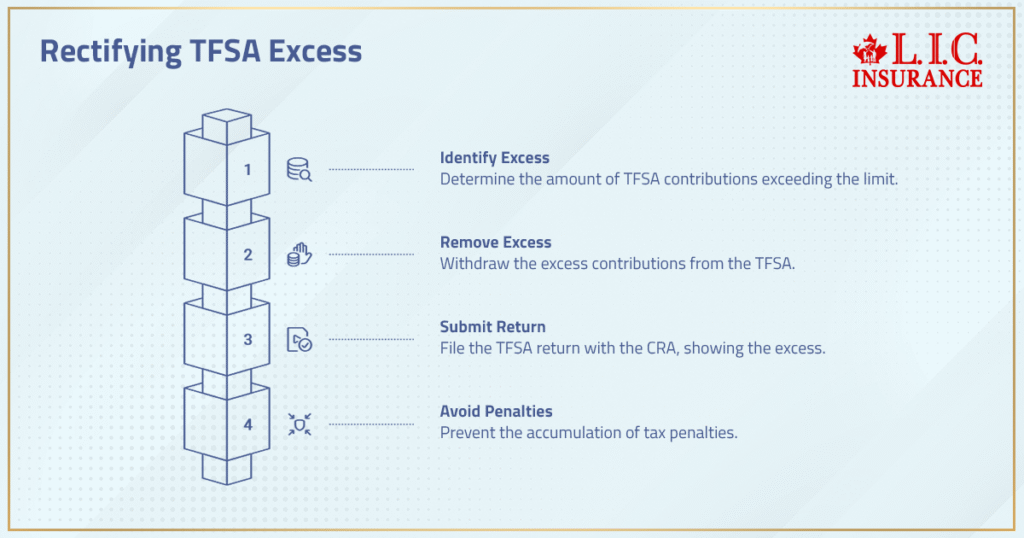
Correcting a TFSA over-contribution involves clear steps:
- Identify the excess TFSA amount
- Withdraw the excess amount immediately
- File the required TFSA return
- Pay applicable tax
- Monitor the future contribution room
The key is to act quickly. Delays increase penalties significantly.
Required CRA Forms
When a TFSA over-contribution occurs, the following forms are required:
- RC243 – TFSA Return
- RC243-SCH-A – Schedule for excess calculation
- RC4288 – Request for Taxpayer Relief (penalty waiver)
Filing Deadline
June 30 of the year following the calendar year in which the excess TFSA amount occurred.
Missing this deadline may result in additional penalties.
Can You Get TFSA Penalty Waived?
If your over-contribution results from a mistake made in good faith, you can make a waiver request.
This entails filing Form RC4288 (Request for Taxpayer Relief).
It should include a letter with a full explanation regarding the mistake, together with proof of taking remedial actions through documentation such as account statements and details of contributions made.
Process
- Submit a detailed explanation letter
- Provide supporting documents
- Demonstrate that the excess TFSA amount was corrected
If approved, the CRA may remove the penalty tax. If CRA denies the request, further steps may be required.
Deliberate Overcontribution
Where the CRA discovers an intentional over-contribution in a TFSA—such as trying to make returns larger than the penalty tax—the possibility of getting relief becomes very slim.
Relief will normally only be offered in situations where an honest mistake was made, not in situations where a calculated decision was made.
What Happens If CRA Denies Your Request
In case your waiver application is turned down, there are still steps that you can take to challenge the decision.
These will involve submitting further documentation and waiting for a response from the Department of Citizenship and Immigration.
Capital Gains And TFSA Over Contribution Risks
While TFSA investments are generally exempt from tax on capital gains, an excess TFSA amount can complicate matters.
Maintaining compliance ensures that your tax-free savings strategy remains effective and uninterrupted.
Death And Successor Holder Rules
Upon death, the treatment of a TFSA depends wholly on the nature of the account when the designation was made. While this is something that may be easily overlooked, it can have major ramifications when it comes to taxation and planning for estate purposes.
In the event that a surviving spouse or common-law partner is designated as the successor holder, there will be a seamless transition to the new account holder. The tax-free status will remain unchanged, as will the contributions for the TFSA.
On the other hand, should a beneficiary be designated to receive the funds, this means that the TFSA cannot pass along. The beneficiary inherits the money but nothing else, including the account status.
TFSA Tracking System (Advisor Insight From Canadian LIC)
Practical Tracking Framework
- Maintain a centralized log of all TFSA contributions
- Record withdrawals and track re-contributions by calendar year
- Reconcile periodically with your CRA account
Recommended Strategy
Simplification improves accuracy. Using fewer TFSA accounts and limiting activity across multiple accounts reduces the likelihood of tracking errors.
Advisor Insight
When viewed from an advisory standpoint, overcontributions in TFSAs generally do not arise from complicated procedures.
They occur due to loss of sight among accounts and timing.
This is not a matter of ignorance; it is a matter of organization.
TFSA Vs RRSP: Why Over-Contribution Risks Differ
On initial observation, it can be seen that TFSA vs RRSP seem to share common ground since both are meant for long-term savings and tax efficiency. When it comes to over contributions, however, the differences lie in the punishment and level of tolerance. For example, an RRSP can tolerate up to $2,000 over the limit without any penalty imposed. On exceeding this amount, however, the same penalty is charged for the RRSP ($1 monthly).
The major difference, therefore, does not lie in the level of penalty but rather in the level of tolerance. While the RRSP can tolerate up to $2,000 over the limit, the TFSA does not have any such tolerance. It strictly adheres to the contribution limit and applies the over-contribution penalty immediately the limit is breached.
However, the RRSP offers a limited safety cushion. According to current regulations, a person can contribute more than the allowable RRSP limit by up to $2,000 annually without penalty. It triggers a psychological predisposition—the assumption that such leeway applies to TFSA as well. This is not the case.
The timing aspect represents another important distinction between RRSP and TFSA accounts. Over-contributing in a TFSA account means that the penalty will carry over to the next year, even if new contribution room becomes available during that time period. This often causes bewilderment, given that people think starting a new year solves the problem.
A different approach to the tax implications represents yet another dissimilarity between the two types of savings programs. RRSP overages mainly impact the ability to claim tax deductions in future periods, while TFSA overages involve additional costs right away.
From a consultant’s perspective, the RRSP program requires less attention to detail since there is no need to monitor TFSA contributions and manage withdrawal and re-contribution activities carefully.
How To Maximize TFSA Benefits Without Penalties
Maximizing the value of a Tax-Free Savings Account is not about contributing aggressively—it is about contributing accurately. The objective is to grow wealth while ensuring zero exposure to TFSA over-contribution penalties, and that requires a structured approach rather than assumptions.
- The first concept is adhering to the prevailing yearly limit. Every calendar year, there will be a newly set TFSA limit; however, this does not mean that this is your current contribution limit. Instead, it will depend on how much you have already contributed, withdrawn, and other transactions within the past years. Depending on the memory or the outdated figures of the CRA, it can result in exceeding the allowable amount before you realize it.
- Another crucial point is constant monitoring. Although your CRA account can help serve as a guide, this does not equate to having updated information at all times. Keeping track of your own investments guarantees that every single contribution made is recorded. Moreover, it is necessary if you have more than one TFSA account from various financial institutions. You cannot expect accurate results from manual computation and tracking alone.
- Lastly, the importance of withdrawal time must be noted. When withdrawing your money, the total amount withdrawn will only be added to your contribution room next year. In other words, reinvesting the withdrawn amount in the same calendar year can be the main reason why many people exceed their limit.
- Practically speaking, being simpler means being more accurate. The reason for sticking to a limited number of TFSAs in one bank is that less can go wrong and cause discrepancies. Also, many advisors advise people to establish personal contribution limits by checking total contributions made during each quarter rather than at the end of the year.
- Lastly, discipline becomes more important than any strategy. While the TFSA is quite flexible and open to various approaches, that does not mean decisions have to be haphazard. All transactions must be deliberate, double-checked, and appropriate given the contribution room. Only through such actions is maximum utilization achieved.
Common Myths About TFSA Overcontribution
Myth: CRA updates instantly
Reality: Delays can create unnoticed excess
Myth: Small errors do not matter
Reality: Even minor overcontribution triggers penalties
Myth: Withdrawal fixes everything
Reality: Timing within the calendar year matters
Final Advisory From Canadian LIC
The Tax-Free Savings Account is among the best means of accumulating capital in Canada. It takes self-control, though. The distinction between getting the most out of your investment and incurring avoidable costs lies in one single issue: accuracy.
By being diligent and knowing what you are doing, it becomes possible to escape all of the TFSA over-contribution penalties that exist out there.
Author: Harpreet Puri, Licensed Insurance Adviser | MDRT Qualifier
Experience: 14 Years In Life Insurance & Financial Planning
LinkedIn Profile:https://www.linkedin.com/in/harpreetpuricanadianlic/
Disclaimer:
This content is for informational purposes only and does not constitute financial, tax, or legal advice. TFSA penalties are governed by Sections 207.02 and 207.06 of the Income Tax Act and administered by the Canada Revenue Agency. Rules, limits, and indexation may change annually. Consult a CPA or qualified tax professional before making decisions.
FAQs
Indeed, when you invest in foreign property, your contribution amount is expressed in Canadian dollars when making the deposit. The exchange rate change following your contribution will have no effect on your contribution limit. Nevertheless, a wrong assumption when converting while making the deposit can result in a contribution excess. It is critical that you monitor your contributions in Canadian dollars to prevent overcontribution to TFSAs.
No, purchasing or selling of the assets within the same TFSA account will not constitute an additional contribution. Even if you switch from cash to mutual funds or stocks, the process will remain within the same TFSA account. Only new additions will result in an adjustment of your total TFSA contribution.
The non-resolution of an issue of over-contribution of the TFSA in itself does not result in decreased benefits. Nevertheless, penalties and reporting problems may influence your financial situation. Multiple instances of problems complying with the CRA may cause you to be scrutinized in your financial dealings.
There might be some reporting mistakes made by the financial institution when it comes to TFSA contribution. In this case, you will have to rely on your own personal documentation. This is because these discrepancies may lead to an unnecessary tax burden on you.
Yes, newcomers only earn their contribution room starting from the year they qualify. They cannot claim back any limits for years prior to when they became residents. This misconception usually causes over-contribution issues right away. It’s important to check your first year of eligibility before depositing anything.
Yes, the CRA can see high levels of trading as business income. In that case, profits can be taxed even if they’re in a TFSA. This is different from the TFSA over-contribution penalties, but it’s just as significant. Keeping an investment-oriented mind ensures tax-free savings advantages.
Having many TFSAs is acceptable; however, it increases monitoring difficulties. Increased activity may attract additional scrutiny in case of discrepancies. Keeping detailed account records makes CRA problems less likely. Accuracy is more critical than having many accounts.
Absolutely, but it’s important to take precautions where frequent deposits and withdrawals are made throughout the year. Timing is essential because there could be cases of overcontributing due to improper timing. It’s best used for short-term purposes when there’s sufficient contribution room.
If the overcontribution was done unintentionally, the Canada Revenue Agency would consider it an excess TFSA amount, irrespective of the intention behind it. The taxman will start imposing a penalty tax each month from the time when there is an excess until the problem is fixed. Filing a TFSA return might be required in such cases.
The CRA imposes an additional 1% per month tax on the overcontribution to the TFSA account. This applies to each calendar year and month that the over contribution persists. Even a modest overcontribution could rack up significant fees over time. Acting quickly prevents further losses from the monthly penalty tax.
Intentional overcontributions to your TFSA are not a good idea. The constant penalty tax usually surpasses any possible gain from investing. It pays off to stick to your contribution limits for future gains. An organized system of tax-free savings always works out better than being reckless.
Determine the precise amount of TFSA excess first by analyzing your data and that of the Canada Revenue Agency. Withdraw the amount immediately from your TFSA account. It will be necessary to file a TFSA return in many situations in order to fulfill your liabilities. This way, you will avoid having further penalties incurred.
The most common error is the misconception that withdrawals automatically replenish the contribution room. This results in inadvertently re-contributing the withdrawn amount during the same calendar year. Another recurring problem is inadequate record-keeping for several TFSA accounts. Proper record keeping is essential to preventing an unforeseen overcontribution.
Yes, the Canada Revenue Agency may issue notices or letters. These usually show up in your CRA account following an examination of the reported information. Nevertheless, notifications are not always instant owing to lags in reporting. Depending only on CRA notifications could put you at risk of hidden penalties.
This is done by taking into consideration the highest excess for the year. The Canada Revenue Agency imposes a 1% tax penalty per month until the excess funds are withdrawn. Each month that there is an excess in TFSAs will lead to an increase in the total payable. Proper monitoring can help reduce the time you incur penalties.
Financial organizations monitor transactions within a single bank account. They do not combine TFSAs from different accounts. There may be some applications that provide assistance; however, they are manually verified. The most accurate way to do it is to keep a record on your own.
Failure to withdraw the excess money will result in continuous monthly penalties. The excess funds remain an unresolved issue from one year to the next. This will increase your liability to the Canada Revenue Agency in the long run. Ignoring such problems usually leads to additional costs and complexities.
Sources and Further Reading
- Canada Revenue Agency – TFSA Overview https://www.canada.ca/en/revenue-agency/services/tax/individuals/topics/tax-free-savings-account.html
- TFSA Contribution Limits And Room Calculator https://www.canada.ca/en/revenue-agency/services/tax/individuals/topics/tax-free-savings-account/contributions.html
- Form RC243 – Tax-Free Savings Account (TFSA) Return
https://www.canada.ca/en/revenue-agency/services/forms-publications/forms/rc243.html - Form RC243-SCH-A – Schedule For Excess TFSA Amount
https://www.canada.ca/en/revenue-agency/services/forms-publications/forms/rc243-scha.html - Form RC4288 – Request For Taxpayer Relief
https://www.canada.ca/en/revenue-agency/services/forms-publications/forms/rc4288.html - Income Tax Act – Section 207.02 (TFSA Excess Tax)
https://laws-lois.justice.gc.ca/eng/acts/I-3.3/section-207.02.html - Income Tax Act – Section 207.06 (Penalty Relief)
https://laws-lois.justice.gc.ca/eng/acts/I-3.3/section-207.06.html
Key Takeaways
- A Tax-Free Savings Account offers powerful tax-free growth, but exceeding your TFSA contributions limit creates an immediate TFSA over-contribution penalty.
- The CRA charges a 1% monthly penalty tax on the excess TFSA amount, calculated based on the highest excess in a calendar month.
- As of 2026, the annual limit is $7,000, with cumulative contribution room reaching about $109,000 for eligible individuals since 2009.
- Missteps like re-contributing in the same calendar year, using multiple accounts, or relying only on CRA data often lead to over-contribution.
- Fix issues quickly by identifying the excess amount, withdrawing it, and filing Form RC243 to minimize penalties.
- Waivers may be possible for a reasonable error, but require strong documentation and timely corrective action.
- Non-resident contributions can trigger additional penalties, even if within normal limits.
- TFSA penalties apply immediately, unlike RRSPs, making accurate tracking essential for compliance.
- Consistent monitoring of the contribution room and maintaining personal records helps avoid costly mistakes.
- Proper planning ensures you maximize TFSA benefits without risking penalties or unnecessary tax exposure.
Your Feedback Is Very Important To Us
IN THIS ARTICLE
- TFSA Overcontribution Penalties: How To Avoid CRA Fines
- What Is A TFSA And How Contribution Room Work
- How TFSA Over Contribution Happens (Mistake → Penalty → Fix Framework)
- What Canadian Lic Advisors See Most Often
- What Is An Excess TFSA Amount And How CRA Defines It
- TFSA Over Contribution Penalty: How CRA Charges You
- Penalty Calculation Example Table
- TFSA Penalty Calculator (Simplified Model)
- CRA Notice Scenario And Recovery Timeline
- Real Client Scenario (Anonymized Experience)
- How To Fix TFSA Over Contribution
- Required CRA Forms
- Can You Get TFSA Penalty Waived?
- What Happens If CRA Denies Your Request
- Capital Gains And TFSA Over Contribution Risks
- Death And Successor Holder Rules
- TFSA Tracking System (Advisor Insight From Canadian LIC)
- TFSA Vs RRSP: Why Over-Contribution Risks Differ
- How To Maximize TFSA Benefits Without Penalties
- Common Myths About TFSA Overcontribution
- Final Advisory From Canadian LIC
Sign-in to CanadianLIC
Verify OTP