Universal Life Insurance Cash Value In Canada: How It Grows & Why It Matters

Universal Life Insurance Cash Value In Canada: How It Grows & Why It Matters

Universal Life Insurance Cash Value In Canada How It Grows & Why It Matters
Canadian LIC

By Pushpinder Puri

CEO & Founder

SUMMARY

A detailed look at Universal Life Insurance cash value in Canada, showing how a Universal Life Insurance Policy supports long-term growth, flexible insurance coverage, and tax-advantaged options. The content compares Universal Life Insurance vs Term Life Insurance, explains Universal Life Insurance cost, highlights access to cash value, and shows why many Canadians request Universal Life Insurance quotes online.

Introduction

Something is quietly changing across Canada, and if you’ve been advising families here with Canadian LIC as long as we have, you can sense it. The statistics show that more Canadians are getting over the thrill of a short-term fix and are shifting their focus towards Universal Life Insurance cash value, not because it sounds cute, but because the financial picture is ugly compared to what it has been.

As a group, Canadians have more than $4.7 trillion of Life Insurance and annuities in place through the CLHIA’s 71-member companies. Add to that additional data published by the National Association of Insurance Commissioners, which says 92% of Life Insurance Policies end up lapsing or being surrendered with no death benefit ever paid, and it becomes even clearer. Canadians are not marked to lose value because policies don’t work — they’re marked to lose value because they’re headed in the wrong direction too late.

Where we sit with families daily, try to make sense of complicated rules in simple terms and guide seniors through decisions no one ever prepared them to even have to consider, accessing Universal Life Insurance cash value is one of the financial instruments Canadians wish they had known about long before now.

Understanding The Cash Value Inside A Universal Life Insurance Policy

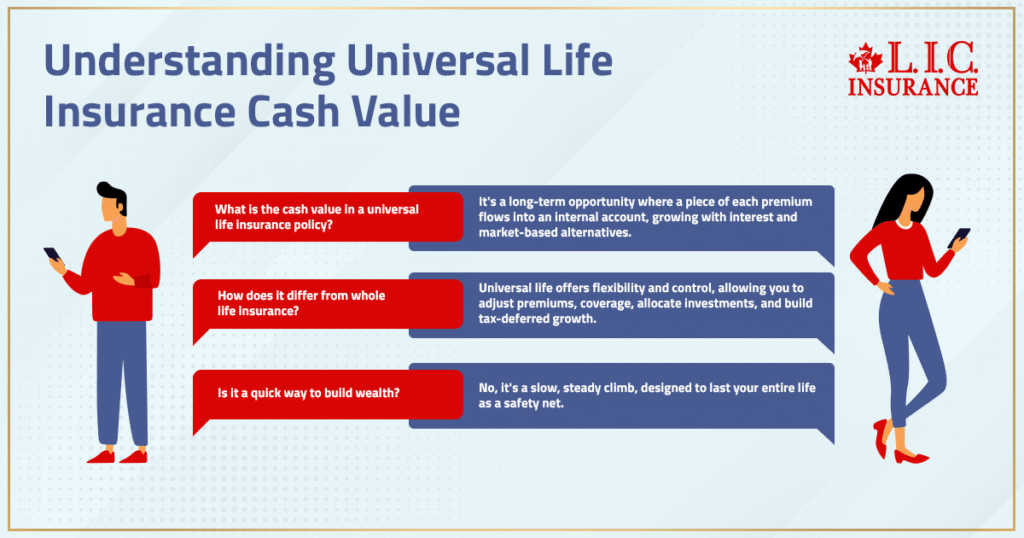
If you’ve never looked under the hood of a Universal Life Insurance Policy in Canada, here’s the engine block: every dollar you pay into it divides like cells into two engines —the death benefit and cash value.

And that second engine, the cash,” he said, “It’s a long-term opportunity.” A piece of each premium quietly flows into an internal account. The insurance company adds it with interest, sometimes with market-based alternatives and in some cases via a guaranteed minimum interest rate. This eventually turns into a large sum of money.

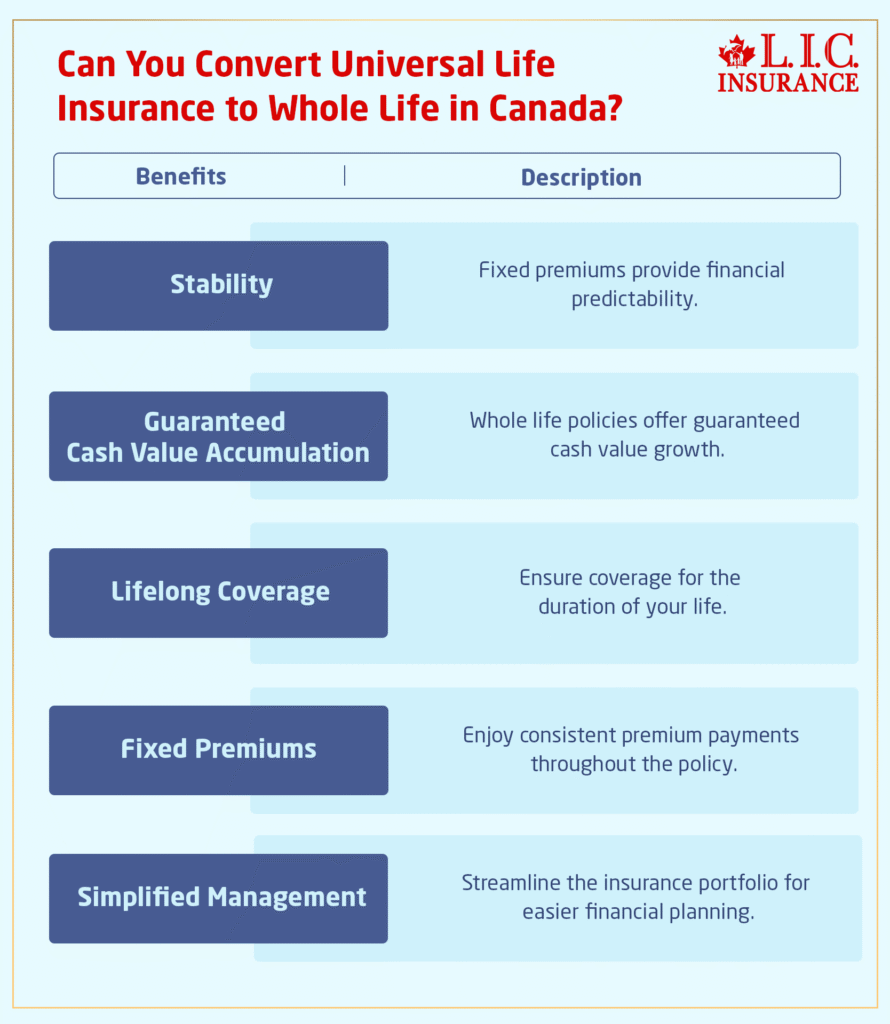
This is often mistaken for whole life, but the differences in structure are significant. Whole life provides the growth pattern; universal life provides flexibility and control. Both are types of permanent Life Insurance, but universal life offers the ability for:

  • Adjust premium payments
  • Increase or decrease Life Insurance Coverage
  • Allocate deposits into different investment accounts
  • Build long-term tax-deferred growth

It’s a slow, steady climb. But that’s exactly the point. A safety net shouldn’t sprint; it should last — ideally for your entire life.

Understanding Universal Life Insurance Cash Value

Why Universal Life Insurance Matters More In This Economic Era

Let’s be real. Costs are up. Taxes feel heavier. Retirements last longer. Families aren’t just looking at protection anymore — they’re looking for flexibility, lifelong coverage, and the ability to access cash without collapsing their financial plans.

And that’s where the benefits of Universal Life Insurance show up.

A well-funded Universal Life Plan can:

  • Build long-term assets quietly in the background
  • Cover you for a lifetime
  • Provide a tax-free death benefit
  • Cushion your savings
  • Replace lost wealth in retirement
  • Offer a more flexible structure than other Permanent Life Insurance Policies

Clients tell us they appreciate that their money isn’t locked away forever. If you need funds — whether for health, debt, or a family emergency — you’ve built your own reservoir.

And unlike Term Life Insurance, universal life isn’t designed to “expire on you.” It evolves.

Life Insurance, Cash Value, And Canada’s Tax Advantage

Here is where Canadians pay attention during our water cooler meetings: taxes.

The tax-free policy and cash value status of universal life enable the growth schedule (for the cash-value component to be graded) without taxation each year. That’s the big win. You are subject to tax only on any amounts withdrawn in excess of the adjusted cost basis.

We have clients call us every single day, asking if they’ll need to pay income tax when accessing their policies. The honest answer?

Not so often — and sometimes not at all.

Here’s how:

  • Policy loans are typically tax-free
  • Withdrawals up to the adjusted cost basis are tax-free
  • A well-managed plan can deliver tax-free retirement income

This is why many high-income Canadians prefer using Cash Value Life Insurance as part of their long-term savings structure. They want growth without the annual tax drag — something traditional investment accounts can’t promise.

How Universal Life Insurance Cash Value Actually Grows

Growth inside a universal life policy is driven by:

  • Premiums paid
  • The insurer’s credited rate
  • Chosen investment component options
  • Market-linked accounts
  • The internal cost of insurance
  • The policy’s age

As the years pass and you build deposits, the policy’s cash value grows more secure and solid. It’s not unusual for policies that have been held a long time to have several hundred thousand dollars, especially if they’ve been structured more aggressively early on.

And the magic here is that you decide how much to pay over and above the minimum premium. A lot of our clients prefer to “overfund” themselves early so they can maximize cash surrender value later.

Universal Life Insurance vs Term Life Insurance – Choosing The Right Path

Let’s dissect a comparison that Canadians tend to get wrong.

Term Life Insurance offers a high death benefit for an affordable premium. But the policy doesn’t have a savings component, no cash value, and it eventually lapses. Most families will outlive their term, and that’s why term is appropriate for mortgages, kids’ college years and income replacement — but not long-term wealth.

Universal Life, on the other hand:

  • Builds the policy’s cash value
  • Creates equity
  • Lasts for life
  • Offers an adjustable death benefit
  • Provides the option to withdraw or borrow
  • Creates a transferable asset for your family

As we always tell clients:

Term is temporary. Universal Life is strategic.

What Happens To Your Cash Value When You Pass Away

This is where many Canadians get surprised.

Depending on the structure, your policy may:

  1. Pay only the death benefit, or
  2. Pay death benefit + cash value

Option 2 is more expensive, but families who want to maximize legacy often choose it. The key is understanding how much of your policy’s cash value you want to leave behind.

And yes — the tax-free death benefit passes directly to your beneficiaries, bypassing probate in most situations.

How Canadians Access Cash From Their Universal Life Policy

There are three main ways to extract money:

1. Policy Loans

The favourite choice of retirees.

Your policy acts like a personal bank — you take a loan secured against your life policy, often at competitive rates. And it remains tax-free in most cases.

2. Withdrawals

This reduces the remaining cash value, and if withdrawals exceed the adjusted cost basis, you may pay tax. But for disciplined planners, it works beautifully.

3. Cash Surrender Value

If you fully surrender, you receive the accumulated cash surrender value. Not ideal, but better than walking away with nothing.

Life Settlements: A New Opportunity For Seniors Holding Universal Life Policies

This is where the conversation gets interesting — especially because Canadians rarely hear about this option.

Based on NAIC findings and independent research:

  • Seniors historically got nothing when they surrendered their policies.
  • Healthy seniors were once excluded from life settlements.
  • Now, many can qualify — even those with stable health.

A typical healthy senior settlement requires:

  • Age 75 or older
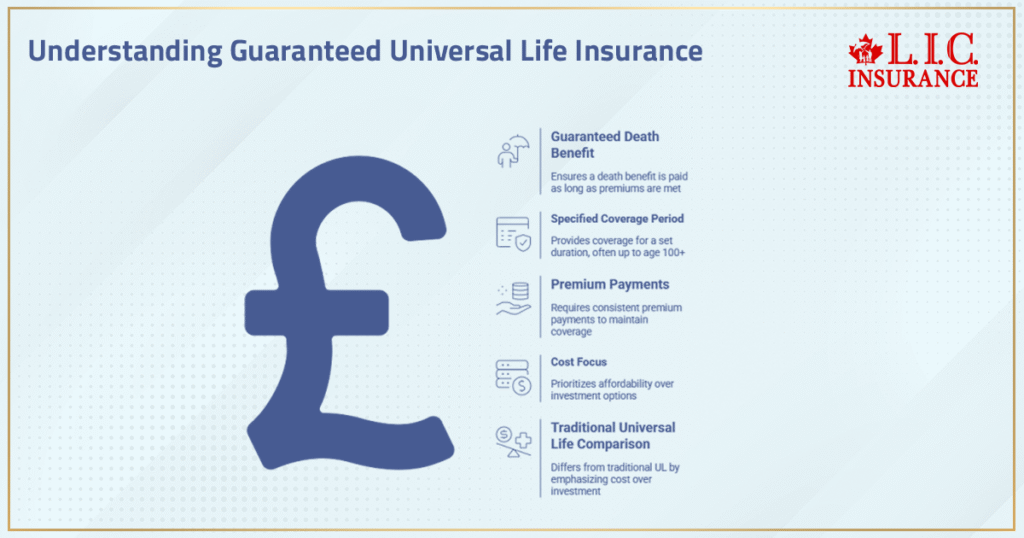
  • A Universal Life or Guaranteed Universal Life Policy
  • A death benefit of $250,000 or more

Let’s revisit the case study you provided:

Case Study: Robert, Age 75

He held a $1 million GUL policy.

No cash value.

No longer needed the coverage.

He received $150,000 from a life settlement — money he would have completely lost if he surrendered the policy.

Not enough Canadians know this. Not enough advisers address it. And too few families know that millions of dollars end up being thrown away each year when policyowners sit back and allow their policies to lapse because they’re convinced they have no other practical value.

We believe awareness is everything. When a policy can turn into retirement income, a lump sum or a bridge over tough years, families should know.

How Much Insurance Coverage Should Canadians Choose?

This depends on:

  • Income replacement needs
  • Debt
  • Family responsibilities
  • Business ownership
  • Legacy or charitable intentions

A universal life policy can be structured around exact needs — and changed as those needs evolve.

Investment Accounts Inside Universal Life Insurance Plans

Canadians enjoy a range of flexible choices:

  • Conservative interest accounts
  • Index-linked strategies
  • Market-linked exposure
  • Equity-based or fixed-income-style options

Unlike standalone mutual funds, the growth inside a Universal Life Plan occurs under a tax-deferred umbrella, as long as the policy remains within CRA guidelines.

This is why high-net-worth families and business owners frequently combine Universal Life with tax planning strategies.

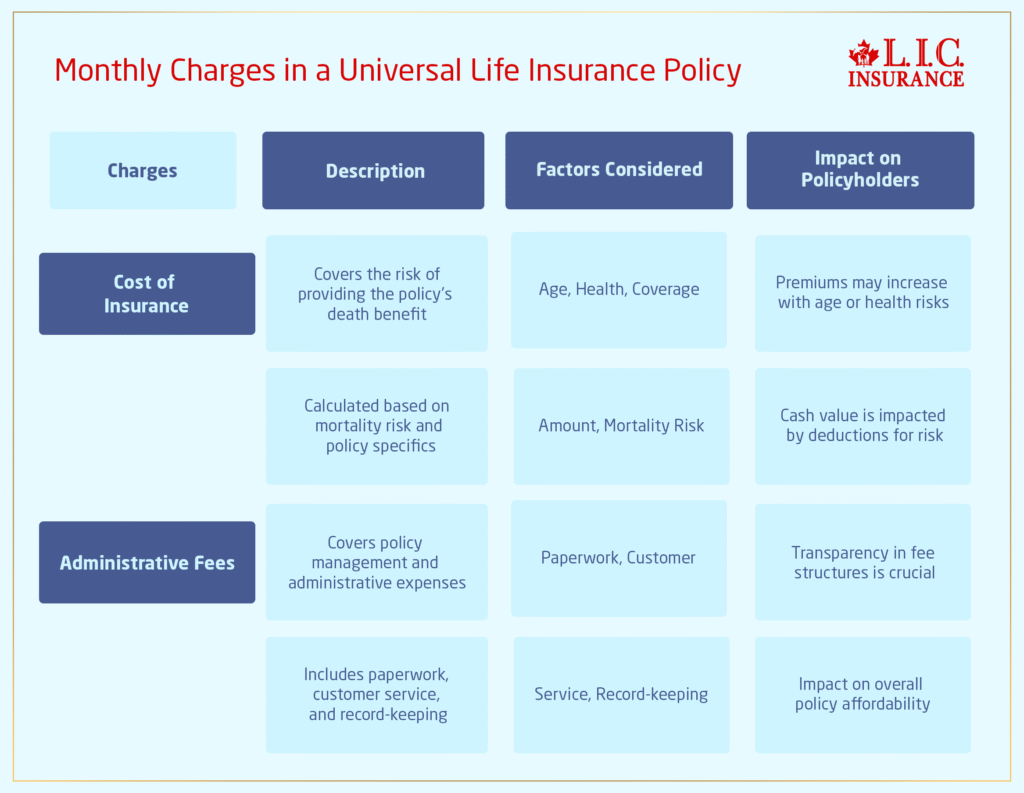
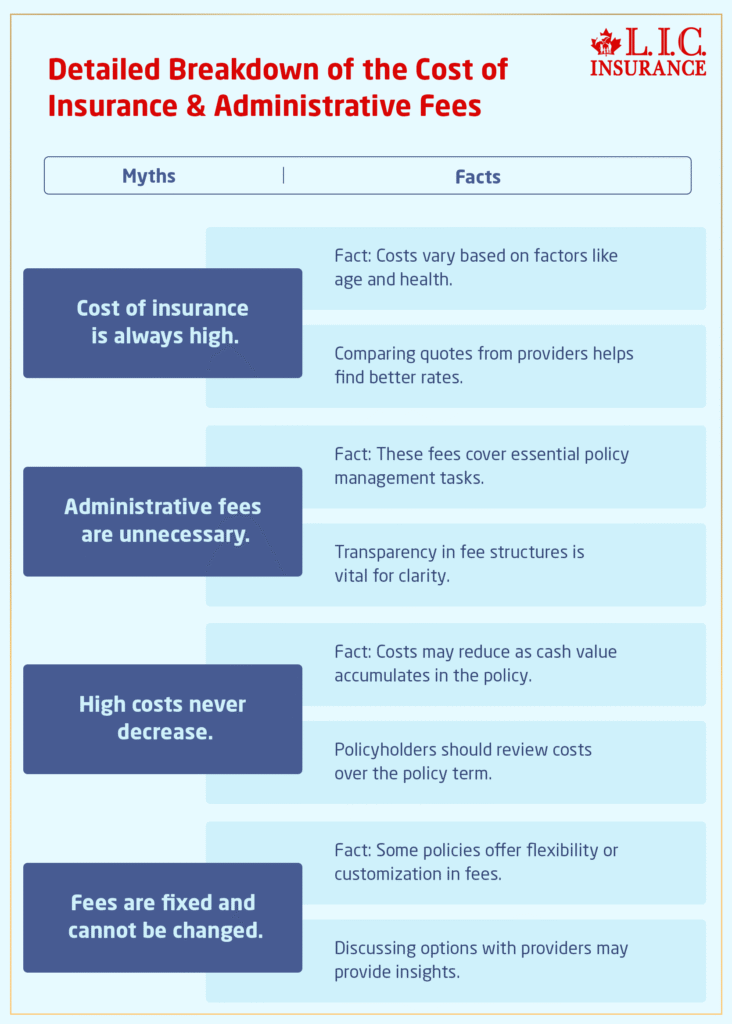
Understanding The Cost Of Universal Life Insurance In Canada

No surprises here — cost varies because the product is customizable.

Factors include:

  • Age
  • Health
  • Deposit strategy
  • Chosen coverage
  • Policy structure
  • Desired cash value performance
  • Internal insurance company charges

We constantly hear the question: “How much premium do I need to put in?”

The truth is, you can deposit minimally… or treat it like a long-term asset and fund it aggressively.

There’s no one path — only the path that matches your goals.

Universal Life Insurance Quotes Online — What Canadians Should Look For

Online quote tools are helpful, but they rarely tell the full story.

Before selecting a policy, Canadians must:

  • Understand whether a medical exam is required
  • Know how the policy will grow
  • Evaluate which Life Insurance companies are most competitive
  • Check how flexible the funding limits are
  • Review how the death benefit paid changes over time

Our advisors walk clients through these variables so they’re choosing strategically — not guessing through online calculators.

Cash Value Policy Strategies For Retirement Income

Some of the strongest retirements we’ve seen were built, not by chasing risky investments, but by layering in Cash Value Life Insurance earlier in life.

Here’s how retirees commonly use their universal life policies:

  • Tax-free policy loans for a steady retirement income
  • Increasing the lifetime coverage
  • Using policy loans instead of taxable withdrawals from RRSPs
  • Keeping overall taxable income low

This provides flexibility and peace in the years where predictability becomes priceless.

Why Canadians Should Take Universal Life Insurance Seriously

Universal life isn’t just another Life Insurance Policy.

It’s a long-term financial system wrapped in protection.

When structured properly, it offers:

  • Lifelong security
  • Tax-advantaged growth
  • A cash value reserve you can lean on
  • A tax-free death benefit
  • Liquidity when you need it most
  • A way to protect, grow, and transfer wealth efficiently

From our desk, after years of walking families through life’s hardest decisions, we can confidently say this:

Universal Life Insurance isn’t about buying coverage. It’s about building options — and Canadians deserve options.

Get The Best Insurance Quote From Canadian L.I.C
Call +1 416-543-9000 to speak to our advisors.
Get Quote Now

FAQs

The cash value of Universal Life Insurance provides you with room to create your financial road, instead of being confined by the framework. It adjusts when your income changes, your goals expand, or life nudges you in a different direction. You call the shots in terms of how the deposits flow and how you want your growth to correspond with your financial objective. It’s a flexible add-on to your Life Insurance in Canada, not a fixed contract.

Canadians also use Universal Life for a smoother retirement, with predictable and structured withdrawals. When used properly, the policy can lessen the need for fully taxable accounts. It mixes protection with strategy and makes it easier to balance your retirement income. Here is where Cash Value Life Insurance provides a quiet stabilizer.

Business owners like coverage that expands with them, not against them. Universal life morphs as their insurance needs change from personal to corporate and back again. It also provides the long-term room for an extra reservoir of value that they can unlock during periods of key business phases. It is protection that follows the realities of building wealth.

Vision is what calls to people who imagine on a decadal horizon — not the year-to-year fix but policies that come of age with them. The price is the ability for you to tweak the funding, change strategies, and create a cash value policy that will last an entire life. Instead, it is integrated into an overall wealth plan, not just a bill that you pay. That’s the long horizon at which universal life justifies itself.

Each insurer has its own pace when it comes to crediting interest, dealing with internal costs and supporting the policy’s long-term health. Strong companies provide clear options for investment accounts and a path to growth. The insurance company’s reliability determines how safely its policyholders can plan for the future. Stability rolls into the real advantage over time.

It all comes down to measured pacing and the right time to take a light touch and when to lay off. With proper design, having a loan doesn’t put pressure on the policy. The point is to watch how the loan meets with this continuing growth. This way, the policy’s cash value is able to work the way it was intended.

Universal Life allows you to steer the growth, whereas whole life sets and keeps the course straight. Some Canadians are looking for the frame of Whole Life; others, the steering wheel that universal life provides. Both are types of Permanent Life Insurance, but the journey is not the same. It’s a matter of whether you opt for the version that aligns with your own pace and priorities.

Online resources should be a starting place, not the whole picture. The real numbers shift depending on age, health, goals for coverage and how aggressively you want the cash value to grow. A good quote will need to factor in more than just monthly premium amounts. That’s why professional advice can still mould the long-term outcome more than a snap estimate.

How much is enough? That’s up to your shoulders — the weight of responsibilities, like income needs, long-term plans and the legacy you intend to leave. Other families use Universal Life to achieve a mix of protection and equity-building. Others zero in on the maximum death benefit. Every path is personal, and the numbers represent building your life.

Seniors appreciate how Universal Life continues working quietly even when traditional investments slow down. The cash value portion can support lifestyle shifts, health needs, or estate goals without forcing drastic moves. It becomes a familiar anchor in unpredictable years. Flexibility is the real benefit here — not just the coverage.

Key Takeaways

  1. Universal Life Insurance cash value is becoming a core financial tool in Canada
    Families are leaning toward long-term protection that also builds internal value, giving them more choice when planning around shifting responsibilities or future goals.
  2. A Universal Life Insurance Policy in Canada offers flexibility that traditional options can’t match
    Policyholders can adjust premium levels, shape their insurance coverage over time, and use different investment accounts to support personal strategies and changing priorities.
  3. The benefits of Universal Life Insurance extend beyond protection
    Canadians value the ability to grow funds quietly, keep savings tax deferred, and use the policy as a financial backup that can support retirement income or long-term plans.
  4. Universal Life Insurance vs Term Life Insurance isn’t just a cost comparison
    Term Life Insurance delivers straightforward coverage, while universal life builds equity and remains in force for an entire life, making it better suited for wealth planning.
  5. Access to cash value adds real financial stability
    Canadians appreciate having the option to borrow through policy loans, draw from the cash value policy when needed, or reposition funds without disrupting their long-term protection.
  6. Universal Life Insurance cost reflects lifetime value, not short-term expense
    When structured properly, deposits strengthen the policy’s cash value, increase future options, and help Canadians maintain a stronger long-term financial position.
  7. Life settlements create new opportunities for seniors with universal life policies
    Older Canadians who no longer need their coverage can convert their policies into meaningful payouts instead of lapsing or surrendering them for little or nothing.
  8. Universal Life Insurance quotes online are only a starting point
    Real planning requires understanding how much insurance coverage is needed, how the cash value portion fits into long-term goals, and how different Life Insurance companies structure growth.
  9. The policy’s cash value can complement retirement income strategies
    Tax-efficient access, thoughtful timing, and long-term planning help Canadians reduce dependence on taxable sources and create a steadier income during retirement.
  10. Universal Life Insurance remains one of the most adaptable permanent Life Insurance tools in Canada
    It supports lifelong coverage, tax advantages, evolving financial needs, and multigenerational planning — giving Canadians a foundation that grows with their lives.

Sources and Further Reading

  1. Canadian Life and Health Insurance Association (CLHIA)
    Industry reports, Canadian Life Insurance data, and policy trends.
    clhia.ca 
  2. Office of the Superintendent of Financial Institutions (OSFI)
    Regulatory guidelines for Life Insurance companies and policy structures.
    osfi-bsif.gc.ca 
  3. Canada Revenue Agency (CRA) – Life Insurance Tax Rules
    Official details on policy taxation, adjusted cost basis, and tax-exempt rules.
    canada.ca  – CRA Income Tax Folio S3-F9-C1
  4. National Association of Insurance Commissioners (NAIC)
    Research on policy lapse statistics, life settlements, and industry findings.
    naic.org 
  5. Conning Research & Consulting
    Independent reports on life settlements, senior markets, and UL policy trends.
    conning.com
  6. Fidelity Investments – Retirement Health Care Cost Estimates
    Annual research on projected medical expenses for retirees.
    fidelity.com  – Health Care Cost Estimate Reports 
  7. Munich Re / Swiss Re (Global Reinsurance Reports)
    Global insights on Life Insurance growth, mortality trends, and product performance.
    munichre.com
    swissre.com 
  8. Canadian Institute of Actuaries (CIA)
    Technical papers on policy design, mortality assumptions, and universal life mechanics.
    cia-ica.ca 
  9. Investment Industry Regulatory Organization of Canada (IIROC)
    Guidance on investment components and market-linked accounts.
    iiroc.ca
  10. Insurance Bureau of Canada (IBC)
    Industry overviews and consumer-friendly insurance explanations.
    ibc.ca 

Feedback Questionnaire:


    Universal Life Insurance In Canada: Benefits, Drawbacks & Costs Explained 2026

    Universal Life Insurance In Canada: Benefits, Drawbacks & Costs Explained 2026

    Universal Life Insurance In Canada Benefits, Drawbacks & Costs Explained
    Canadian LIC

    By Pushpinder Puri

    CEO & Founder

    SUMMARY

    The article explains how a Universal Life Insurance Policy that Canadian residents choose combines flexible premiums, lifetime coverage, and growing cash value. It details the benefits, drawbacks, and 2026 costs, outlines how Universal Life Insurance rates by age chart compares with other permanent plans, and shows how to get Universal Life Insurance quotes online for tailored protection and long-term investment options that support lasting financial security.

    Introduction

    A CPP Universal Life Insurance Policy. If you’re looking into Universal Life Insurance in Canada, you might already be aware that it’s one of the types of permanent life coverage out there. It’s a policy that doesn’t just protect your loved ones — it can also quietly build up your savings.

    More than half of Canadian households have some life insurance, according to the Canadian Life & Health Insurance Association, and permanent plans like Universal Life have not grown as quickly since 2024, as Whole Life Insurance has become more popular under post-IFRS-17 pricing changes. The answer is simple: Because Canadians don’t just want coverage, they also want flexibility and control. A Universal Policy allows you to pay your premiums however you choose, let cash value accrue, and use the policy as part of an investment strategy in which you can work to build up wealth over time.

    But like all good things in finance, it involves trade-offs. Let’s just be up-front about the benefits, drawbacks and costs of this uniquely Canadian product — and why in 2026 getting Universal Life Insurance quotes online can help to demonstrate how flexibly it can be made to perform.

    What Is Universal Life Insurance?

    A Universal Life Insurance Policy is a Permanent Life Insurance Policy that provides coverage for the duration of the insured’s lifetime and couples an insurance component with an investment feature. You pay a premium (a payment that includes the cost of your insurance and an amount contributed toward your policy’s cash value).

    Unlike Term Insurance, which expires after a predetermined time, Universal Life is good for your whole life — typically until age 95 or 120. It’s meant to provide financial protection for your loved ones with a guaranteed death benefit and give you access to participate in the market by way of investment options that grow the value of your money inside the policy.

    That could make a difference for entrepreneurs, freelancers or anyone with a lumpy income. If your business has a slow quarter, you can reduce your premium payments; when cash flow is strong, you can invest more in the investment portion.

    How Does a Universal Life Insurance Policy Work?

    Here’s the breakdown. When you make your premium payments, the insurance company takes out administrative costs, the cost of insurance and any surrender charges, if they apply. The rest goes into your cash value, which earns interest or returns according to the specific investment direction you’ve selected.

    That’s where the flexibility shines. You may pick fixed-interest accounts, equity-linked funds or even market-linked accounts (not U.S.-style Indexed UL, which is not offered in Canada) that follow an index such as the S&P/TSX Composite. It can also grow tax-exempt under CRA’s exempt test rules based on Canada’s tax treatment of life insurance restrictions.

    The policy offers:

    • Lifelong protection through a guaranteed death benefit.
    • Flexible premium payment options that can increase or decrease over time.
    • Cash value growth that you can borrow against, withdraw, or use to cover future premiums.

    But this also means you must be involved—Universal Life Insurance work requires a hands-on approach. If you stop monitoring your account, poor investment performance or rising administrative fees could erode your cash value.

    Types of Universal Life Policies in Canada

    Canadian insurers like Canada Life, Sun Life, and Manulife offer several variations, each tailored to a specific financial personality:

    1. Standard Universal Life

    The traditional plan. You control your premium payments, choose how your investment components are allocated, and watch your cash value grow at rates set by the insurer.

    2. Indexed Universal Life Insurance

    Canadian insurers do not offer true U.S.-style Indexed UL (IUL). Instead, they offer market-linked or equity-indexed accounts without the capped-and-floored return structure used in the United States.

    3. Variable Universal Life Insurance

    This product type is no longer available in Canada. No Canadian insurer offers Variable UL (VUL) in 2026, as the category was discontinued years ago.

    4. Guaranteed Universal Life

    A “set-and-forget” version. The cash value growth is minimal, but you get predictable premium payments and a guaranteed death benefit—ideal for those who want lifelong protection without market risk.

    Note: Several Canadian insurers streamlined their UL product lines between 2024 and 2026. Some investment options and policy variations available before 2024 may no longer be offered in 2026.

    Universal Life Insurance Cash Value

    The living, breathing part of your policy is the cash value. Consider it an internal savings account that accrues within your coverage. This balance increases with each payment you make, net of any deductions. The policy’s cash balance can then grow over time, as interest compounds in the perspective of a death benefit, leaving a powerful financial cushion.

    You can then access the money in several ways — by making a partial withdrawal, taking out policy loans, or even paying premiums with it if other months are tight. The value of a cash surrender — that is, the amount you’d get paid if you cancel it — will vary depending on how long you’ve owned the policy and how much growth has accumulated.

    Some Canadians access the cash value when needed, although using UL as an emergency fund is not recommended under the 2026 tax-exempt guidelines. Others see it simply as a supplement to their retirement income or even as collateral for a small business loan.

    Universal Life Insurance Premiums and Costs

    Flexibility is one of the major benefits of a Universal Life Plan. You can choose how much to pay beyond your minimum premium. Paying more increases your cash value, while paying less may still keep coverage in place if there is enough money in the account to cover the monthly cost of insurance.

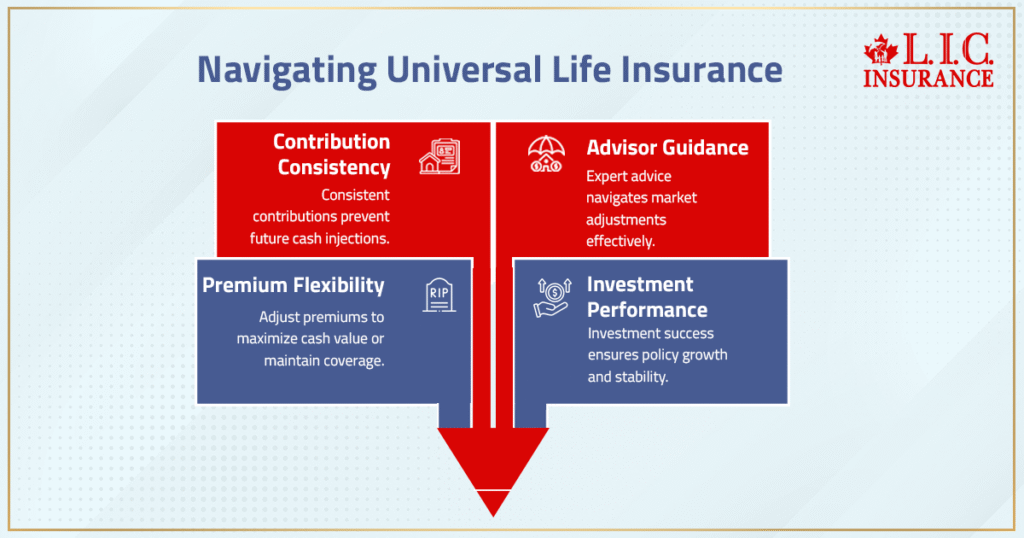
    But flexibility had its downside, too. If your investments don’t perform well, or if you skip contributions, the amount of money you owe could grow and ultimately require you to inject more cash later. That is, if you have a licensed insurance advisor in your corner who can support and guide you on managing market value adjustments to get the most from your investment strategy.

    Navigating Universal Life Insurance

    Universal Life Insurance Rates by Age in Canada (2026 Estimates)

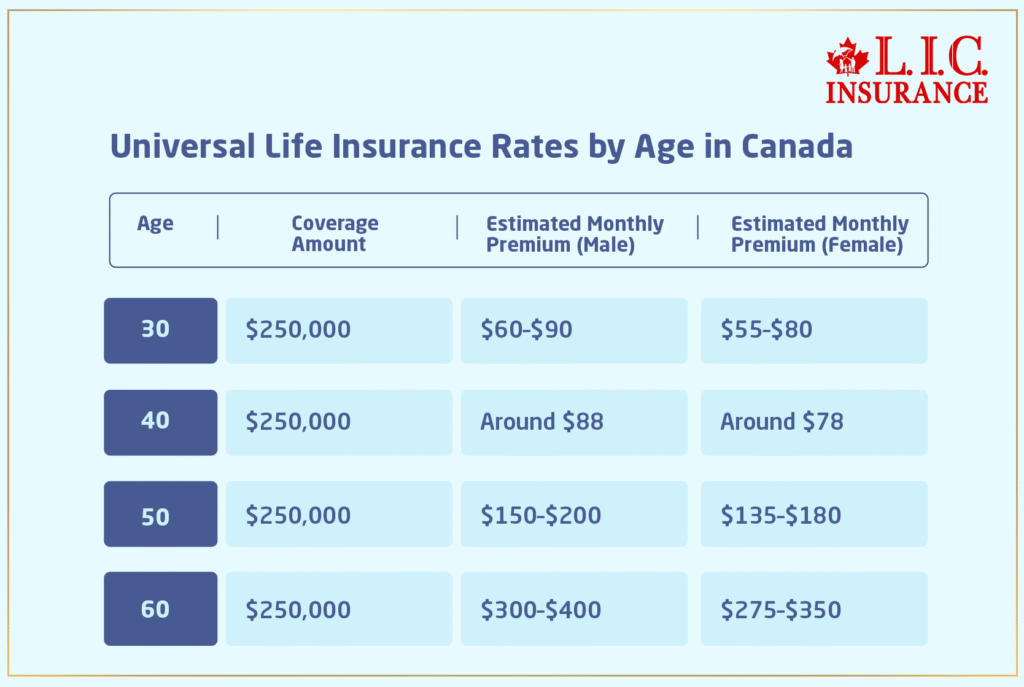
    Here’s a general look at the Universal Life Insurance rates by age chart based on 2026 market data from major Canadian insurers:

    Universal Life Insurance Rates by Age in Canada

    While Universal Life Insurance premiums are higher than term policies, they often cost less than Whole Life Insurance. And unlike term plans, they build cash value that can enhance your financial future.

    Benefits of Universal Life Insurance in Canada

    1. Flexible Protection and Premiums
      You control the premium payments and frequency. This flexibility is unmatched in other forms of life insurance.
    2. Tax-Free Growth
      Your cash value grows tax-exempt under CRA’s exempt test, meaning the returns compound without immediate income tax.
    3. Build Wealth While Protected
      Because of the investment portion, you can build wealth while keeping your family protected. For many, it’s a way to diversify beyond traditional savings accounts.
    4. Lifelong Protection
      Unlike term insurance, which expires, Universal Life offers lifetime coverage—ideal for estate planning or leaving a tax-free legacy.
    5. Adjustable Death Benefit
      You can modify your coverage amount to match your changing needs. Some even use their policies to fund buy-sell agreements or cover business debt.

    Drawbacks and Risk Factors

    1. Higher Costs
      Compared to term insurance, the cost of Universal Life is higher due to its investment features and lifelong nature.
    2. Complexity
      It’s not a “set it and forget it” product. You need to monitor performance, premium payment levels, and potential market value adjustments.
    3. Exposure to Market Fluctuations
      When markets fall, so can your cash value — although Variable UL is not offered in Canada in 2026.
    4. Possible Lapse
      If you don’t have enough cash value to cover the cost of insurance, your policy could lapse unless additional funds are paid.
    5. Administrative Fees
      Insurers charge ongoing administrative fees for managing the investment portion, which can slightly increase costs over time. Since 2026, many insurers have reduced their UL fund shelf options and increased administrative and management fees as part of IFRS-17 adjustments.

    Universal Life Insurance vs Whole Life Insurance

    Both are Permanent Life Insurance products offering cash value, but they differ in structure and management.

    • Whole Life Insurance provides guaranteed growth, fixed monthly premiums, and a steady death benefit—ideal for those who prefer predictability.
    • Universal Life, by contrast, provides flexibility, optional investment components, and variable returns—best for those comfortable managing their policy.
    • Since 2024, Whole Life Insurance has become more stable and more competitively priced than Universal Life due to IFRS-17 reserve requirements, which increased the long-term cost structure of UL policies. 
    • For Canadians who value lifelong protection and adaptability, Universal Life strikes a balance between investment opportunity and insurance protection.

    Using Universal Life Insurance as an Investment Strategy

    Universal Life can be more than protection — it is a quiet investment strategy that complements long-term financial planning. The cash value can be used to augment retirement income, as tax-exempt growth, or supplement—not replace—a Registered Retirement Savings Plan (RRSP).

    The investment funds within your policy may or may not outperform traditional savings depending on market conditions, fees, and risk exposure, when handled with care. That’s why insurers suggest you review the investment options — and discuss them with an adviser — annually.

    There are even Canadians to whom Universal Life makes sense in combination with small businesses — they secure key-person coverage and also build funds for future succession planning.

    However, rising COI charges after 2024 mean policies must be monitored more actively to protect long-term value.

    Is Universal Life Insurance Right for You?

    Ask yourself:

    • Do I want lifelong protection with flexible protection options?
    • Am I comfortable adjusting premium payments as my income changes?
    • Would I like to grow cash value that can help with financial obligations later?

    If your answers lean yes, a Universal Life Insurance Policy Canada could fit your financial goals. However, if you prefer stability and predictable returns, a Whole Life Plan might be more your style.

    How to Find the Best Universal Life Policy

    1. Compare Multiple Companies — Get Universal Life Insurance quotes online from major insurers.
    2. Review Investment Options — Make sure the available investment options match your investment strategy.

    Consult a Licensed Insurance Advisor — A qualified expert can tailor coverage and guide you through premium payment strategies that maximize growth while maintaining the policy’s tax-exempt status.

    Final Thoughts

    Universal Life Insurance in Canada is proving to be an increasingly versatile financial product. It takes care of your family, helps you accumulate wealth and gives you options no other plan offers.

    It’s not for everyone — you need comprehension, patience and a dash of fiscal discipline. But for those who crave lifetime coverage, tax-free growth and the freedom to create a policy around their life, Universal Life is a formidable option.

    We have had clients use this plan to pay off a mortgage, finance their retirement and leave legacies for generations. The best Universal Life Insurance quote Canada can provide is tailored to you: one that evolves as you do—safeguarding more than just your here and now but also the trajectory of your financial outlook.

    Get The Best Insurance Quote From Canadian L.I.C
    Call +1 416-543-9000 to speak to our advisors.
    Get Quote Now

    FAQs

    Hundreds of thousands of Canadians — not millions — use Universal Life Insurance as part of their long-term planning. The value of that policy’s cash portion can increase with your market-based investment options, so you can adjust your coverage based on upcoming financial responsibilities, such as retirement or estate planning.

    The cash value performance inside a Universal Life Plan is affected by interest rates. When interest rates rise, insurer crediting rates may increase; when rates fall, the long-term cost of insurance tends to rise, which can reduce projected cash value growth.

    If you take out a withdrawal or loan from the cash value of your policy that is beyond your adjusted cost basis, it could result in income tax consequences. With the policy maintaining its tax-exempt status under CRA rules, your investment fund grows tax-exempt within the plan.

    Absolutely. In Canada, for a majority of small businesses with Universal Life Insurance, it would serve as lifelong protection for key people and as a financial asset that builds up cash value. The accumulated funds, in turn, may contribute to business growth, succession plans or collateral for a loan from the bank. Rising COI and fee structures after 2024 mean owners should monitor performance annually.

    Compared to other Permanent Life Insurance Policies, Universal Life also allows the flexibility of premium payments and investment options that can be adjusted. You can mould cash value growth to suit evolving objectives, which you can’t do with a traditional whole life policy.

    It can happen if the portion of the investment that you’ve put to work underperforms, or if certain market risks go rogue. The cash value in the policy is based on returns from interest and the market. Nonetheless, most plans guarantee a minimum interest rate, preventing you from losing it all.

    Not always. Certain providers offer simplified or express approval for limited levels of coverage. But for more coverage or investment options, a complete medical exam is generally required to obtain cheaper Universal Life Insurance rates.

    A lot of Canadians use Universal Life Insurance to transfer wealth in a tax-efficient way. Its income-tax-free death benefit can be used to pay any income tax liabilities or made available as liquidity to heirs. The cash value has other financial advantages to it as well, such as the ability to make strategic withdrawals and keep your estate whole.

    If your cash value is strong, it can float to pay the premiums for a period of time. But if it falls too low, your coverage may lapse. As long as you consult with a licensed insurance advisor to understand your account policy’s cash balance, it can be easy simply by not paying.

    Yes, many entrepreneurs do use it to protect key people or partners. The policy’s investment fund can grow tax-deferred, while the death benefit provides continuity in the event a business owner dies, so Universal Life is an intelligent long-term asset for small businesses.

    Key Takeaways

    • Universal Life Insurance in Canada provides both lifetime coverage and the ability to build cash value, offering a flexible alternative to traditional plans.
    • A Universal Life Insurance Policy Canada residents to adjust premium payments, manage investment options, and grow funds that can be used for future financial obligations or retirement goals.
    • The 2026 Universal Life Insurance rates by age chart shows premiums rise with age, but the plan’s tax-free growth and death benefit make it a powerful long-term asset.
    • Indexed and variable Universal Life Insurance options offer greater investment components and growth potential, though they carry higher risk factors and require active monitoring.
    • A well-structured Universal Life Plan supports small businesses, estate planning, and legacy goals by combining insurance protection with investment strategy and tax-advantaged growth.
    • Before buying, always compare Universal Life Insurance quotes online and work with a licensed insurance advisor to design coverage that fits your income, goals, and tolerance for market risk.

    Sources and Further Reading

    • Canada Life — “Universal Life Insurance” overview and features (insurance + investment component) Canada Life
    • Canada Life — Universal Life advisor guide/product features (Stable Growth Account, AI 100 COI, etc.) acp.canadalife.com+1
    • Manulife UL product page — flexibility, customization, how their Universal Life product is marketed in Canada manulife.ca
    • Sun Life Canada — Universal Life Insurance (death benefit, premium flexibility, investment savings elements) Sun Life
    • Canada.ca (Government of Canada) — life insurance basics, how Universal Life works in a Canadian regulatory context Canada.ca
    • Lifebuzz Canada — detailed explanation of Universal Life mechanics, indexed and variable forms in Canada lifebuzz.ca
    • PolicyMe — pros, cons, and practical commentary about Universal Life as an “investment strategy” for Canadians policyme.com
    • Assuris — protecting policyholders in case an insurer becomes insolvent in Canada (important for life insurance risk) Wikipedia
    • Insurance-Portal / article on Manulife reinsurance of Universal Life block in Canada (industry risk/capital moves) insurance-portal.ca

    Feedback Questionnaire:

    Your experience and opinions help us guide Canadians toward smarter insurance and investment decisions.
    Please take a minute to share your thoughts below.


      Universal Vs Variable Universal Life Insurance In Canada: Which Policy Fits You Best

      Universal Vs Variable Universal Life Insurance In Canada: Which Policy Fits You Best

      Universal Vs Variable Universal Life Insurance In Canada - Which Policy Fits You Best
      Canadian LIC

      By Harpreet Puri

      CEO & Founder

      SUMMARY

      Universal Life Insurance Canada and Variable Universal Life Insurance Policy are compared to highlight benefits, flexibility, cash value growth, and lifelong coverage. The content explains how Universal Life Insurance works with guaranteed minimums, while Variable Universal Life offers investment options and higher risk. Key differences, premium payments, tax-free death benefit, and estate planning advantages are outlined to help assess which Permanent Life Insurance Policy fits financial goals.


      Introduction

      Money decisions… they creep up on families. Not the daily ones about coffee runs or skipping takeout. The real weight comes later — when someone isn’t here anymore. The mortgage. Tuition bills. Credit cards. Those obligations don’t disappear. They land on the people left behind.

      That’s why life insurance matters. It isn’t just another product; it’s a safeguard. The difference between a family scrambling and a family staying secure.

      In Canada, there isn’t just one choice on the shelf. Term life insurance works for short-term needs. Whole life insurance appeals to those who want fixed costs and predictable growth. But when clients sit with us, the conversation often shifts toward Universal Life Insurance Canada and the Variable Universal Life Insurance Policy.

      Both are permanent. Both carry a death benefit. Both give you a chance to build cash value. But they don’t operate the same way, and choosing which one to fund is where the real decision happens.

      Universal Life Insurance

      A Universal Life Policy is designed to adjust with you, not against you. Premium payments are flexible. Pay more when income allows, reduce them if life gets tight.

      Part of those payments goes toward the cost of insurance. The rest builds inside the cash value component.

      Here’s what that means in practice:

      • The insurance company credits interest. Rates can shift with markets, but there’s almost always a guaranteed minimum. It cushions the policy from extreme swings.
      • That cash value portion isn’t locked away. You can use it. Withdraw. Take a policy loan. It’s there for financial hardship or future expenses.
      • And the death benefit? It stays intact, tax-free, supporting family members with funeral costs, estate taxes, or outstanding debt.

      It’s Permanent Life Insurance, but more adaptable than whole life. We often see it as a middle ground — steady enough to provide security, yet flexible enough to work in real-world financial planning.

      Variable Universal Life Insurance

      A Variable Universal Life Insurance Policy takes the same foundation but adds an investment component.
      Your cash value isn’t just credited interest. It’s allocated to subaccounts — mutual funds, equities, and bonds. You choose from the investment options your insurance company provides.

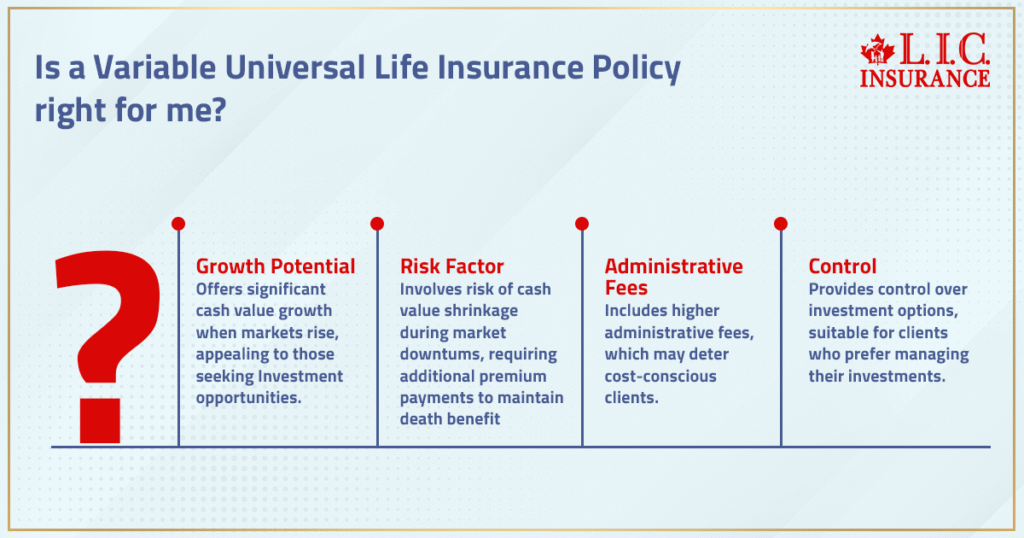
      When markets rise, your cash value growth can be significant. When markets fall, your accumulated cash value may shrink. And if it shrinks too far, the death benefit could be at risk unless additional premium payments are made.

      It’s a higher-risk design, and yes, there are more administrative fees. But for clients who want growth potential and control, it can be the right fit.

      Is a Variable Universal Life Insurance Policy right for me
      Death Benefit: Why It Matters

      All the charts and numbers eventually circle back to one question: what does your family receive when you’re gone?

      That’s the death benefit. The payment provides financial protection when your income disappears. The cheque can cover outstanding debt, credit card balances, even basic groceries and household costs.

      Both universal and Variable Universal Life provide a death benefit payout. Both are designed to deliver that payout tax-free. But with variable policies, markets can influence how stable that protection feels.

      Cash Value: The Secondary Strength

      The cash value is often the overlooked part of Permanent Life Insurance Policies. It builds slowly with a universal life policy, more aggressively — but less predictably — with Variable Universal Life.

      Either way, it’s there. It can be borrowed against for personal loans, car loans, or education costs. It can provide financial support when other resources aren’t enough. Just remember: using it reduces the total death benefit if it’s not repaid.

      Indexed Universal Life Insurance

      There’s also a hybrid — Indexed Universal Life Insurance.

      Here, the cash value is linked to a market index like the S&P 500. Growth is tied to performance, but there’s still a guaranteed minimum. For Canadians who want some market exposure without taking on full investment risk, it can be a practical middle ground.

      How Much Life Insurance Do You Need?

      There isn’t one answer.

      For some families, enough coverage means paying off the mortgage and leaving room for estate taxes. For others, it’s about funeral costs, smaller debts, or providing a cushion for children’s education.

      We don’t hand out one-size-fits-all figures. We run projections. We factor in personal loans, credit card balances, and future expenses. Then we help decide whether an affordable life insurance policy, like term insurance, works, or if Permanent Life Insurance with lifelong coverage makes more sense.

      Comparing Life Insurance Types

      To keep the options clear:

      • Term Life Insurance Policy – Lower premiums, temporary coverage, no cash surrender value.
      • Whole Life Insurance – Fixed premiums, guaranteed cash value accumulation, lifelong coverage, possible dividends.
      • Universal Life Policy – Flexible premiums, adjustable death benefit, interest-based cash value growth.
      • Variable Universal Life Insurance – Flexible premiums, investment options, higher risk, higher reward.

      Every policy type supports a different set of financial goals.

      The Role Of The Insurance Company

      The insurance company behind your policy matters as much as the policy itself.

      Different providers apply different rules on cash surrender value, surrender charges, policy loans, and administrative fees. Choosing poorly can mean higher premiums compared to other options, or not enough cash value to keep lifelong protection in place.

      That’s why we compare policies across multiple insurance companies. We deliver a Universal Life Insurance quote online right alongside a variable illustration, so you see the differences clearly.

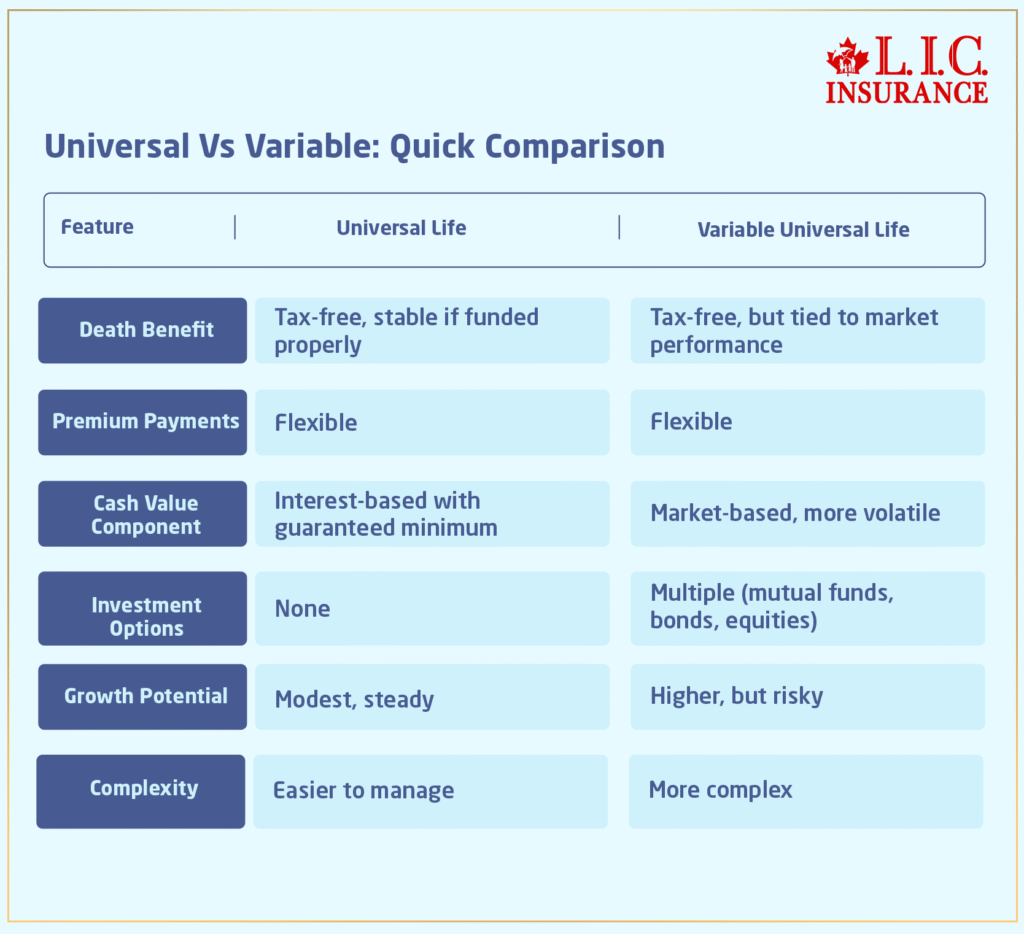
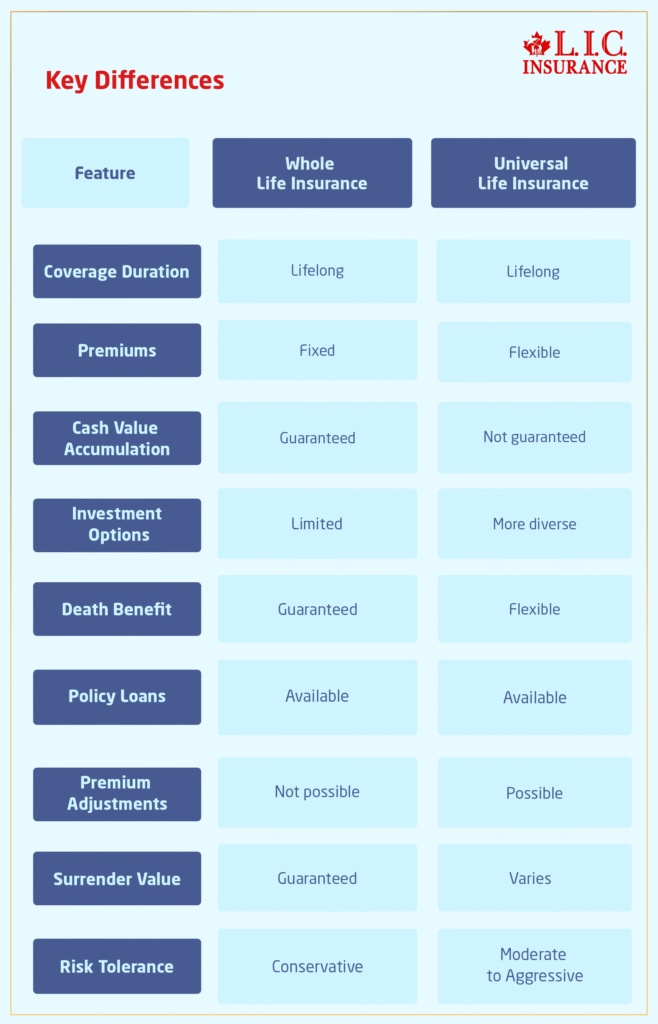
      Universal Vs Variable: Quick Comparison

      Universal Life Insurance Vs Variable Universal Life Insurance In Canada

      Choosing The Right Policy

      If you value predictability — modest cash value, guaranteed minimums, fewer surprises — Universal Life Insurance Canada is the likely fit.

      If you value control — the ability to select investments, pursue higher growth, and accept higher risk — then a Variable Universal Life Insurance Policy may suit you better.

      And if neither seems right? Whole life may provide security. Term insurance may handle a specific period. That’s why conversations with experienced insurance advisors matter more than sales brochures.

      Canadian LIC’s Perspective

      We’ve seen both sides. Clients who were unsettled when their policy’s cash value declined in weak markets. Others benefited when their Variable Universal Life policy grew significantly. The difference? They understood what they were signing up for.

      We walk clients through how Universal Life Insurance works. We compare Universal Life Insurance quote online options, explain the benefits of Universal Life Insurance, and highlight the risks in variable policies.

      Because in the end, this isn’t just about buying insurance. It’s about financial security for your family, managing future expenses, and building a financial future that lasts.

      Get The Best Insurance Quote From Canadian L.I.C
      Call +1 416-543-9000 to speak to our advisors.
      Get Quote Now

      FAQs

      Here’s what we typically tell clients: Whole life insurance is inflexible. Fixed premiums. Guaranteed growth. No surprises. Universal life policy is felt differently — it flexes throughout your life. Payments are not set; the cash value portion changes with it, and yet you still have a death benefit that covers you for your entire life.

      It can, but it’s going to be bumpy. The investment aspect enables your cash value to pursue greater growth. Mutual Funds, stocks or other features offered by the insurance company. And if the market does well, it’s fine. If it doesn’t? The risk is yours. Some people love the control. Others find it stressful.

      Yes, that’s the promise — but it’s not merely a payout. It’s the death benefit that keeps family members afloat when income has ceased. It’s tax-free, so money goes directly to cover funeral expenses, unpaid debts, or estate taxes. We’ve witnessed families depend on this support when everything else felt uncertain.

      There isn’t a magic number. Some homeowners are only interested in making mortgage payments. Others require sufficient life insurance to tackle car loans, credit card balances or future bills for something like kids’ tuition. We do real numbers with clients — not just “how much life insurance” in theory (plugging a figure out of thin air), but also what makes sense to their financial future.

      Cash surrender value is what you would get if you cancelled the policy. It’s not the equivalent of cash value growth over time, but it is there if you need to access cash. Just remember this: Go too soon and you could end up paying surrender charges. That’s why we say to people: Universal policies are most effective when you give them a chance.

      Sure — we witness it every day. Universal Life Insurance Canada Universal Life Insurance offers coverage for life and a tax-free payout at death. Families frequently use it to pay for estate taxes so their children don’t have to sell property or tap savings. It’s one way to leave financial security rather than just not coming right out of a crisis.

      Variable Universal Life Insurance puts you right in the stock market. Subaccounts rise and decline, and so does the cash value in your policy. Indexed Universal Life Insurance is distinct — it’s connected to a market index but with a guaranteed minimum. One is high control, high risk.’ The other rebalances growth with a safety net.

      Yes — and clients do. Some use the policy loan feature to borrow money for personal loans or car loans. Some take the withdrawals to finance a cash crunch or even large future purchases. Just remember: Removing dollars brings down the overall death benefit received by your family. That’s the tradeoff.

      Premium payments are the fuel. They pay insurance charges and feed the cash value component. Skip too many times and the policy starts draining itself, potentially jeopardizing lifelong coverage. We always have to remind people: universal life is flexible, but in ‘flexible’ it doesn’t mean optional.

      Don’t just ask about the shiny features. Ask about administrative fees. Inquire about how the insurance company treats policy loans, cash surrender value, or a lapse in making premium payments if you have financial trouble and can’t pay premiums for several months. Clients regret not having asked those questions in the beginning, we’ve seen. Clarity now avoids problems later.

      Key Takeaways

      • Universal Life Insurance Canada gives stability — flexible premium payments, steady cash value growth with a guaranteed minimum, and a tax-free death benefit your family can count on.

      • Variable Universal Life Insurance Policy puts growth in your hands — investment options, higher upside, but also higher risk if markets fall.

      • Both are Permanent Life Insurance Policies: they last your entire life and build a cash value portion you can tap into for future expenses, loans, or emergencies.

      • Universal life = predictable. Variable Universal Life = more control, but more volatility. Neither is “better,” it depends on your financial goals and comfort with risk.

      • For estate planning, covering future expenses, or leaving a stable death benefit, Permanent Life Insurance Policies (universal, variable, or even indexed Universal Life Insurance) can provide financial security that term life insurance alone cannot.

      • The right choice comes down to how much life insurance you need, your appetite for investment growth, and whether lifelong coverage or temporary coverage fits your family’s financial future.

      Sources and Further Reading

      1. Canadian Life & Health Insurance Association — CLHIA Factbook
        Detailed statistics on life insurance penetration, claims paid, and market trends in Canada. clhia.ca+2clhia.ca+2

      2. Government of Canada – Life Insurance (Financial Consumer Agency)
        Official overview: how universal life, whole life, term life insurance work in Canada; rights & rules. Canada.ca

      3. Office of the Superintendent of Financial Institutions — Life Insurance Regulatory Framework
        Regulatory rules, capital adequacy, and risk-based oversight for life insurers in Canada. osfi-bsif.gc.ca+1

      4. NerdWallet — What Is Universal Life Insurance?
        A consumer-friendly breakdown of universal life vs other types, pros and cons, and cash value behaviour. NerdWallet

      5. Equitable Life of Canada — What Is Universal Life Insurance?
        A Canadian insurer’s explanation of how the policy works, its flexibility, and its savings feature. equitable.ca

      6. Assuris – Protection For Policyholders
        Info on what happens if a life insurer becomes insolvent, and how your policy is protected in Canada. Wikipedia

      7. “A Guide To Life Insurance” — CLHIA Consumer Brochure
        A neutral, educative guide for consumers: types of life insurance, how to choose, and legal promises. clhia.ca

      Feedback Questionnaire:


        Universal Life Insurance Plan Vs. Indexed Universal Life: Which One Fits Your Financial Goals

        Universal Life Insurance Plan Vs. Indexed Universal Life: Which One Fits Your Financial Goals

        Universal Life Insurance Plan Vs. Indexed Universal Life
        Canadian LIC

        By Harpreet Puri

        CEO & Founder

        SUMMARY

        Universal Life Insurance Plan in Canada and Indexed Universal Life Insurance Policy both offer Permanent Coverage, flexible premium payments, and cash value growth. Universal Life Insurance benefits include steady accumulation with insurer-declared rates, while Indexed Universal Life links growth to a market index with downside protection. The comparison highlights how each policy fits different financial goals and levels of risk tolerance.

        Introduction

        We will be upfront. Most families we meet don’t wake up thinking about Universal Life Insurance benefits. They come in asking about term Life Insurance because it’s cheap and easy. But once we start talking about financial goals, about building something for the future, about protecting children and covering estate taxes, the conversation shifts. That’s when Universal Life and Indexed Universal Life Policies enter the picture.

        Both are Permanent Life Insurance. Both last your entire life if you keep up with premium payments. Both give you a death benefit. But how they grow your cash value component, and how much risk you’re willing to accept, that’s where the decision gets personal.

        Life Insurance Policy: Getting The Basics Right

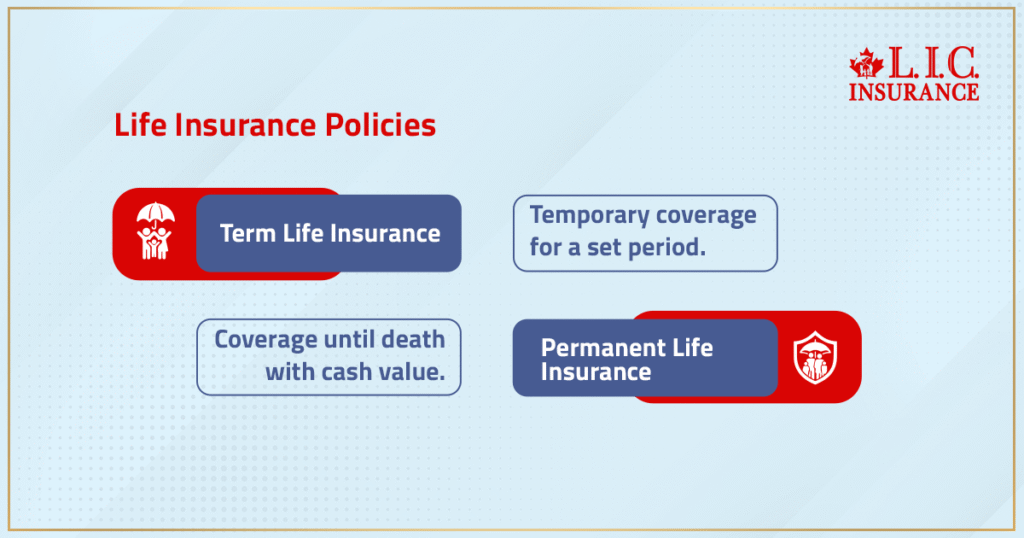
        Let’s slow down. A Life Insurance Policy is either temporary or permanent. The Term is temporary. Universal, indexed universal, whole life, variable Universal Life—those are Permanent Life Insurance options. Permanent means coverage stays in force until you pass away, not until a set year.
        Permanent Life Insurance Policies do more than just pay out a tax-free death benefit. They also build a cash value. That cash value account is what sets these Life Insurance types apart from plain Term Life Insurance. Some clients use it as supplemental retirement income. Others let it sit to cover estate taxes. A few draw from it during emergencies.

        The way that cash value grows is what separates a Universal Life Insurance Plan in Canada from an Indexed Universal Life Insurance Policy.

        Types of Life Insurance Policies

        Universal Life Insurance Coverage Benefits In Simple Words

        Universal Life Insurance is flexible. That’s the word we use most often. Flexibility in premium payments, flexibility in how your death benefit is structured, and flexibility in how you use your policy’s cash.

        Here’s how it works:

        • You pay premiums on a monthly or annual basis.
        • Part of that money goes toward insurance costs, and the rest builds cash value.
        • You can add more than the minimum if you want your cash value growth to be stronger.
        • The insurance company declares the interest rate, so you know where you stand.
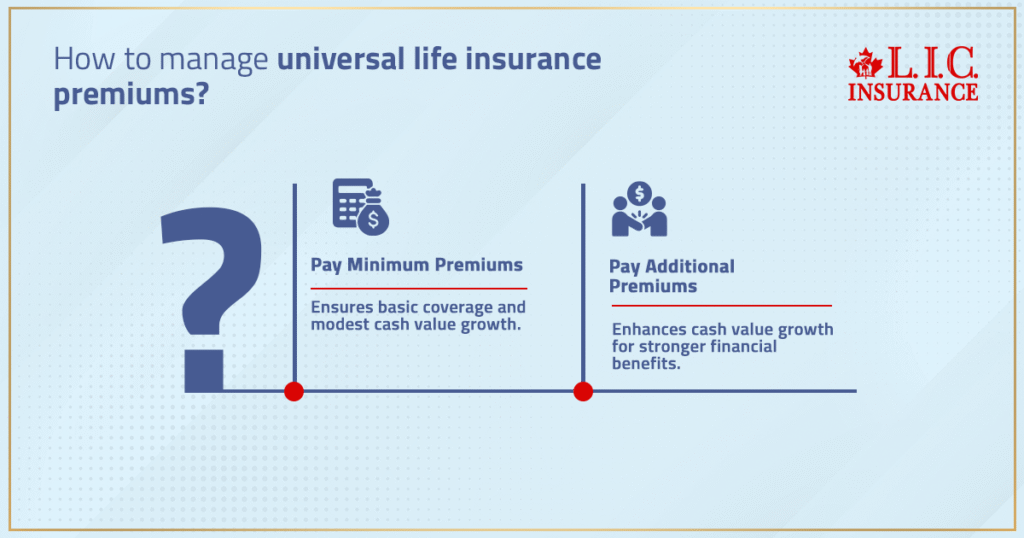
        How to Manage Universal Life Insurance Premiums

        People like this because it’s predictable. You are not watching stock market index numbers every night. You’re not worried about market performance cutting into your savings. You’re building steady cash value growth on a tax-deferred basis.

        And of course, the permanent death benefit protection is always there. Your beneficiaries receive it tax-free. It handles final expenses, it can cover estate taxes, and it makes sure your family isn’t stuck with debt.

        Some clients see the cash value as a backup fund. Others use it as part of a broader financial strategy for retirement. That’s the beauty of Universal Life Policies—you have room to adapt.

        Indexed Universal Life Insurance: A Different Angle

        Indexed Universal Life, often shortened to IUL, changes the way your cash value grows. Instead of being tied to rates declared by the insurance company, the cash value component is linked to a market index. Not direct market exposure—you’re not buying mutual funds. The insurance company simply credits your growth based on how the market index performs.

        Think S&P 500 or another index. If the market index goes up, your cash value growth is stronger. If the index drops, you don’t lose money. That’s called downside protection. But growth is capped, so you never get the full upside either.

        Here’s what clients usually care about:

        • You still have Permanent Coverage and tax-free death benefit protection.
        • Premium payments remain flexible.
        • Growth potential is higher than that of traditional Universal Life.
        • Market risk is limited by downside protection.

        Indexed Universal Life Insurance is for someone comfortable with a bit more risk tolerance. They want cash value accumulation that outpaces what an insurance company credits on traditional Universal Life. But they don’t want to risk losing everything in a bad year, like with variable Universal Life Insurance.

        Death Benefit: The Core That Never Changes

        No matter what you choose—Universal Life or Indexed Universal Life—the death benefit is the non-negotiable piece. It’s Permanent Coverage. It’s a financial safety net. It pays out on a tax-free basis.

        We have seen families use it to cover final expenses. We have seen it settle estate taxes. Sometimes it simply creates a legacy, money for the next generation. This is the part that makes Permanent Life Insurance coverage so valuable. Term Life Insurance runs out—permanent stays.

        We remind clients that while we spend time analyzing cash value growth, the death benefit is why you buy Life Insurance in the first place. Everything else is additional.

        How A Life Insurance Company Shapes These Policies

        Every insurance company designs their policies a little differently. They set participation rates for Indexed Universal Life. They decide on caps for market performance. They declare interest rates for traditional Universal Life Insurance Policies.

        That’s why you can’t just go by product names. Universal Life from one Life Insurance company may look different than another. Same with Indexed Universal Life Insurance.

        We always pull Universal Life Insurance Quotes Online and compare them against indexed universal illustrations. You see the numbers side by side. Premium payments, policy’s cash growth, and long-term death benefit values. Only then can you see which Life Insurance Plan supports your financial goals.

        Financial Goals: Decide Which One Fits

        It always comes back to this: what are your financial goals?

        • If you want stable growth, low stress, and predictable cash value accumulation, a Universal Life Insurance Plan in Canada is the fit.
        • If you want higher potential returns, are okay with caps, and have personal risk tolerance for index-linked growth, Indexed Universal Life works better.

        Ask yourself:

        • Do I want Permanent Coverage, mostly for estate planning?
        • Will I use cash value as supplemental retirement income?
        • How important is downside protection compared to guaranteed steady growth?
        • What does my broader financial strategy look like?

        There’s no best Life Insurance Policy in general. There’s only what fits your financial circumstances and your family.
        Life Insurance Types Worth Mentioning

        We’ve focused on Universal Life and Indexed Universal Life. But clients often ask about whole Life Insurance. Whole life is permanent, with fixed premiums and guaranteed cash value. Some people prefer the certainty, even if it comes with higher premiums.

        Variable Universal Life Insurance, or variable Life Insurance, is another option. It ties cash value growth directly to investment options, like mutual funds. That means higher upside, but also the real chance to lose money. For some, that level of market risk is too much.

        These Life Insurance types exist because not everyone shares the same goals or risk tolerance. Universal Life Policies sit in the middle: more flexible than whole life, less volatile than variable Life Insurance. Indexed Universal Life sits between as well, adding growth potential while protecting against losses.

        Talking Through Real Choices With Clients

        Here’s what happens in practice. A family comes in with a mortgage, young kids, and a need for Permanent Coverage. They’re not focused on market index charts. We lean toward Universal Life Insurance benefits—predictable, stable, with room to add premiums later when income rises.

        Then we meet professionals who already max out retirement accounts. They want Permanent Coverage but also a way to push cash value growth harder. An Indexed Universal Life Insurance Policy fits them better. They like the idea of tying growth to market performance without direct market exposure.

        This is how Life Insurance Policies work in real life: not as abstract concepts but as tools matched to financial goals and personal risk tolerance.

        The Role Of An Insurance Professional

        Honestly, these decisions are not easy without help. An insurance professional runs projections. We explain how participation rates change indexed universal returns. We walk you through tax-deferred growth. We show what happens if you pay premiums at minimum levels versus adding extra each year.

        We don’t say “this is the only answer.” We compare Universal Life Policies against Indexed Universal Life. We explain Life Insurance costs, cash value growth, and the long-term picture. That’s how you choose a policy that aligns with your financial plan.

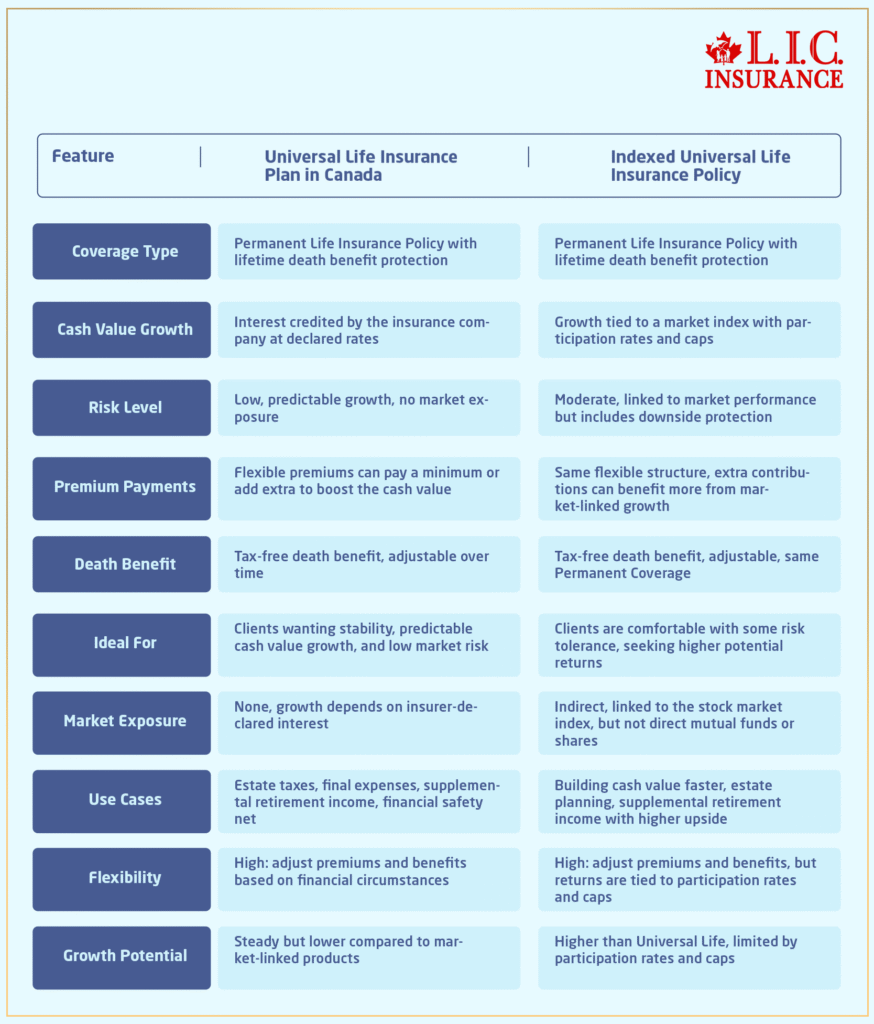
        Universal Life Insurance Plan in Canada vs. Indexed Universal Life Insurance Policy

        Our Closing View

        Universal Life and Indexed Universal Life are both Permanent Life Insurance Policies. Both provide tax-free death benefit protection, both let you build a cash value component, and both give you flexibility with premium payments.

        Universal Life is the choice if you want predictable growth and simple management. Indexed Universal Life is the choice if you want more upside, are okay with caps, and value downside protection.

        Your financial goals, personal risk tolerance, and broader financial strategy determine the most sensible path.

        We’ll run the numbers, request a Universal Life Insurance Quotes Online, and match it against Indexed Universal Life illustrations. That way, you see how the policies look in your real financial circumstances. No pressure, no generic advice—just clarity about which Life Insurance Plan fits your future.

        Get The Best Insurance Quote From Canadian L.I.C
        Call +1 416-543-9000 to speak to our advisors.
        Get Quote Now

        FAQs

        Here’s what happens. Cash value inside a Universal Life Insurance Policy grows on a tax-deferred basis, so you’re not reporting it every year the way you would with investment income. Later on, if you want extra retirement income, you can access the policy through withdrawals or loans. That flexibility can mean less income tax than if you were to withdraw from RRSPs directly.

        Consider Indexed Universal Life as a middle-of-the-road option. Your cash value growth is based on a market index, but you are not actually invested in it. You have downside protection, so you don’t lose money in a bad year. Variable Universal Life, also known as VUL or variable Life Insurance, puts you directly into the market with investments, including mutual funds, so the risk level will be higher.

        Yes, and we see this a lot with entrepreneurs. Permanent Life Insurance Policy structures that they use to fund buy-sell agreements or pay estate taxes at death by transferring shares. Some even use its cash value to secure loans. It’s not just something to keep from getting sick; it could help form part of an overall financial strategy.

        Participation rates determine what percentage of the market performance you actually get to keep in your policy’s cash value account. If the index goes up by 8 percent but the participation rate is 60 percent, only some of that gain is credited. Throw in caps, and your cash value’s growth is more a function of how the insurance company builds the Indexed Universal Life contract than the index itself.

        They do. A Universal Life Policy offers a tax-free death benefit, which means your family can have liquidity when they need it the most. Rather than liquidate assets or liquidate an investment, the Life Insurance proceeds pay estate taxes and final expenses.” It is for this reason that many wealthy families include Permanent Life Insurance in their estate plans.

        Universal Life has some of the best U.L. benefits, with one of the most popular being premium payments. You are not bound to that particular number till the end of time. You pay the minimum to keep the Permanent Coverage for some years. In years other than the first, you dump more to help the cash value grow faster. This flexibility allows you to adjust as your financial situation changes.

        It depends. Indexed Universal Life provides downside protection, which makes individuals who feel nervous about losing money feel better. However, the growth is still tied to a stock market index, so your cash value accumulation may be less predictable than with traditional Universal Life. For younger children, whole Life Insurance or traditional Universal Life (not IUL) is the safer route for the most risk-averse.

        Yes, and it’s a tactic we recommend on occasion. A policyholder may hold a permanent policy — say in Canada, a Universal Life Policy, for lifetime coverage — while also purchasing a term life policy, many with high death benefits, for temporary protection. Universal Life Policies create a cash value that accumulates tax-deferred. By contrast, Term can keep insurance costs lower when you’re young or when your debts are at their highest.

        Whole life is steady. Premiums are fixed, cash value growth is guaranteed, and you don’t have to follow participation rates or market index returns. Indexed Universal Life, however, provides greater upside linked directly to the market, with a safety net. So the trade-off is straightforward: dependability of whole life or the greater growth potential of Indexed Universal Life.

        Yes, and people forget this. The policy’s cash becomes available later in life. That could be a combination of systematic distributions or loans. The key is not to disturb the tax-free death benefit. That’s why a Universal Life Insurance Policy is typically part of an overall financial plan, along with pensions and registered accounts.

        Key Takeaways

        • A Universal Life Insurance Plan in Canada gives steady cash value growth with interest rates set by the insurance company and flexible premium payments.

        • An Indexed Universal Life Insurance Policy ties cash value growth to a market index, offers downside protection, and suits those with moderate risk tolerance.

        • Both Permanent Life Insurance options provide lifetime death benefit protection and support broader financial goals like estate taxes or supplemental retirement income.

        • The choice depends on financial goals, personal risk tolerance, and whether predictable accumulation or market-linked growth fits your financial circumstances best.

        Sources and Further Reading

        Government of Canada – Life Insurance Overview
        https://www.canada.ca/en/financial-consumer-agency/services/insurance/life-insurance.htm l
        (Provides a neutral overview of Life Insurance Policy types, including Permanent Coverage options.)

        Canadian Life and Health Insurance Association (CLHIA)
        https://www.clhia.ca
        (Industry association resources explaining Universal Life, whole life, and other Life Insurance types offered in Canada.)

        Investopedia – Indexed Universal Life Insurance
        https://www.investopedia.com/indexed-universal-life-insurance-5209256
        (Detailed breakdown of how Indexed Universal Life Policies work, including cash value growth and market index linkage.)

        Insurance Bureau of Canada (IBC) – Understanding Life Insurance
        https://www.ibc.ca/on/insurance-101/life-health-disability/life-insurance
        (Explains Permanent Life Insurance options, including Universal Life Insurance benefits and death benefit protection.)

        CFP Canada – Financial Planning with Insurance
        https://www.fpcanada.ca
        (Provides insights on how Life Insurance coverage fits into a broader financial plan and estate planning strategies.)

        Investopedia – Universal Life Insurance
        https://www.investopedia.com/terms/u/universallife.asp
        (Clear explanation of Universal Life Policies, cash value components, and how flexible premiums work.)

        Feedback Questionnaire:

          Personal Information


          Understanding Your Situation


          What Is the Best Age to Buy Universal Life Insurance?

          Has it also happened to you that you are in a pleasant family get-together with the smell of food cooking and sounds of laughter all around, and you see your kids playing and think about how to keep them safe and happy, not just today, but in the future too? Many of us feel like this in a lot of our happy moments. Don’t we? The best solution to this is Life

          What Is the Best Age to Buy Universal Life Insurance?

          By Canadian LIC, March 14, 2024, 8 Minutes

          What Is the Best Age to Buy Universal Life Insurance

          Has it also happened to you that you are in a pleasant family get-together with the smell of food cooking and sounds of laughter all around, and you see your kids playing and think about how to keep them safe and happy, not just today, but in the future too? Many of us feel like this in a lot of our happy moments. Don’t we? The best solution to this is Life Insurance. It might seem like a big, confusing topic if you have not ever thought about it seriously, but it’s the only perfect way to ensure your family is okay, even when you’re not around to take care of them.

          Let’s understand this better through Alex’s story. Alex began looking into life insurance to make sure that his family would always have what they needed. At first, it seemed hard, but he learned that starting at the right time can make things much easier and better for his family.

          Universal Life Insurance can very well help protect your family. This blog will help you understand how it works. It’s not as hard as it sounds; it’s all about making sure the people you love are safe and sound. So, let’s take this step together and make sure you can enjoy many more happy moments with your family without worrying about the future.

          If you have thought about Universal Life Insurance, then you might have many questions related to it, especially if you are new to insurance, and a very important one among them is the right time to start with it. Don’t worry; you are not alone. Many of us get stuck in our financial decisions, hoping to secure our family’s future without understanding where to start. Continue reading, and all your doubts will get clear as you will discover how to make your life and that of your loved ones better and more secure.

          Let’s First Know What Universal Life Insurance

          It’s important to know what Universal Life Insurance is before we try to figure out the best age to buy it. An increasing cash value component and a death benefit are both features of Universal Life Insurance, a type of permanent life insurance. It stands out because payments are flexible, and there is a chance to build wealth without paying taxes on it right away. Think of it as an insurance policy that is tied to a savings account. The choices you make could affect how your money grows in this account.

          Find Out: The Benefits of Universal Life Insurance

          The Best Age to Buy Universal Life Insurance

          You don’t have to go through the world of Universal Life Insurance Plans by yourself. Let’s take a look at it together, focused on the best age to start at, and see how this choice fits into the bigger picture of your life.

          Start Early: In Your 20s and 30s

          Let’s say you want to start saving money in a savings jar. In your 20s or 30s, every coin or note you drop in has the chance to multiply, building a bigger fund over time. This is much like getting Universal Life Insurance early. At this youthful stage, you’re likely in better health, which means lower insurance costs—think of it as a bonus for getting ahead of the game.

          Yet, it’s not just about the immediate savings. The cash value part of your policy—kind of like a special savings account inside your insurance—grows best with more time. As you add to it, just like adding to your savings jar, it expands, becoming a solid foundation that can support big future plans, like owning a home or retiring comfortably.”

          How to Implement This in Your Life:

          Building Foundations: 40s

          By the time you reach your 40s, you’re in the midst of life’s marathon, balancing responsibilities such as family, home, and future planning. You’ve taken care of your money, so now it’s time to make sure it gives you the best harvest. Because it is flexible, Universal Life Insurance can be used in a lot of different ways.

          Right now is a very important time to strengthen the protection system for your family, and it’s also a great time to start saving diligently for retirement. The cash value of a Universal Life Insurance policy can complement your retirement savings, providing an additional source of income if managed wisely.

          How to Implement This in Your Life:

          Starting Late: 50s and After

          Are you entering your 50s or later without Universal Life Insurance? It’s not too late. Now, it’s about preservation and legacy. While premiums may be higher, the value of securing a legacy for your heirs or providing for a surviving spouse can’t be overstated.

          This stage is about strategic financial decisions, ensuring that the ones you love are protected and your life’s work is preserved. It’s also a time to consider the tax advantages of Universal Life Insurance, providing your heirs with a tax-efficient inheritance.

          How to Implement This in Your Life:

          Universal Life Insurance Canada Pros and Cons

          Pros:

          Cons:

          Implementing Universal Life Insurance in Daily Life

          Understanding is one thing; applying this knowledge is another. Here are a few steps to integrate Universal Life Insurance into your financial planning effectively

          The Bottom Line

          Alongside helping you choose the ideal insurance policy for you and your family, working with expert insurance brokers has its advantages. Here’s how you will benefit from hiring an insurance broker in Toronto before choosing a policy:

          Get The Best Insurance Quote From Canadian L.I.C

          Call 1 844-542-4678 to speak to our advisors.

          Best Insurance Plans Helpline From Canadian L.I.C

          Faq's

          Universal life policies are permanent life insurance types that bring together death benefits with a savings component. This savings component can grow based on the policy’s investments, providing flexibility in premiums and the potential for cash value accumulation.

          The best age to consider Universal Life Insurance is in your 20s or 30s, as you’ll qualify for lower premiums and give the cash value component more time to grow. However, purchasing in your 40s or even 50s and beyond can still offer significant benefits, such as financial security for your loved ones and estate planning advantages.

          Yes, you can purchase Universal Life Insurance in your 50s or later. Even though the premiums may be higher due to age and health considerations, it can still provide valuable coverage and serve as a tool for estate planning and leaving a legacy.

          Starting early makes it possible for you to lock in lower premiums due to your age and health. Additionally, the longer your policy is in place, the more time the cash value has to grow, potentially providing you with a substantial financial resource in the future.

          Yes, one of the main features of Universal Life Insurance is its flexibility, including the ability to adjust premium payments. You can pay more to increase the cash value more quickly or pay less if finances are tight as long as enough value is available to cover the costs of insurance.

          The main advantages include flexibility in premiums and death benefits, the potential for cash value growth, and lifelong coverage. It also offers tax advantages, such as tax-deferred growth of the cash value component.

          Yes, there are risks, including the possibility that the investment component may not perform as expected, which can affect the cash value and potentially increase the premiums needed to keep the policy active. It’s important to regularly review and manage your policy with the help of a financial advisor.

          Universal Life Insurance can be very valuable in estate planning. It can provide a tax-efficient way to transfer wealth to your heirs, help cover estate taxes, and make sure that the ones you love are financially cared for after your death.

          <p>Universal Life Insurance policies can be a good investment for some people, as they offer a combination of life insurance protection and the opportunity to grow cash value within a tax-advantaged account. The investment component depends on the chosen sub-accounts or funds, which can vary in performance. It&#8217;s essential to consider your financial goals, risk tolerance, and the cost of the insurance component when evaluating if it&#8217;s a suitable investment for you.</p>
           

          Universal Life Insurance is a type of permanent (or whole) life insurance that offers lifelong coverage as long as premiums are paid. It places both the death benefit with a cash value component together, allowing for more flexibility in premiums and the potential for investment growth.

          Yes, Universal Life Insurance can lapse if the cash value of the policy cannot cover the cost of insurance and other expenses and if no additional premiums are paid. Policyholders need to monitor their policy’s performance and make adjustments to premiums or the death benefit as necessary to prevent lapsing.

          The cost of the insurance component within a universal life policy can increase with age. However, Universal Life Insurance offers flexible premiums, allowing policyholders to adjust the amount they pay. They can utilize the accumulated cash value to cover the cost of insurance as they age, potentially offsetting increases in premiums due to aging.

          Yes, one of the primary features of Universal Life Insurance is its cash value component. Part of the premiums paid into the policy goes towards the cost of insurance, and the excess can be invested, allowing the cash value to grow over time. Under certain conditions, Policyholders can withdraw or take loans against the cash value.

          Universal Life Insurance is a good idea for individuals looking for flexible life insurance coverage that also helps in financial planning. It’s well-suited for those who want the potential to grow cash value within their policy on a tax-advantaged basis, have a need for permanent insurance coverage, and are comfortable with the investment risks involved. It can also be strategic for estate planning, providing tax-efficient wealth transfer to heirs.

          Yes, consulting with a financial advisor is very necessary. They can help assess your financial situation, goals, and needs to determine if Universal Life Insurance is the right choice for you and guide you through the process of selecting and managing a policy.

          The above information is only meant to be informative. It comes from Canadian LIC’s own opinions, which can change at any time. This material is not meant to be financial or legal advice, and it should not be interpreted as such. If someone decides to act on the information on this page, Canadian LIC is not responsible for what happens. Every attempt is made to provide accurate and up-to-date information on Canadian LIC. Some of the terms, conditions, limitations, exclusions, termination, and other parts of the policies mentioned above may not be included, which may be important to the policy choice. For full details, please refer to the actual policy documents. If there is any disagreement, the language in the actual policy documents will be used. All rights reserved.

          Please let us know if there is anything that should be updated, removed, or corrected from this article. Send an email to Contact@canadianlic.com or Info@canadianlic.com

          Can You Convert Universal Life to Whole Life?

          Universal Life Insurance policies offer flexibility and customizable features, making them an attractive option for many Canadians seeking financial protection and investment opportunities. However, circumstances change, and you may find yourself wondering if you can convert your Universal Life Insurance policy to Whole Life Insurance. In this blog, we will learn the process of converting Universal Life Insurance to whole life, addressing key considerations, benefits, and potential drawbacks.

          Can You Convert Universal Life to Whole Life?

          By Pushpinder Puri, February 14, 2024, 11 Mins

          Can you convert Universal Life to Whole Life

          Members have the flexibility to customize their Universal Life policy, which makes it an attractive option for many Canadians looking for protection and investment opportunities. But life throws us curves, and so you’re probably wondering can I convert my Universal Life Insurance to Whole Life Insurance.” This post will address the specifics, including various pros and cons, of replacing Universal Life Insurance and considering a whole life conversion.

          Understanding Universal Life Insurance Policies

          But, before we get into converting let’s get what Universal Life Insurance means?

          Universal Life Insurance: One form of Permanent Life Insurance is a policy which bundles a death benefit with a savings portion. The traditional plan provides policyholders the ability to change both the premium payments they make and the death benefit they receive as their financial situation and objectives change. Universal Life Policies have cash value accumulations, which allows the policyholder to save over time.

          Exploring Whole Life Insurance

          Whole Life Insurance, on the other hand, provides lifelong coverage with fixed premiums and guaranteed cash value accumulation. Unlike Universal Life Insurance, where premiums and death benefits can fluctuate, Whole Life Insurance offers stability and certainty, making it a popular choice for those seeking long-term financial security.

          Universal Life Insurance vs. Whole Life: An Overview

          In comparing universal life policies to Whole Life Insurance, it really is important to recognize that they have different features, and one may be more appropriate than the other based on their specific financial needs and objectives.

          Universal Life Insurance Policies:

          Universal Life Insurance Policy provides flexibility and customizable features, enabling policyholders to adjust Universal Life Insurance premiums, payments, and death benefits according to their changing financial situations. Most of these policies also have a savings component that builds cash value over time. The policyholder can access this value through policy loans or withdrawals, offering increased liquidity for different financial needs.

          Whole Life Insurance Policies:

          Whole Life Insurance offers permanent coverage and stable Whole Life Insurance hauliers, and guaranteed cash value growth. Drastically different from universal life policy … Financial Planning Moreover, Whole Life Insurance policies provide a guaranteed death benefit, meaning that a predetermined payment is made to the beneficiaries upon the death of the person whose life was insured.

          More: Know the benefits of Whole Life Insurance

          Key Differences

          Universal Life Insurance vs Whole Life Insurance

          Universal Life Insurance vs Whole Life Insurance. The most noticeable variation between the two is flexibility and stability. Universal Life Insurance Flexible premium payments and flexible death benefit options for those with changing financial needs. In contrast to this, Whole Life Insurance provides stability and security with fixed premiums and guaranteed cash value accumulation giving you worry free financial security all your life.

          Can You Convert Universal Life Insurance to Whole Life in Canada?

          Convert Universal Life Insurance to Whole Life in Canada

          Can I convert my Universal Life Insurance policy to Whole Life Insurance in Canada? Yes, it can be converted, but this is subject to change and depends on your provider and policy terms. There are some advantages to converting your Universal Life Insurance into Whole Life, such as:

          Key Considerations Before Converting

          The points below will come in handy for you when considering converting a Universal Life Insurance to a Whole Life Insurance:

          Benefits of Converting Universal Life Insurance to a Whole Life Insurance Policy

          Here are the reasons you’re going to love converting your Universal Life Insurance policy to Whole Life Insurance in Canada:

          Why Some Canadians Consider Switching from Universal to Whole Life

          Just as Canadians’ financial needs evolve throughout their lives, so does the type of life insurance that makes sense at any given time. One of those shifts has come in the form of more clients wanting to exchange their currently flexible but complicated Universal Life Insurance for the guaranteed protection of Whole Life Insurance. Generally it’s not a decision made in the dead of night — it tends to happen as years of expertise, the evolution of life stages, or a reconsideration of long-term financial security.

          And with that, below are the main reasons people are re-evaluating their universal life vs whole life strategy and making the change:

          1. Shift from Wealth-Building to Stability

          For most Canadians, when they first purchase a Universal Life Insurance policy, it is the investment options and flexibility that attracts them to the concept. Such features would be appealing to younger policyholders or business owners seeking to accumulate wealth with coverage in place.

          But when it comes to retirement or estate planning, the appetite for flexibility often takes a back seat to the need for predictability. In that case Whole Life Insurance — which has level premiums, guaranteed cash value, and a level death benefit — is more attractive. For many, the move isn’t just about returns, but about setting up a financial legacy with as few variables as possible.

          2. Concerns Over Market Volatility and Interest Rate Risk

          Universal Life policies are partially underpinned by market-linked or interest-sensitive elements. These can perform well in favourable circumstances, but the negative is that some can perform poorly when markets move to within the band or interest rates fall, and this is what Canadians are used to seeing during economic downturns and crazy financial times.

          This is where Whole Life truly gains the upper hand in the universal life vs Whole Life argument. Your death benefit and cash value are shielded from the vagaries of the market because Whole Life Insurance does not rely upon it. Consequently, it is gaining popularity as a choice in the Canadian market for cautious individuals or those who have had poor past experiences with proportional returns, who value the protection offered by Whole Life guarantees.

          3. Underperformance Compared to Initial Projections

          Quite possibly one of the most prevalent areas of regret among Universal Life policyholders is seeing real outcomes fall short of those initially presented at the point of sale. Perhaps the investment didn’t grow as large, the policy required higher premiums to continue in effect, or charges dissipated the gains.

          Down the years, the gap between the sale and in reality has made a lot of people rethink the whole life vs universal life debate. Whole Life, spent prudently, offers stable returns, but premiums will generally be higher, which can be more advantageous if you are seeking an inheritance to create or assist in transferring expenses.

          4. Complexity vs. Simplicity in Policy Management

          Universal Life Insurance requires regular monitoring and financial decision-making. Policyholders may need to:

          • Review investment performance


          • Adjust death benefits


          • Monitor the cost of insurance increases


          • Pay attention to market trends


          For busy families, aging individuals, or anyone not keen on micromanaging their insurance portfolio, this can become overwhelming. By contrast, Whole Life Insurance is hands-off: fixed premiums, a clear schedule of cash value growth, and no market exposure.

          When people compare universal life vs whole life, the simplicity of Whole Life becomes a major selling point—especially for those approaching retirement or managing multiple financial responsibilities.

          5. Emotional Drivers: Estate Planning, Peace of Mind, and Family Security

          Estate Planning and Peace of Mind for Family Security

          Not every financial decision is number-oriented — many of them are very emotionally based. When individuals get older, the need for a proper, tax-saving, and reliable legacy grows greater. In that case, Whole Life Insurance will give more people peace of mind.

          With Whole Life, there is no concern about whether a down market will affect the death benefit or need to deal with policy complexities. With the universal life vs whole life controversy, the latter provides emotional comfort, especially for those planning to support children, grandchildren, or charities to continue after they leave.

          We have people who have crossed over to make this change simply because they do not like the uncertainty. They like the idea of knowing their loved ones are going to have a guaranteed, tax-free income no matter what happens. Something that Universal Life does not necessarily offer.

          Potential Drawbacks and Considerations

          While there are numerous advantages of converting your Universal Life Insurance policy to Whole Life Insurance, be sure to look at the following drawbacks:

          Get The Best Insurance Quote From Canadian L.I.C

          Call 1 844-542-4678 to speak to our advisors.

          The Cost of Converting

          If you are interested in knowing how much actually costs you when you need to convert your Universal Life Insurance policy to Whole Life Insurance in Canada, here is a tip. While converting a policy, there are some financial concerns that can impact your overall financial strategy. So here is what you should know about the cost factors of converting your Universal Life Insurance policy:

          Exploring the Cost Considerations

          Being aware of the cost implications of switching your Universal Life Insurance policy to Whole Life Insurance entails cautious consideration and planning. Below are some guidelines that can assist you in proceeding with the process successfully:

          How Hidden Cost Structures Impact Conversion Decisions in Canada

          One under-considered element in the universal life insurance versus whole life debate is the effect of internal policy cost structures, infrequently revealed in simplified examples. Numerous Canadians searching to determine if they can transfer universal life to whole life do not consider how these internal fees, like mortality and expense (M&E) fees or cost-of-insurance rate hikes, stealthily consume cash value, particularly on older Universal Life policies.

          In contrast to Whole Life Insurance, where fees tend to be level and incorporated into the fixed premium, Universal Life policies can increase internal fees over time, especially as the policyholder gets older. If not controlled, this can lead to the policy becoming underfunded, needing higher out-of-pocket payments to keep coverage in force.

          This subtle level of financial pressure is causing more Canadian policyholders to reconsider the whole life vs universal life debate, no longer simply about investment control or death benefit, but also on cost predictability. When to convert, gaining insight into what portion of today’s cash value is consumed by these internal fees becomes paramount.

          Financial experts advise seeking a complete cost breakdown disclosure prior to starting a conversion. This frequently neglected process keeps clients converting from Universal Life to Whole Life in the know and with confidence, particularly when attempting to construct a lifelong, secure financial foundation.

          When Does It Make Sense to Convert?

          Whether or not you should replace your qualifying universal life insurance with whole life insurance is a complex decision which requires you to consider your financial situation, goals, and really what is important to you. There is no one-size-fits-all answer, but, basically, some circumstances that might indicate converting would be wise are the following:

          Consulting with Universal Life Insurance Providers

          When determining whether or not to convert your Universal Life policy to Whole Life, it is critical to work with the best Universal Life insurance companies and investigate your options to make sure that the decision fits with the long-term financial plan and goals. Universal Life Insurance companies can also provide valuable information, advice, and support to help you with the conversion so that you make the most advantageous decisions for your circumstances and goals.

          Need Help Getting Life Insurance Coverage?

          Wondering if you should convert your Universal Life Insurance to Whole Life in Canada? At the same time, there are resources to help you get what you need and want in terms of coverage.

          The Bottom Line: Making The Perfect Decision

          In summary, you can turn a Universal Life Insurance policy into Whole Life Insurance in Canada, and it has plenty of rewards: stability, security, and cash value growth. But you should first look at your policy’s specifics, how much coverage you need, and what your financial goals are before you do. Work with someone you trust. Your insurance advisor or financial professional can help you through the conversion process and ensure it is suitable for your financial goals and priorities. Choose wisely and best for you and your family’s financial protection and peace of mind!

          Get The Best Insurance Quote From Canadian L.I.C

          Call 1 844-542-4678 to speak to our advisors.

          Best Insurance Plans Helpline From Canadian L.I.C

          FAQ's

          Conversion eligibility depends on your policy terms. Check with your provider.

          No, the coverage amount and death benefit should remain unchanged.

          Stability, guaranteed cash value, and fixed premiums distinguish whole life.

          The timeline varies; initiate early and coordinate closely with your provider.

          Reach out to your provider, advisor, or financial professional for tailored guidance.

          The above information is only meant to be informative. It comes from Canadian LIC’s own opinions, which can change at any time. This material is not meant to be financial or legal advice, and it should not be interpreted as such. If someone decides to act on the information on this page, Canadian LIC is not responsible for what happens. Every attempt is made to provide accurate and up-to-date information on Canadian LIC. Some of the terms, conditions, limitations, exclusions, termination, and other parts of the policies mentioned above may not be included, which may be important to the policy choice. For full details, please refer to the actual policy documents. If there is any disagreement, the language in the actual policy documents will be used. All rights reserved.

          Please let us know if there is anything that should be updated, removed, or corrected from this article. Send an email to Contact@canadianlic.com or Info@canadianlic.com

          How Long Do You Pay Premiums For Universal Life Insurance?

          Securing the financial future of your loved ones is a priority for many Canadians, and one effective way to achieve this is through Universal Life Insurance. This versatile insurance offers both a death benefit and a savings component, making it an attractive option for those seeking long-term financial protection. This blog aims to provide knowledge about the Universal Life Insurance premiums in Canada, shed light on the duration of premium payments, and offer valuable insights to those searching for the best insurance brokerage.

          How Long Do You Pay Premiums for Universal Life Insurance?

          By Pushpinder Puri, January 29, 2024, 8 Minutes

          How Long Do You Pay Premiums for Universal Life Insurance?

          Universal Life Insurance is a special kind of protection that combines death benefits with investments. In this way, people can accumulate cash value over time, which can be used for many things, like adding to their retirement income or paying for unforeseen expenditures. A key feature of Universal Life Insurance is the flexibility it provides, allowing policyholders to adjust both the death benefit and premium payments.

          Know Universal Life Insurance Benefits here

          Let’s Understand Universal Life Insurance

          Let’s Understand Universal Life Insurance

          Universal Life Insurance is a special kind of protection that combines death benefits with investments. In this way, people can accumulate cash value over time, which can be used for many things, like adding to their retirement income or paying for unforeseen expenditures. A key feature of Universal Life Insurance is the flexibility it provides, allowing policyholders to adjust both the death benefit and premium payments.

          Know Universal Life Insurance Benefits here

          Duration of Premium Payments

          Understanding the duration of premium payments is extremely essential when considering Universal Life Insurance in Canada. Unlike Term Life Insurance, where premiums are paid for a specified term, Universal Life Insurance covers the policyholder’s entire lifetime. This unique feature makes it a dynamic and enduring financial tool, allowing individuals to tailor their premium payments to suit their evolving needs and circumstances.

          Lifetime Coverage

          The overarching difference between Universal Life Insurance and its term counterpart is the length of time your coverage exists. Term Life Insurance covers you for a specific length of time, usually from 10 to 30 years. Permanent Life Insurance, on the other hand, will last as long as the user needs it to. This durability feature is particularly attractive for individuals with a long-term goal and who want to put something in place that isn’t going to be easily changed to protect their loved one’s financial future.

          Although with Universal Life Insurance, you still have the peace of mind of knowing that your death benefit will still be in place, protecting your beneficiaries, even as you grow old. And of course, the lifelong (to 121 at least) nature of this coverage is attractive to those who believe life insurance is a permanent need, not just a temporary one.

          Find out why one should get Term Life Insurance here

          Flexibility in Premium Payments

          One of the things that makes Universal Life Insurance unique is the control it gives to policyholders regarding premium payments. This flexibility is especially beneficial in light of the changing financial circumstances in people’s lives.

          The policyholder has the flexibility to adjust premiums – how much and how often to save – according to their individual financial requirements and objectives. Others may prefer keeping the premiums the same throughout life, and have a fixed and predictable outgo. It’s a compliment to give a sense of continuity and will prevent the coverage from being interrupted.

          By contrast, people with inconsistent income streams or who expect to face additional financial commitments further down the line can choose a more adaptable payment schedule. They could, for example, front-load their premium payments during their working years, when earnings are generally higher, and cut back during retirement, when they might have fewer financial responsibilities.

          That adjustability also means you can take a break from paying premiums or add extra premiums in a given year, depending on your situation. It’s a financial product that grows with you, with a level of control not typically available in other insurance offerings.

          Understanding Regional Costs and Real-Time Estimations

          When it comes to preparing for long-term financial security through insurance, location may do more to determine cost than is commonly realized. For example, individuals who are seeking out Universal Life Insurance in Calgary tend to run into different price points than those in smaller towns and rural areas. This is driven by geographic underwriting habits, variances in the availability of healthcare, and lifestyle-related policies that factor into underwriting.

          So, what is the cost of Universal Life Insurance in these areas? The answer is: It varies based on your age, health history, investment goals, and whether you choose to purchase Universal Life Insurance, which provides a cash value accumulation. Although entry-level policies for young people might begin at around $50 a month, high-value policies with strong cash value components can easily top $300 a month.

          To understand that range, more and more Canadians are now using tools such as a Universal Life Insurance Policy calculator. These tools provide customized estimates that consider the amount of coverage, the length of premium payment, and options for growth potential in cash value. These are particularly helpful for seeing how Premium Increases on Universal Life Insurance may impact your policy over time, from age-related risk increases or higher cost of insurance charges.

          When you’re thinking long term and want to focus on protecting your wealth for your lifetime and your heirs’, these are the instruments that could help demystify pricing and make sure you’re only getting into what’s right for your actual financial road map.

          Exploring Universal Life Insurance Quotes Online

          Exploring Universal Life Insurance Quotes Online

          In this modern age, the internet has changed how we get services and information, including insurance. People can now get insurance quotes online with just a few clicks, which makes the process faster and easier than ever. When it comes to securing the best Universal Life Insurance quotes online in Canada, choosing the right insurance brokerage is the most important.

          Partnering with a Reputable Insurance Brokerage:

          The internet is flooded with insurance options, but not all are created equal. It’s very important to partner with a reputable insurance brokerage that understands the little details of the Canadian market. A reliable brokerage will have a deep understanding of the world of insurance and will be equipped to guide you through the process of obtaining Universal Life Insurance quotes online.

          User-Friendly Online Platforms:

          The right insurance brokerage will have a convenient online system in place where individuals can input their specific information and be given the type of quotes that makes sense for them. These platforms are built to make the quoting process easier by providing the ability for a person to research coverage from their computer at home.

          If you are searching for Universal Life Insurance quotes online, then find a brokerage that values simplicity and clarity. The top online platforms will hold your hand through each part of the quoting process so that the information is clear for you.

          Competitive Quotes and Informed Decision-Making:

          Getting online Universal Life Insurance quotes is only half the battle. You will want to work with a broker that offers competitive quotes and that takes the time to walk you through any complexities in each policy. Trustworthy brokers will be staffed with knowledgeable professionals who can answer all your questions and guide you to the best decision about your coverage.

          When doing a comparison of Universal Life Insurance rates, use the following three factors to help you compare policies and decide which one is best for you. While price is an important consideration, it’s hardly the only thing to keep in mind when choosing a policy. Find coverage that strikes the right balance between coverage and affordability, while taking into account long-term financial goals and commitments.

          Transparency and Trust:

          And when it comes to online Universal Life Insurance quotes, that is not a quality you want in a company. An insurance brokerage should be able to present each policy in a transparent & understandable way, complete with potential limitations or exclusions. They should also be transparent about any fees or costs linked to the policy so that you know the T’s and C’s before making a commitment.

          So, getting Universal Life Insurance quotes online is the most convenient, easiest way to see what you have to choose from when it comes to coverage. First thing is to team up with a trusted insurance brokerage and land the best coverage available, with a clear, no-hassle agenda. And keep in mind, your financial well-being is too valuable to just hope for the best. Then take the time to carefully consider your options—and the peace of mind you deserve.

          Choosing the Right Insurance Brokerage

          Choosing the right insurance broker is a critically important decision for your financial future. In Canada, there are so many different options on the market that if you just review some of these factors and go from there, you can usually find yourself a brokerage that is a pretty good fit.

          Reputation Matters:

          You should start your search by checking the reputation of your insurance brokerages. A good brokerage is always determined by service, quality and satisfaction. Several online platforms, social media and review websites are great places where you can learn about the reputation of different brokerages. Check for signs of reliability. If the company has happy clients and can demonstrate a legacy of superior service, there is reason to trust them.

          Customer Reviews:

          Read the reviews of traders; doing so can give you insight into other people’s expectations and thoughts on the chosen broker. Look for reviews that touch on the Universal Life Insurance policies they handle and how easy it was to receive online quotes. If they have had successful interactions and received timely responses to questions in the past, then the experience with the broker will be more seamless.

          Transparent Communication:

          An important consideration when comparing potential brokerages is their transparency in communicating information. A reputable broker makes all aspects of their service transparent and understandable, offline and online. Find a broker who is willing to sit down and discuss complicated terms and conditions that come with your Universal Life Insurance policy. By keeping things in the open, you can be more confident and make smarter decisions about your financial future.

          Experienced Professionals:

          To fully comprehend the obstacles of Universal Life Insurance, you need the direction of a seasoned professional. A reliable broker will possess a crew of informed experts to help you with this issue. Whether it’s about coverage questions, premium payments or the online quoting process, having access to experts who are well-versed in the industry can be a huge benefit.

          To Wrap It All Up

          A Universal Life Insurance policy is a great insurance solution that combines life insurance protection with the advantages of tax-free savings. Knowing the length of the premium payment is the cornerstone to achieving the potential of this adaptable insurance policy. When it comes to finding the best Universal Life Insurance quotes online in Canada and having the peace of mind knowing that you will be taken care of, that’s where we come in.

          You need to keep in mind that your financial future is a forever investment, and down this road, the right Universal Life Insurance policy and insurance brokerage will help you travel this road with the confidence that you’ll be financially secure and protected.

          Get The Best Insurance Quote From Canadian L.I.C

          Call 1 844-542-4678 to speak to our advisors.

          Best Insurance Plans Helpline From Canadian L.I.C

          FAQs

          Universal Life Insurance provides a death benefit when you die and allows you to save money while you’re alive. Term Life Insurance Vs Universal Life Insurance. There is a contrast between term life coverage and all-inclusive disaster protection. Term Life Insurance protects you for a certain period, and that’s it, whereas Universal Life Insurance is known to be there indefinitely. The policyholder can also adjust the death payout as well as the premiums they pay as the years pass.

          Universal Life Insurance is a good investment. Whether or not Universal Life Insurance is a good investment for you will depend on your financial goals and risk appetite. Universal Life Insurance policies have a component that accrues cash value over time, referred to as either a savings or investment element. This cash can be used for many things, including supplementing your retirement income and paying for unexpected costs. It’s important to do a comprehensive review of your financial goals and talk with an investment advisor to see if buying a Universal Life Insurance policy is consistent with your total investment plan.

          Yes, Universal Life policies can and do lapse if they are not properly funded. Since it’s whole life, your premium depends on keeping a premium payment current in order to keep the policy in force. That the policy could “lapse” is correct in that it is another way of saying that if premiums are not paid, the policy terminates and coverage is lost. Policyholders should be aware of premiums due and make sure that the premium payment is received in time for the continuity of the policy.

          For the most part, Universal Life Insurance rates can go up as you get older. Age, health, and coverage amount are some of the factors that affect the cost of insurance. There is an increasing risk of death, and hence, the insurance cost increases as policyholders live longer. To account for these escalating costs, your premiums can adjust over time. Be sure to see the policy terms and premium structure when considering Universal Life Insurance to see how the premium could increase as you get older.

          Yes, a key characteristic of the Universal Life insurance policy is the buildup of cash value. A portion of the premium you pay for it gets allocated to a cash value account. Thanks to the investment portion of the insurance, this account increases over time. This cash value is different from the death benefit, and the insured is able to use it. Being able to take a loan against or withdraw from the cash value offers some flexibility and an investment element to Universal Life Insurance, which is in addition to protection.

          Universal Life Insurance premiums can differ depending on your own preferences. With a Term Life Insurance policy, the payment of premiums is for a certain period of time, while with a Universal Life Insurance policy, policyholders may continue to pay premiums as long as desired to preserve insurance protection. Some may prefer to pay a fairly level premium all the way through to life, while others may prefer to front-load the premium while they are working.

          Yes, there are several credible insurance brokerages in Canada that offer online platforms that are simple and easy to use in order to provide your details and obtain accurate Universal Life Insurance quotes. You want to work with a brokerage that knows the Canadian market and gives competitive quotes. Seek a platform that not only gives you quotes but breaks down the details for each policy to ensure you make a smart choice.

          When you get online, instantly compare quotes for Universal Life Insurance, and don’t get caught up in just the price. Examine coverage limits, premium amounts, and policy features. With your long-term financial goals and responsibilities in mind, select a policy that provides optimal coverage at an affordable price. Make sure to also check how transparent the broker is as you want to see what the terms of the policy are, the limitations on the policy, and any other charges.

          Yes, Universal Life Insurance quotes online can be safe with a reputable and established insurance brokerage. Ensure the website is using a secure encryption protocol to secure your personal data. You should always check if the broker is reliable before giving any personal or sensitive information.

          Yes, flexibility is a big part of Universal Life Insurance. Once you have quotes online, you can use your insurance brokerage to tweak your coverage as your situation changes! This might involve changing the death benefit or the premiums in a way that better suits your financials.

          When you receive your Universal Life Insurance quotes online, you will likely be asked for personal information, including age, sex, health, and the amount of coverage you want. The more specific and detailed your information is, the more accurate the quotes will be. Have ready at your fingertips answers to questions about how you live and work, and if you are managing any health ailments now.

          The above information is only meant to be informative. It comes from Canadian LIC’s own opinions, which can change at any time. This material is not meant to be financial or legal advice, and it should not be interpreted as such. If someone decides to act on the information on this page, Canadian LIC is not responsible for what happens. Every attempt is made to provide accurate and up-to-date information on Canadian LIC. Some of the terms, conditions, limitations, exclusions, termination, and other parts of the policies mentioned above may not be included, which may be important to the policy choice. For full details, please refer to the actual policy documents. If there is any disagreement, the language in the actual policy documents will be used. All rights reserved.

          Please let us know if there is anything that should be updated, removed, or corrected from this article. Send an email to Contact@canadianlic.com or Info@canadianlic.com

          What Are the Two Main Charges Deducted Monthly from a Universal Life Insurance Policy?

          Hello, and welcome to the universe of Universal Life Insurance! Knowing what goes on behind the scenes of Universal Life Insurance policies is important if you’re looking into insurance options in Canada. Universal Life Insurance is like a multipurpose tool, just like a financial Swiss army knife, offering protection and savings all in one package. The monthly Universal Life Insurance cost is an important factor that is often ignored.

          What Are the Two Main Charges Deducted Monthly from a Universal Life Insurance Policy?

          By Pushpinder Puri, January 3, 2024, 8 Minutes

          What Are the Two Main Charges Deducted Monthly from a Universal Life Insurance Policy

          Hello, and welcome to the universe of Universal Life Insurance! It’s good to know what happens behind the scenes of Universal Life Insurance policies if you are considering insurance coverage in Canada. Universal Life Insurance is akin to a Swiss army knife of finances, a multifunctional tool with protection and savings combined in one package. The monthly Universal Life Insurance price is a significant consideration that is frequently overlooked.

          When diving deep into the functionality of Universal Life Insurance, two primary charges will catch your eye: administrative fees and the cost of insurance. These charges play an essential role since they affect your Universal Life Insurance policy’s performance and your wallet.

          Various firms providing Universal Life Insurance cover these fees differently, thus the need to request quotations from multiple insurance firms. You can compare various Universal Life Insurance policies and select one that suits you best and your budget.

          We’ll assist you in comprehending Universal Life Insurance better by defining these routine deductions. Having these fees known provides you with the confidence to handle Universal Life Insurance schemes.

          If you are residing in Canada and possess a Universal Life Insurance policy, you should be aware of routine fees that could be deducted. Usually, these fees consist of two primary components: the cost of insurance and administrative charges.

          Most Canadians wonder the same thing before they commit: how much is Universal Life Insurance a month, and what are they paying for anyway? The answer isn’t one-size-fits-all—it varies depending on your age, health, and how your policy is set up. Knowing what impacts your monthly fees can prevent surprises down the road. That’s why it’s more crucial than ever to break down these charges.

          Monthly Charges in a Universal Life Insurance Policy

          Universal Life Insurance Monthly Charges

          Cost of Insurance

          What is the Cost of Insurance?

          The cost of insurance is what the insurance provider deducts to cover the risk of providing Universal Life Insurance coverage. It’s like the fee for the protection your Universal Life Insurance offers.

          How does it work?

          • This charge is calculated based on factors like your age, health, and the coverage amount.
          • As you keep growing older or if your health changes, this charge might increase.

          Understanding Quotes from Different Providers

          • Different Universal Life Insurance providers may offer varying costs for insurance.
          • It’s smart to explore quotes from multiple providers to find a suitable option.

          Administrative Fees

          What are Administrative Fees?

          These fees take care of the maintenance and management of your Universal Life Insurance policy. Think of them as the cost for the company to keep things running smoothly.

          What’s Included?

          • Administrative fees take care of tasks like paperwork, customer service, and keeping records up-to-date.
          • Providers may differ in how they structure these fees.

          Comparing Providers

          • Just like with insurance costs, different providers might have varying administrative fees.
          • Checking out quotes from different providers helps in understanding these differences.

          Beyond the Basics: How Policy Design Impacts Your Monthly Cost

          While most discussions around Universal Life Insurance stop at the cost of insurance and administrative fees, there’s another layer that directly affects how much is Universal Life Insurance per month—your policy design choices. These include how much you allocate toward the investment portion of the policy, your selected death benefit option (Level vs. Increasing), and how frequently you contribute over and above your minimum premium.

          For example, policyholders who choose to contribute higher amounts into the investment portion early on may offset the rising cost of insurance later in life. This proactive funding can ease future financial pressure and prevent unexpected policy lapses due to underfunding. Additionally, opting for an increasing death benefit structure may slightly raise monthly costs but can provide better long-term value for families concerned about inflation or growing liabilities.

          Another often-overlooked factor is the insurer’s internal cost structure—some insurers allow you to customize the investment component or frequency of administrative charges. These micro-adjustments can significantly influence how much is Universal Life Insurance per month and ultimately shape the sustainability of your policy.

          By understanding these behind-the-scenes levers, you’re not just managing charges—you’re strategically building a policy that aligns with your long-term financial goals. This is where working with a knowledgeable advisor becomes essential—they can help you explore how to design your policy efficiently, based on your age, budget, and future needs.

          Detailed Breakdown of the Cost of Insurance & Administrative Fees

          Detailed Breakdown of the Cost of Insurance & Administrative Fees

          Cost of Insurance

          The insurance premium is what the insurance company charges to bear the risk of insuring you. It’s similar to hiring a security guard to keep an eye on your belongings. They determine this fee based on your age, health, and the amount of coverage you’ve selected.

          This fee is important since it has a direct effect on your Universal Life Insurance policy’s cash value. Over the years, this fee increases as you age or in the event of changes in your health status. This is why comparing Universal Life Insurance quotes from various providers is important. All providers might have varying methods of determining this fee; hence, comparing quotes ensures that you get the most suitable one for you.

          Importance of Comparing Quotes

          Not all Universal Life Insurance companies compute the cost of insurance in the same manner. There may be some more competitive rates available under your conditions. This is where it is so critical to shop around for quotes with various companies. It’s similar to finding the best bargain when you’re purchasing something on the internet—browsing through various sites enables you to get the best price.

          When you’re comparing quotes, it’s not only about the numbers. You’re also looking at what each provider can do for you for that amount. Some may include something extra or a different payment system that is more suitable for your needs.

          Knowing how much insurance in your Universal Life Insurance costs is a little like knowing how much gasoline your vehicle requires to drive on a journey. You’d like to ensure you’re purchasing the appropriate amount for the best value, and getting quotes from different providers to compare helps to do exactly that.

          Administrative Fees

          The other that gets removed from your Universal Life Insurance each month is the administrative fee. These fees account for the work that must be conducted at the back of your Universal Life Insurance policy to keep your insurance content. They will handle the paperwork, record keeping, and other tasks that are required to operate your Universal Life Insurance policy.

          That aside, every company selling Universal Life Insurance charges these fees differently. Some charge a bit more, some charge a bit less. It’s similar to viewing various stores selling the same running shoes. They might be different prices, but they all perform the same task.

          If you wish to locate the top Universal Life Insurance, check how they deal with their administrative charges. Some may be more transparent in explaining why they price their insurance the way they do. That transparency may assist you in understanding what you are paying for.

          Also, when you’re receiving quotes for Universal Life Insurance, don’t forget to compare the way each company administers its administrative costs. There is something tiny that could end up making a big difference down the line. It’s just about getting the most for your money and yourself.

          It is essential to know these monthly premiums because they have a direct impact on the cash value of your Universal Life Insurance and the benefit you receive overall. You can select the Universal Life Insurance policy that suits your desires and budget by viewing quotes from several different insurance providers.

          Individuals in Canada selling Universal Life Insurance will discover that every insurance company will charge these fees in a unique manner. It’s best to compare Universal Life Insurance quotes from more than one company so you can observe how they separate these charges. There are some providers that will give you lower COI but higher insurance fees, and vice versa. The most efficient method of maximizing your Universal Life Insurance protection is to establish the proper balance between these charges.

          Keep in mind that Universal Life Insurance is adjustable, so you can modify your coverage and premiums until they are where you need them to be. When shopping around at various providers, don’t just consider the amount you pay per month. Consider what else they provide and what else you get out of their services. Some will provide more investment options or more helpful customer service, which will make your Universal Life Insurance valuable beyond the monthly payment.

          Importance of Being Informed

          Knowing how Universal Life Insurance companies compute monthly fees is important to policyholders. With a good understanding of these fees, you can make better decisions regarding your Universal Life Insurance and have it suited to your needs.

          When you are comparing Universal Life Insurance Policies, you need to get quotes from multiple providers. This ensures that you compare not only the premiums but also the composition of monthly charges, such as the charge for insurance and administrative charges. Each provider would have a different set of charges affecting how your policy performs. It affects the overall value your policy provides in the long term.

          You equip yourself with knowledge by requesting quotes from more than one Universal Life Insurance company. You are able to view the differences in fees and make an educated choice on what is suitable for your budget and coverage needs.

          Keep in mind that being aware of monthly charges allows you to determine the actual worth of a policy. It makes it possible for you to understand not just the premium but also the cost breakdown, allowing you to choose the best fit for your financial protection.

          Therefore, invest the time to find quotes from various Universal Life Insurance companies. It’s a move that can have a great bearing on the worth and efficiency of your policy in the future.

          Concluding Thoughts

          In conclusion, knowing the ins and outs of Universal Life Insurance policies is imperative in maximizing their benefits prior to purchasing Universal Life Insurance. By learning the two main charges—the charge for insurance and administrative fees—you have a better understanding of how your policy works.

          While looking into your alternatives, make sure to contact different Universal Life Insurance companies. These different companies will have different quotes and plans for these fees. This diversity can actually benefit you by enabling you to obtain the most suitable Universal Life Insurance policy that will suit your needs and expenditure.

          By remaining well informed and comparing quotes from several providers, you’re in a position to make an informed choice. It’s not merely taking out a policy; it’s taking out the optimum Universal Life Insurance policy—a policy that will protect your future while being conscious of your monthly rates.

          Therefore, take the initiative to compare various Universal Life Insurance quotes from other providers. Your financial future is worth the attention to detail that comes with the knowledge of these fees and finding the most appropriate Universal Life Insurance plan for yourself.

          Get The Best Insurance Quote From Canadian L.I.C

          Call 1 844-542-4678 to speak to our advisors.

          Best Insurance Plans Helpline From Canadian L.I.C

          Faq's

          The cost of insurance refers to the amount deducted monthly to cover the risk component of the policy. It includes the expenses associated with providing the death benefit.

          Providers calculate this charge based on factors like age, health, coverage amount, and the insurer’s mortality risk.

          Administrative fees cover the operational costs of managing the policy, such as paperwork, customer service, and record-keeping.

          Yes, different providers can structure the cost of insurance and administrative fees differently, leading to variations in the quotes they offer.

          The deductions for these charges impact the policy’s cash value. Understanding them is crucial as they directly influence the growth of the cash value over time.

          Getting quotes from different providers allows you to compare not only premiums but also the structure of charges. This helps in finding a policy that aligns with your needs and budget.

          Some providers might offer flexibility or customization options for charges based on the policy terms or your negotiation abilities. It’s worth discussing these aspects when exploring policies.

          The charges can remain consistent throughout the policy term or may change based on various factors. It’s advisable to clarify this with your insurance provider before finalizing a policy.

          Missing payments due to deductions for charges can impact the policy’s performance. It’s crucial to understand the policy terms regarding missed payments and their consequences.

          While charges are inherent to the policy structure, some strategies might help minimize their impact. Discussing options with your insurance provider or financial advisor can provide insights into potential approaches.

          Comparing quotes from different providers can give you an idea of what’s typical. Additionally, discussing the breakdown of charges with your insurance agent can help gauge reasonableness.

          In some cases, policyholders can switch providers through a process called policy replacement. However, it’s essential to consider potential consequences and evaluate if the change benefits your financial goals.

          Generally, these charges are separate from the death benefit. However, high charges over time can impact the policy’s cash value, potentially affecting the amount available for the death benefit.

          Maintaining good health and reviewing the policy periodically with your provider can help ensure you’re getting the best rates. Some policies may also offer opportunities to adjust coverage or payment structures.

          Request a detailed breakdown of charges from prospective insurance providers or the insurance brokers. Reviewing policy documents and asking questions about charges during consultations can provide clarity.

          Yes, policies often have a free look period, allowing cancellation within a specified timeframe after purchase. However, cancelling a policy might have financial implications, so it’s advisable to understand the terms beforehand.

          The cost of insurance usually increases as you age since mortality risk rises. It’s important to anticipate potential increases and plan for them when considering long-term financial strategies.

          Some policies may have provisions for waivers or reductions under specific conditions, such as disability or premium payment moratoriums. It’s crucial to review policy terms for such features.

          The deductions for charges typically don’t have direct tax implications. However, the policy’s cash value and death benefit might have tax considerations, so consulting an insurance broker or a tax advisor is advisable.

          Regularly reviewing your universal life policy, staying informed about any changes, and discussing options with your insurance provider or financial advisor can help maximize the benefits of your Universal Life Insurance.

          The above information is only meant to be informative. It comes from Canadian LIC’s own opinions, which can change at any time. This material is not meant to be financial or legal advice, and it should not be interpreted as such. If someone decides to act on the information on this page, Canadian LIC is not responsible for what happens. Every attempt is made to provide accurate and up-to-date information on Canadian LIC. Some of the terms, conditions, limitations, exclusions, termination, and other parts of the policies mentioned above may not be included, which may be important to the policy choice. For full details, please refer to the actual policy documents. If there is any disagreement, the language in the actual policy documents will be used. All rights reserved.

          Please let us know if there is anything that should be updated, removed, or corrected from this article. Send an email to Contact@canadianlic.com or Info@canadianlic.com

          What Are The Benefits Of Universal Life Insurance In Canada?

          The way Canada’s financial system functions makes Universal Life Insurance a helpful tool with a lot of benefits. Throughout the duration of the policy, this type of insurance allows you to accumulate financial value in addition to providing protection. It’s essential to investigate the causes behind the rising popularity of this kind of insurance as well as the advantages it provides in Canada.

          What Are The Benefits Of Universal Life Insurance In Canada?

          By Canadian LIC,  December 27, 2023, 8 Minutes

          What Are The Benefits Of Universal Life Insurance In Canada

          Universal Life Insurance is helpful as a tool with many benefits if you understand how Canada’s financial system operates. By the time you reach the end of the cover, the policy has built a cash value which can be cashed in should you survive the policy. It’s important to understand why this insurance is becoming so popular and the benefits it provides for Canada.

          What Are the Benefits of Universal Life Insurance in Canada

          What is Universal Life Insurance?

          Universal Life Insurance Myths and Facts

          In Canada, there is a thing called Universal Life Insurance. Insurance of this kind serves two purposes: it ensures your family’s or your dependents’ financial safety net in the event of your death and helps in the accumulation of long-term savings. Or to phrase it differently, it’s as if you have a plan that leaves at least your relatives something, and also builds savings over time.

          Understanding Universal Life Insurance in Canada

          It is a material that can take many shapes. So you can always tweak things, like how much money you spend, how much service you get, no matter what is happening at any particular time in your life. You may need to take stock and rework your plan if there are changes in your life, perhaps you earn different money or you bring different money to your family. This is usually something you would be able to do with a standard life insurance policy.

          This type of insurance protects you, and it can save you money over the long term. A portion of your money will be put into a savings account, to be left to grow over time. This is the good news, right? You are not taxed on this growth until you take it out.

          One could find several pros and cons of purchasing such an insurance policy. You can adjust both what you pay and what features are in your plan. Also, save until you use, and save money that receives no tax.

          Downside: These plans could be pricier than those other, more stripped-down types of insurance. The way in which they function and how much they charge might be a bit more complicated because they need more work.

          Why Universal Life Insurance Might Work for You

          It’s nice to know that Universal Life Insurance can cover you for the rest of your life as well. You don’t ever have to be afraid you won’t be protected, as you always will be protected. It can also be especially beneficial if you want to ensure your family receives anything from yo,u or it can then help them with future financial obligations.

          Making the Most of Universal Life Insurance

          Remember the simple thing - you need to be very familiar with the idea you’re thinking of. Universal Life Insurance policies offer some significant benefits; on the other hand, they are not for everyone. Maybe the cost is way too much as well as the level of intricacy not at all what you are looking for. An insurance expert or advisor can help you decide if Universal Life Insurance policies are the best choice for both your future and the future of your family.

          Beyond the Basics: Real-World Strategic Uses of Universal Life Insurance in Canada

          For most individuals that are wondering “what is Universal Life Insurance? they’re waiting for tax-free death benefits or long-term savings potential. Although those are foundational functions, the true strategic value of a universal life insurance policy in Canada comes not from what it offers, but from how it can be applied.

          And finally, we’ll look at unique situations and advantages of life insurance in Canada not everyone knows about. This is not just a matter of flexibility or deferral of taxes. Get more advice to help your business succeed: “ 12 Steps to Make a Mentorship Work for You: Making Mentorship Work” is the most recent post from Amy Cuddy on Adam Grant’s “Work in Progress” blog — so here’s just one nugget: “Kindergarten teachers never say to their students, ‘You know Timmy, I’m sorry, but you’ll never be a good reader, you’re just not a good reader,’” explains psychologist Ellen Langer: “On the other hand, the only thing holding people back often is believing that they can’t do something.” It’s about how to turn a simple policy into a multi-purpose financial instrument — and why that trait makes it one of the most underused tools in financial planning.

          1. Business Universal Life Insurance: Protect and Build Value Simultaneously

          If you’re a business owner, the benefits of business universal life insurance extend far beyond key-person protection. In Canada, these policies can be used to:

          Retain executives with tax-advantaged compensation packages

          Fund shareholder buy-sell agreements

          Create corporate-owned investment vehicles that grow on a tax-deferred basis

          Preserve capital gains exemptions by funding future tax liabilities

          Unlike typical insurance, corporate universal life insurance structures allow businesses to pay premiums through the company, accumulate cash value tax-deferred, and use the policy’s death benefit to smooth ownership transitions or finance succession plans. A qualified universal life insurance broker can help tailor solutions that balance coverage, cost, and investment growth.

          1. Building a Tax-Free Retirement Bridge for Individuals

          For those who have maxed out their RRSPS and TFSAS, the best universal life insurance Canada has may be the one which fills the tax-free saving gap.

          The cash value of a universal life insurance policy also grows on a tax-deferred basis and can generally be taken out in the form of policy loans or withdrawals without generating immediate taxes. That, in turn, makes universal life insurance a great retirement income cushion, especially for high-income earners or self-employed individuals.

          It mostly ends up functioning as a personal pension alternative, though one that can outpace inflation if investment allocations are handled well. The thing is, few Canadians know that it can be used this way, even though it is one of the best universal life insurance tax benefits that are accessible under the current rules set by the CRA.

          1. Real-Time Adaptability to Life Events

          One of the underrated benefits of a universal life insurance policy is its dynamic adjustability. While most people understand it’s flexible, they often don’t realize how flexible:

          Experiencing income instability? Shift to minimum premium mode.

          Want to leave a larger legacy? Boost premiums during high-earning years.

          Need emergency funds? Access the growing universal life insurance investment account or borrow against it, often at favourable rates.

          This is where universal life insurance in Canada outpaces whole life and term insurance. With the right guidance, you’re not locked in—you’re equipped to pivot.

          1. Regional Considerations: Universal Life Insurance in Alberta

          Policyholders in Alberta face unique financial planning environments, including inheritance strategies, agricultural business transitions, and corporate taxation structures. The universal life insurance Alberta residents choose can act as a bridge across generations, funding succession in farming families or providing liquidity during probate.

          A tailored policy can:

          Provide equal inheritance to non-farming heirs

          Ensure surviving spouses have income continuation

          Minimize estate shrinkage via universal life insurance tax-free payouts

          These highly localized benefits rarely appear in generic content, yet are decisive in real-life planning outcomes.

          1. What Does Universal Life Insurance Cover—and What It Enables

          Yes, universal life insurance covers death benefits and a savings component. But it also enables a smarter financial lifestyle.

          Ask any seasoned advisor, “How does a universal life insurance policy work?” and they’ll point you to how it empowers people to:

          Blend life insurance with long-term investment planning

          Take control of tax positioning in later life

          Maintain liquidity while accumulating wealth

          Reallocate funds based on market opportunities or personal needs

          All while keeping the universal life insurance tax-free growth engine running.

          1. Understanding Cost and Commitment

          One of the most searched queries today is “average universal life insurance cost.” The reality? It depends on age, coverage amount, investment performance, and policy structure. But here’s what matters more: cost efficiency over time.

          Unlike term policies, which expire, universal life insurance investment builds up—and if used strategically, often ends up paying back more than it ever cost, especially when you count:

          Tax-free death benefits

          Tax-deferred investment growth

          Legacy value

          Emergency liquidity

          This perspective reframes the common universal life insurance Canada pros and cons comparison and encourages a longer-term outlook.

          Designing a Policy for Purpose

          The true benefits of universal life insurance emerge when a policy is designed around purpose, not just protection. Whether you’re managing personal wealth, building a family legacy, or navigating corporate financial planning, the right universal life insurance broker can craft a policy that reflects your unique path.

          Rather than asking “What is universal life insurance?” a better question might be: “What could it do for me, my business, and my family—10, 20, or 30 years from now?”

          The answer might surprise you.

          Benefits of Universal Life Insurance in Canada

          Customers who are looking for powerful financial security and possibilities to save money can take full advantage of the numerous benefits that are offered by Universal Life Insurance in Canada. These benefits are specifically developed to cater to the needs of insurance policyholders. Let us provide you with a more in-depth look at the benefits that these insurance policies provide:

          Benefits of Universal Life Insurance in Canada

          1. Flexible Premiums:

          If they have Universal Life Insurance plans, policyholders have the ability to adjust their premiums up to a specific point. Because of its versatility, it enables individuals to adjust their coverage whenever it is necessary to take into account changes in their financial circumstances.

          2. Cash Value Growth:

          The cash value of a universal life policy gradually increases over the course of time. This accumulation is a method for saving money, and it grows tax-deferred, which means that taxes are not required on the growth until the money is withdrawn out of the account.

          3. Tax Benefits:

          Under most circumstances, the beneficiaries of Universal Life Insurance are not required to pay taxes on the death benefit they receive. There is also the possibility of a tax gain due to the fact that the growth of the cash value is not immediately taxed.

          4. Lifetime Coverage:

          For as long as the premiums are paid, Universal Life Insurance will continue to provide coverage for the insured throughout their entire life. As a result of this, it can be utilized for estate planning, which offers protection for the financial well-being of loved ones in the future.

          5. Investment Options:

          When you purchase some Universal Life Insurance plans, you have the freedom to choose how you want to spend the money that you have been given. Policyholders have the choice of investing the cash value in a variety of different forms of investments, every one of which has the potential to encourage growth.

          6. Estate Planning Tool:

          One of the most practical choices to make when it comes to making preparations for the future is to purchase Universal Life Insurance. You will be able to use the funds that it gives you to pay your estate taxes or to leave an inheritance to your children, both of which contribute to the maintenance of your existing financial security.

          7. Loan and Withdrawal Options:

          Cash value policies permit policyholders to borrow money on the policy’s cash value or withdraw cash from the cash value. With the utilization of these options, you can possibly save money for the use of meeting an unforeseen need or increase the level of income that you have during your retirement years.

          It could be that Universal Life Insurance policies in Canada could be adaptive and beneficial, as can be shown by the benefits offered. Before settling on a purchase of an insurance policy, it is crucial to take these benefits into account based on your own personal taste and objectives for financial issues. Consulting with a financial advisor or an insurance professional can assist you in purchasing Universal Life Insurance that is personalized to your needs and objectives, thus securing your financial status in the long run. This can be achieved through the selection of a policy that is tailored to your protection requirements.

          Pros and Cons of Universal Life Insurance in Canada

          Universal Life Insurance plans offer unique advantages and considerations for individuals seeking comprehensive coverage in Canada. Understanding the pros and cons can help make a well-informed decision regarding this financial tool.

          Pros of Universal Life Insurance:

          1. Flexibility in Premiums and Coverage:

          Universal Life Insurance provides flexibility to adjust premiums and coverage according to changing financial needs. This adaptability makes it suitable for various life stages, allowing policyholders to increase or decrease coverage based on circumstances.

          2. Cash Value Growth with Tax Advantages:

          One of the significant benefits is the cash value component that grows over time. This accumulation occurs on a tax-deferred basis, meaning the money invested grows without immediate taxation, offering potential long-term savings benefits.

          3. Lifetime Coverage and Investment Options:

          Universal Life Insurance provides coverage throughout the policyholder’s life, ensuring financial protection for beneficiaries. Some policies offer investment options, allowing individuals to allocate cash value into various investment vehicles, potentially enhancing growth.

          Cons of Universal Life Insurance:

          1. Higher Premiums Compared to Term Life Insurance:

          Universal Life Insurance typically involves higher premiums compared to term life insurance. The added expense accounts for the cash value accumulation and the flexibility it offers, making it costlier.

          2. Complexity in Understanding Policy Features:

          Understanding the features and costs of Universal Life Insurance can be complex. Policyholders may need help to grasp the intricacies of the policy, including fees, investment options, and the impact of changes.

          3. Changes in Premiums Due to Market Fluctuations:

          Premiums in Universal Life Insurance may vary due to market fluctuations, impacting the cash value growth and the cost of maintaining the policy. Economic changes could influence the overall expenses of the policy.

          Considering Universal Life Insurance Plans in Canada

          Although these points highlight the benefits and drawbacks of Universal Life Insurance, individual situations should be balanced before making any conclusions. Contacting a financial planner or insurance agent can provide worthwhile feedback tailored to your individual financial objectives and requirements.

          Before settling on any policy, read the terms and conditions very carefully, analyze the cost and benefits, and weigh long-term financial goals. Such a detailed analysis helps the selected plan be in line with your financial security objectives and provide the desired level of coverage.

          Knowing the intricacies of Universal Life Insurance plans and recognizing their possible advantages and disadvantages equips individuals to make informed choices for their financial welfare in Canada.

          The End

          Universal Life Insurance in Canada provides many benefits, from premium flexibility to growth potential on the cash value. But it’s very important to make careful measurements of your financial requirements and know the policy benefits prior to selecting this kind of insurance.

          Talk to a financial planner or insurance agent to discuss whether a Universal Life Insurance policy fits into your long-term financial objectives and requirements.

          Remember, insurance needs can vary, so it’s essential to consider your individual circumstances before choosing a policy.

          By carefully considering these advantages and disadvantages, you can make a well-informed decision as to whether Universal Life Insurance is suitable for your and your family’s financial well-being in Canada.

          Get The Best Insurance Quote From Canadian L.I.C

          Call 1 844-542-4678 to speak to our advisors.

          Best Insurance Plans Helpline From Canadian L.I.C

          FAQ's

          Universal Life Insurance is a kind of permanent life insurance that brings you coverage throughout the policyholder’s life and has a savings component. It allows flexibility in premiums and offers cash value accumulation.

          Cash value accumulates over time as premiums are paid. This component grows on a tax-deferred basis, meaning it’s not taxed until withdrawal.

          Yes, the death benefit is typically tax-free for beneficiaries. Moreover, the cash value accumulation portion is tax-deferred.

          Yes, within certain limits. Universal life policies offer flexibility, allowing policyholders to adjust premiums to suit changing financial situations.

          Some policies offer investment choices where policyholders can allocate the cash value into various investment vehicles, potentially increasing growth.

          Universal Life Insurance can serve as an essential tool for estate planning. It provides liquidity to cover estate taxes or leave an inheritance for heirs.

          Yes, policyholders can access the cash value through loans or withdrawals. These options offer financial flexibility during emergencies or for supplementing retirement income.

          Generally, Universal Life Insurance premiums are higher than term life insurance because of the added cash value and investment components.

          Sometimes, yes. The combination of insurance coverage and investment elements can make understanding the policy features and costs complex. Consulting an expert can clarify these aspects.

          Assess your long-term financial goals, the need for lifelong coverage, and your willingness to manage investment options within the policy. Consulting with a financial expert can help in making an informed decision.

          Yes, some policies allow for changes in the coverage amount, although there might be certain restrictions or conditions associated with such alterations.

          If premiums are discontinued, the policy might lose its cash value or terminate based on the ability of the accumulated cash value to cover ongoing charges.

          Some insurance providers offer conversion options that allow you to convert term life insurance to a universal life policy. However, this might involve specific terms and limitations.

          The guarantees provided by Universal Life Insurance policies might vary. Some elements, like the death benefit, might have guarantees, but other aspects, such as cash value accumulation, might be subject to market conditions.

          If you surrender the policy, you may receive the cash value accumulated, subject to surrender charges or fees. However, surrendering the policy might lead to the loss of coverage and potential tax implications.

          Yes, riders or additional policy features can often be added to enhance coverage. These riders might include options for accelerated death benefits, accidental death, or waiver of premium, among others.

          Generally, loans taken against the cash value of a Universal Life Insurance policy are not taxable, as they’re considered loans and not income.

          The ideal coverage amount depends on various factors like your financial obligations, future expenses, and long-term goals. Assessing your financial needs and consulting a financial advisor can help in figuring out the appropriate coverage.

          Yes, the premiums in Universal Life Insurance can change, particularly if market conditions or policy features influence the cost structure.

          Yes, policyholders have the option to cancel or terminate their Universal Life Insurance policies. However, it’s essential to understand any penalties, fees, or consequences associated with cancellation.

          These FAQS aim to provide comprehensive information about Universal Life Insurance policies, but specific terms and conditions might vary between insurance providers. Taking the help of an insurance agent or financial advisor can offer personalized insights based on individual circumstances.

          The above information is only meant to be informative. It comes from Canadian LIC’s own opinions, which can change at any time. This material is not meant to be financial or legal advice, and it should not be interpreted as such. If someone decides to act on the information on this page, Canadian LIC is not responsible for what happens. Every attempt is made to provide accurate and up-to-date information on Canadian LIC. Some of the terms, conditions, limitations, exclusions, termination, and other parts of the policies mentioned above may not be included, which may be important to the policy choice. For full details, please refer to the actual policy documents. If there is any disagreement, the language in the actual policy documents will be used. All rights reserved.

          Please let us know if there is anything that should be updated, removed, or corrected from this article. Send an email to Contact@canadianlic.com or Info@canadianlic.com

          Life Insurance Policy Form